
Kubernetes 编写自定义 controller
原文链接:Kubernetes编写自定义controller
来自kubernetes官方github的一张图:
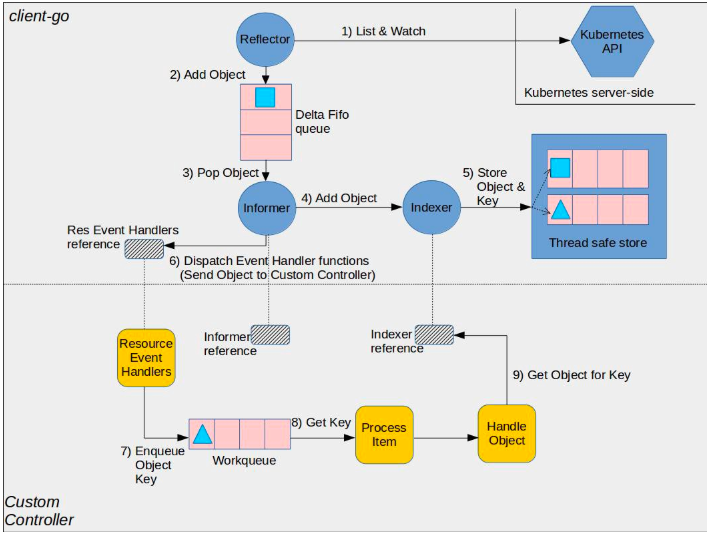
如图所示,图中的组件分为client-go和custom controller两部分:
client-go部分
- Reflector: 监视特定资源的k8s api, 把新监测的对象放入Delta Fifo队列,完成此操作的函数是ListAndWatch。
- Informer: 从Delta Fifo队列拿出对象,完成此操作的函数是processLoop。
- Indexer: 提供线程级别安全来存储对象和key。
custom-controller部分
- Informer reference: Informer对象引用
- Indexer reference: Indexer对象引用
- Resource Event Handlers: 被Informer调用的回调函数,这些函数的作用通常是获取对象的key,并把key放入Work queue,以进一步做处理。
- Work queue: 工作队列,用于将对象的交付与其处理分离,编写Resource event handler functions以提取传递的对象的key并将其添加到工作队列。
- Process Item: 用于处理Work queue中的对象,可以有一个或多个其他函数一起处理;这些函数通常使用Indexer reference或Listing wrapper来检索与该键对应的对象。
client-go官方代码例子
package main

import (

    "flag"

    "fmt"

    "time"

    "k8s.io/klog"

    "k8s.io/api/core/v1"

    meta_v1 "k8s.io/apimachinery/pkg/apis/meta/v1"

    "k8s.io/apimachinery/pkg/fields"

    "k8s.io/apimachinery/pkg/util/runtime"

    "k8s.io/apimachinery/pkg/util/wait"

    "k8s.io/client-go/kubernetes"

    "k8s.io/client-go/tools/cache"

    "k8s.io/client-go/tools/clientcmd"

    "k8s.io/client-go/util/workqueue"

)

// 定义一个结构体Controller

type Controller struct {

    indexer  cache.Indexer

    queue    workqueue.RateLimitingInterface

    informer cache.Controller

}

// 获取controller的函数

func NewController(queue workqueue.RateLimitingInterface, indexer cache.Indexer, informer cache.Controller) *Controller {

    return &Controller{

        informer: informer,

        indexer:  indexer,

        queue:    queue,

    }

}

// 处理workqueue中的对象

func (c *Controller) processNextItem() bool {

    // Wait until there is a new item in the working queue

    key, quit := c.queue.Get()

    if quit {

        return false

    }

    // Tell the queue that we are done with processing this key. This unblocks the key for other workers

    // This allows safe parallel processing because two pods with the same key are never processed in

    // parallel.

    defer c.queue.Done(key)

    // Invoke the method containing the business logic

    err := c.syncToStdout(key.(string))

    // Handle the error if something went wrong during the execution of the business logic

    c.handleErr(err, key)

    return true

}

// syncToStdout is the business logic of the controller. In this controller it simply prints

// information about the pod to stdout. In case an error happened, it has to simply return the error.

// The retry logic should not be part of the business logic.

func (c *Controller) syncToStdout(key string) error {

    obj, exists, err := c.indexer.GetByKey(key)

    if err != nil {         klog.Errorf("Fetching object with key %s from store failed with %v", key, err)

        return err

    }

    if !exists {         // Below we will warm up our cache with a Pod, so that we will see a delete for one pod

        fmt.Printf("Pod %s does not exist anymore\n", key)

    } else {

        // Note that you also have to check the uid if you have a local controlled resource, which

        // is dependent on the actual instance, to detect that a Pod was recreated with the same name

        fmt.Printf("Sync/Add/Update for Pod %s\n", obj.(*v1.Pod).GetName())

    }

    return nil

}

// handleErr checks if an error happened and makes sure we will retry later.

func (c *Controller) handleErr(err error, key interface{}) {

    if err == nil {

        // Forget about the #AddRateLimited history of the key on every successful synchronization.

        // This ensures that future processing of updates for this key is not delayed because of

        // an outdated error history.

        c.queue.Forget(key)

        return

    }

    // This controller retries 5 times if something goes wrong. After that, it stops trying.

    if c.queue.NumRequeues(key) <  {

        klog.Infof("Error syncing pod %v: %v", key, err)

        // Re-enqueue the key rate limited. Based on the rate limiter on the

        // queue and the re-enqueue history, the key will be processed later again.

        c.queue.AddRateLimited(key)

        return

    }

    c.queue.Forget(key)

    // Report to an external entity that, even after several retries, we could not successfully process this key

    runtime.HandleError(err)

    klog.Infof("Dropping pod %q out of the queue: %v", key, err)

}

func (c *Controller) Run(threadiness int, stopCh chan struct{}) {

    defer runtime.HandleCrash()

    // Let the workers stop when we are done

    defer c.queue.ShutDown()

    klog.Info("Starting Pod controller")

    go c.informer.Run(stopCh)

    // Wait for all involved caches to be synced, before processing items from the queue is started

    if !cache.WaitForCacheSync(stopCh, c.informer.HasSynced) {         runtime.HandleError(fmt.Errorf("Timed out waiting for caches to sync"))

        return

    }

    for i := ; i < threadiness; i++ {

        go wait.Until(c.runWorker, time.Second, stopCh)

    }

    <-stopCh

    klog.Info("Stopping Pod controller")

}

func (c *Controller) runWorker() {

    for c.processNextItem() {

    }

}

func main() {

    var kubeconfig string

    var master string

    // 指定kubeconfig文件

    flag.StringVar(&kubeconfig, "kubeconfig", "", "absolute path to the kubeconfig file")

    flag.StringVar(&master, "master", "", "master url")

    flag.Parse()

    // creates the connection

    config, err := clientcmd.BuildConfigFromFlags(master, kubeconfig)

    if err != nil {         klog.Fatal(err)

    }

    // creates the clientset

    clientset, err := kubernetes.NewForConfig(config)

    if err != nil {         klog.Fatal(err)

    }

    // create the pod watcher

    podListWatcher := cache.NewListWatchFromClient(clientset.CoreV1().RESTClient(), "pods", v1.NamespaceDefault, fields.Everything())

    // create the workqueue

    queue := workqueue.NewRateLimitingQueue(workqueue.DefaultControllerRateLimiter())

    // Bind the workqueue to a cache with the help of an informer. This way we make sure that

    // whenever the cache is updated, the pod key is added to the workqueue.

    // Note that when we finally process the item from the workqueue, we might see a newer version

    // of the Pod than the version which was responsible for triggering the update.

    indexer, informer := cache.NewIndexerInformer(podListWatcher, &v1.Pod{}, , cache.ResourceEventHandlerFuncs{

        AddFunc: func(obj interface{}) {

            key, err := cache.MetaNamespaceKeyFunc(obj)

            if err == nil {

                queue.Add(key)

            }

        },

        UpdateFunc: func(old interface{}, new interface{}) {

            key, err := cache.MetaNamespaceKeyFunc(new)

            if err == nil {

                queue.Add(key)

            }

        },

        DeleteFunc: func(obj interface{}) {

            // IndexerInformer uses a delta queue, therefore for deletes we have to use this

            // key function.

            key, err := cache.DeletionHandlingMetaNamespaceKeyFunc(obj)

            if err == nil {

                queue.Add(key)

            }

        },

    }, cache.Indexers{})

    controller := NewController(queue, indexer, informer)

    // We can now warm up the cache for initial synchronization.

    // Let's suppose that we knew about a pod "mypod" on our last run, therefore add it to the cache. // If this pod is not there anymore, the controller will be notified about the removal after the // cache has synchronized. indexer.Add(&v1.Pod{ ObjectMeta: meta_v1.ObjectMeta{ Name: "mypod", Namespace: v1.NamespaceDefault, }, }) // Now let's start the controller

    stop := make(chan struct{})

    defer close(stop)

    go controller.Run(, stop)

    // Wait forever

    select {}

}
Kubernetes 编写自定义 controller的更多相关文章
- k8s自定义controller设计与实现
k8s自定义controller设计与实现 创建CRD 登录可以执行kubectl命令的机器,创建student.yaml apiVersion: apiextensions.k8s.io/v1bet ...
- 用mel编写自定义节点的属性编辑器界面
用mel编写自定义节点的属性编辑器界面比较麻烦,而且网上例子又少,下面给出一个范例,说明基本的格式 // 初始化节点时调用 global proc initControl(string $attrNa ...
- MVC自定义过滤器,自定义Area过滤器,自定义Controller,Action甚至是ViewData过滤器
实现MVC自定义过滤器,自定义Area过滤器,自定义Controller,Action甚至是ViewData过滤器 MVC开发中几种以AOP方式实现的Filters是非常好用的,默认情况下,我们通过A ...
- django “如何”系列4:如何编写自定义模板标签和过滤器
django的模板系统自带了一系列的内建标签和过滤器,一般情况下可以满足你的要求,如果觉得需更精准的模板标签或者过滤器,你可以自己编写模板标签和过滤器,然后使用{% load %}标签使用他们. 代码 ...
- RobotFramework自动化测试框架-使用Python编写自定义的RobotFramework Lib
使用Python构建Lib工程 可以用来开发Python Lib的IDE工具有很多,常见的有Pycharm,Eclipse with PyDev插件等,而且在RobotFramework官网中也已经提 ...
- SpringBoot编写自定义的starter 专题
What’s in a name All official starters follow a similar naming pattern; spring-boot-starter-*, where ...
- kubernetes nginx ingress controller部署
Kubernetes nginx ingress controller部署 1.下载kubernetes nginx的yaml文件 Wget https://raw.githubusercontent ...
- SpringBoot编写自定义配置信息
⒈编写自定义配置类 1.浏览器配置 package cn.coreqi.security.properties; public class BrowserProperties { private St ...
- R语言-编写自定义函数 ZZ
一.函数构造器 每一个R函数都包括三个部分:函数名,程序主体以及参数集合,在编写自定义R函数时,需要将三个部分各自储存在一个R对象中.这里需要使用function函数,形如: my_function& ...
随机推荐
- Andriod开发---《横竖屏切换时 Activity的生命周期的总结》
横屏切换竖屏Activity的生命周期详解,下面分析一下切换时具体的生命周期: 1.新建一个Activity,并把各个生命周期打印出来 2.运行Activity,得到如下信息 onCreate--&g ...
- 事件流和初识Jquery
一.事件流 定义: 多个彼此嵌套元素,他们拥有相同的事件,最内部元素事件被触发后,外边多个元素的同类型事件也会被触发,多个元素他们同类型事件同时执行的效果称为“事件流”. 事件对象获取: 获得: ①主 ...
- Csrf+Xss组合拳
本文首发于“合天智汇”公众号,作者: 影子 各位大师傅,第一次在合天发文章,请多多关照 今年年初的疫情确实有点突然,打乱了上半年的所有计划(本来是校内大佬带我拿奖的时刻,没了 ,学长毕业了,就剩下我这 ...
- Java数据结构和算法(1)之队列
1.队列的基本概念 队列(queue)是一种特殊的线性表,特殊之处在于它只允许在表的前端(front)进行删除操作,而在表的后端(rear)进行插入操作,和栈一样,队列是一种操作受限制的线性表.进行插 ...
- Day10_ElasticSearch
学于黑马和传智播客联合做的教学项目 感谢 黑马官网 传智播客官网 微信搜索"艺术行者",关注并回复关键词"乐优商城"获取视频和教程资料! b站在线视频 老师的码 ...
- Python爬虫开发与项目实战pdf电子书|网盘链接带提取码直接提取|
Python爬虫开发与项目实战从基本的爬虫原理开始讲解,通过介绍Pthyon编程语言与HTML基础知识引领读者入门,之后根据当前风起云涌的云计算.大数据热潮,重点讲述了云计算的相关内容及其在爬虫中的应 ...
- [草稿] Linux 各种 打包 / 解包 命令
https://www.cnblogs.com/yeungchie/ 有不少错误 .tar格式 解包: tar -xvf FileName.tar 打包: tar -cvf FileName.tar ...
- 排序HEOI2016/TJOI2016 二分+线段树判定
LINK:排序 此题甚好我一点思路都没有要是我当时省选此题除了模拟我恐怕想不到还可以二分 还可以线段树... 有点ex 不太好写 考虑 暴力显然每次给出询问我们都是可以直接sort的 无视地形无视一切 ...
- 网络通信-RESTful API 设计指南
http://www.ruanyifeng.com/blog/2014/05/restful_api.html 作者: 阮一峰 日期: 2014年5月22日 网络应用程序,分为前端和后端两个部分.当前 ...
- 无所不能的Embedding 1 - Word2vec模型详解&代码实现
word2vec是google 2013年提出的,从大规模语料中训练词向量的模型,在许多场景中都有应用,信息提取相似度计算等等.也是从word2vec开始,embedding在各个领域的应用开始流行, ...