
【Spring-web】RestTemplate源码学习
前言
这种开发内容除了业务逻辑,剩下的基本都是套路代码,而Spring从3.0版本开始,为我们提供了封装好的访问HTTP的模板代码RestTemplate。
RestTemplate 类说明
/**

 * <strong>Spring's central class for synchronous client-side HTTP access.</strong>

 * It simplifies communication with HTTP servers, and enforces RESTful principles.

 * It handles HTTP connections, leaving application code to provide URLs

 * (with possible template variables) and extract results.

 *

 * <p><strong>Note:</strong> by default the RestTemplate relies on standard JDK

 * facilities to establish HTTP connections. You can switch to use a different

 * HTTP library such as Apache HttpComponents, Netty, and OkHttp through the

 * {@link #setRequestFactory} property.

 *

 * <p>The main entry points of this template are the methods named after the six main HTTP methods:

 * <table>

 * <tr><th>HTTP method</th><th>RestTemplate methods</th></tr>

 * <tr><td>DELETE</td><td>{@link #delete}</td></tr>

 * <tr><td>GET</td><td>{@link #getForObject}</td></tr>

 * <tr><td></td><td>{@link #getForEntity}</td></tr>

 * <tr><td>HEAD</td><td>{@link #headForHeaders}</td></tr>

 * <tr><td>OPTIONS</td><td>{@link #optionsForAllow}</td></tr>

 * <tr><td>POST</td><td>{@link #postForLocation}</td></tr>

 * <tr><td></td><td>{@link #postForObject}</td></tr>

 * <tr><td>PUT</td><td>{@link #put}</td></tr>

 * <tr><td>any</td><td>{@link #exchange}</td></tr>

 * <tr><td></td><td>{@link #execute}</td></tr> </table>

 *

 * <p>In addition the {@code exchange} and {@code execute} methods are generalized versions of

 * the above methods and can be used to support additional, less frequent combinations (e.g.

 * HTTP PATCH, HTTP PUT with response body, etc.). Note however that the underlying HTTP

 * library used must also support the desired combination.

 *

 * <p>For each HTTP method there are three variants: two accept a URI template string

 * and URI variables (array or map) while a third accepts a {@link URI}.

 * Note that for URI templates it is assumed encoding is necessary, e.g.

 * {@code restTemplate.getForObject("http://example.com/hotel list")} becomes

 * {@code "http://example.com/hotel%20list"}. This also means if the URI template

 * or URI variables are already encoded, double encoding will occur, e.g.

 * {@code http://example.com/hotel%20list} becomes

 * {@code http://example.com/hotel%2520list}). To avoid that use a {@code URI} method

 * variant to provide (or re-use) a previously encoded URI. To prepare such an URI

 * with full control over encoding, consider using

 * {@link org.springframework.web.util.UriComponentsBuilder}.

 *

 * <p>Internally the template uses {@link HttpMessageConverter} instances to

 * convert HTTP messages to and from POJOs. Converters for the main mime types

 * are registered by default but you can also register additional converters

 * via {@link #setMessageConverters}.

 *

 * <p>This template uses a

 * {@link org.springframework.http.client.SimpleClientHttpRequestFactory} and a

 * {@link DefaultResponseErrorHandler} as default strategies for creating HTTP

 * connections or handling HTTP errors, respectively. These defaults can be overridden

 * through {@link #setRequestFactory} and {@link #setErrorHandler} respectively.

 *

 * @author Arjen Poutsma

 * @author Brian Clozel

 * @author Roy Clarkson

 * @author Juergen Hoeller

 * @since 3.0

 * @see HttpMessageConverter

 * @see RequestCallback

 * @see ResponseExtractor

 * @see ResponseErrorHandler

 * @see AsyncRestTemplate

 */
Java Doc

补充说明:
重载的3个方法怎么选择呢?建议选择URL参数类型为String的那个两个方法。因为当这个参数是一个非URI格式的,需要进行转换,而URI的构造函数会抛出一个检查异常URISyntaxException,该异常必须捕获。另外两个重载方法则避免了捕获异常,所以上面表格中推荐的方法的第一个参数都是String类型。
简单例子
package com.practice;

import java.net.URLEncoder;

import java.util.HashMap;

import java.util.Map;

import junit.framework.TestCase;

import net.sf.json.JSONObject;

import org.junit.Before;

import org.junit.Test;

import org.springframework.http.HttpEntity;

import org.springframework.http.ResponseEntity;

import org.springframework.util.LinkedMultiValueMap;

import org.springframework.util.MultiValueMap;

import org.springframework.web.client.RestTemplate;

public class RestTemplateTest extends TestCase {

    RestTemplate restTpl;

    @Before

    public void setUp() {

        restTpl = new RestTemplate();

    }

    @Test

    public void testGet() {

        Map<String, Object> paramsMap = new HashMap<String, Object>();

        paramsMap.put("cityCode", "xxxxxxxxxx");

        paramsMap.put("key", "xxxxxxxxxxxxxxxxxxxxx");

        String url = "http://xxx.xxx.xxx.xxx:8080/xxx/xxxx?xxxx&config=xxx&cityCode={cityCode}&key={key}";

        String respStr = restTpl.getForObject(url, String.class, paramsMap);

        System.out.println(respStr);

        JSONObject respJson = restTpl.getForObject(url, JSONObject.class, paramsMap);

        System.out.println(respJson);

    }

    @Test

    public void testPost() throws Exception {

        String posturl = "http://xxx.xxx.xxx.xxx:8080/xxxx/xxxx/xxxxx";

        JSONObject metadata = new JSONObject();

        metadata.put("dddddd", "xxxxx");

        metadata.put("ssssss", "xxxxxx");

        metadata.put("flag", true);

        JSONObject paramsJson = new JSONObject();

        paramsJson.put("mmmmm", "mmm");

        paramsJson.put("nnnnn", "nnn");

        paramsJson.put("password", "xxxxxxxxxxx");

        paramsJson.put("metadata", metadata);

        String params = "RequestJson=" + URLEncoder.encode(paramsJson.toString(), "utf-8");

        MultiValueMap<String, String> headers = new LinkedMultiValueMap<String, String>();

        headers.add("Content-Type", "application/x-www-form-urlencoded; charset=UTF-8");

        HttpEntity<Object> hpEntity = new HttpEntity<Object>(params, headers);

        ResponseEntity<String> respEntity = restTpl.postForEntity(posturl, hpEntity, String.class);

        System.out.println(respEntity);

    }

}
然而,就是这么简单的几行代码还不断出错~~~~~~~


疑问解答
RestTemplate中是如何处理请求头信息的呢?
以GET方法为例,getForObject()方法中有这么一句【RequestCallback requestCallback = acceptHeaderRequestCallback(responseType);】

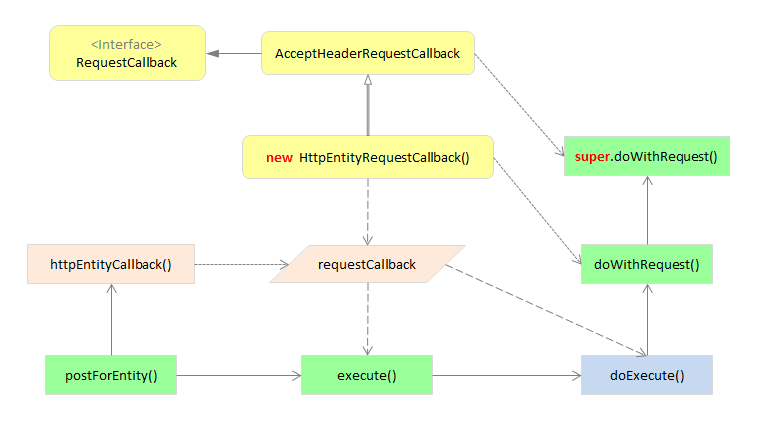
这里为什么使用内部类呢?
复习下内部类的作用:
【Spring-web】RestTemplate源码学习的更多相关文章
- spring源码学习(三)--spring循环引用源码学习
在spring中,是支持单实例bean的循环引用(循环依赖)的,循环依赖,简单而言,就是A类中注入了B类,B类中注入了A类,首先贴出我的代码示例 @Component public class Add ...
- 捋一捋Spring Web的源码思路
Servlet前提 Java规定了Servlet Container为每一个web app创建一个Servlet Context:而Servlet Context中又包含了诸多Servlet -- 其 ...
- 【Spring-web】RestTemplate源码学习——梳理内部实现过程
2016-12-28 by 安静的下雪天 http://www.cnblogs.com/quiet-snowy-day/p/6228198.html 提示:使用手机浏览时请注意,图多费流量. 本篇 ...
- 【目录】Spring 源码学习
[目录]Spring 源码学习 jwfy 关注 2018.01.31 19:57* 字数 896 阅读 152评论 0喜欢 9 用来记录自己学习spring源码的一些心得和体会以及相关功能的实现原理, ...
- spring源码学习——spring整体架构和设计理念
Spring是在Rod Johnson的<Expert One-On-One J2EE Development and Design >的基础上衍生而来的.主要目的是通过使用基本的java ...
- Spring5.0源码学习系列之Spring AOP简述
前言介绍 附录:Spring源码学习专栏 在前面章节的学习中,我们对Spring框架的IOC实现源码有了一定的了解,接着本文继续学习Springframework一个核心的技术点AOP技术. 在学习S ...
- Spring源码学习笔记12——总结篇,IOC,Bean的生命周期,三大扩展点
Spring源码学习笔记12--总结篇,IOC,Bean的生命周期,三大扩展点 参考了Spring 官网文档 https://docs.spring.io/spring-framework/docs/ ...
- SpringBoot源码学习1——SpringBoot自动装配源码解析+Spring如何处理配置类的
系列文章目录和关于我 一丶什么是SpringBoot自动装配 SpringBoot通过SPI的机制,在我们程序员引入一些starter之后,扫描外部引用 jar 包中的META-INF/spring. ...
- spring源码学习之路---深入AOP(终)
作者:zuoxiaolong8810(左潇龙),转载请注明出处,特别说明:本博文来自博主原博客,为保证新博客中博文的完整性,特复制到此留存,如需转载请注明新博客地址即可. 上一章和各位一起看了一下sp ...
随机推荐
- tomcat相关
一.下面这篇文章介绍了tomcat log相关内容 http://blog.csdn.net/cowmich/article/details/8173005
- Android 中关于ListView分割线的设置
今天发现许多App上的listview的item之间的分割线都只显示了右边一部分,而左边的那一半则没有,第一反应则是给分割线设置一张背景图片就ok了: android:divider="@m ...
- 初探SQL注入
1.1注入语句(通过时间注入函数) 数据库名称 localhost:8080/ScriptTest/userServlet?username='union SELECT IF(SUBSTRING(cu ...
- 同一个页面多个page之间的切换
今天接触了JQ Mobile以下是本小白的理解(不怕大家笑话): 创建移动 web 应用程序的框架:适用于所有流行的智能手机和平板电脑: 将“写得更少.做得更多”这一理念提升到了新的层次:它会自动为网 ...
- Github上传代码菜鸟超详细教程
最近需要将课设代码上传到Github上,之前只是用来fork别人的代码. 这篇文章写得是windows下的使用方法. 第一步:创建Github新账户 第二步:新建仓库 第三部:填写名称,简介(可选 ...
- SQLPrompt 7.2发布
SQLPrompt 7.2发布 下载地址:http://www.red-gate.com/products/sql-development/sql-prompt/ 红门的热门产品SQLPrompt 发 ...
- 新书到手 TRANSACTION PROCESSING:CONCEPTS AND TECHNIQUES
新书到手 TRANSACTION PROCESSING:CONCEPTS AND TECHNIQUES Jim Gray大神的著作 本文版权归作者所有,未经作者同意不得转载.
- 从viewport发现小米手机参数不一致
想要在移动web领域有所深造的小伙伴,第一关要过的就是逻辑像素与设备像素之间的关系. 初入移动web,一定要搞懂的几个单位(DPI.PPI.DP.PX 的详细计算方法及算法来源是什么?): dip(d ...
- 作业二:个人编程项目——编写一个能自动生成小学四则运算题目的程序
1. 编写一个能自动生成小学四则运算题目的程序.(10分) 基本要求: 除了整数以外,还能支持真分数的四则运算. 对实现的功能进行描述,并且对实现结果要求截图. 本题发一篇随笔,内容包括: 题 ...
- 从阿里巴巴IPO联想到创始人和资方关系
[小九的学堂,致力于以平凡的语言描述不平凡的技术.如要转载,请注明来源:小九的学堂.cnblogs.com/xfuture] 5月7日,阿里巴巴于今日向美国证券交易委员会(SEC)提交了IPO(首次公 ...