
异常类的构建——顶层父类Exception的实现
异常类构建
异常的类型可以是自定义类类型
对于类类型异常的匹配依旧是从上到下严格的匹配
赋值兼容性原则在异常匹配中依然适用
一般而言
-匹配子类异常的catch放在上部
-匹配父类异常的catch放在下部
现代C++库必然包含充要的异常类族
异常类是数据结构类所依赖的基础设施
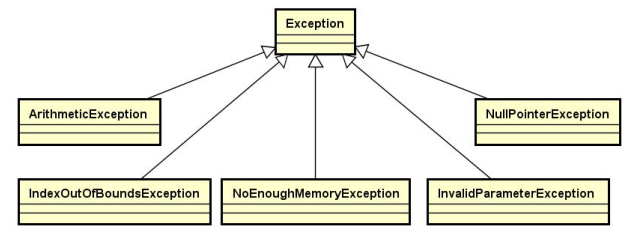
Exception是一个抽象类,不能定义对象,用来被继承。通过继承的方式,定义了5个异常类。
ArithmetricException:计算异常。例如1/0的错误
NullPointerException:空指针异常
IndexOutOfBoundsException:越界异常。访问数组的时候,有可能越界
NoEnoughMemoryException:内存不足异常。动态申请内存空间,没有充足的空间时
InvalidParameterException:参数错误异常。参数是否合法
异常类中的接口定义
class Exception

{
protected:
  char* m_message;
  char* m_location;
public:

    Exception(const char* message);

    Exception(const char* file, int line);

    Exception(const char* message, const char* file, int line);

    Exception(const Exception& e);

    Exception& operator= (const Exception& e);

    virtual const char* message() const;

    virtual const char* location() const;

    virtual ~Exception() = ;

};
Exception.h
#ifndef EXCEPTION_H

#define EXCEPTION_H

namespace DTLib

{

class Exception

{

protected:

    char* m_location;

    char* m_message;

    void init(const char* message, const char* file, int line);

public:

    Exception(const char* message);

    Exception(const char* file, int line);

    Exception(const char* message, const char* file, int line);

    Exception(const Exception& e);

    Exception& operator= (const Exception& e);

    virtual const char* message() const;

    virtual const char* location() const;

    virtual ~Exception()= 0 ; //纯虚析构函数,纯虚函数需要提供实现吗?纯虚函数是不需要提供实现的,等待子类去实现。但是这个地方是个例外,C++规定只要自定义了析构函数,不管

                              //这个析构函数是不是纯虚函数,一定要提供实现。为什么?在析构一个对象的时候,最后肯定会调用到父类的析构函数,

};

}

#endif // EXCEPTION_H
Exception.cpp
#include "Exception.h"

#include <cstring>

#include <cstdlib>

namespace DTLib

{

void Exception::init(const char *message, const char *file, int line)

{

    //m_message = message; //直接进行这样的赋值,这样写可以吗?肯定不行,因为参数的message这个指针它指向的字符串有可能在栈上,有可能在堆空间中,还有可能在全局数据区。

                         //这样的话,没有办法控制message所指向的外部字符串的生命周期,所以说这样的写法是不安全的。可以拷贝一份字符串出来。

    m_message = strdup(message);  //将字符串复制到了堆空间。

    if(file != NULL)

    {

        char sl[] = {};

        itoa(line,sl,);   //itoa在linux下是无法使用的,需要使用sprintf

        //m_location = malloc(strlen(file) + strlen(sl) + 2);  //malloc函数返回的是void*,将void*直接赋值给char*是不可以的。因此需要进行强制类型转换。使用static_cast

        m_location = static_cast<char*>(malloc(strlen(file) + strlen(sl) + ));

        m_location = strcpy(m_location,file);

        m_location = strcat(m_location, ":");

        m_location = strcat(m_location, sl);

    }

    else

    {

        m_location = NULL;

    }

}

Exception::Exception(const char* message)

{

    init(message,NULL,);

}

Exception::Exception(const char* file, int line)

{

    init(NULL,file,line);

}

Exception::Exception(const char* message, const char* file, int line)

{

    init(message,file,line);

}

Exception::Exception(const Exception& e)

{

    m_location = strdup(e.m_location);

    m_message = strdup(e.m_message);

}

Exception& Exception::operator= (const Exception& e)

{

    if(this != &e)

    {

        free(m_location);

        free(m_message);

        m_location = strdup(e.m_location);

        m_message = strdup(e.m_message);

    }

    return *this;

}

const char* Exception::message() const

{

    return m_message;

}

const char* Exception::location() const

{

    return m_location;

}

Exception::~Exception()

{

    free(m_location);

    free(m_message);

}

}
main.cpp
#include <iostream>

#include "Exception.h"

using namespace std;

using namespace DTLib;

int main()

{

    try

    {

        throw Exception("test", __FILE__,__LINE__);  //将析构函数定义成了纯虚函数,是不能定义对象的,为了测试,先将纯虚去掉。

    }

    catch(const Exception& e)

    {

        cout << " catch(const Exception& e)" << endl;

        cout << e.message() << endl;

        cout << e.location() << endl;

    }

    return ;

}
进一步修改,在头文件中
namespace DTLib

{

#define THROW_EXCEPTION(e,m) (throw e(m, __FILE__,__LINE__))

class Exception
在main.cpp中这样使用
 try

    {

        THROW_EXCEPTION(Exception,"test");  //为了测试,还需要将纯虚特性去掉

    }
使用这个宏的意义在于在需要的地方直接扔出相应的异常对象就可以了,具体的文件名和行号就不用去管了。
异常类的构建——顶层父类Exception的实现的更多相关文章
- python的异常处理及异常类定义
python的异常处理语法和大多数语言相似: try: try块的语句... except exceptiontype1 as var:#使用as语句获得本次捕获到的异常的实例var except块语 ...
- 【转】【C#】异常类 Exception 枚举所有类型的异常
一.基础 在C# 里,异常处理就是C# 为处理错误情况提供的一种机制.它为每种错误情况提供了定制的处理方式,并且把标识错误的代码与处理错误的代码分离开来. 对.NET类来说,一般的 异常类System ...
- 每天一点点java---继承exception类来实现自己的异常类
package prac_1; /** * <p>Title: 捕获异常和实现自己的异常类</p> * <p>Description: 通过继承Exception类 ...
- C++异常第二篇---C++标准库异常类exception的使用
1 继承图示 2 具体讲解 C++标准库异常类继承层次中的根类为exception,其定义在exception头文件中,它是C++标准库所有函数抛出异常的基类,exception的接口定义如下: na ...
- 2019-2-21.NET中异常类(Exception)
.NET中异常类(Exception) 异常:程序在运行期间发生的错误.异常对象就是封装这些错误的对象. try{}catch{}是非常重要的,捕获try程序块中所有发生的异常,如果没有捕获异常的话, ...
- 借助backtrace和demangle实现异常类Exception
C++的异常类是没有栈痕迹的,如果需要获取栈痕迹,需要使用以下函数: #include <execinfo.h> int backtrace(void **buffer, int size ...
- .NET中异常类(Exception)
异常:程序在运行期间发生的错误.异常对象就是封装这些错误的对象. try{}catch{}是非常重要的,捕获try程序块中所有发生的异常,如果没有捕获异常的话,程序运行的线程将会挂掉,更严重的是这些错 ...
- 类的继承与super()的意义以即如何写一个正确的异常类
这些东西都是我看了许多名师课程和自己研究的成果,严禁转载,这里指出了如何正确的自己定义一个异常类并看一看sun写的java的源代码话题一:子类的构造器执行是否一定会伴随着父类的构造执行? 1.this ...
- Java异常类(Throwable)
一.异常类体系 二.异常类由来与定义 [异常类的由来]:Java把程序在运行时出现的各种不正常情况也看成了对象, 提取属性和行为进行描述,比如异常名称,异常信息,异常发生位置,从而形成了各种异常类 [ ...
随机推荐
- PHP-FPM 使用(含多站点多端口)
PHP-FPM 使用 PHP-FPM 是在 Linux 环境下用来管理调度 PHP 执行的调度器,源码安装时会自动安装,PHP 安装可参考Centos 下安装 PHP (新) 查看版本 # php-f ...
- (转)Python中的常见特殊方法—— repr方法
原文链接:https://www.cnblogs.com/tizer/p/11178473.html 在Python中有些方法名.属性名的前后都添加了双下划线,这种方法.属性通常都属于Python的特 ...
- 设置UICollectionViewCell圆角和阴影
设置cell圆角: cell.contentView.layer.cornerRadius =2.0f; cell.contentView.layer.borderWidth =1.0f; cell. ...
- linux系统的特殊符号
符号 作用 示例 # 注释符号,井号后的内容不会执行 echo #WORD ~ 当前用户的家目录 cd ~ ; 命令顺序执行,前面执行成功与否对后面没影响 COMMAND1 ; COMMAND2 &a ...
- js中自执行函数(function(){})()和(function(){}())区别
方式一,调用函数,得到返回值.强制函数直接量执行再返回一个引用,引用在去调用执行方式二,调用函数,得到返回值.强制运算符使函数调用执行(function(){})(); 是 把函数当作表达式解析,然后 ...
- a是什么??
//解决Linux下默认中文字体乱码问题 QFont font("simsun", 11, QFont::Normal, false); a.setFont(font);
- Zuul 修改 请求头、响应头 (死磕)
疯狂创客圈 Java 高并发[ 亿级流量聊天室实战]实战系列 [博客园总入口 ] 架构师成长+面试必备之 高并发基础书籍 [Netty Zookeeper Redis 高并发实战 ] 前言 Crazy ...
- Windows安装与配置—Node.js
一.搭建环境 1.下载软件 打开下载链接:https://nodejs.org/zh-cn/ , 2.双击安装,指定安装位置 3.测试是否安装成功 用管理员方式打开命令行cmd,输入node -v如果 ...
- 【linux命令 】文件特殊权限(SUID、SGID、SBIT)
chmod 2770 /home/admins,刚看到这个命令,有点不解,后边770分别表示用户,组,其他人,前面的2不知道代表的是什么意思.百度之后发现2是代表八进制数,也是一种权限,它的三个bit ...
- python——map()函数
描述 map() 会根据提供的函数对指定序列做映射. 第一个参数 function 以参数序列中的每一个元素调用 function 函数,返回包含每次 function 函数返回值的新列表. 语法 m ...