
Spring学习笔记(二)——Spring相关配置&属性注入&Junit整合
一、Spring的相关配置
1.1 Bean元素
- class属性:被管理对象的完整类名
- name属性:给Bean起个名字,能重复,能使用特殊字符.后来属性
- id属性:给Bean起个名字,不能重复,不能使用特殊字符.早期属性
- scope属性
- singleton:默认值,单例对象.项目一启动就创建对象,而且容器只创建一次
- prototype:多例原型.被标识为多例的对象,每次在获得才会创建.每次创建都是新的对象(整合struts2时,ActionBean必须配置为多例的.)
- request(了解):web项目中,Spring创建一个Bean的对象,将对象存入到request域中。.对象与request生命周期一致.
- session(了解):web项目中,Spring创建一个Bean的对象,将对象存入到session域中。,对象与session生命周期一致.
- 生命周期属性(了解)
- init-method:指出初始化方法,spring会在对象创建之后立即调用
- destory-method:指出销毁方法,spring在关闭并销毁所有容器中的对象之前调用.
1.2 spring创建对象的方式
【方式一:无参数的构造方法】
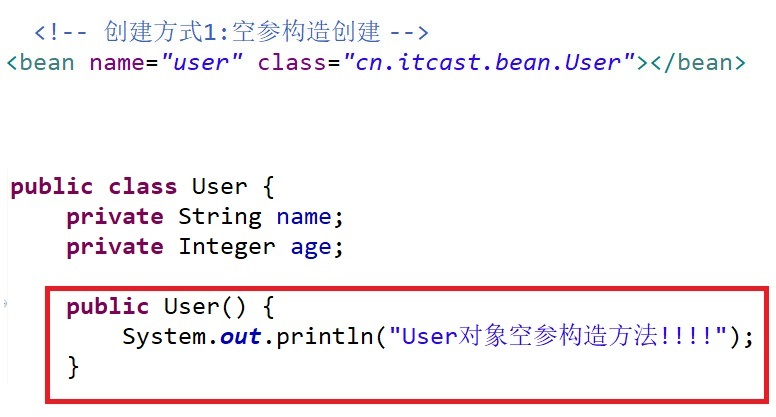
spring容器启动后就创建User对象。如果对象中提供了带参构造,而没有提供无参构造,这样讲无法创建对象,程序会报错:
警告: Exception encountered during context initialization - cancelling refresh attempt: org.springframework.beans.factory.BeanCreationException: Error creating bean with name 'user' defined in class path resource [applicationContext.xml]: Instantiation of bean failed; nested exception is org.springframework.beans.BeanInstantiationException: Failed to instantiate [cn.itcast.domain.User]: No default constructor found; nested exception is java.lang.NoSuchMethodException: cn.itcast.domain.User.<init>()
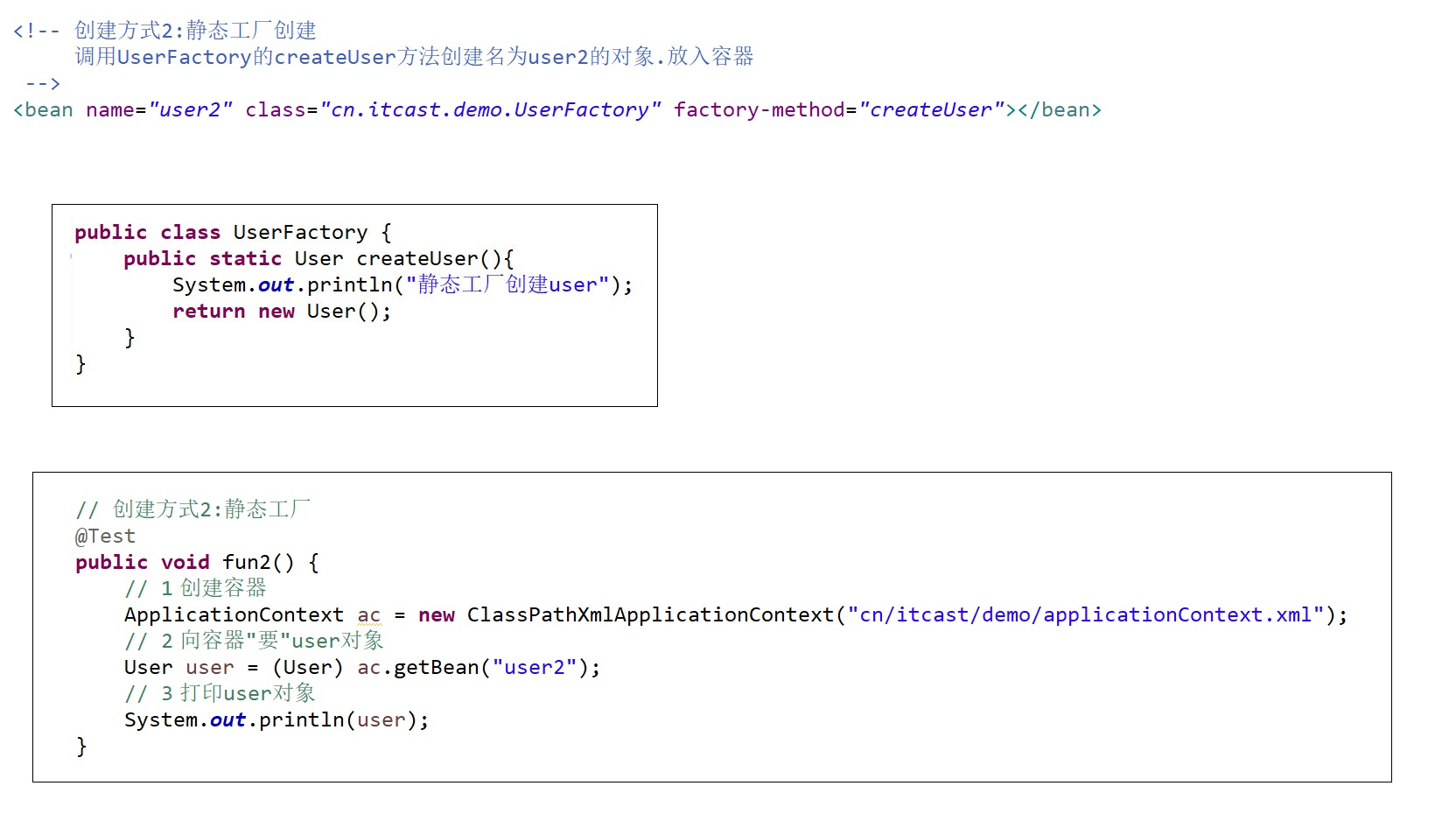
【方式二:静态工厂创建】(了解)
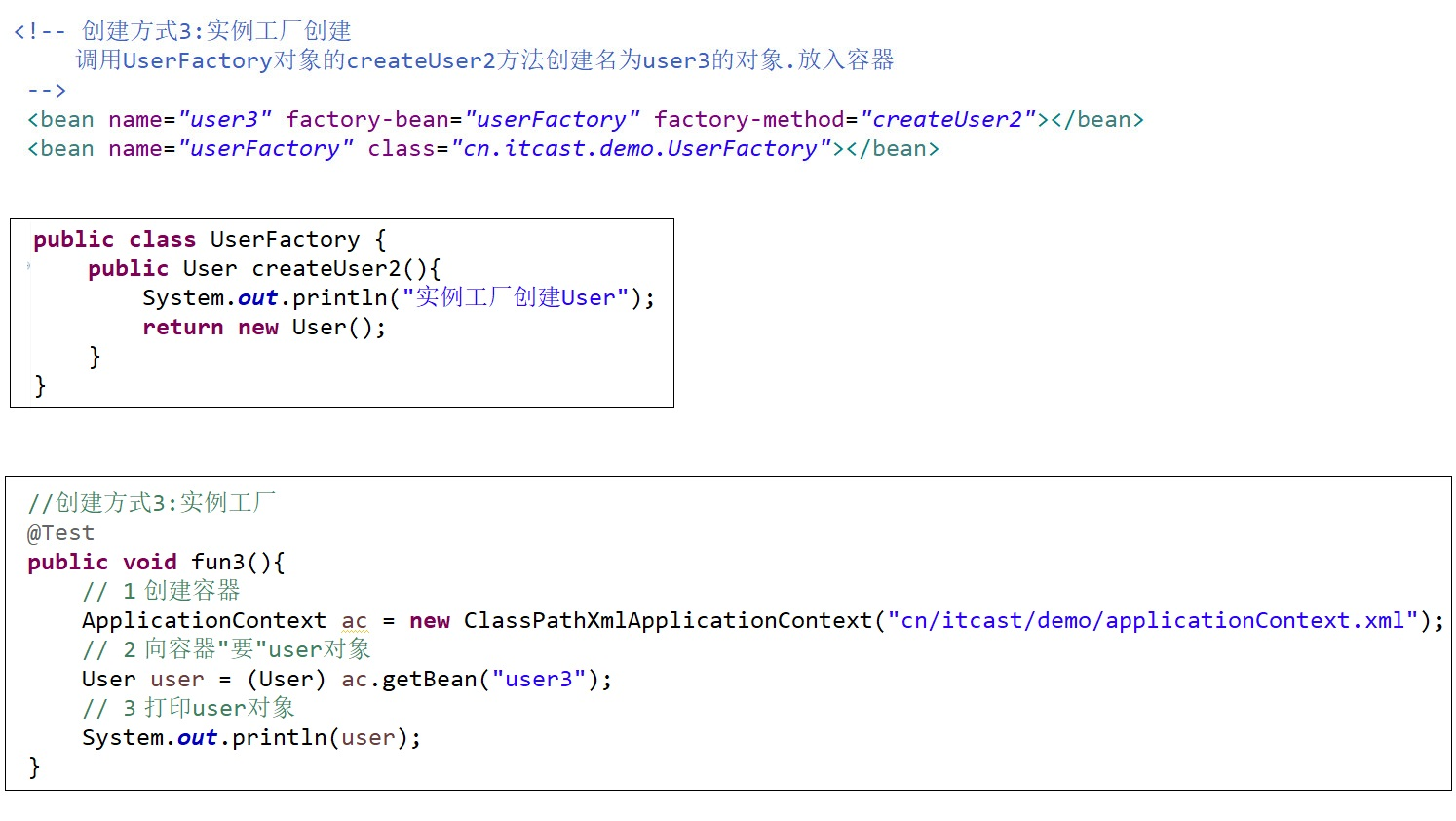
【方式三:实例工厂创建】(了解)
1.3 Spring的分模块配置
<!-- 导入其他spring配置文件 -->

<import resource="cn/itcast/demo/applicationContext.xml"/>
1.4 管理容器在项目中的生命周期
【让spring容器随项目的启动而创建,随项目的关闭而销毁】
在web.xml中配置
<!-- 可以让spring容器随项目的启动而创建,随项目的关闭而销毁 -->

<listener>

    <!-- 注意:引入此类前,要导入spring-web-4.2.4.RELEASE.jar -->

    <listener-class>org.springframework.web.context.ContextLoaderListener</listener-class>

</listener>

<!-- 指定加载spring配置文件的位置 -->

<context-param>

    <param-name>contextConfigLocation</param-name>

    <param-value>classpath:applicationContext.xml</param-value>

</context-param>
【在Action中获得容器中的Service对象】
  public String execute() throws Exception {

        // 获得spring容器=>从Application域获得即可

        // 1.获得servletContext对象

        ServletContext servletContext = ServletActionContext.getServletContext();

        // 2.从servletContext中获得applicationContext容器

        WebApplicationContext applicationContext = WebApplicationContextUtils.getWebApplicationContext(servletContext);

        // 3.从容器中获得CustomerService

        CustomerService service = (CustomerService)applicationContext.getBean("customerService");

        return NONE;

    }
错误示例:(这样会导致每次请求都会创建新的容器)
// 创建容器

ApplicationContext applicationContext = new ClassPathXmlApplicationContext("applicationContext.xml");

CustomerService service = (CustomerService)applicationContext.getBean("customerService");
二、属性注入
2.1 注入方式
【set方法注入】
<!-- set方式注入: -->

<bean  name="user" class="cn.itcast.bean.User" >

    <!--值类型注入: 为User对象中名为name的属性注入tom作为值 -->

    <property name="name" value="tom" ></property>

    <property name="age"  value="18" ></property>

    <!-- 引用类型注入: 为car属性注入下方配置的car对象 -->

    <property name="car"  ref="car" ></property>

</bean>

<!-- 将car对象配置到容器中 -->

<bean name="car" class="cn.itcast.bean.Car" >

    <property name="name" value="兰博基尼" ></property>

    <property name="color" value="黄色" ></property>

</bean>
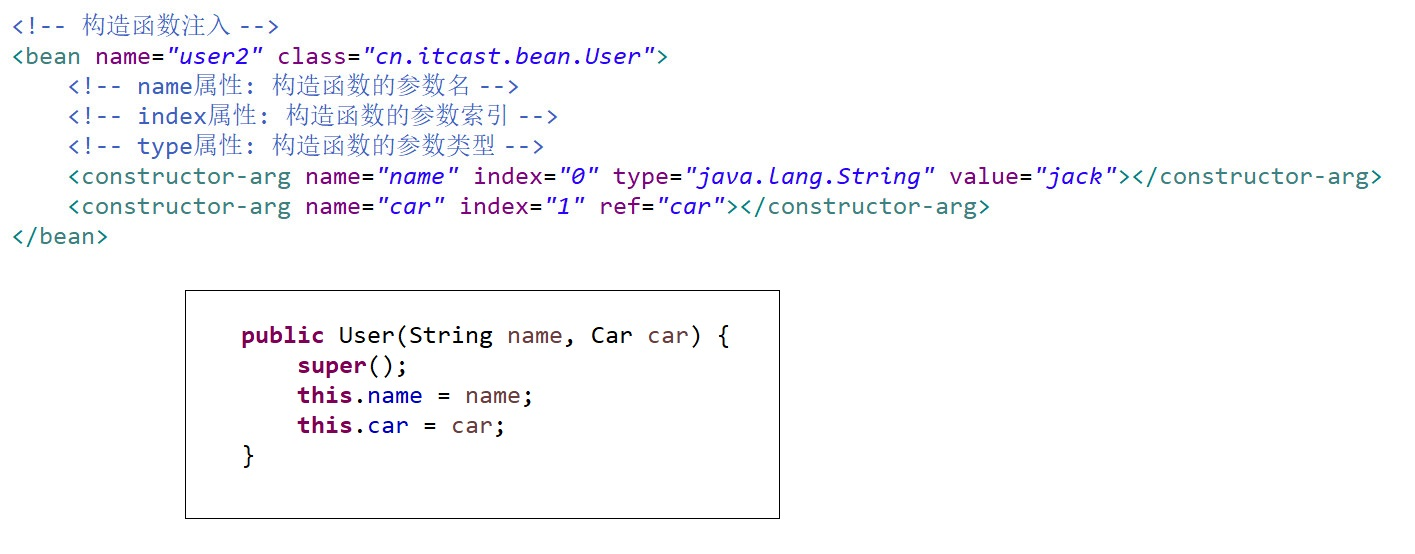
【构造函数注入】
【p名称空间注入】(了解)
<?xml version="1.0" encoding="UTF-8"?>

<beans xmlns:xsi="http://www.w3.org/2001/XMLSchema-instance"

        xmlns="http://www.springframework.org/schema/beans"

        xmlns:p="http://www.springframework.org/schema/p"

         xsi:schemaLocation="http://www.springframework.org/schema/beans http://www.springframework.org/schema/beans/spring-beans-4.2.xsd ">

<!-- p名称空间注入, 走set方法

    1.导入P名称空间  xmlns:p="http://www.springframework.org/schema/p"

    2.使用p:属性完成注入

        |-值类型: p:属性名="值"

        |-对象类型: p:属性名-ref="bean名称"

 -->

    <bean  name="user3" class="cn.itcast.bean.User" p:name="jack" p:age="20" p:car-ref="car"  >    </bean>

</beans>
【spel注入】(了解)
<!--

    spel注入: spring Expression Language sping表达式语言

 -->

<bean  name="user4" class="cn.itcast.bean.User" >

        <property name="name" value="#{user.name}" ></property>

        <property name="age" value="#{user3.age}" ></property>

        <property name="car" ref="car" ></property>

</bean>
2.2 复杂类型的注入
【数组】
<!-- 复杂类型注入 -->

<bean name="cb" class="cn.itcast.c_injection.CollectionBean" >

    <!-- 如果数组中只准备注入一个值(对象),直接使用value|ref即可

    <property name="arr" value="tom" ></property>

    -->

    <!-- array注入,多个元素注入 -->

    <property name="arr">

        <array>

            <value>tom</value>

            <value>jerry</value>

            <ref bean="user4" />

        </array>

    </property>

</bean>
【list】
<bean name="cb" class="cn.itcast.c_injection.CollectionBean" >

    <!-- 如果List中只准备注入一个值(对象),直接使用value|ref即可

    <property name="list" value="jack" ></property>-->

    <property name="list"  >

        <list>

            <value>jack</value>

            <value>rose</value>

            <ref bean="user3" />

        </list>

    </property>

</bean>
【map】
<bean name="cb" class="cn.itcast.c_injection.CollectionBean" >

    <!-- map类型注入 -->

    <property name="map"  >

        <map>

            <entry key="url" value="jdbc:mysql:///crm" ></entry>

            <entry key="user" value-ref="user4"  ></entry>

            <entry key-ref="user3" value-ref="user2"  ></entry>

        </map>

    </property>

</bean>
【Properties】
<!-- prperties 类型注入 -->

<property name="prop"  >

    <props>

        <prop key="driverClass">com.jdbc.mysql.Driver</prop>

        <prop key="userName">root</prop>

        <prop key="password">1234</prop>

    </props>

</property>
三、spring与Junit整合测试
首先要导入Junit测试包:
测试代码如下:
// 帮我们创建容器

@RunWith(SpringJUnit4ClassRunner.class)

// 指定创建容器时使用哪个配置文件

@ContextConfiguration("classpath:applicationContext.xml")

public class Demo {

    // 将名为user的对象注入到user变量中

    @Resource(name="user")

    private User user;

    @Test

    public void fun1() throws Exception {

        // 1.创建容器对象

        // ApplicationContext applicationContext = new ClassPathXmlApplicationContext("applicationContext.xml");

        // 2.向容器"要"user对象

        // User user = (User) applicationContext.getBean("user");

        // 3.打印user对象

        System.out.println(user);

    }

}
Spring学习笔记(二)——Spring相关配置&属性注入&Junit整合的更多相关文章
- Spring4学习笔记二:Bean配置与注入相关
一:Bean的配置形式 基于XML配置:在src目录下创建 applicationContext.xml 文件,在其中进行配置. 基于注解配置:在创建bean类时,通过注解来注入内容.(这个不好,因 ...
- Java框架spring 学习笔记(六):属性注入
属性注入:创建对象的时候,向类里面的属性设置值. Java属性注入有三种方法: 使用set方法注入 有参数构造注入 使用接口注入 Spring框架里面的属性注入方式 有参数构造属性注入 set方法属性 ...
- spring学习笔记二:spring使用构造方法注入(set方式注入)
项目目录树: 1.spring的依赖包配置 * SPRING_HOME/dist/spring.jar * SPRING_HOME/lib/log4j/log4j-1.2.14.jar * SPRIN ...
- Spring学习笔记之 Spring IOC容器(一)之 实例化容器,创建JavaBean对象,控制Bean实例化,setter方式注入,依赖属性的注入,自动装配功能实现自动属性注入
本节主要内容: 1.实例化Spring容器示例 2.利用Spring容器创建JavaBean对象 3.如何控制Bean实例化 4.利用Spring实现bean属性sett ...
- spring学习笔记(一) Spring概述
博主Spring学习笔记整理大部分内容来自Spring实战(第四版)这本书. 强烈建议新手购入或者需要电子书的留言. 在学习Spring之前,我们要了解这么几个问题:什么是Spring?Spring ...
- Java架构师之路 Spring学习笔记(一) Spring介绍
前言 这是一篇原创的Spring学习笔记.主要记录我学习Spring4.0的过程.本人有四年的Java Web开发经验,最近在面试中遇到面试官总会问一些简单但我不会的Java问题,让我觉得有必要重新审 ...
- Springboot学习笔记(六)-配置化注入
前言 前面写过一个Springboot学习笔记(一)-线程池的简化及使用,发现有个缺陷,打个比方,我这个线程池写在一个公用服务中,各项参数都定死了,现在有两个服务要调用它,一个服务的线程数通常很多,而 ...
- Spring学习记录(二)---容器和bean属性配置
下载spring包,在eclipse搭建spring环境. 这步我在eclipse中无法导入包,看网上的: http://sishuok.(和谐)com/forum/blogPost/list/242 ...
- Spring学习笔记之 Spring IOC容器(二) 之注入参数值,自动组件扫描方式,控制Bean实例化方式,使用注解方式
本节主要内容: 1. 给MessageBean注入参数值 2. 测试Spring自动组件扫描方式 3. 如何控制ExampleBean实例化方式 4. 使用注解方式重构Jdb ...
随机推荐
- wdcp挂载数据盘为WWW以及之后出现的各种问题解决方法
昨天晚上突然有客户反映服务器访问不了,经检查后是因为磁盘满了! 购买阿里云的ECS选择linux系统的时候会赠送20G的系统盘,通常来讲自己用的话基本够了,但是我们作为网络公司,安装了一个WDCP后给 ...
- 819. Most Common Word 统计高频词(暂未被禁止)
[抄题]: Given a paragraph and a list of banned words, return the most frequent word that is not in the ...
- 19. AUTO INCREMENT 字段
Auto-increment 会在新记录插入表中时生成一个唯一的数字. AUTO INCREMENT 字段 我们通常希望在每次插入新记录时,自动地创建主键字段的值. 我们可以在表中创建一个 auto- ...
- github如何上传代码
别人写的太好了,没必要重写.备份给自己参看. 1.https://www.cnblogs.com/zlxbky/p/7727895.html 2.https://blog.csdn.net/pql92 ...
- Smarty3——内置函数
Table of Content {$var} {$append} {assign} {block} {call} {config_load} {debug} {extends} {for} {for ...
- 2.2开源的魅力:编译opencv源代码
1.下载安装CMake 要在Windows平台下生成opencv的解决方案,需要一个名为CMake的开源软件.CMake的全称是crossplatform make.它是一个跨平台的安装(编译)工具, ...
- Entity Framework Tutorial Basics(43):Download Sample Project
Download Sample Project: Download sample project for basic Entity Framework tutorials. Sample projec ...
- Quartus II 14.0正式版 下载链接和破解器
Windows版本 必装组件: Quartus II http://download.altera.com/akdlm/software/acdsinst/14.0/200/ib_installers ...
- tornado+nginx上传视频文件
[http://arloz.me/tornado/2014/06/27/uploadvideotornado.html] [NGINX REFRER:Nginx upload module] 由于to ...
- canvas基本绘制图形
canvas H5新增的元素,提供了强大的图形的绘制,变换,图片,视频的处理等等.需要使用JavaScript脚本操作 浏览器支持 大多数的现代浏览器都可以支持:IE8以下的浏览器不支持 画布 可支持 ...