
Struts2(十三)国际化-internationalization
一、国际化是什么--I18N
即internationalization
首字母i-结束字母n之间有18个字母
特征:在程序不做修改的情况下,可以根据不同的语言环境显示相应内容
二、Java内置国际化

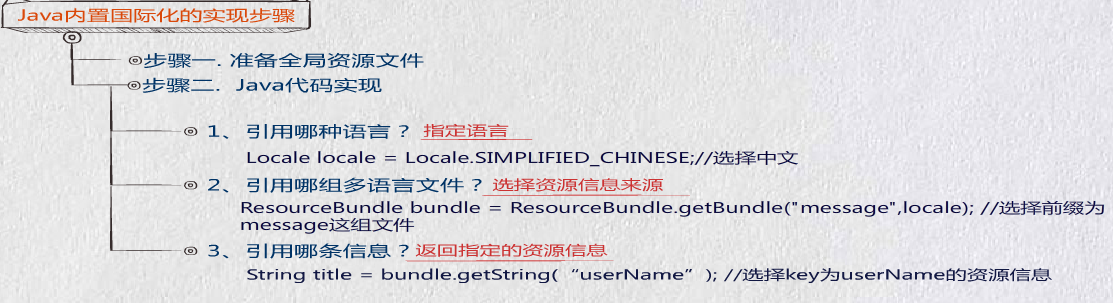
message_en_US.properties
demo = hello world!

userName = user name

password = password

welcome = welcome!
message_zh_CN.properties
demo = \u60A8\u597D\u4E16\u754C!

userName = \u7528\u6237\u540D

password = \u5BC6\u7801

welcome = \u6B22\u8FCE!
message.properties
demo = \u60A8\u597D\u4E16\u754C!

userName = \u7528\u6237\u540D

password = \u5BC6\u7801

welcome = \u6B22\u8FCE!
实现代码
<%@page import="java.util.ResourceBundle"%>

<%@page import="java.util.Locale"%>

<%@ page language="java" contentType="text/html; charset=UTF-8"

    pageEncoding="UTF-8"%>

<!DOCTYPE html PUBLIC "-//W3C//DTD HTML 4.01 Transitional//EN" "http://www.w3.org/TR/html4/loose.dtd">

<html>

<head>

<meta http-equiv="Content-Type" content="text/html; charset=UTF-8">

<title>测试</title>

</head>

<body>

<h1>测试页面</h1>

<%

//获取当前已经安装的语言数组

Locale [] locals=Locale.getAvailableLocales();

//遍历数组

for(Locale local:locals){

    //国家+国家代码

    out.print("国家:    "+local.getDisplayCountry()+"     国家代码:"+local.getCountry()+"   ");

    //语言+语言代码

    out.println("语言:  "+local.getDisplayLanguage()+"   语言代码:"+local.getLanguage()+"<hr/>");

}

//引用语言            此处可以更改

Locale ls=Locale.getDefault();

//使用哪个资源文件

ResourceBundle rb=ResourceBundle.getBundle("message",ls);

//输出

out.println(rb.getString("demo"));

out.println(rb.getString("userName"));

out.println(rb.getString("password"));

out.println(rb.getString("welcome"));

%>

</body>

</html>
三、Struts2实现
准备全局资源文件:通常至少三个文件
命名规则:前缀名_语言_国家.properties
内容格式:key=value
指定资源文件(设置常量)
1.struts.xml文件中:
<constant name="struts.custom.i18n.resources" value="message" />
2.struts.properties中:
struts.custom.i18n.resources=message
<s:text name="demo"></s:text>

<s:text name="userName" />

<s:text name="password" />

<s:text name="welcome" />
更改资源文件
message.properites
demo = 您好世界!

userName = 用户名

password = 密码

welcome = 欢迎!

submit =提交

reset=重置
message_zh_CN.properties
demo = 您好世界!

userName = 用户名

password = 密码

welcome = 欢迎!

submit =提交

reset=重置
message_en_US.properties
demo = hello world!

userName = user name

password = password

welcome = welcome!

submit =submit

reset=reset
<%@ page language="java" contentType="text/html; charset=UTF-8"

    pageEncoding="UTF-8"%>

 <%@ taglib prefix="s" uri="/struts-tags" %>

<!DOCTYPE html PUBLIC "-//W3C//DTD HTML 4.01 Transitional//EN" "http://www.w3.org/TR/html4/loose.dtd">

<html>

<head>

<meta http-equiv="Content-Type" content="text/html; charset=UTF-8">

<title>测试</title>

</head>

<body>

<s:text name="demo"></s:text>

<s:text name="userName" />

<s:text name="password" />

<s:text name="welcome" />

<s:form action="" method="post">

<s:textfield key="userName" />

<s:password  key="password"/>

<s:submit key="submit"/>

<s:reset key="reset" />

</s:form>

</body>

</html>

四、Action类实现国际化
message.properties
demo = 您好世界!

userName = 用户名

password = 密码

welcome = {0}欢迎!{1}

submit =提交

reset=重置

fail=登录失败

usermsg=用户名不能为空

usermsglength=用户名的长度为2-16位

pwdmsg=密码不能为空

pwdmsglength=密码的长度为2-16位
message_zh_CN.properties同上
message_en_US.properties
demo = hello world!

userName = user name

password = password

welcome = {0}welcome!{1}

submit =submit

reset=reset

fail=login failed

usermsg=user name do not empty

usermsglength=user name length is 2 to 16!

pwdmsg=password do not empty

pwdmsglength=password length is 2 to 16!
struts.xml
<struts>

    <constant name="struts.enable.DynamicMethodInvocation" value="false" />

    <constant name="struts.devMode" value="true" />

    <constant name="struts.custom.i18n.resources" value="message" />

    <package name="default" namespace="/" extends="struts-default">

    <action name="login" class="action.LoginAction" method="login">

    <result name="success">

    /demo.jsp

    </result>

    <result name="input">

    /demo.jsp

    </result>

    </action>

 </package>

</struts>
demo.jsp
<%@ page language="java" contentType="text/html; charset=UTF-8"

    pageEncoding="UTF-8"%>

 <%@ taglib prefix="s" uri="/struts-tags" %>

<!DOCTYPE html PUBLIC "-//W3C//DTD HTML 4.01 Transitional//EN" "http://www.w3.org/TR/html4/loose.dtd">

<html>

<head>

<meta http-equiv="Content-Type" content="text/html; charset=UTF-8">

<title>测试</title>

</head>

<body>

<%-- <s:text name="demo"></s:text>

<s:text name="userName" />

<s:text name="password" />

<s:text name="welcome" /> --%>

<s:form action="login.action" method="post">

<s:textfield name="username" key="userName" />

<s:password  name="password" key="password"/>

<s:submit key="submit"/>

<s:reset key="reset" />

</s:form>

<hr/><br/>

<s:actionmessage />

<s:debug/>

</body>

</html>
LogionAction
package action;

import com.opensymphony.xwork2.ActionSupport;

public class LoginAction extends ActionSupport {

    private String username;

    private String password;

    public String login() {

        if ("admin".equalsIgnoreCase(username)

                && "admin".equalsIgnoreCase(password)) {

            this.addActionMessage(this.getText("welcome", new String[] {

                    username,password}));

            return SUCCESS;

        }

        this.addActionMessage(this.getText("fail"));

        return INPUT;

    }

    public String getUsername() {

        return username;

    }

    public void setUsername(String username) {

        this.username = username;

    }

    public String getPassword() {

        return password;

    }

    public void setPassword(String password) {

        this.password = password;

    }

}
LogionAction.login()验证文件
LogionAction-login-validation.xml
<?xml version="1.0" encoding="UTF-8"?>

<!DOCTYPE validators PUBLIC "-//Apache Struts//XWork Validator 1.0.3//EN"

        "http://struts.apache.org/dtds/xwork-validator-1.0.3.dtd">

<validators>

<field name="username">

<field-validator type="requiredstring">

<param name="trim">true</param>

<message>${getText("usermsg")}</message>

</field-validator>

<field-validator type="stringlength">

<param name="trim">true</param>

<param name="minLength">2</param>

<param name="maxLength">16</param>

<message>${getText("usermsglength")}</message>

</field-validator>

</field>

<field name="password">

<field-validator type="requiredstring">

<param name="trim">true</param>

<message>${getText("pwdmsg")}</message>

</field-validator>

<field-validator type="stringlength">

<param name="trim">true</param>

<param name="minLength">2</param>

<param name="maxLength">16</param>

<message>${getText("pwdmsglength")}</message>

</field-validator>

</field>

</validators>
五、Jsp页面国际化传参数
<!-- First Example -->

<s:i18n name="struts.action.test.i18n.Shop">

    <s:text name="main.title"/>

</s:i18n>

<!-- Second Example -->

<s:text name="main.title" />

<!-- Third Examlpe -->

<s:text name="i18n.label.greetings">

   <s:param >Mr Smith</s:param>

</s:text>
<s:text name="welcome">

<s:param>admin</s:param>

<s:param>ffff</s:param>

</s:text>

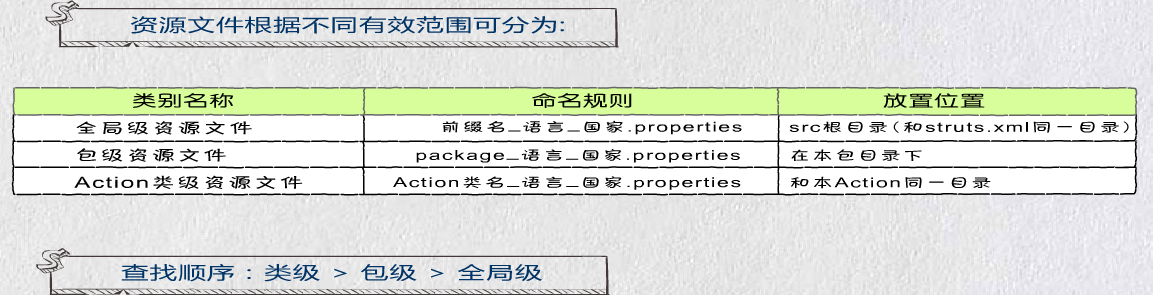
六、资源查找顺序
七、在JSP中使用国际化
使用UI表单标志时,getText可以用来设置label属性,例如: <s:textfield name="name" label="%{getText('UserName')}"/>
八、资源文件里使用OGNL表达式
许多情况下,我们都需要在动行时(runtime)为国际化字符插入一些参数,例如在输入验证提示信息的时候。在Struts 2.0中,我们可以通过在资源文件的国际化字符串中使用OGNL做到这点: 格式为${表达式},例如:
validation.require=${fileName} is required
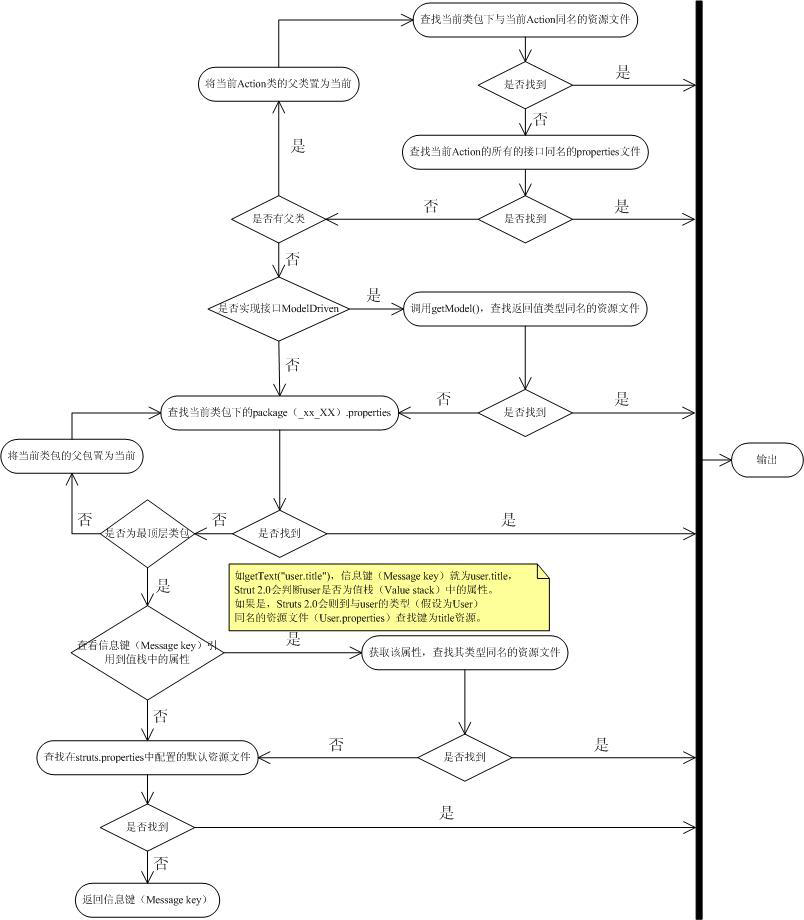
九、资源文件查找顺序
Struts2(十三)国际化-internationalization的更多相关文章
- 浅谈struts2的国际化----i18n
可能大家在使用struts框架的时候,偶尔会看到这个词: i18n.也就是 Internationalization i 开头,n 结尾. 总共18个字母,今天的主要内容就是环绕这 四个字母. ...
- (十四)struts2的国际化
一.国际化的概念 国际化是指web程序在运行时,根据客户端请求的国家.语言的不同而显示不同的界面. 例如,如果请求来自中文客户端,则页面的显示,提示信息等都是中文,如果是英文客户端,则显示英文信息. ...
- 十四、Struts2的国际化
十四.Struts2的国际化 1.配置全局国际化消息资源包 配置全局消息资源包 <!--配置全局消息资源包 --> <constant name="struts.c ...
- JavaWeb框架_Struts2_(八)----->Struts2的国际化
这一篇博文拖了蛮久了,现在先把它完成,结束struts2这个版块,当然这只是最基础的部分,做项目还需要更深的理解.下一个web后端的版块准备做Spring框架的学习-嗯,加油! 1. Struts2的 ...
- struts2使用拦截器完成登陆显示用户信息操作和Struts2的国际化
其实学习框架,就是为了可以很好的很快的完成我们的需求,而学习struts2只是为了替代之前用的servlet这一层,框架使开发更加简单,所以作为一个小菜鸟,特别感谢那些超级无敌变态开发的框架供我们使用 ...
- struts2 资源国际化
web.xml: <?xml version="1.0" encoding="UTF-8"?><web-app id="WebApp ...
- Struts2的国际化入门
Struts2的国际化入门 Struts2国际化是建立在Java国际化的基础上的,一样是通过提供不同国家/语言环境的消息资源,然后通过ResourceBundle加载指定Locale对应的资源文件,再 ...
- 【Struts2】 国际化
一.概述 二.Struts2中国际化: 2.1 问题1 全局 局部 2.2 问题2 2.3 问题3 2.4 问题4 在Action中怎样使用 在JSP页面上怎样使用 一.概述 同一款软件 可以为不同用 ...
- Struts2之国际化
时间:2017-1-11 11:12 --国际化Struts2已经对国际化进行了封装,我们只需要根据其提供的API进行访问即可.要使用国际化的Action必须继承ActionSupport.1.什么是 ...
随机推荐
- smartjs - DataManager 场景示例分析 - 数据懒加载
发一张policy的参数图设置图: 场景1 - 数据的懒加载/延迟加载 在很多时候,为了提高网页的加载速度,减少不必要的开销,会将页面的数据拆分成几个部分,首先加载呈现可视区域内的数据,然后剩下来的会 ...
- JS事件委托的原理和应用
js事件委托也叫事件代理,实际上事件委托就是通过事件冒泡实现的,所谓的事件就是onclick,onmouseover,ondown等等,那么委托呢?委托就是指本来这个事是要你自己做的,但是你却让别人帮 ...
- java模拟一个简单的QQ
v 项目源码 https://github.com/hjzgg/java_QQ v 标题效果 package testFour; import java.awt.Color; import ...
- ruby -- 进阶学习(十三)解说ckeditor在production环境下如何完整显示
将ROR项目从development环境改为production环境时,运行rake assets:precompile后, ckeditor的界面就无法完整显示?! @_@?? 出现 ActionC ...
- Asp.Net(C#)自动执行计划任务的程序实例分析
在业务复杂的应用程序中,有时候会要求一个或者多个任务在一定的时间或者一定的时间间隔内计划进行,比如定时备份或同步数据库,定时发送电子邮件等,我们称之为计划任务.实现计划任务的方法也有很多,可以采用SQ ...
- DDD:Strategic Domain Driven Design with Context Mapping
Introduction Many approaches to object oriented modeling tend not to scale well when the application ...
- asynchronous-logging-with-log4j-2--转
原文地址:https://dzone.com/articles/asynchronous-logging-with-log4j-2 Log4J 2 is a logging framework des ...
- Webstrom (或Phpstrom)使用git(oschina-码云)
.登录"码云"(题外话,这名字起得真好),创建一个新项目 .自动进入了新项目主页,复制该git 仓库的https地址,第4步会用到 .打开Webstrom,选择chec ...
- 开放产品开发(OPD):开篇
OPD?这是什么玩意?google一下.忘记说了,最近google被封锁的厉害,那就百度一下吧.可惜,OPD找不出是什么.你今天你找不到是正常的,因为之前还没有OPD,而现在才开始有OPD这个东东.相 ...
- 【推荐】iOS带有加载网络图片进度的UIImageView
UCZProgressView 是一个带有通用的圆形图片进度下载控件.动画效果不错 特性 Customizable indicator (line width, radius, and color) ...