
[模拟电路] 2、Passive Band Pass Filter
note: Some articles are very good in http://www.electronics-tutorials.ws/,I share them in the Cnblog so that Chinese hardware engineers can enjoy and learn.
The cut-off frequency or ƒc point in a simple RC passive filter can be accurately controlled using just a single resistor in series with a non-polarized(非极性) capacitor, and depending upon which way around they are connected, we have seen that either a Low Pass or a High Pass filter is obtained.
One simple use for these types of passive filters is in audio amplifier applications or circuits such as in loudspeaker crossover filters(扬声器分频滤波器) or pre-amplifier tone controls(前置放大器音色控制). Sometimes it is necessary to only pass a certain range of frequencies that do not begin at 0Hz, (DC) or end at some upper high frequency point but are within a certain range or band of frequencies, either narrow or wide.
By connecting or “cascading” together(连接或级联) a single Low Pass Filter circuit with a High Pass Filter circuit, we can produce another type of passive RC filter that passes a selected range or “band” of frequencies that can be either narrow or wide while attenuating all those outside of this range. This new type of passive filter arrangement produces a frequency selective filter known commonly as a Band Pass Filter or BPF for short.
Band Pass Filter Circuit
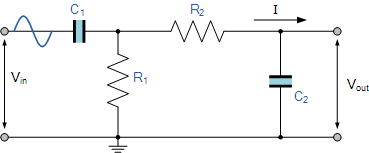
Unlike a low pass filter that only pass signals of a low frequency range or a high pass filter which pass signals of a higher frequency range, a Band Pass Filters passes signals within a certain “band” or “spread” of frequencies without distorting(扭曲) the input signal or introducing(引入) extra noise. This band of frequencies can be any width and is commonly known as the filters Bandwidth.
Then for widely spread frequencies, we can simply define the term “bandwidth”, BW as being the difference between the lower cut-off frequency ( ƒcLOWER ) and the higher cut-off frequency ( ƒcHIGHER ) points. In other words, BW = ƒH – ƒL. Clearly for a pass band filter to function correctly, the cut-off frequency of the low pass filter must be higher than the cut-off frequency for the high pass filter.
The “ideal” Band Pass Filter(理想带通滤波器) can also be used to isolate or filter out(隔离或滤除) certain frequencies that lie within a particular(特定的) band of frequencies, for example, noise cancellation(噪声消除). Band pass filters are known generally as second-order(二阶) filters, (two-pole) because they have “two” reactive component(活性原件), the capacitors, within their circuit design. One capacitor in the low pass circuit and another capacitor in the high pass circuit.
Frequency Response of a 2nd Order Band Pass Filter.
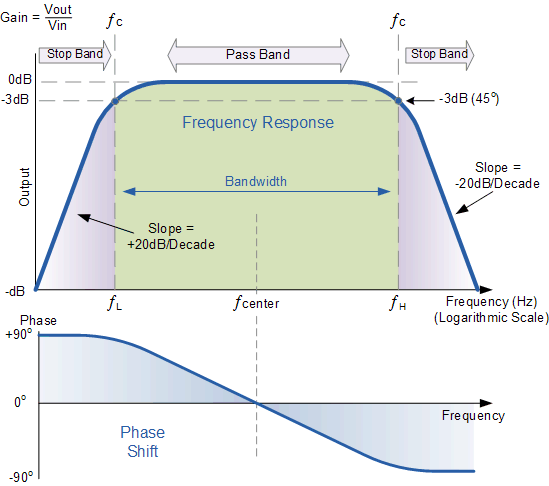
The Bode Plot(波特图) or frequency response curve(频率响应曲线) above shows the characteristics of the band pass filter. Here the signal is attenuated(衰减) at low frequencies with the output increasing at a slope of +20dB/Decade (6dB/Octave)(随着+20dB/Decade的坡度衰减)until the frequency reaches the “lower cut-off” point ƒL. At this frequency the output voltage is again 1/√2 = 70.7% of the input signal value or -3dB (20 log (Vout/Vin)) of the input.
The output continues at maximum gain(增益) until it reaches the “upper cut-off” point ƒHwhere the output decreases at a rate of -20dB/Decade (6dB/Octave) attenuating any high frequency signals. The point of maximum output gain is generally the geometric mean of the two -3dB value between the lower and upper cut-off points(最大输出增益点一般是两个在最低和最高截止点之间值为-3dB的频率的几何平均) and is called the “Centre Frequency” or “Resonant Peak(共振峰)” value ƒr. This geometric mean value is calculated as being ƒr 2 = ƒ(UPPER) x ƒ(LOWER).
A band pass filter is regarded as a second-order (two-pole) type filter because it has “two” reactive components within its circuit structure, then the phase angle will be twice that of the previously seen first-order filters, ie, 180o. The phase angle of the output signal LEADS that of the input by +90o up to the centre or resonant frequency, ƒrpoint were it becomes “zero” degrees (0o) or “in-phase” and then changes to LAG the input by -90o as the output frequency increases.
The upper and lower cut-off frequency points for a band pass filter can be found using the same formula(公式) as that for both the low and high pass filters, For example.
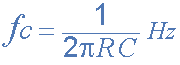
Then clearly, the width of the pass band of the filter can be controlled by the positioning of the two cut-off frequency points of the two filters.
Band Pass Filter Example No1.
A second-order band pass filter is to be constructed using RC components that will only allow a range of frequencies to pass above 1kHz (1,000Hz) and below 30kHz (30,000Hz). Assuming that both the resistors have values of 10kΩ´s, calculate the values of the two capacitors required.
The High Pass Filter Stage.
The value of the capacitor C1 required to give a cut-off frequency ƒL of 1kHz with a resistor value of 10kΩ is calculated as:

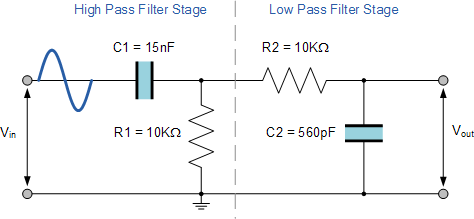
Then, the values of R1 and C1 required for the high pass stage to give a cut-off frequency of 1.0kHz are: R1 = 10kΩ´s and C1 = 15nF.
The Low Pass Filter Stage.
The value of the capacitor C2 required to give a cut-off frequency ƒH of 30kHz with a resistor value of 10kΩ is calculated as:

Then, the values of R2 and C2 required for the low pass stage to give a cut-off frequency of 30kHz are, R = 10kΩ´s and C = 510pF. However, the nearest preferred value of the calculated capacitor value of 510pF is 560pF so this is used instead.
With the values of both the resistances R1 and R2 given as 10kΩ, and the two values of the capacitors C1 and C2 found for both the high pass and low pass filters as 15nF and 560pF respectively, then the circuit for our simple passive Band Pass Filter is given as.
Completed Band Pass Filter Circuit
Band Pass Filter Resonant Frequency
We can also calculate the “Resonant” or “Centre Frequency” (ƒr) point of the band pass filter were the output gain is at its maximum or peak value. This peak value is not the arithmetic average of the upper and lower -3dB cut-off points as you might expect but is in fact the “geometric” or mean value. This geometric mean value is calculated as being ƒr 2 = ƒc(UPPER) x ƒc(LOWER) for example:
Centre Frequency Equation
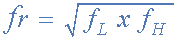
- Where, ƒr is the resonant or centre frequency
- ƒL is the lower -3dB cut-off frequency point
- ƒH is the upper -3db cut-off frequency point
and in our simple example above, the calculated cut-off frequencies were found to be ƒL= 1,060 Hz and ƒH = 28,420 Hz using the filter values.
Then by substituting these values into the above equation gives a central resonant frequency of:

Band Pass Filter Summary
A simple passive Band Pass Filter can be made by cascading together a single Low Pass Filter with a High Pass Filter. The frequency range, in Hertz, between the lower and upper -3dB cut-off points of the RC combination is know as the filters “Bandwidth”.
The width or frequency range of the filters bandwidth can be very small and selective, or very wide and non-selective depending upon the values of R and C used.
The centre or resonant frequency point is the geometric mean of the lower and upper cut-off points. At this centre frequency the output signal is at its maximum and the phase shift of the output signal is the same as the input signal.
The amplitude of the output signal from a band pass filter or any passive RC filter for that matter, will always be less than that of the input signal. In other words a passive filter is also an attenuator giving a voltage gain of less than 1 (Unity). To provide an output signal with a voltage gain greater than unity, some form of amplification is required within the design of the circuit.(无源带通滤波器输出小于输入,想要增益大于1的带通滤波器就要设计一种新的电路了)
A Passive Band Pass Filter is classed as a second-order type filter because it has two reactive components within its design, the capacitors. It is made up from two single RC filter circuits that are each first-order filters themselves.
If more filters are cascaded together the resulting circuit will be known as an “nth-order” filter where the “n” stands for the number of individual reactive components and therefore poles within the filter circuit. For example, filters can be a 2nd-order, 4th-order, 10th-order, etc.
The higher the filters order the steeper will be the slope(斜率) at n times -20dB/decade. However, a single capacitor value made by combining together two or more individual capacitors is still one capacitor.
Our example above shows the output frequency response curve for an “ideal” band pass filter with constant gain in the pass band and zero gain in the stop bands. In practice(实际中) the frequency response of this Band Pass Filter circuit would not be the same as the input reactance of the high pass circuit would affect the frequency response of the low pass circuit (components connected in series or parallel组件的串并联) and vice versa(高通滤波器的输入电抗将会影响低通滤波器的频率响应,反之亦然). One way of overcoming this would be to provide some form of electrical isolation(隔离) between the two filter circuits as shown below.
Buffering Individual Filter Stages
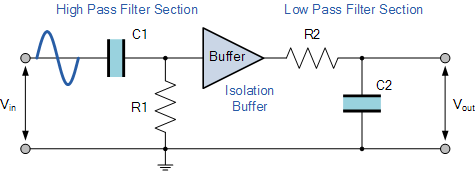
One way of combining amplification and filtering into the same circuit would be to use an Operational Amplifier or Op-amp, and examples of these are given in the Operational Amplifier section. In the next tutorial we will look at filter circuits which use an operational amplifier within their design to not only to introduce gain but provide isolation between stages. These types of filter arrangements are generally known as Active Filters.
@beautifulzzzz

智能硬件、物联网,热爱技术,关注产品

博客:http://blog.beautifulzzzz.com

sina:http://weibo.com/beautifulzzzz?is_all=1
[模拟电路] 2、Passive Band Pass Filter的更多相关文章
- Sallen-Key Active Butterworth Low Pass Filter Calculator
RC 2nd Order Passive Low Pass Filter The cut-off frequency of second order low pass filter is given ...
- 模拟电路"虚短" & "虚断"
<虚短 & 虚断> 运算放大器组成的电路五花八门,令人眼花瞭乱,是模拟电路中学习的重点.遍观所有模拟电子技朮的书籍和课程,在介绍运算放大器电路的时候,无非是先给电路来个定性,比如这 ...
- 初级模拟电路:3-1 BJT概述
回到目录 1. 名称由来 BJT的全称是双极性结型晶体管(Bipolar Junction Transistor),国内俗称三极管.其实,在英语中,三极管(triode)特指以前的真空电子管形式的 ...
- 初级模拟电路:4-1 BJT交流分析概述
回到目录 BJT晶体管的交流分析(也叫小信号分析)是模拟电路中的一个难点,也可以说是模电中的一个分水岭.如果你能够把BJT交流分析的原理全都搞懂,那之后的学习就是一马平川了.后面的大部分内容,诸如:场 ...
- 【SCALA】3、模拟电路
Simulation package demo17 abstract class Simulation { type Action = () => Unit case class WorkIte ...
- 初级模拟电路:1-2 PN结与二极管
回到目录 1. 掺杂半导体 上面我们分析了本征半导体的导电情况,但由于本征半导体的导电能力很低,没什么太大用处.所以,一般我们会对本征半导体材料进行掺杂,即使只添加了千分之一的杂质,也足以改变半导 ...
- 初级模拟电路:4-3 BJT晶体管的交流建模
回到目录 1. 四种BJT模型概述 对BJT晶体管建模的基本思路就是,用电路原理中的五大基本元件(电阻.电容.电感.电源.受控源)构建一个电路,使其在一定工作条件下能等效非线性半导体器件的实际工作.一 ...
- 初级模拟电路:3-11 BJT实现电流源
回到目录 1. 恒流源 (1)简易恒流源 用BJT晶体管可以构造一个简易的恒流源,实现电路如下: 图3-11.01 前面我们在射极放大电路的分压偏置时讲过,分压偏置具有非常好的稳定性,几乎不受晶体管的 ...
- 初级模拟电路:3-2 BJT的工作原理
回到目录 和前面介绍二极管的PN结的工作原理一样,BJT的量子级工作机制也非常复杂,一般教科书上为了帮助学习者能快速理解,也都是用一种简化模型的方法来介绍BJT的工作机理,一般只需大致了解即可.只要记 ...
随机推荐
- H5单页面手势滑屏切换原理
H5单页面手势滑屏切换是采用HTML5 触摸事件(Touch) 和 CSS3动画(Transform,Transition)来实现的,效果图如下所示,本文简单说一下其实现原理和主要思路. 1.实现原理 ...
- .NET 4.6.2正式发布带来众多特性
虽然大多数人的注意力都集中在.NET Core上,但与原来的.NET Framework相关的工作还在继续..NET Framework 4.6.2正式版已于近日发布,其重点是安全和WinForms/ ...
- webapi - 模型验证
本次要和大家分享的是webapi的模型验证,讲解的内容可能不单单是做验证,但都是围绕模型来说明的:首先来吐槽下,今天下午老板为自己买了套新办公家具,看起来挺好说明老板有钱,不好的是我们干技术的又成了搬 ...
- 用scikit-learn学习DBSCAN聚类
在DBSCAN密度聚类算法中,我们对DBSCAN聚类算法的原理做了总结,本文就对如何用scikit-learn来学习DBSCAN聚类做一个总结,重点讲述参数的意义和需要调参的参数. 1. scikit ...
- iOS逆向工程之App脱壳
本篇博客以微信为例,给微信脱壳."砸壳"在iOS逆向工程中是经常做的一件事情,,因为从AppStore直接下载安装的App是加壳的,其实就是经过加密的,这个“砸壳”的过程就是一个解 ...
- Opserver开源的服务器监控系统(ASP.NET)
Opserver是Stack Exchange下的一个开源监控系统,系统本身由C#语言开发的ASP.NET(MVC)应用程序,无需任何复杂的应用配置,入门很快.下载地址:https://github. ...
- 2014年暑假c#学习笔记目录
2014年暑假c#学习笔记 一.C#编程基础 1. c#编程基础之枚举 2. c#编程基础之函数可变参数 3. c#编程基础之字符串基础 4. c#编程基础之字符串函数 5.c#编程基础之ref.ou ...
- C#泛型详解(转)
初步理解泛型: http://www.cnblogs.com/wilber2013/p/4291435.html 泛型中的类型约束和类型推断 http://www.cnblogs.com/wilber ...
- 使用Git Bash远程添加分支和简单部署你的静态页面
新建一个分支:git branch mybranch(mybranch你的分支名字) 切换到你的新分支: git checkout mybranch 将新分支发布在github上: git push ...
- JavaScript对象和数组
1.JavaScript中有两个非常重要的数据类型是对象和数组. 通过"."或者"[]"来访问对象属性 举例:var book = { topic:" ...