
day37 03-Hibernate二级缓存:集合缓冲区特点

所以说要经常检查hibernate3的核心配置文件hibernate.cfg.xml.
Hibernate:
select
customer0_.cid as cid0_0_,
customer0_.version as version0_0_,
customer0_.cname as cname0_0_,
customer0_.age as age0_0_
from
customer customer0_
where
customer0_.cid=?
Hibernate:
select
orders0_.cno as cno0_1_,
orders0_.oid as oid1_,
orders0_.oid as oid1_0_,
orders0_.addr as addr1_0_,
orders0_.cno as cno1_0_
from
orders orders0_
where
orders0_.cno=?
订单的数量:11


这是咱们的默认情况,fetch="select" lazy="tue"的情况。这种情况发多条SQL语句。所以不是连接查询,而是分步单表查询。
向下执行,查询customer2没有发SQL,因为使用了二级缓存。再向下执行查询customer2的订单也没有发SQL,跟hibernate3核心配置文件hibernate.cfg.xml中的一句话:<collection-cache usage="read-write" collection="cn.itcast.hibernate3.demo1.Customer.orders"/>有关。集合缓冲区 所以在获得客户的订单的数量的时候,就没有再去发送SQL语句了。因为它已经把我们的集合orders也给缓存了。集合缓存区用来缓存对象中的集合。我们现在用的就是对象中的集合,所以它没有发送SQL语句。
现在要证明集合缓存区的数据是依赖于类缓存区的。尝试注释掉<collection-cache usage="read-write" collection="cn.itcast.hibernate3.demo1.Customer.orders"/>这句话。
Hibernate:
select
customer0_.cid as cid0_0_,
customer0_.version as version0_0_,
customer0_.cname as cname0_0_,
customer0_.age as age0_0_
from
customer customer0_
where
customer0_.cid=?
Hibernate:
select
orders0_.cno as cno0_1_,
orders0_.oid as oid1_,
orders0_.oid as oid1_0_,
orders0_.addr as addr1_0_,
orders0_.cno as cno1_0_
from
orders orders0_
where
orders0_.cno=?
订单的数量:11
Hibernate:
select
orders0_.cno as cno0_1_,
orders0_.oid as oid1_,
orders0_.oid as oid1_0_,
orders0_.addr as addr1_0_,
orders0_.cno as cno1_0_
from
orders orders0_
where
orders0_.cno=?
订单的数量:11
取消了集合缓存区的话查询customer2不会发SQL(因为customer2使用了二级缓存)。而查询customer2的订单数量的时候就会发SQL(因为取消了集合缓存区)。如果把查询订单的类缓存区给注释掉的话,把订单的类缓存区 <class-cache usage="read-write" class="cn.itcast.hibernate3.demo1.Order"/>的这句话注释掉的话,而把集合缓存区恢复的话,把<collection-cache usage="read-write" collection="cn.itcast.hibernate3.demo1.Customer.orders"/>这句话取消注释的话,
Hibernate:
select
customer0_.cid as cid0_0_,
customer0_.version as version0_0_,
customer0_.cname as cname0_0_,
customer0_.age as age0_0_
from
customer customer0_
where
customer0_.cid=?
Hibernate:
select
orders0_.cno as cno0_1_,
orders0_.oid as oid1_,
orders0_.oid as oid1_0_,
orders0_.addr as addr1_0_,
orders0_.cno as cno1_0_
from
orders orders0_
where
orders0_.cno=?
订单的数量:11
Hibernate:
select
order0_.oid as oid1_0_,
order0_.addr as addr1_0_,
order0_.cno as cno1_0_
from
orders order0_
where
order0_.oid=?
Hibernate:
select
order0_.oid as oid1_0_,
order0_.addr as addr1_0_,
order0_.cno as cno1_0_
from
orders order0_
where
order0_.oid=?
Hibernate:
select
order0_.oid as oid1_0_,
order0_.addr as addr1_0_,
order0_.cno as cno1_0_
from
orders order0_
where
order0_.oid=?
Hibernate:
select
order0_.oid as oid1_0_,
order0_.addr as addr1_0_,
order0_.cno as cno1_0_
from
orders order0_
where
order0_.oid=?
Hibernate:
select
order0_.oid as oid1_0_,
order0_.addr as addr1_0_,
order0_.cno as cno1_0_
from
orders order0_
where
order0_.oid=?
Hibernate:
select
order0_.oid as oid1_0_,
order0_.addr as addr1_0_,
order0_.cno as cno1_0_
from
orders order0_
where
order0_.oid=?
Hibernate:
select
order0_.oid as oid1_0_,
order0_.addr as addr1_0_,
order0_.cno as cno1_0_
from
orders order0_
where
order0_.oid=?
Hibernate:
select
order0_.oid as oid1_0_,
order0_.addr as addr1_0_,
order0_.cno as cno1_0_
from
orders order0_
where
order0_.oid=?
Hibernate:
select
order0_.oid as oid1_0_,
order0_.addr as addr1_0_,
order0_.cno as cno1_0_
from
orders order0_
where
order0_.oid=?
Hibernate:
select
order0_.oid as oid1_0_,
order0_.addr as addr1_0_,
order0_.cno as cno1_0_
from
orders order0_
where
order0_.oid=?
Hibernate:
select
order0_.oid as oid1_0_,
order0_.addr as addr1_0_,
order0_.cno as cno1_0_
from
orders order0_
where
order0_.oid=?
订单的数量:11
不仅仅发了,而且发了很多条SQL。那样的话有多少个订单就发多少条SQL。这其实跟我们的集合缓存区的结构特性有关。
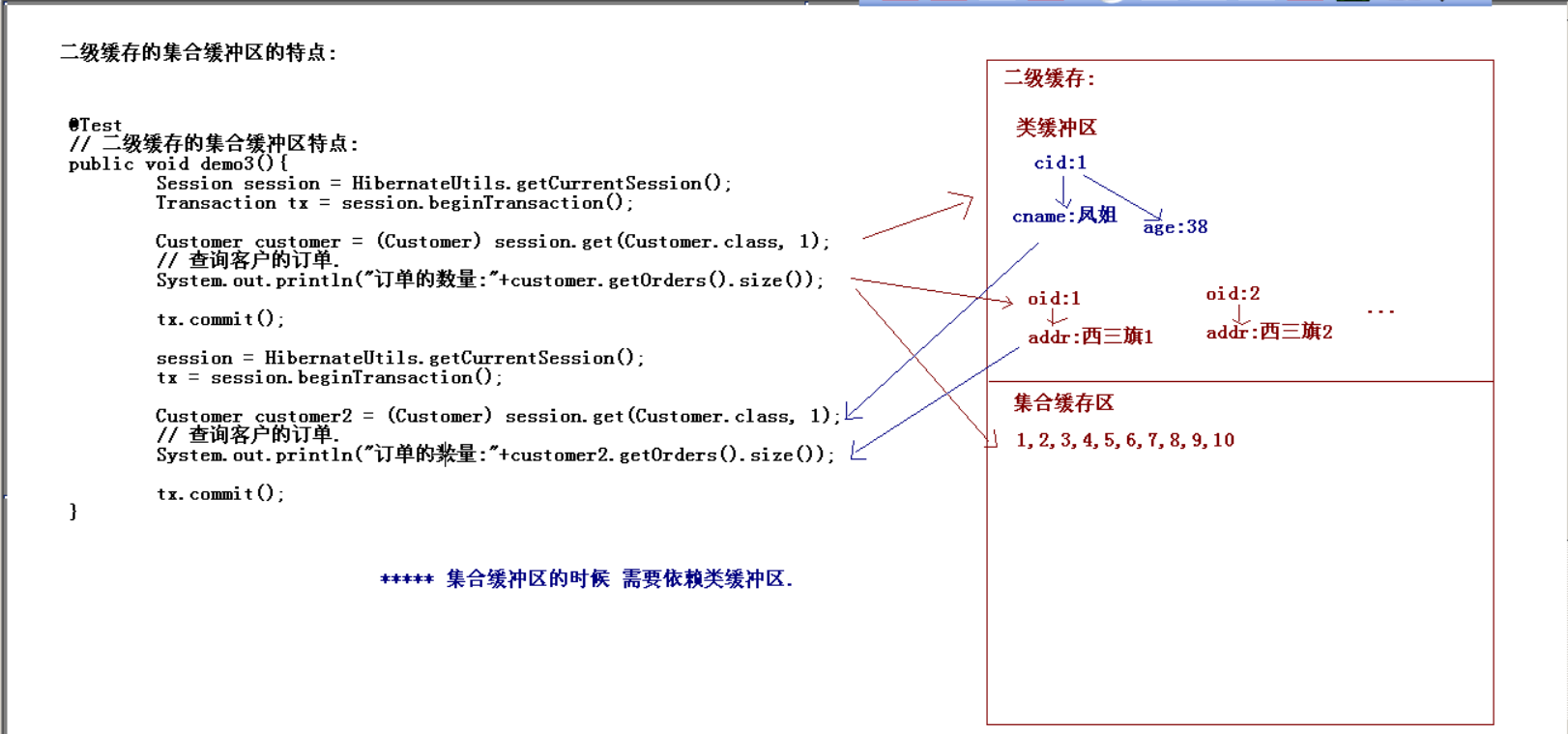
这是刚才二级缓存的类缓存区的散装数据。

二级缓存区分为类缓存区和集合缓存区等等。集合缓存区里面缓存的都是对象的id,而且它是需要依赖类缓存区的。类缓存区缓存的是对象的散装数据。可以通过cid引用这两个属性的值。就是一查Customer,它就会这样去做了。获得订单是我们的集合缓存区。集合缓存区缓存的都是对象的id。它会把我们所有的订单的id给缓存了。集合缓存的是我们订单的id。集合缓存区的使用需要依赖类缓存区。oid对addr有引用。类缓存区是有这些对象数据的。它就不发sql了,直接从二级缓存区获取了。如果不开放/配置类缓存区,它就会根据对象的id一个个地去检索。
下面是同时开放/配置Order类缓存区和集合缓存区的效果:
Hibernate:
select
customer0_.cid as cid0_0_,
customer0_.version as version0_0_,
customer0_.cname as cname0_0_,
customer0_.age as age0_0_
from
customer customer0_
where
customer0_.cid=?
Hibernate:
select
orders0_.cno as cno0_1_,
orders0_.oid as oid1_,
orders0_.oid as oid1_0_,
orders0_.addr as addr1_0_,
orders0_.cno as cno1_0_
from
orders orders0_
where
orders0_.cno=?
订单的数量:11
订单的数量:11
<?xml version="1.0" encoding="UTF-8"?>

<!DOCTYPE hibernate-configuration PUBLIC

    "-//Hibernate/Hibernate Configuration DTD 3.0//EN"

    "http://www.hibernate.org/dtd/hibernate-configuration-3.0.dtd">

<hibernate-configuration>

<session-factory>

    <!-- 必须去配置的属性 -->

    <!-- 配置数据库连接的基本信息: -->

    <property name="hibernate.connection.driver_class">

        com.mysql.jdbc.Driver

    </property>

    <property name="hibernate.connection.url">

        jdbc:mysql:///hibernate3_day03

    </property>

    <property name="hibernate.connection.username">root</property>

    <property name="hibernate.connection.password"></property>

    <!-- Hibernate的方言 -->

    <!-- 生成底层SQL不同的 -->

    <property name="hibernate.dialect">

        org.hibernate.dialect.MySQLDialect

    </property>

    <!-- 可选的属性 -->

    <!-- 显示SQL -->

    <property name="hibernate.show_sql">true</property>

    <!-- 格式化SQL -->

    <property name="hibernate.format_sql">true</property>

    <property name="hibernate.connection.autocommit">false</property>

    <!-- hbm:映射 to DDL: create drop alter -->

    <property name="hibernate.hbm2ddl.auto">update</property>

    <!-- 设置事务的隔离级别 -->

    <property name="hibernate.connection.isolation">4</property>

    <!-- 设置本地Session -->

    <property name="hibernate.current_session_context_class">thread</property>

    <!-- C3P0连接池设定-->

    <!-- 使用c3po连接池  配置连接池提供的供应商-->

    <property name="connection.provider_class">

        org.hibernate.connection.C3P0ConnectionProvider

    </property>

    <!-- Hibernate中开启二级缓存 -->

    <property name="hibernate.cache.use_second_level_cache">true</property>

    <!-- 配置二级缓存的提供商 -->

    <property name="hibernate.cache.provider_class">org.hibernate.cache.EhCacheProvider</property>

    <!-- 配置查询缓存 -->

    <property name="hibernate.cache.use_query_cache">true</property>

    <!--在连接池中可用的数据库连接的最少数目 -->

    <property name="c3p0.min_size">5</property>

    <!--在连接池中所有数据库连接的最大数目  -->

    <property name="c3p0.max_size">20</property>

    <!--设定数据库连接的过期时间,以秒为单位,

        如果连接池中的某个数据库连接处于空闲状态的时间超过了timeout时间,就会从连接池中清除 -->

    <property name="c3p0.timeout">120</property>

    <!--每3000秒检查所有连接池中的空闲连接 以秒为单位-->

    <property name="c3p0.idle_test_period">3000</property>

    <!-- 通知Hibernate加载那些映射文件 -->

    <mapping resource="cn/itcast/hibernate3/demo1/Customer.hbm.xml" />

    <mapping resource="cn/itcast/hibernate3/demo1/Order.hbm.xml" />

    <!-- 配置哪些类使用二级缓存 -->

    <class-cache usage="read-write" class="cn.itcast.hibernate3.demo1.Customer"/>

    <!--查询订单的类缓存区-->

    <class-cache usage="read-write" class="cn.itcast.hibernate3.demo1.Order"/>

    <!-- 集合缓冲区

    所以在获得客户的订单的数量的时候,就没有再去发送SQL语句了。因为它已经把我们的集合orders也给缓存了。集合缓存区用来缓存对象中的集合。

    我们现在用的就是对象中的集合,所以它没有发送SQL语句。证明集合缓存区的数据是依赖于类缓存区的。

    -->

    <collection-cache usage="read-write" collection="cn.itcast.hibernate3.demo1.Customer.orders"/>

</session-factory>

</hibernate-configuration>
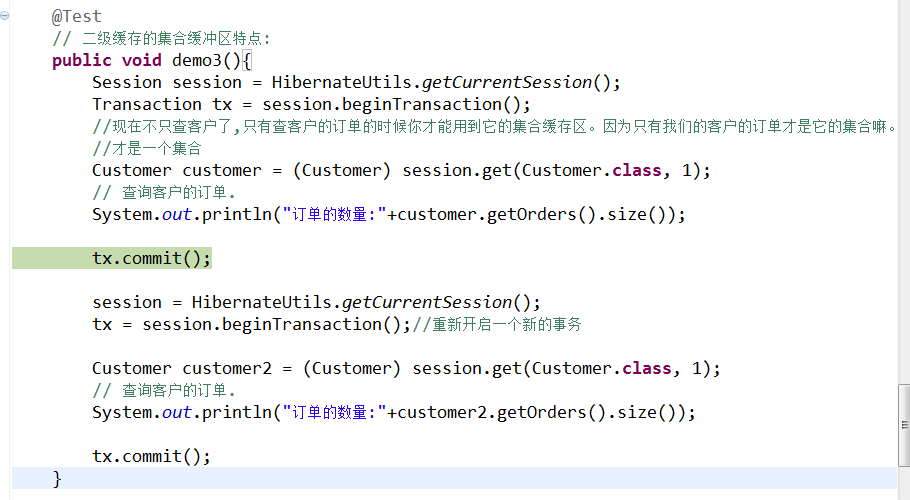
    @Test

    // 二级缓存的集合缓冲区特点:

    public void demo3(){

        Session session = HibernateUtils.getCurrentSession();

        Transaction tx = session.beginTransaction();

        //现在不只查客户了,只有查客户的订单的时候你才能用到它的集合缓存区。因为只有我们的客户的订单才是它的集合嘛。Customer.hbm.xml里面的<set name="orders">

        //才是一个集合

        Customer customer = (Customer) session.get(Customer.class, 1);

        // 查询客户的订单.

        System.out.println("订单的数量:"+customer.getOrders().size());

        tx.commit();

        session = HibernateUtils.getCurrentSession();

        tx = session.beginTransaction();//重新开启一个新的事务

        Customer customer2 = (Customer) session.get(Customer.class, 1);

        // 查询客户的订单.

        System.out.println("订单的数量:"+customer2.getOrders().size());

        tx.commit();

    }

day37 03-Hibernate二级缓存:集合缓冲区特点的更多相关文章
- Hibernate 二级缓存 总结整理(转)
和<Hibernate 关系映射 收集.总结整理> 一样,本篇文章也是我很早之前收集.总结整理的,在此也发上来 希望对大家有用.因为是很早之前写的,不当之处请指正. 1.缓存:缓存是什么, ...
- ssh整合hibernate 使用spring管理hibernate二级缓存,配置hibernate4.0以上二级缓存
ssh整合hibernate 使用spring管理hibernate二级缓存,配置hibernate4.0以上二级缓存 hibernate : Hibernate是一个持久层框架,经常访问物理数据库 ...
- js相关(easyUI),触发器,ant,jbpm,hibernate二级缓存ehcache,Javamail,Lucene,jqplot,WebService,regex,struts2,oracle表空间
*********************************************js相关********************************************* // 在指 ...
- Hibernate ——二级缓存
一.Hibernate 二级缓存 1.Hibernate 二级缓存是 SessionFactory 级别的缓存. 2.二级缓存分为两类: (1)Hibernate内置二级缓存 (2)外置缓存,可配置的 ...
- 配置Hibernate二级缓存步骤
配置Hibernate二级缓存步骤: 加入二级缓存的jar包及配置文件 jar包位置:hibernate-release-4.1.8.Final\lib\optional\ehcache下所有jar包 ...
- 配置Hibernate二级缓存时,不能初始化RegionFactory的解决办法
配置Hibernate 二级缓存时,出现以下bug提示: SLF4J: Failed to load class "org.slf4j.impl.StaticLoggerBinder&quo ...
- Hibernate(十六):Hibernate二级缓存
Hibernate缓存 缓存(Cache):计算机领域非常通用的概念.它介于应用程序和永久性数据存储源(如磁盘上的文件或者数据库)之间,起作用是降低应用程序直接读取永久性数据存储源的频率,从而提高应用 ...
- hibernate二级缓存demo2
@Test public void hello3(){ Session session=sessionFactory.openSession(); List list = session.create ...
- hibernate二级缓存整合
<?xml version="1.0" encoding="UTF-8"?> <ehcache xmlns:xsi="http:// ...
- spring boot集成ehcache 2.x 用于hibernate二级缓存
https://www.jianshu.com/p/87b2c309b776 本文将介绍如何在spring boot中集成ehcache作为hibernate的二级缓存.各个框架版本如下 spring ...
随机推荐
- Ubuntu安装Windows软件
https://www.cnblogs.com/chendeqiang/p/10177530.html Windows系列软件 安装Deepin封装好的框架 git clone https://git ...
- Java常用英语汇总(面试必备)
Java常用英语汇总(面试必备) abstract (关键字) 抽象 ['.bstr.kt] access vt.访问,存 ...
- VS2010-MFC(对话框:为对话框添加控件)
转自:http://www.jizhuomi.com/software/151.html 上一讲创建了一个名为“Addition”的工程,目的是生成一个实现加法运算的应用程序.实现加法计算有几个必要的 ...
- 更改git提交显示的用户名
问题描述 同一项目多人开发难免会用到版本控制,最为流行的当属git.开发中出现一个小问题,每个人提交后显示的用户名,如下图 组长发话:把用户名都改成自己的名字! 这时发现用户名并不是自己的名字,怎么改 ...
- vue页面刷新数据丢失问题
参考: https://blog.csdn.net/aliven1/article/details/80743470 https://blog.csdn.net/liang37712 ...
- 如何使用Pig集成分词器来统计新闻词频?
散仙在上篇文章中,介绍过如何使用Pig来进行词频统计,整个流程呢,也是非常简单,只有短短5行代码搞定,这是由于Pig的内置函数TOKENIZE这个UDF封装了单词分割的核心流程,当然,我们的需求是各种 ...
- DROOLS通过URL访问changset
package droolsRule; import java.net.Authenticator; import java.net.PasswordAuthentication; import ka ...
- spark生态圈简介
原文引自:http://www.cnblogs.com/shishanyuan/p/4700615.html 1.简介 1.1 Spark简介 Spark是加州大学伯克利分校AMP实验室(Algori ...
- Grep- Linux必学的60个命令
1.作用 grep命令可以指定文件中搜索特定的内容,并将含有这些内容的行标准输出.grep全称是Global Regular Expression Print,表示全局正则表达式版本,它的使用权限是所 ...
- Quick BI 的模型设计与生成SQL原理剖析
一.摘要 随着物联网的告诉发展,数据量呈现井喷式的增长,如何来分析和使用这些数据,使数据产生商业价值,已经变得越来越重要.值得高兴的是,当前越来越多的人已经意识到了用数据分析决定商业策略的重要性,也都 ...