
[POJ2528]Mayor's posters(离散化+线段树)
| Time Limit: 1000MS | Memory Limit: 65536K | |
| Total Submissions: 70365 | Accepted: 20306 |
Description
- Every candidate can place exactly one poster on the wall.
- All posters are of the same height equal to the height of the wall; the width of a poster can be any integer number of bytes (byte is the unit of length in Bytetown).
- The wall is divided into segments and the width of each segment is one byte.
- Each poster must completely cover a contiguous number of wall segments.
They have built a wall 10000000 bytes long (such that there is enough place for all candidates). When the electoral campaign was restarted, the candidates were placing their posters on the wall and their posters differed widely in width. Moreover, the candidates started placing their posters on wall segments already occupied by other posters. Everyone in Bytetown was curious whose posters will be visible (entirely or in part) on the last day before elections.
Your task is to find the number of visible posters when all the posters are placed given the information about posters' size, their place and order of placement on the electoral wall.
Input
Output
The picture below illustrates the case of the sample input. 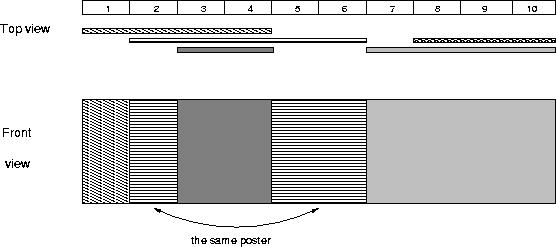
Sample Input
1

5

1 4

2 6

8 10

3 4

7 10
Sample Output
4

[线段树+离散化]

有关这道题的离散化我说一下,例如海报区间为[1,10],[1,4],[6,10],离散化后区间为[1,4],[1,2],[3,4],这样第一张海报就被覆盖掉了,实际上第一张并没有被覆盖。

解决方法就是在[1,10]中间加一个[1,2]&[2,10]这样离散化就会出现一个新的离散化区间。

但下面的标程是luogu的3740,poj的只需要修改一下。
#include<cmath>

#include<cstdio>

#include<algorithm>

using namespace std;

const int N=,M=;

int n,m,Ans,A[M],B[M];

bool flag,colored[N<<];

int read()

{

    int now=;char c=getchar();

    while(c<''||c>'')c=getchar();

    while(c>=''&&c<='')now=(now<<)+(now<<)+c-'',c=getchar();

    return now;

}

void PushUp(int rt)

{

    colored[rt]= colored[rt<<]&&colored[rt<<|];

}

void Modify(int l,int r,int rt,int L,int R)

{

    if(colored[rt]) return;

    if(L<=l && r<=R)

    {

        flag=;colored[rt]=;

        return;

    }

    int m=(l+r)>>;

    if(L<=m) Modify(l,m,rt<<,L,R);

    if(m<R) Modify(m+,r,rt<<|,L,R);

    PushUp(rt);

}

int main()

{

    n=read();m=read();

    for(int i=;i<=m;i++)

      A[i]=read(),B[i]=read();

    for(int i=m;i>=;i--)

    {

        flag=;

        Modify(,n,,A[i],B[i]);

        if(flag) ++Ans;

    }

    printf("%d",Ans);

    return ;

}
[POJ2528]Mayor's posters(离散化+线段树)的更多相关文章
- 【POJ】2528 Mayor's posters ——离散化+线段树
Mayor's posters Time Limit: 1000MS Memory Limit: 65536K Description The citizens of Bytetown, A ...
- POJ-2528 Mayor's posters(线段树区间更新+离散化)
http://poj.org/problem?id=2528 https://www.luogu.org/problem/UVA10587 Description The citizens of By ...
- POJ-2528 Mayor's posters (线段树区间更新+离散化)
题目分析:线段树区间更新+离散化 代码如下: # include<iostream> # include<cstdio> # include<queue> # in ...
- POJ2528 Mayor's posters(线段树+离散化)
题意 : 在墙上贴海报, n(n<=10000)个人依次贴海报,给出每张海报所贴的范围li,ri(1<=li<=ri<=10000000).求出最后还能看见多少张海报. 分析 ...
- Mayor's posters(离散化线段树)
Mayor's posters Time Limit: 1000MS Memory Limit: 65536K Total Submissions: 54067 Accepted: 15713 ...
- poj2528 Mayor's posters (线段树+离散化)
恩,这区间范围挺大的,需要离散化.如果TLE,还需要优化一下常数. AC代码 #include <stdio.h> #include <string.h> #include & ...
- POJ2528 Mayor's posters(线段树&区间更新+离散化)题解
题意:给一个区间,表示这个区间贴了一张海报,后贴的会覆盖前面的,问最后能看到几张海报. 思路: 之前就不会离散化,先讲一下离散化:这里离散化的原理是:先把每个端点值都放到一个数组中并除重+排序,我们就 ...
- POJ2528 Mayor's posters(线段树染色问题+离散化)
题目大意:有t组数据,每组数据给你n张海报(1<=n<=10000),下面n组数据分别给出每张海报的左右范围(1 <= l <= r <= 10000000),下一张海报 ...
- poj2528 Mayor's posters【线段树】
The citizens of Bytetown, AB, could not stand that the candidates in the mayoral election campaign h ...
- POJ-2528 Mayor's posters (离散化, 线段树)
题目传送门: POJ-2528 题意就是在一个高度固定的墙面上贴高度相同宽度不同的海报,问贴到最后还能看到几张?本质上是线段树区间更新问题,但是要注意的是题中所给数据范围庞大,直接搞肯定会搞出问题,所 ...
随机推荐
- 草地排水 改了又改(DCOJ6013)
题目描述 在农夫约翰的农场上,每逢下雨,贝茜最喜欢的三叶草地就积聚了一潭水.这意味着草地被水淹没了,并且小草要继续生长还要花相当长一段时间.因此,农夫约翰修建了一套排水系统来使贝茜的草地免除被大水淹没 ...
- @RequestBody对象为空,异常Required request body is missing错误解决
1.异常 org.springframework.http.converter.HttpMessageNotReadableException: Required request body is mi ...
- oracle copy
用法: COPY FROM <db> TO <db> <opt> <table> {(<cols>)} USING <sel> ...
- Ubuntu修改root密码,ssh 允许root用户登录
1,切换为root用户 2,passwd root(or others) 3,输两次密码 4,重启. ssh允许root用户登录: 1,vim /etc/ssh/sshd_config 2,修改Per ...
- Dataphin公共云重磅发布,提供一站式智能数据构建与管理能
点击订阅新品发布会! 新产品.新版本.新技术.新功能.价格调整,评论在下方,下期更新!关注更多内容,了解更多 最新发布 Dataphin公共云重磅发布 2019年6月26日15时,阿里云Dataphi ...
- Java版各种排序算法 (冒泡,快速,选择,插入)
package com.test4; import java.util.*; //Calendar 显示时间 /** * @author qingfeng * 功能:排序算法 */ public cl ...
- iOS开发那些事-响应内存警告
好的应用应该在系统内存警告情况下释放一些可以重新创建的资源.在iOS中我们可以在应用程序委托对象.视图控制器以及其它类中获得系统内存警告消息. 1.应用程序委托对象 在应用程序委托对象中接收内存警告消 ...
- oracle使用TKPROF 工具来查询SQL性能状态
SQL trace 工具收集正在执行的SQL的性能状态数据并记录到一个跟踪文件中. 这个跟踪文件提供了许多有用的信息,例如解析次数.执行次数,CPU使用时间等.这些数据将可以用来优化你的系统. 设置S ...
- [转]Netty实现原理浅析
Netty是JBoss出品的高效的Java NIO开发框架,关于其使用,可参考我的另一篇文章netty使用初步.本文将主要分析Netty实现方面的东西,由于精力有限,本人并没有对其源码做了极细致的研 ...
- Python--day70--ORM查询练习
ORM查询练习: import os import sys if __name__ == '__main__': # 加载Djang00项目的配置信息 os.environ.setdefault(&q ...