
TensorFlow从入门到理解(三):你的第一个卷积神经网络(CNN)
运行代码:
from __future__ import print_function

import tensorflow as tf

from tensorflow.examples.tutorials.mnist import input_data

# number 1 to 10 data

mnist = input_data.read_data_sets('MNIST_data', one_hot=True)

def compute_accuracy(v_xs, v_ys):

    global prediction

    y_pre = sess.run(prediction, feed_dict={xs: v_xs, keep_prob: 1})

    correct_prediction = tf.equal(tf.argmax(y_pre,1), tf.argmax(v_ys,1))

    accuracy = tf.reduce_mean(tf.cast(correct_prediction, tf.float32))

    result = sess.run(accuracy, feed_dict={xs: v_xs, ys: v_ys, keep_prob: 1})

    return result

def weight_variable(shape):

    initial = tf.truncated_normal(shape, stddev=0.1)

    return tf.Variable(initial)

def bias_variable(shape):

    initial = tf.constant(0.1, shape=shape)

    return tf.Variable(initial)

def conv2d(x, W):

    # stride [1, x_movement, y_movement, 1]

    # Must have strides[0] = strides[3] = 1

    return tf.nn.conv2d(x, W, strides=[1, 1, 1, 1], padding='SAME')

def max_pool_2x2(x):

    # stride [1, x_movement, y_movement, 1]

    return tf.nn.max_pool(x, ksize=[1,2,2,1], strides=[1,2,2,1], padding='SAME')

# define placeholder for inputs to network

xs = tf.placeholder(tf.float32, [None, 784])/255.   # 28x28

ys = tf.placeholder(tf.float32, [None, 10])

keep_prob = tf.placeholder(tf.float32)

x_image = tf.reshape(xs, [-1, 28, 28, 1])

# print(x_image.shape)  # [n_samples, 28,28,1]

## conv1 layer ##

W_conv1 = weight_variable([5,5, 1,32]) # patch 5x5, in size 1, out size 32

b_conv1 = bias_variable([32])

h_conv1 = tf.nn.relu(conv2d(x_image, W_conv1) + b_conv1) # output size 28x28x32

h_pool1 = max_pool_2x2(h_conv1) # output size 14x14x32

## conv2 layer ##

W_conv2 = weight_variable([5,5, 32, 64]) # patch 5x5, in size 32, out size 64

b_conv2 = bias_variable([64])

h_conv2 = tf.nn.relu(conv2d(h_pool1, W_conv2) + b_conv2) # output size 14x14x64

h_pool2 = max_pool_2x2(h_conv2) # output size 7x7x64

## fc1 layer ##

W_fc1 = weight_variable([7*7*64, 1024])

b_fc1 = bias_variable([1024])

# [n_samples, 7, 7, 64] ->> [n_samples, 7*7*64]

h_pool2_flat = tf.reshape(h_pool2, [-1, 7*7*64])

h_fc1 = tf.nn.relu(tf.matmul(h_pool2_flat, W_fc1) + b_fc1)

h_fc1_drop = tf.nn.dropout(h_fc1, keep_prob)

## fc2 layer ##

W_fc2 = weight_variable([1024, 10])

b_fc2 = bias_variable([10])

prediction = tf.nn.softmax(tf.matmul(h_fc1_drop, W_fc2) + b_fc2)

# the error between prediction and real data

cross_entropy = tf.reduce_mean(-tf.reduce_sum(ys * tf.log(prediction),reduction_indices=[1]))

train_step = tf.train.AdamOptimizer(1e-4).minimize(cross_entropy)

sess = tf.Session()

# important step

init = tf.global_variables_initializer()

sess.run(init)

for i in range(1000):

    batch_xs, batch_ys = mnist.train.next_batch(100)

    sess.run(train_step, feed_dict={xs: batch_xs, ys: batch_ys, keep_prob: 0.5})

    if i % 50 == 0:

        print(compute_accuracy(

            mnist.test.images[:1000], mnist.test.labels[:1000]))
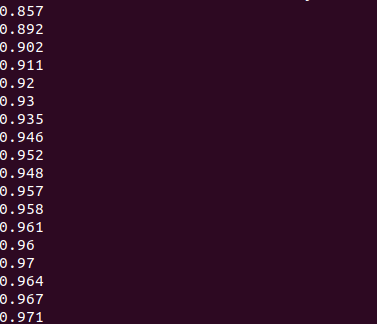
运行结果(本人电脑太差,准确度出现了下滑的问题):
TensorFlow从入门到理解(三):你的第一个卷积神经网络(CNN)的更多相关文章
- TensorFlow从入门到理解
一.<莫烦Python>学习笔记: TensorFlow从入门到理解(一):搭建开发环境[基于Ubuntu18.04] TensorFlow从入门到理解(二):你的第一个神经网络 Tens ...
- 卷积神经网络(CNN)学习笔记1:基础入门
卷积神经网络(CNN)学习笔记1:基础入门 Posted on 2016-03-01 | In Machine Learning | 9 Comments | 14935 Vie ...
- 深度学习之卷积神经网络CNN及tensorflow代码实例
深度学习之卷积神经网络CNN及tensorflow代码实例 什么是卷积? 卷积的定义 从数学上讲,卷积就是一种运算,是我们学习高等数学之后,新接触的一种运算,因为涉及到积分.级数,所以看起来觉得很复杂 ...
- 深度学习之卷积神经网络CNN及tensorflow代码实现示例
深度学习之卷积神经网络CNN及tensorflow代码实现示例 2017年05月01日 13:28:21 cxmscb 阅读数 151413更多 分类专栏: 机器学习 深度学习 机器学习 版权声明 ...
- 卷积神经网络CNN原理以及TensorFlow实现
在知乎上看到一段介绍卷积神经网络的文章,感觉讲的特别直观明了,我整理了一下.首先介绍原理部分. [透析] 卷积神经网络CNN究竟是怎样一步一步工作的? 通过一个图像分类问题介绍卷积神经网络是如何工作的 ...
- TensorFlow 2.0 深度学习实战 —— 浅谈卷积神经网络 CNN
前言 上一章为大家介绍过深度学习的基础和多层感知机 MLP 的应用,本章开始将深入讲解卷积神经网络的实用场景.卷积神经网络 CNN(Convolutional Neural Networks,Conv ...
- 【原创 深度学习与TensorFlow 动手实践系列 - 4】第四课:卷积神经网络 - 高级篇
[原创 深度学习与TensorFlow 动手实践系列 - 4]第四课:卷积神经网络 - 高级篇 提纲: 1. AlexNet:现代神经网络起源 2. VGG:AlexNet增强版 3. GoogleN ...
- TensorFlow从1到2(三)数据预处理和卷积神经网络
数据集及预处理 从这个例子开始,相当比例的代码都来自于官方新版文档的示例.开始的几个还好,但随后的程序都将需要大量的算力支持.Google Colab是一个非常棒的云端实验室,提供含有TPU/GPU支 ...
- 深度学习:Keras入门(二)之卷积神经网络(CNN)
说明:这篇文章需要有一些相关的基础知识,否则看起来可能比较吃力. 1.卷积与神经元 1.1 什么是卷积? 简单来说,卷积(或内积)就是一种先把对应位置相乘然后再把结果相加的运算.(具体含义或者数学公式 ...
- 深度学习:Keras入门(二)之卷积神经网络(CNN)【转】
本文转载自:https://www.cnblogs.com/lc1217/p/7324935.html 说明:这篇文章需要有一些相关的基础知识,否则看起来可能比较吃力. 1.卷积与神经元 1.1 什么 ...
随机推荐
- java 不定长参数
一,不定长参数的规定 一个方法只能有一个不定长参数,并且这个不定长参数必须是该方法的最后一个参数. 示例: public class VariArgs { public static void mai ...
- Git中撤销提交
Git的几种状态 未修改 原始内容 已修改 ↓ 工 作 区 已暂存 ↓ git add 暂 存 区 已提交 ↓ git commit 本地仓库 已推送 ↓ git push 远程仓库 注意:下面所有命 ...
- 【洛谷P1059 明明的随机数】
题目描述明明想在学校中请一些同学一起做一项问卷调查,为了实验的客观性,他先用计算机生成了N个1到1000之间的随机整数(N≤100),对于其中重复的数字,只保留一个,把其余相同的数去掉,不同的数对应着 ...
- Nginx.conf配置文件参数说明与优化
参考连接:nginx 核心配置优化详解 先说下优化 1.nginx运行工作进程个数 worker_processes 1; Nginx进程,一般设置为和cpu核数一样(nginx启动后有多少个wor ...
- 第十六篇-使用CheckBox实现多项选择
话不多说,先上效果图 屏幕截图方法,全屏截图按键盘print screen就行,活动窗口截图,按住ALT+print screen. 图片默认保存在home/picture路径下.可以通过自带的图片处 ...
- 第五篇 - Selenium突破反爬获取qq邮件标题
from selenium import webdriver from selenium.webdriver import ActionChains #1.打开登陆页面 wd = webdriver. ...
- 生产环境Linux常用命令【随时更新】
1. 查询文件中的关键字并高亮显示[查询当前目录关键字为elasticsearch的日志文件] find ./ -name "my-elasticsearch.log" | xar ...
- IDEA或Webstorm设置Ctrl+滚轮调整字体大小
按Ctrl+Shift+A,出现搜索框 输入mouse: 点击打开这个设置:勾选 点击ok,之后就可以通过Ctrl+滚轮 调整字体大小了.
- 过滤富文本编辑器中的html元素和其他元素
https://blog.csdn.net/fjssharpsword/article/details/53467079 1.应用场景:从一份html文件中或从String(是html内容)中提取纯文 ...
- vue购物车和地址选配(三)
参考资料:vue.js官网 项目演示: 项目源代码: 核心代码及踩坑 删除: new Vue({ el:'#app', data:{ productlist:[], totalMoney:0, che ...