
pg_stat_statements源代码分析
磨砺技术珠矶,践行数据之道,追求卓越价值
回到上一级页面:PostgreSQL内部结构与源代码研究索引页 回到顶级页面:PostgreSQL索引页
pg_stat_statement的源代码,非常地有示范意义。其中使用了各种hook,同时又定义为extension。
先看初始化是如何发生的:
在postgresql.conf里,如果有 preload_shared_libraries='pg_stat_statements',那么成功启动的时候,会提示:
[root@server ~]# su - postgres

[postgres@server ~]$ cd /usr/local/pgsql

[postgres@server pgsql]$ ./bin/pg_ctl -D ./data start

server starting

[postgres@server pgsql]$ LOG:  loaded library "pg_stat_statements"

LOG:  database system was shut down at -- :: CST

LOG:  autovacuum launcher started

LOG:  database system is ready to accept connections
在这个时刻(具体说是loaded library "pg_stat_statements"信息提示之前,会执行 pg_stat_statements的_PG_init函数完成初始化):初始化过程中准备好了各式hook。
/*

 * Module load callback

 */

void

_PG_init(void)

{

    …

    /*

     * Install hooks.

     */

    prev_shmem_startup_hook = shmem_startup_hook;

    shmem_startup_hook = pgss_shmem_startup;

    prev_ExecutorStart = ExecutorStart_hook;

    ExecutorStart_hook = pgss_ExecutorStart;

    prev_ExecutorRun = ExecutorRun_hook;

    ExecutorRun_hook = pgss_ExecutorRun;

    prev_ExecutorFinish = ExecutorFinish_hook;

    ExecutorFinish_hook = pgss_ExecutorFinish;

    prev_ExecutorEnd = ExecutorEnd_hook;

    ExecutorEnd_hook = pgss_ExecutorEnd;

    prev_ProcessUtility = ProcessUtility_hook;

    ProcessUtility_hook = pgss_ProcessUtility;

}
从整体上来看,画一个图来描述,从执行的角度而言,加挂了hook之后,在postmaster是这样的:
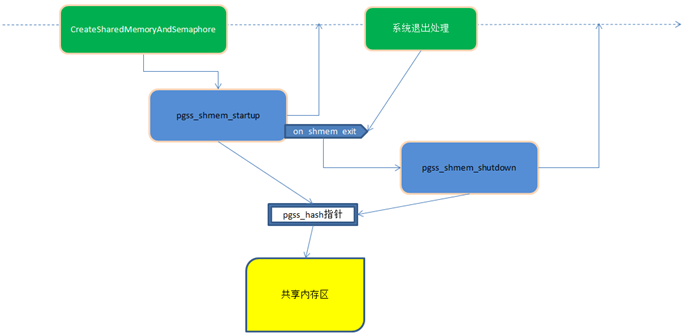
在上图中,Postmaster进程启动之后,当发现有shmem_startup_hook的时候,会去执行此hook函数,这里挂的是
pgss_shmem_startup函数,故此函数被执行,然后返回。
在pgss_shmem_startup中,在shared memory中,建立一个hashtable,由pgss_hash指针来指向。此后,postmaster的各子进程,可以通过此pgss_hash指针,来使用此hashtable存取sql语句执行的信息。
再来看sql问执行时,发生了什么:
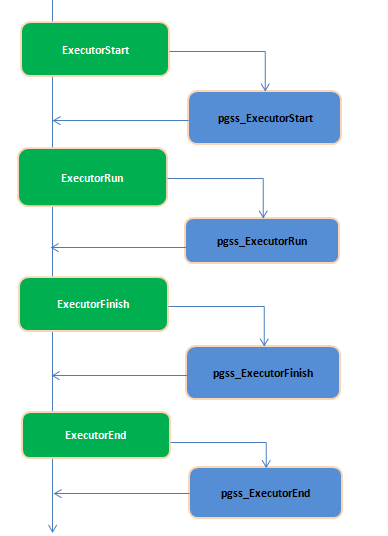
对于处理用户请求的,Postmaster的各子进程,加挂了hook后,当用户执行一条SELETE/INSERT/UPDATE/DELETE的SQ文的时候,执行计划确定后,执行过程是这样的:
而对于 SELETE/INSERT/UPDATE/DELETE 之外的语句(Utility Command:例:create table),执行过程是这样的:
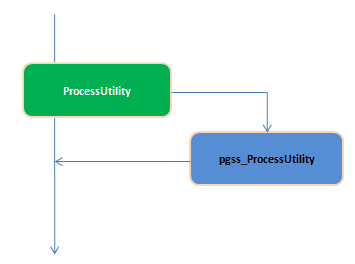
从代码上,可以比较清楚地看到pgss_ProcessUtility是如何发生的:
void

ProcessUtility(Node *parsetree, const char *queryString,ParamListInfo params,  bool isTopLevel,

                           DestReceiver *dest, char *completionTag)

{

        Assert(queryString != NULL);    /* required as of 8.4 */

        /*

         * We provide a function hook variable that lets loadable plugins get

         * control when ProcessUtility is called.  Such a plugin would normally

         * call standard_ProcessUtility().

         */

        if (ProcessUtility_hook)

                (*ProcessUtility_hook) (parsetree, queryString, params,

                                                                isTopLevel, dest, completionTag);

        else

                standard_ProcessUtility(parsetree, queryString, params,

                                                                isTopLevel, dest, completionTag);

}
其余的hook发生过程都与此类似。
那么sql文执行的数据,是如何收集的呢?看如下代码的概要:
执行到pgss_ExecutorEnd的时候,调用了pgss_store来存储sql运行信息到共享内存的hash表里:
/*

 * ExecutorEnd hook: store results if needed

 */

static void

pgss_ExecutorEnd(QueryDesc *queryDesc)

{

    if (queryDesc->totaltime && pgss_enabled())

    {

        /*

         * Make sure stats accumulation is done.  (Note: it's okay if several

         * levels of hook all do this.)

         */

        InstrEndLoop(queryDesc->totaltime);

        pgss_store(queryDesc->sourceText,queryDesc->totaltime->total,

                   queryDesc->estate->es_processed,  &queryDesc->totaltime->bufusage);

    }

    if (prev_ExecutorEnd)

        prev_ExecutorEnd(queryDesc);

    else

        standard_ExecutorEnd(queryDesc);

}
而pgss_store函数的概要,大致如下:
/*

 * Store some statistics for a statement.

 */

static void

pgss_store(const char *query, double total_time, uint64 rows,

           const BufferUsage *bufusage)

{

    pgssHashKey         key;

    double        usage;

    pgssEntry  *entry;

    Assert(query != NULL);

    /* Safety check... */

    if (!pgss || !pgss_hash)

        return;

    /* Set up key for hashtable search */

    key.userid = GetUserId();

    key.dbid = MyDatabaseId;

    key.encoding = GetDatabaseEncoding();

    key.query_len = strlen(query);

    if (key.query_len >= pgss->query_size)

        key.query_len = pg_encoding_mbcliplen(key.encoding,

                              query,

                              key.query_len,

                              pgss->query_size - );

    key.query_ptr = query;

    usage = USAGE_EXEC(duration);

    /* Lookup the hash table entry with shared lock. */

    LWLockAcquire(pgss->lock, LW_SHARED);

    entry = (pgssEntry *) hash_search(pgss_hash, &key, HASH_FIND, NULL);

    if (!entry)

    {

        /* Must acquire exclusive lock to add a new entry. */

        LWLockRelease(pgss->lock);

        LWLockAcquire(pgss->lock, LW_EXCLUSIVE);

        entry = entry_alloc(&key);

    }

    /* Grab the spinlock while updating the counters. */

    {

        volatile pgssEntry *e = (volatile pgssEntry *) entry;

        SpinLockAcquire(&e->mutex);

        e->counters.calls += 1;

        e->counters.total_time += total_time;

        e->counters.rows += rows;

        e->counters.shared_blks_hit += bufusage->shared_blks_hit;

        e->counters.shared_blks_read += bufusage->shared_blks_read;

        e->counters.shared_blks_written += bufusage->shared_blks_written;

        e->counters.local_blks_hit += bufusage->local_blks_hit;

        e->counters.local_blks_read += bufusage->local_blks_read;

        e->counters.local_blks_written += bufusage->local_blks_written;

        e->counters.temp_blks_read += bufusage->temp_blks_read;

        e->counters.temp_blks_written += bufusage->temp_blks_written;

        e->counters.usage += usage;

        SpinLockRelease(&e->mutex);

    }

    LWLockRelease(pgss->lock);

}
如果把上述e->counters的各个组成部分和定义,与下面的pg_stat_statements的文档资料对比,可以发现它们完全一致:
http://www.postgresql.org/docs/9.1/static/pgstatstatements.html
/*

 * Statistics per statement

 *

 * NB: see the file read/write code before changing field order here.

 */

typedef struct pgssEntry

{

    pgssHashKey key;                /* hash key of entry - MUST BE FIRST */

    Counters    counters;            /* the statistics for this query */

    slock_t        mutex;        /* protects the counters only */

    char        query[];        /* VARIABLE LENGTH ARRAY - MUST BE LAST */

    /* Note: the allocated length of query[] is actually pgss->query_size */

} pgssEntry;
/*

 * The actual stats counters kept within pgssEntry.

 */

typedef struct Counters

{

    int64        calls;            /* # of times executed */

    double        total_time;            /* total execution time in seconds */

    int64        rows;            /* total # of retrieved or affected rows */

    int64        shared_blks_hit;            /* # of shared buffer hits */

    int64        shared_blks_read;            /* # of shared disk blocks read */

    int64        shared_blks_written;            /* # of shared disk blocks written */

    int64        local_blks_hit;             /* # of local buffer hits */

    int64        local_blks_read;            /* # of local disk blocks read */

    int64        local_blks_written;            /* # of local disk blocks written */

    int64        temp_blks_read;             /* # of temp blocks read */

    int64        temp_blks_written;            /* # of temp blocks written */

    double        usage;            /* usage factor */

} Counters;
/*

 * Hashtable key that defines the identity of a hashtable entry.  The

 * hash comparators do not assume that the query string is null-terminated;

 * this lets us search for an mbcliplen'd string without copying it first.

 *

 * Presently, the query encoding is fully determined by the source database

 * and so we don't really need it to be in the key.  But that might not always

 * be true. Anyway it's notationally convenient to pass it as part of the key.

 */

typedef struct pgssHashKey

{

    Oid            userid;        /* user OID */

    Oid            dbid;        /* database OID */

    int            encoding;        /* query encoding */

    int            query_len;        /* # of valid bytes in query string */

    const char *query_ptr;                    /* query string proper */

} pgssHashKey;
再:看看建立extension时使用的脚本,也是一致的:
CREATE FUNCTION pg_stat_statements(

    OUT userid oid,

    OUT dbid oid,

    OUT query text,

    OUT calls int8,

    OUT total_time float8,

    OUT rows int8,

    OUT shared_blks_hit int8,

    OUT shared_blks_read int8,

    OUT shared_blks_written int8,

    OUT local_blks_hit int8,

    OUT local_blks_read int8,

    OUT local_blks_written int8,

    OUT temp_blks_read int8,

    OUT temp_blks_written int8

)

RETURNS SETOF record

AS 'MODULE_PATHNAME'

LANGUAGE C;
那么,在pg_stat_statements的hook函数中,保存在hash表里的sql文执行信息,是如何通过
类似于 select * from pg_stat_statemens的语句取得的呢?这是因为 此extension的定义和实现:
Datum        pg_stat_statements_reset(PG_FUNCTION_ARGS);

Datum        pg_stat_statements(PG_FUNCTION_ARGS);

PG_FUNCTION_INFO_V1(pg_stat_statements_reset);

PG_FUNCTION_INFO_V1(pg_stat_statements);
在pg_stat_statements函数中,从hash表中取出了所有数据:
/*

 * Retrieve statement statistics.

 */

Datum

pg_stat_statements(PG_FUNCTION_ARGS)

{

    ...

    MemoryContextSwitchTo(oldcontext);

    LWLockAcquire(pgss->lock, LW_SHARED);

    hash_seq_init(&hash_seq, pgss_hash);

    while (      (entry = hash_seq_search(&hash_seq)) != NULL      )

    {

        Datum        values[PG_STAT_STATEMENTS_COLS];

        bool        nulls[PG_STAT_STATEMENTS_COLS];

        int            i = ;

        Counters        tmp;

        memset(values, , sizeof(values));

        memset(nulls, , sizeof(nulls));

        values[i++] = ObjectIdGetDatum(entry->key.userid);

        values[i++] = ObjectIdGetDatum(entry->key.dbid);

        if (is_superuser || entry->key.userid == userid)

        {

            char       *qstr;

            qstr = (char *)

                pg_do_encoding_conversion((unsigned char *) entry->query,

                                  entry->key.query_len,

                                  entry->key.encoding,

                                  GetDatabaseEncoding());

            values[i++] = CStringGetTextDatum(qstr);

            if (qstr != entry->query)

                pfree(qstr);

        }

        else

            values[i++] = CStringGetTextDatum("<insufficient privilege>");

        /* copy counters to a local variable to keep locking time short */

        {

            volatile pgssEntry *e = (volatile pgssEntry *) entry;

            SpinLockAcquire(&e->mutex);

            tmp = e->counters;

            SpinLockRelease(&e->mutex);

        }

        values[i++] = Int64GetDatumFast(tmp.calls);

        values[i++] = Float8GetDatumFast(tmp.total_time);

        values[i++] = Int64GetDatumFast(tmp.rows);

        values[i++] = Int64GetDatumFast(tmp.shared_blks_hit);

        values[i++] = Int64GetDatumFast(tmp.shared_blks_read);

        values[i++] = Int64GetDatumFast(tmp.shared_blks_written);

        values[i++] = Int64GetDatumFast(tmp.local_blks_hit);

        values[i++] = Int64GetDatumFast(tmp.local_blks_read);

        values[i++] = Int64GetDatumFast(tmp.local_blks_written);

        values[i++] = Int64GetDatumFast(tmp.temp_blks_read);

        values[i++] = Int64GetDatumFast(tmp.temp_blks_written);

        Assert(i == PG_STAT_STATEMENTS_COLS);

        tuplestore_putvalues(tupstore, tupdesc, values, nulls);

    }

    LWLockRelease(pgss->lock);

    /* clean up and return the tuplestore */

    tuplestore_donestoring(tupstore);

    return (Datum) ;

}
分析到此结束!
回到上一级页面:PostgreSQL内部结构与源代码研究索引页 回到顶级页面:PostgreSQL索引页
磨砺技术珠矶,践行数据之道,追求卓越价值
pg_stat_statements源代码分析的更多相关文章
- android-plugmgr源代码分析
android-plugmgr是一个Android插件加载框架,它最大的特点就是对插件不需要进行任何约束.关于这个类库的介绍见作者博客,市面上也有一些插件加载框架,但是感觉没有这个好.在这篇文章中,我 ...
- Twitter Storm源代码分析之ZooKeeper中的目录结构
徐明明博客:Twitter Storm源代码分析之ZooKeeper中的目录结构 我们知道Twitter Storm的所有的状态信息都是保存在Zookeeper里面,nimbus通过在zookeepe ...
- 转:SDL2源代码分析
1:初始化(SDL_Init()) SDL简介 有关SDL的简介在<最简单的视音频播放示例7:SDL2播放RGB/YUV>以及<最简单的视音频播放示例9:SDL2播放PCM>中 ...
- 转:RTMPDump源代码分析
0: 主要函数调用分析 rtmpdump 是一个用来处理 RTMP 流媒体的开源工具包,支持 rtmp://, rtmpt://, rtmpe://, rtmpte://, and rtmps://. ...
- 转:ffdshow 源代码分析
ffdshow神奇的功能:视频播放时显示运动矢量和QP FFDShow可以称得上是全能的解码.编码器.最初FFDShow只是mpeg视频解码器,不过现在他能做到的远不止于此.它能够解码的视频格式已经远 ...
- UiAutomator源代码分析之UiAutomatorBridge框架
上一篇文章<UIAutomator源代码分析之启动和执行>我们描写叙述了uitautomator从命令行执行到载入測试用例执行測试的整个流程.过程中我们也描写叙述了UiAutomatorB ...
- MyBatis架构设计及源代码分析系列(一):MyBatis架构
如果不太熟悉MyBatis使用的请先参见MyBatis官方文档,这对理解其架构设计和源码分析有很大好处. 一.概述 MyBatis并不是一个完整的ORM框架,其官方首页是这么介绍自己 The MyBa ...
- hostapd源代码分析(三):管理帧的收发和处理
hostapd源代码分析(三):管理帧的收发和处理 原文链接:http://blog.csdn.net/qq_21949217/article/details/46004379 这篇文章我来讲解一下h ...
- hostapd源代码分析(二):hostapd的工作机制
[转]hostapd源代码分析(二):hostapd的工作机制 原文链接:http://blog.csdn.net/qq_21949217/article/details/46004433 在我的上一 ...
随机推荐
- apache2.2+php5.3+mysql5.5+Zend Guard Loader集成包
由前一篇文章 http://www.cnblogs.com/darktime/p/3407980.html 我就配置了一个环境包,免安装的,只需要运行一个.bat的文件文件就算安装成功了 如果你需要用 ...
- 分享:将WDCP中的PHP5.2 1.7升级到PHP 5.3的方法
将wdcp中php 5.2.17升级到php 5.3方法: 1.首先下载wdcp php5.3升级脚本 wget http://down.wdlinux.cn/in/php_up53.sh 2.进行安 ...
- UITableView中cell里的UITextField不被弹出键盘挡住
UITableView中cell里的UITextField不被弹出键盘挡住 本人视频教程系类 iOS中CALayer的使用 效果如下: 源码: EditCell.h 与 EditCell.m // ...
- 归并排序(php实现)
<?php function mergeSort(&$arr){ $len = count($arr); msort($arr,0,$len-1); } function msort(& ...
- C# 词法分析器(一)词法分析介绍
系列导航 (一)词法分析介绍 (二)输入缓冲和代码定位 (三)正则表达式 (四)构造 NFA (五)转换 DFA (六)构造词法分析器 (七)总结 虽然文章的标题是词法分析,但首先还是要从编译原理说开 ...
- Echarts 曲线数少于图例数解决方法
在上一篇文章 Echarts 多曲线“断点”问题解决方法 中说到了Angular 项目中要使用 Echarts 的方法. 说明了自己解决当“每一条曲线的横坐标不相同”时,在各条曲线上,它们的值采用数组 ...
- __autoreleasing 与 局部变量
__autoreleasing 修饰的变量不是局部变量: 它的生命周期由autoreleasepool负责: +(Reachability*)reachabilityWithHostname:(NSS ...
- RLE Iterator LT900
Write an iterator that iterates through a run-length encoded sequence. The iterator is initialized b ...
- 《信息安全技术》实验一 PGP的原理与使用
<信息安全技术>实验一 PGP的原理与使用(macOS High Sierra下实现) 实验目的 理解传统加密.公钥加密.混合加密.数字签名等概念 理解公钥.私钥.会话密钥.对称密钥等概念 ...
- 《Java程序设计》第12周课堂实践总结
<Java程序设计>第12周课堂实践总结 实践一 教材代码检查-p98 要求 修改教材P98 Score2.java, 让执行结果数组填充是自己的学号: 提交在IDEA或命令行中运行结查截 ...