
Vehicle’s communication protocol
http://www.crecorder.com/techInfo/commuProtocols.jsp
|
COMMUNICATION PROTOCOLS
A “communication protocol” is a means by which data is exchanged between the vehicle’s on-board computer and an external data retrieval device, such as a Code Reader or Scan Tool. The SAE has defined three distinct communication protocol “classifications,” based on the speed at which data transfer takes place:
Currently, five communication protocols are defined for use in OBD2 computer control systems. An OBD2-compliant vehicle will employ one of the following protocols:
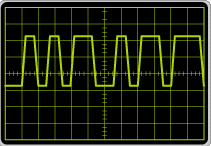
ISO 9141-2 Classification: A Commonly Used On: European, Asian, and some Chrysler Description: The ISO 9141-2 protocol is essentially a serial interface, similar to the RS232 interface found in personal computers. The ISO 9141-2 data bus can be implemented as either a single-wire or two-wire interface (DLC pins 7 and 15) with a data transfer speed of up to 10.4 Kb/s. The “K” line (pin 7) is a bidirectional line. During initialization, this line carries address information or (in the case of fast initialization), the “wake up” pattern from the Code Reader or Scan Tool to the vehicle’s computer. After initialization, bidirectional data flow between the Code Reader or Scan Tool and the vehicle’s computer takes place over the “K” line. The “L” line (pin 15) is a unidirectional line (from the Code Reader or Scan Tool to the vehicle’s computer). It is used only during initialization to carry address information or (in the case of fast initialization), the “wake up” pattern from the Code Reader or Scan Tool to the vehicle’s computer simultaneously with the “K” line. After initialization, the “L” line is held in a “high” (logic “1”) state. The ISO 9141-2 data signal is a square wave of uniform frequency, with a varying voltage level (either +12VDC or 0VDC), as illustrated.
ISO 14230-4 KW 2000 Classification: A Commonly Used On: European, Asian, and some Chrysler Description: The ISO 14230-4 KW 2000 protocol is a variation of the ISO 9141-2 protocol, complying with the specific requirements of ISO 14230-2 and ISO 14230 Parts 2 and 3. The ISO ISO 14230-4 data bus can be implemented as either a single-wire or two-wire interface (DLC pins 7 and 15) with a data transfer speed of up to 10.4 Kb/s. The “K” line (pin 7) is a bidirectional line. During initialization, this line carries address information or (in the case of fast initialization), the “wake up” pattern from the Code Reader or Scan Tool to the vehicle’s computer. After initialization, bidirectional data flow between the Code Reader or Scan Tool and the vehicle’s computer takes place over the “K” line. The “L” line (pin 15) is a unidirectional line (from the Code Reader or Scan Tool to the vehicle’s computer). It is used only during initialization to carry address information or (in the case of fast initialization), the “wake up” pattern from the Code Reader or Scan Tool to the vehicle’s computer simultaneously with the “K” line. After initialization, the “L” line is held in a “high” (logic “1”) state. The ISO 14230-4 KW 2000 data signal is a square wave of uniform frequency, with a varying voltage level (either +12VDC or 0VDC), as illustrated.
SAE J1850 (VPW 10.4K) Classification: B Commonly Used On: Chrysler and General Motors Description: The SAE J1850 (VPW 10.4K) data bus is implemented as a single-wire bidirectional interface (DLC pin 2), with a data transfer speed of 10.4 Kb/s. The data signal is a series of pulses of uniform amplitude (7VDC) and variable pulse width (VPW), as illustrated.
SAE J1850 (PWM 41.6K) Classification: B Commonly Used On: Ford Description: The SAE J1850 (PWM 41.6K) protocol is implemented as a two-wire bidirectional interface (DLC pins 2 and 10) that supports data transfer rates of up to 41.6 Kb/s. The “+” (pin 2) and “-“ (pin 10) bus lines carry differential signals; that is, the signal on the “-“ line is an exact inversion of the signal on the “+” line. This implementation minimizes the effects of Radio Frequency Interference (RFI) or Electromagnetic Interference (EMI) on the data signal.
ISO 15765 CAN (Control Area Network) Classification: C Commonly Used On: Beginning in 2008, all new vehicles will be required to use the CAN protocol Description: The ISO 15765 CAN protocol is implemented as a two-wire bidirectional interface (DLC pins 6 and 14) that supports data transfer rates of up to 1 Mb/s. The “High” (pin 6) and “Low“ (pin 14) bus lines carry differential signals; that is, the signal on the “Low“ line is an exact inversion of the signal on the “High” line. This implementation minimizes the effects of Radio Frequency Interference (RFI) or Electromagnetic Interference (EMI) on the data signal.
|




Vehicle’s communication protocol的更多相关文章
- MySQL8.0.16新特性:The Communication Protocol In Group Replication
MGR优雅升级到MySQL8.0.16 传统的升级手段之一,5.7 MGR集群与8.0 MGR集群进行数据传输,程序切换新集群后测试是否正常. 如果不正常,要么将新集群的新增数据同步回旧集群,要么就舍 ...
- DB2 和 有道词典冲突: A communication error has been detected. Communication protocol being used: Reply.fill().
我在本机安装了DB2 9.5. 使用java jdbc连接,一直没有问题. QC for db2 连接 也一直没有问题. 突然有一天 Java程序连接 报错: A communication erro ...
- Serial Communication Protocol Design Hints And Reference
前面转载的几篇文章详细介绍了UART.RS-232和RS-485的相关内容,可以知道,串口通信的双方在硬件层面需要约定如波特率.数据位.校验位和停止位等属性,才可以正常收发数据.实际项目中使用串口通信 ...
- VPW Communication Protocol
http://www.fastfieros.com/tech/vpw_communication_protocol.htm Breakdown of the j1850 3 byte Header f ...
- 无线电源传输 Wireless Power Consortium (WPC) Communication
Universally Compatible Wireless Power Using the Qi Protocol Wireless charging of portable electronic ...
- Design Your Own Protocol In Five Minutes
https://mayaposch.wordpress.com/2011/10/03/design-your-own-protocol-in-five-minutes ---------------- ...
- 分布式计算 要不要把写日志独立成一个Server Remote Procedure Call Protocol
w https://en.wikipedia.org/wiki/Remote_procedure_call In distributed computing a remote procedure ca ...
- Introduction into ISO 27145 WWH-OBD
全球统一的重型发动机的车载诊断系统(WWH-OBD) ISO/PAS 27145 is intended to become the single communication standard for ...
- SAE/ISO standards for Automotive
On-Board Diagnostics J1962 Diagnostic Connector Equivalent to ISO/DIS 15031-3: December 14, 2001J201 ...
随机推荐
- linux 修改时间 - [命令操作]
我们一般使用“date -s”命令来修改系统时间.比如将系统时间设定成1996年6月10日的命令如下. #date -s 06/10/96 将系统时间设定成下午1点12分0秒的命令如下. #date ...
- [再寄小读者之数学篇](2014-11-19 $\tan x/x$ 在 $(0,\pi/2)$ 上递增)
$$\bex \frac{\tan x}{x}\nearrow. \eex$$ Ref. [Proof Without Words: Monotonicity of $\tan x/x$ on $(0 ...
- 使用Firebug和FirePHP调试PHP
大家都知道Firebug,可能不知大FirePHP,它也是FireFox插件用来调试PHP的,首先确保你安装了Firebug,然后再去安装FirePHP,这是你会看到Firebug多了一只蓝色的虫: ...
- 插件二之页面加载进度条pace.js
关于pace.js pace.js包含14样式,每种样式可以自定义颜色,官方下载中提供了几种颜色的主题,使用方式也很简单,引入pace的js文件跟所需样式文件即可 <link rel=" ...
- 在刚接触TI-DM8127-ipnc框架时注意的问题
1. 修改内存分配不成功? 解决方法: 修改内存分配后需要重新编译mcfw.它影响3个核. 如果修改了cmem需要修改boostara. 2. 命令make clean后在make相机跑不起来? 解决 ...
- C++设计模式——单例模式
问题描述 现在,不管开发一个多大的系统(至少我现在的部门是这样的),都会带一个日志功能:在实际开发过程中,会专门有一个日志模块,负责写日志,由于在系统的任何地方,我们都有可能要调用日志模块中的函数,进 ...
- JAVA分析html算法(JAVA网页蜘蛛算法)
近来有些朋友在做蜘蛛算法,或者在网页上面做深度的数据挖掘.但是遇到复杂而繁琐的html页面大家都望而却步.因为很难获取到相应的数据. 最古老的办法的是尝试用正则表达式,估计那么繁琐的东西得不偿失,浪费 ...
- html5 拖放到购物车
<!doctype html> <html> <head> <meta charset="utf-8"> <title> ...
- Android 横屏时禁止输入法全屏
在自己EditText的xml里加上属性 android:imeOptions="flagNoExtractUi"
- XE8 hash
c++builder xe8 hash calc md5.sha256.sha384.sha512 file and string sha256.sha384.sha512 must call l ...