
HeadFirst设计模式之模板方法模式
一、
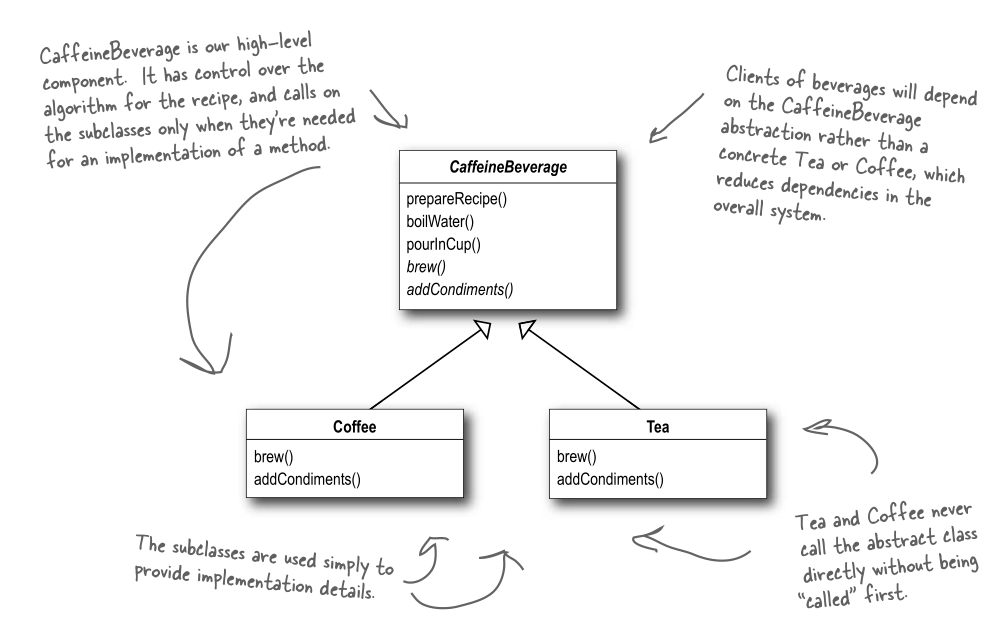
1.The Template Method defines the steps of an algorithm and allows subclasses to provide the implementation for one or more steps.
2.The Template Method Pattern defi nes the skeleton of an algorithm in a method, deferring some steps to subclasses. Template Method lets subclasses redefine certain steps of an algorithm without changing the algorithm’s structure.
3.With a hook, I can override the method, or not. It’s my choice.If I don’t, the abstract class provides a default implementation.

4.
二、


1.
 package headfirst.designpatterns.templatemethod.barista;

 public abstract class CaffeineBeverage {

     final void prepareRecipe() {

         boilWater();

         brew();

         pourInCup();

         addCondiments();

     }

     abstract void brew();

     abstract void addCondiments();

     void boilWater() {

         System.out.println("Boiling water");

     }

     void pourInCup() {

         System.out.println("Pouring into cup");

     }

 }
2.
 package headfirst.designpatterns.templatemethod.barista;

 public abstract class CaffeineBeverageWithHook {

     final void prepareRecipe() {

         boilWater();

         brew();

         pourInCup();

         if (customerWantsCondiments()) {

             addCondiments();

         }

     }

     abstract void brew();

     abstract void addCondiments();

     void boilWater() {

         System.out.println("Boiling water");

     }

     void pourInCup() {

         System.out.println("Pouring into cup");

     }

     boolean customerWantsCondiments() {

         return true;

     }

 }
3.
 package headfirst.designpatterns.templatemethod.barista;

 public class Coffee extends CaffeineBeverage {

     public void brew() {

         System.out.println("Dripping Coffee through filter");

     }

     public void addCondiments() {

         System.out.println("Adding Sugar and Milk");

     }

 }
4.
 package headfirst.designpatterns.templatemethod.barista;

 import java.io.*;

 public class CoffeeWithHook extends CaffeineBeverageWithHook {

     public void brew() {

         System.out.println("Dripping Coffee through filter");

     }

     public void addCondiments() {

         System.out.println("Adding Sugar and Milk");

     }

     public boolean customerWantsCondiments() {

         String answer = getUserInput();

         if (answer.toLowerCase().startsWith("y")) {

             return true;

         } else {

             return false;

         }

     }

     private String getUserInput() {

         String answer = null;

         System.out.print("Would you like milk and sugar with your coffee (y/n)? ");

         BufferedReader in = new BufferedReader(new InputStreamReader(System.in));

         try {

             answer = in.readLine();

         } catch (IOException ioe) {

             System.err.println("IO error trying to read your answer");

         }

         if (answer == null) {

             return "no";

         }

         return answer;

     }

 }
5.
 package headfirst.designpatterns.templatemethod.barista;

 public class Tea extends CaffeineBeverage {

     public void brew() {

         System.out.println("Steeping the tea");

     }

     public void addCondiments() {

         System.out.println("Adding Lemon");

     }

 }
6.
 package headfirst.designpatterns.templatemethod.barista;

 import java.io.*;

 public class TeaWithHook extends CaffeineBeverageWithHook {

     public void brew() {

         System.out.println("Steeping the tea");

     }

     public void addCondiments() {

         System.out.println("Adding Lemon");

     }

     public boolean customerWantsCondiments() {

         String answer = getUserInput();

         if (answer.toLowerCase().startsWith("y")) {

             return true;

         } else {

             return false;

         }

     }

     private String getUserInput() {

         // get the user's response

         String answer = null;

         System.out.print("Would you like lemon with your tea (y/n)? ");

         BufferedReader in = new BufferedReader(new InputStreamReader(System.in));

         try {

             answer = in.readLine();

         } catch (IOException ioe) {

             System.err.println("IO error trying to read your answer");

         }

         if (answer == null) {

             return "no";

         }

         return answer;

     }

 }
7.
 package headfirst.designpatterns.templatemethod.barista;

 public class BeverageTestDrive {

     public static void main(String[] args) {

         Tea tea = new Tea();

         Coffee coffee = new Coffee();

         System.out.println("\nMaking tea...");

         tea.prepareRecipe();

         System.out.println("\nMaking coffee...");

         coffee.prepareRecipe();

         TeaWithHook teaHook = new TeaWithHook();

         CoffeeWithHook coffeeHook = new CoffeeWithHook();

         System.out.println("\nMaking tea...");

         teaHook.prepareRecipe();

         System.out.println("\nMaking coffee...");

         coffeeHook.prepareRecipe();

     }

 }
8.
三、The Hollywood Principle and Template Method
1.The Hollywood Principle Don’t call us, we’ll call you.
2.

3.
4.
5.
四、Sorting with Template Method
1.
 package headfirst.designpatterns.templatemethod.sort;

 public class Duck implements Comparable<Duck> {

     String name;

     int weight;

     public Duck(String name, int weight) {

         this.name = name;

         this.weight = weight;

     }

     public String toString() {

         return name + " weighs " + weight;

     }

     public int compareTo(Duck object) {

         Duck otherDuck = object;

         if (this.weight < otherDuck.weight) {

             return -1;

         } else if (this.weight == otherDuck.weight) {

             return 0;

         } else { // this.weight > otherDuck.weight

             return 1;

         }

     }

 }
五、JFrame中的templateMethod的hook方法
1.If you haven’t encountered JFrame, it’s the most basic Swing container and inherits
a paint() method. By default, paint() does nothing because it’s a hook! By overriding
paint(), you can insert yourself into JFrame’s algorithm for displaying its area of the
screen and have your own graphic output incorporated into the JFrame. Here’s
an embarrassingly simple example of using a JFrame to override the paint() hook
method:
2.
 package headfirst.designpatterns.templatemethod.frame;

 import java.awt.*;

 import javax.swing.*;

 public class MyFrame extends JFrame {

     private static final long serialVersionUID = 2L;

     public MyFrame(String title) {

         super(title);

         this.setDefaultCloseOperation(JFrame.EXIT_ON_CLOSE);

         this.setSize(300,300);

         this.setVisible(true);

     }

 //    JFrame’s update algorithm calls paint(). By

 //    default, paint() does nothing... it’s a hook.

 //    We’re overriding paint(), and telling the

 //    JFrame to draw a message in the window.

     public void paint(Graphics graphics) {

         super.paint(graphics);

         String msg = "I rule!!";

         graphics.drawString(msg, 100, 100);

     }

     public static void main(String[] args) {

         MyFrame myFrame = new MyFrame("Head First Design Patterns");

     }

 }
六、Applet的hook方法
1.Concrete applets make extensive use of hooks to supply their
own behaviors. Because these methods are implemented as
hooks, the applet isn’t required to implement them.
2.
 package headfirst.designpatterns.templatemethod.applet;

 import java.applet.Applet;

 import java.awt.Graphics;

 public class MyApplet extends Applet {

     private static final long serialVersionUID = 2L;

     String message;

     public void init() {

         message = "Hello World, I'm alive!";

         repaint();

     }

     public void start() {

         message = "Now I'm starting up...";

         repaint();

     }

     public void stop() {

         message = "Oh, now I'm being stopped...";

         repaint();

     }

     public void destroy() {

         message = "Goodbye, cruel world";

         repaint();

     }

     public void paint(Graphics g) {

         g.drawString(message, 5, 15);

     }

 }
3.
七、
1.
Q: When I’m creating a template method, how do I know when to use abstract methods and when to use hooks?
A: Use abstract methods when your subclass MUST provide an implementation of the method or step in the algorithm.
Use hooks when that part of the algorithm is optional. With hooks, a subclass may choose to implement that hook, but it doesn’t have to.
2.
Q: This implementation of sorting
actually seems more like the Strategy
Pattern than the Template Method
Pattern. Why do we consider it
Template Method?
A: You’re probably thinking that
because the Strategy Pattern uses object
composition. You’re right in a way – we’re
using the Arrays object to sort our array, so
that’s similar to Strategy. But remember,
in Strategy, the class that you compose
with implements the entire algorithm. The
algorithm that Arrays implements for sort
is incomplete; it needs a class to fill in the
missing compareTo() method. So, in that
way, it’s more like Template Method.
3.
Q: Are there other examples of
template methods in the Java API?
A: Yes, you’ll find them in a few
places. For example, java.io has a read()
method in InputStream that subclasses
must implement and is used by the tempate
method read(byte b[], int off, int len).
4.
The Strategy and Template Method Patterns both encapsulate algorithms, one by inheritance and one by composition.
HeadFirst设计模式之模板方法模式的更多相关文章
- 乐在其中设计模式(C#) - 模板方法模式(Template Method Pattern)
原文:乐在其中设计模式(C#) - 模板方法模式(Template Method Pattern) [索引页][源码下载] 乐在其中设计模式(C#) - 模板方法模式(Template Method ...
- 折腾Java设计模式之模板方法模式
博客原文地址:折腾Java设计模式之模板方法模式 模板方法模式 Define the skeleton of an algorithm in an operation, deferring some ...
- js设计模式——6.模板方法模式与职责链模式
js设计模式——6.模板方法模式与职责链模式 职责链模式
- [C++设计模式]template 模板方法模式
模板法模式:定义一个操作中的算法骨架.而将一些步骤延迟到子类中. 依照<headfirst 设计模式>的样例.煮茶和煮咖啡的算法框架(流程)是一样的.仅仅是有些算法的实现是不一样的,有些是 ...
- java设计模式之模板方法模式
模板方法模式 定义一个操作中的算法的骨架,而将一些步骤延迟到子类中. 模板方法使得子类可以不改变一个算法的结构即可重定义该算法的某些特定步骤.通俗的说的就是有很多相同的步骤的,在某一些地方可能有一些差 ...
- C#设计模式(14)——模板方法模式(Template Method)
一.引言 提到模板,大家肯定不免想到生活中的“简历模板”.“论文模板”.“Word中模版文件”等,在现实生活中,模板的概念就是——有一个规定的格式,然后每个人都可以根据自己的需求或情况去更新它,例如简 ...
- 【GOF23设计模式】模板方法模式
来源:http://www.bjsxt.com/ 一.[GOF23设计模式]_模板方法模式.钩子函数.方法回调.好莱坞原则 package com.test.templateMethod; publi ...
- [设计模式] 22 模板方法模式 template
转http://www.jellythink.com/archives/407 在GOF的<设计模式:可复用面向对象软件的基础>一书中对模板方法模式是这样说的:定义一个操作中的算法骨架,而 ...
- java_设计模式_模板方法模式_Template Method Pattern(2016-08-11)
定义: 定义一个操作中算法的骨架,而将一些步骤延迟到子类中,使得子类可以不改变算法的结构即可重定义该算法中的某些特定步骤.这里的算法的结构,可以理解为你根据需求设计出来的业务流程.特定的步骤就是指那些 ...
随机推荐
- Map的三种遍历方式
对于Map的三种方式遍历 1.keySet() 2.values() 3.entrySet()三种方式得到Set之后,都可以使用 foreach或者iterator, 不能使用for,因为数据结构决定 ...
- String 转Clob
把String转Clob java.sql.Clob c = new javax.sql.rowset.serial.SerialClob("abc".toCharArray())
- md5值计算
1.md5(Message Digest 5th/消息概要加密算法 第5版) REFER: MD5 On wikipedia 2.应用范围 ① 验证下载文件的完整性 ② 3.关于MD5的几个问题 ①只 ...
- 119. Pascal's Triangle II
Given an index k, return the kth row of the Pascal's triangle. For example, given k = 3,Return [1,3, ...
- dsu + lca
贴一下使用dsu和lca的代码,dsu的代码很简单,可以马上写出来,但是lca的代码就不熟练了.这里lca的计算还是用了dfs的访问时间标记,我想起来割边, 割点的判断, dfu[u], low[u] ...
- C++与Lua交互(四)
引言 通过前几篇,我们已经对Lua的C API有了一定的了解,如lua_push*.lua_is*.lua_to*等等.用C++调用Lua数据时,我们主要运用lua_getglobal与lua_pus ...
- 把div固定在网页顶部
很多网站都有把某一块固定在顶部的功能,今天上网搜搜然后自己又写了一遍,贴出来给大家看看,哪天用到的时候自己也可以随时看看 <!DOCTYPE html PUBLIC "-//W3C// ...
- 译文:javascript function中的this
个人理解+google翻译.如有错误,请留言指正.原文来自MDN: this 简介 Javascript中一个函数的this关键字的行为相对其它语言有些不同.在严格模式和非严格模式间也有区别. 在大多 ...
- Android 控件收集
SwipeMenuExpandableListView https://github.com/tycallen/SwipeMenu-Expandable-ListView
- KM3
本科:读完一本书,知道book里讲的是什么,带有知识吸收: 硕士:读完一本书,知道book里的内容,而且还能发现相关的问题,带有知识的思考: 博士:读完一本书,知道book里的内容,而且还能发现相关的 ...