
BFS与DFS常考算法整理
BFS与DFS常考算法整理
- Preface
BFS(Breath-First Search,广度优先搜索)与DFS(Depth-First Search,深度优先搜索)是两种针对树与图数据结构的遍历或搜索算法,在树与图相关算法的考察中是非常常见的两种解题思路。
Definition of DFS and BFS
DFS的wikipedia定义:
Depth-first search (DFS) is an algorithm for traversing or searching tree or graph data structures. The algorithm starts at the root node (selecting some arbitrary node as the root node in the case of a graph) and explores as far as possible along each branch before backtracking.
BFS的wikipedia定义:
Breadth-first search (BFS) is an algorithm for traversing or searching tree or graph data structures. It starts at the tree root (or some arbitrary node of a graph, sometimes referred to as a ‘search key’[1]), and explores all of the neighbor nodes at the present depth prior to moving on to the nodes at the next depth level.
It uses the opposite strategy as depth-first search, which instead explores the highest-depth nodes first before being forced to backtrack and expand shallower nodes.
So obviously, as their name suggest, DFS focuses on ‘depth’ when searching or traversing while BFS focuses on ‘breath’.
By the way, because of DFS’s feature, it’s easy to relate it with ‘Backtracking’ algorithm as the wiki definition mentions. The relationship between DFS and backtracking is well explained by Reed Copsey on StackOverflow:
Backtracking is a more general purpose algorithm.
Depth-First search is a specific form of backtracking related to searching tree structures. From Wikipedia:
One starts at the root (selecting some node as the root in the graph case) and explores as far as possible along each branch before backtracking.
It uses backtracking as part of its means of working with a tree, but is limited to a tree structure.
Backtracking, though, can be used on any type of structure where portions of the domain can be eliminated - whether or not it is a logical tree. The Wiki example uses a chessboard and a specific problem - you can look at a specific move, and eliminate it, then backtrack to the next possible move, eliminate it, etc.
How to Implement DFS and BFS
DFS
In tree structure, DFS means we always start from a root node and try to reach the leaf node as direct as possible before we have to backtrack.

Order in which the nodes are visited
In graph, DFS means we start from a random assigned node in the graph, and explores as far as possible along the branch before we have to backtrack.
So the key points for DFS are:
- How to explore as far as possible?
- How to backtrack?
How to explore as far as possible
Normally, for tree node, it would have left child or right child, so we would continuously go on exploring current node’s child node until we encounter a null node, then we go back to last node. Repeat above procedures until all nodes have been visited.
for graph node, we do the similar exploration: explore as further as possible according to the representation of graph (adjacency list, adjacency matrix or incidence matrix) until we find no more node that hasn’t been visited and connected with current node, then we go back to last node. Repeat above procedures until all nodes have been visited.
How to backtrack/go back?
‘Go back’ generally can be realized using data structure ——stack—— or by recursion. And if we use stack, it means we would need to push each node we visited in the process of exploring each branch, and pop when we can’t explore further starting from current node.
BFS
In tree structure, BFS means we always start from a root node and try to all the other nodes in the same breath before we further try exploring nodes at next depth level. (The same explanation for graph)
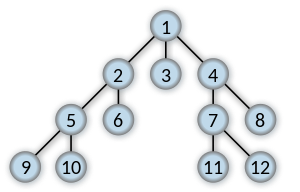
Order in which the nodes are visited
So the key points for BFS are:
- How to explore all nodes of same depth level?
How to explore all nodes of same depth level?
We can use a queue to do this: Starting from root node of a tree (Or a random node in a graph), we add visit all nodes connected with the starting node and add them to the queue. Then, we poll node from queue one by one and repeat above procedures until all nodes have been visited.
Typical Leetcode Prbolems
DFS
Path Sum II
Given a binary tree and a sum, find all root-to-leaf paths where each path’s sum equals the given sum.
Note: A leaf is a node with no children.
Example:
Given the below binary tree and sum = 22,
      5

     / \

    4   8

   /   / \

  11  13  4

 /  \    / \

7    2  5   1
Return:
[

   [5,4,11,2],

   [5,8,4,5]

]- My Answer
package medium2;

import java.util.ArrayList;

import java.util.List;

/**

 * @author Tom Qian

 * @email tomqianmaple@outlook.com

 * @github https://github.com/bluemapleman

 * @date 2018年6月7日

 */

public class PathSumII

{

    // DFS: make use of recursion to backtrack

    public List<List<Integer>> pathSum(TreeNode root, int sum) {

        List<List<Integer>> ans=new ArrayList<List<Integer>>();

        if(root==null)

            return ans;

        int goal=sum-root.val;

        if(goal==0) {

            if(root.left==null && root.right==null) {

                List<Integer> tempList=new ArrayList<>();

                tempList.add(root.val);

                ans.add(tempList);

                return ans;

            }

        }

        List<List<Integer>> temp;

        if((temp=pathSum(root.left, goal)).size()!=0) {

            for(List<Integer> list:temp) {

                list.add(0, root.val);

                ans.add(list);

            }

        }

        if((temp=pathSum(root.right, goal)).size()!=0) {

            for(List<Integer> list:temp) {

                list.add(0,root.val);

                ans.add(list);

            }

        }

        return ans;

    }

}
Convert Sorted List to Binary Search Tree
Given a singly linked list where elements are sorted in ascending order, convert it to a height balanced BST.
For this problem, a height-balanced binary tree is defined as a binary tree in which the depth of the two subtrees of every node never differ by more than 1.
Example:
Given the sorted linked list: [-10,-3,0,5,9],

One possible answer is: [0,-3,9,-10,null,5], which represents the following height balanced BST:

      0

     / \

   -3   9

   /   /

-10 5- My Answer
package medium2;

/**

 * @author Tom Qian

 * @email tomqianmaple@outlook.com

 * @github https://github.com/bluemapleman

 * @date 2018年6月11日

 */

public class ConvertSortedListtoBinarySearchTree

{

    // DFS: make use of recursion to backtrack

    // find the middle node of sorted linked list, and take it as the root node of the BST.

    public TreeNode sortedListToBST(ListNode head) {

        if(head==null)

            return null;

        ListNode slow=head,fast=head,followSlow=head;

        boolean moveFlag=false;

        while(fast!=null && fast.next!=null) {

            if(moveFlag)

                followSlow=followSlow.next;

            moveFlag=true;

            slow=slow.next;

            fast=fast.next.next;

        }

        TreeNode root=new TreeNode(slow.val);

        if(moveFlag) {

            followSlow.next=null;

            root.left=sortedListToBST(head);

            root.right=sortedListToBST(slow.next);

        }

        return root;

    }

}
Course Schedule
There are a total of n courses you have to take, labeled from 0 to n-1.
Some courses may have prerequisites, for example to take course 0 you have to first take course 1, which is expressed as a pair: [0,1]
Given the total number of courses and a list of prerequisite pairs, is it possible for you to finish all courses?
Example 1:
Input: 2, [[1,0]]

Output: true

Explanation: There are a total of 2 courses to take.

             To take course 1 you should have finished course 0. So it is possible.
Example 2:
Input: 2, [[1,0],[0,1]]

Output: false

Explanation: There are a total of 2 courses to take.

             To take course 1 you should have finished course 0, and to take course 0 you should

             also have finished course 1. So it is impossible.
Note:
1.The input prerequisites is a graph represented by a list of edges, not adjacency matrices. Read more about how a graph is represented.
2.You may assume that there are no duplicate edges in the input prerequisites.
- My Answer
// DFS

    public boolean canFinish(int numCourses, int[][] prerequisites) {

        Map<Integer, List<Integer>> map=new HashMap<>();

        for(int i=0;i<numCourses;i++)

            map.put(i, new ArrayList<>());

        for(int i=0;i<prerequisites.length;i++) {

            map.get(prerequisites[i][0]).add(prerequisites[i][1]);

        }

        // start DFS: detect if there is any circle in course graph, i.e. whether DFS starting from certain start point i would lead to the start point again.

        for(int i=0;i<numCourses;i++) {

            // Use a set to avoid infinite loop: when met same node twice, ignore it.

            Set<Integer> set=new HashSet<>();

            // Use a stack to backtrack

            ArrayDeque<Integer> stack=new ArrayDeque<>();

            List<Integer> preCourseList=map.get(i);

            for(Integer preCourse:preCourseList)

                stack.push(preCourse);

            while(!stack.isEmpty()) {

                int preCourse=stack.pop();

                if(set.contains(preCourse))

                    continue;

                else

                    set.add(preCourse);

                if(preCourse==i)

                    return false;

                else {

                    preCourseList=map.get(preCourse);

                    for(Integer tempPreCourse:preCourseList) {

                        stack.push(tempPreCourse);

                    }

                }

            }

        }

        return true;

    }
BFS
Course Schedule
- My Answer
// BFS

    public boolean canFinish(int numCourses, int[][] prerequisites) {

        Map<Integer, List<Integer>> map=new HashMap<>();

        for(int i=0;i<numCourses;i++)

            map.put(i, new ArrayList<>());

        for(int i=0;i<prerequisites.length;i++) {

            map.get(prerequisites[i][0]).add(prerequisites[i][1]);

        }

        // start DFS: detect if there is any circle in course graph, i.e. whether BFS starting from certain start point i would lead to the start point again.

        for(int i=0;i<numCourses;i++) {

            // Use a set to avoid infinite loop: when met same node twice, ignore it.

            Set<Integer> set=new HashSet<>();

            // Use a queue to remember nodes of same depth level

            ArrayDeque<Integer> queue=new ArrayDeque<>();

            List<Integer> preCourseList=map.get(i);

            for(Integer preCourse:preCourseList)

                queue.add(preCourse);

            while(!queue.isEmpty()) {

                int preCourse=queue.poll();

                if(set.contains(preCourse))

                    continue;

                else

                    set.add(preCourse);

                if(preCourse==i)

                    return false;

                else {

                    preCourseList=map.get(preCourse);

                    for(Integer tempPreCourse:preCourseList) {

                        queue.add(tempPreCourse);

                    }

                }

            }

        }

        return true;

    }
Binary Tree Right Side View
Given a binary tree, imagine yourself standing on the right side of it, return the values of the nodes you can see ordered from top to bottom.
Example:
Input: [1,2,3,null,5,null,4]

Output: [1, 3, 4]

Explanation:

   1            <---

 /   \

2     3         <---

 \     \

5 4 <---- My Answer
package medium2;

import java.util.ArrayDeque;

import java.util.ArrayList;

import java.util.List;

/**

 * @author Tom Qian

 * @email tomqianmaple@outlook.com

 * @github https://github.com/bluemapleman

 * @date 2018年6月12日

 */

public class BinaryTreeRightSideView

{

     public List<Integer> rightSideView(TreeNode root) {

         List<Integer> ans=new ArrayList<>();

         if(root==null)

             return ans;

         ans.add(root.val);

         ArrayDeque<TreeNode> queue1=new ArrayDeque<>(),queue2=new ArrayDeque<>();;

         queue1.add(root);

         while(!queue1.isEmpty() || !queue2.isEmpty()){

             TreeNode rightestNode=null;

             if(!queue1.isEmpty()) {

                 while(!queue1.isEmpty()) {

                     TreeNode fatherNode=queue1.poll();

                     if(fatherNode.right!=null) {

                         queue2.add(fatherNode.right);

                         if(rightestNode==null)

                             rightestNode=fatherNode.right;

                     }

                     if(fatherNode.left!=null) {

                         queue2.add(fatherNode.left);

                         if(rightestNode==null)

                             rightestNode=fatherNode.left;

                     }

                 }

             }else{

                 while(!queue2.isEmpty()) {

                     TreeNode fatherNode=queue2.poll();

                     if(fatherNode.right!=null) {

                         queue1.add(fatherNode.right);

                         if(rightestNode==null)

                             rightestNode=fatherNode.right;

                     }

                     if(fatherNode.left!=null) {

                         queue1.add(fatherNode.left);

                         if(rightestNode==null)

                             rightestNode=fatherNode.left;

                     }

                 }

             }

             if(rightestNode!=null)

                 ans.add(rightestNode.val);

         }

         return ans;

     }

}
.
BFS与DFS常考算法整理的更多相关文章
- Leetcode——二叉树常考算法整理
二叉树常考算法整理 希望通过写下来自己学习历程的方式帮助自己加深对知识的理解,也帮助其他人更好地学习,少走弯路.也欢迎大家来给我的Github的Leetcode算法项目点star呀~~ 二叉树常考算法 ...
- Leetcode——回溯法常考算法整理
Leetcode--回溯法常考算法整理 Preface Leetcode--回溯法常考算法整理 Definition Why & When to Use Backtrakcing How to ...
- C++常考算法
1 strcpy, char * strcpy(char* target, char* source){ // 不返回const char*, 因为如果用strlen(strcpy(xx,xxx)) ...
- c++常考算法知识点汇总
前言:写这篇博客完全是给自己当做笔记用的,考虑到自己的c++基础不是很踏实,只在大一学了一学期,c++的面向对象等更深的知识也一直没去学.就是想当遇到一些比较小的知识,切不值得用一整篇 博客去记述的时 ...
- .NET面试常考算法
1.求质数 质数也成为素数,质数就是这个数除了1和他本身两个因数以外,没有其他因数的数,叫做质数,和他相反的是合数, 就是除了1和他本身两个因数以外,还友其他因数的数叫做合数. 1 nam ...
- JS-常考算法题解析
常考算法题解析 这一章节依托于上一章节的内容,毕竟了解了数据结构我们才能写出更好的算法. 对于大部分公司的面试来说,排序的内容已经足以应付了,由此为了更好的符合大众需求,排序的内容是最多的.当然如果你 ...
- 近5年常考Java面试题及答案整理(三)
上一篇:近5年常考Java面试题及答案整理(二) 68.Java中如何实现序列化,有什么意义? 答:序列化就是一种用来处理对象流的机制,所谓对象流也就是将对象的内容进行流化.可以对流化后的对象进行读写 ...
- 近5年常考Java面试题及答案整理(二)
上一篇:近5年常考Java面试题及答案整理(一) 31.String s = new String("xyz");创建了几个字符串对象? 答:两个对象,一个是静态区的"x ...
- 面试常考的常用数据结构与算法(zz)
数据结构与算法,这个部分的内容其实是十分的庞大,要想都覆盖到不太容易.在校学习阶段我们可能需要对每种结构,每种算法都学习,但是找工作笔试或者面试的时候,要在很短的时间内考察一个人这方面的能力,把每种结 ...
随机推荐
- Mysql锁和死锁分析
在MySQL中,行级锁并不是直接锁记录,而是锁索引.索引分为主键索引和非主键索引两种,如果一条sql语句操作了主键索引,MySQL就会锁定这条主键索引;如果一条语句操作了非主键索引,MySQL会先锁定 ...
- 黑客必学之“网页木马webshell”
摘要: 这节课,我们来了解一下网页的木马,首先我们了解网页木马之前,先来了解一下什么是一句话木马.小马和大马.什么是webshell首先简单说一下webshell,webshell简单来说就是黑客植入 ...
- Newman+Jenkins实现接口自动化测试
目录 一.是什么Newman 二.如何安装 三.如何使用 1.运行本地文件 2.运行在线文件 3.以node.js库运行 4.导出报告 四.命令行测试真实接口 1.导出collection文件 2.导 ...
- 丰富图文详解B-树原理,从此面试再也不慌
本文始发于个人公众号:TechFlow,原创不易,求个关注 本篇原计划在上周五发布,由于太过硬核所以才拖到了这周五.我相信大家应该能从标题当中体会到这个硬核. 周五的专题是大数据和分布式,我最初的打算 ...
- css 进度条的文字根据进度渐变
需求 1.进度条里面的文字需要根据进度的长度而变化 原理 用两个一模一样的样式的 div 重叠起来 效果 字体开始为 蓝色,跟随进度条变为 白色 在线预览: https://jsfiddle.net/ ...
- D3.js实现拓扑图
最近写项目需要画出应用程序调用链的网路拓扑图,完全自己写需要花费些时间,那么首先想到的是echarts,但echarts的自定义写法写起来非常麻烦,而且它的文档都是基于配置说明的,对于自定义开发不太方 ...
- vue2.0中eventBus实现兄弟组件通讯
我们知道,在vue中父子组件的通讯是通过props和自定义事件搞定的,简单那的非父子组件通讯用bus(一个空的Vue实例),针对中大型的项目会选择vuex,然而小项目的话,便捷的解决方案就是event ...
- linux使用php动态安装模块mysqli.so(ext/mysqlnd/mysqlnd.h: 没有那个文件或目录)
由于我先安装的php,再安装的mysql! 正常过程: 1.安装mysql 2.安装php configure时带–with-mysql参数 现在我不想重装,因此使用phpize动态安装mysqli, ...
- django 从零开始 10 缓存控制
设置django缓存,比如一些访问频繁的页面 首页 并且不需要进行太大的变化,那么可以设置为一定是时间内请求该url视图 不经过视图计算直接返回缓存的内容 django文档选择了几种方式,但是我这 ...
- 使用flask-dropzone 上传图片文件
引用 http://greyli.com/flask-dropzone/ 现在需要上传图片文件的页面使用jijin2渲染,由于是使用flask-dropzone的,所以我们使用dropzone的cs ...