
MCMC and Bayesian Data Analysis(PPT在文件模块)
How to generate a sample from $p(x)$?
Let's first see how Matlab samples from a $p(x)$. In Matlab, there are several common probability distributions.

Try univariate Gaussian distribution
p= normpdf(linspace(xmin , xmax , num_of_points) , mean, standard_deviation);%PDF

c= normcdf(linspace(xmin , xmax , num_of_points) , mean, standard_deviation);%CDF

y=normrnd(mean, standard_deviation,number_of_samples, 1);%Random Number Generating Method
Try PDF:
x=linespace(-1,1,1000);

p=normpdf(x ,0, 1);

plot(x,p);
Note: linespace returns a vector which is usually accessed like this
x(1)%the first elem, not x(0)

x(:)

x(1,:)
Try RSM:
y=normrnd(0, 1,100, 1);%试试采10000个样本

hist( y , 20 );%20 bars
Try univariate uniform distribution
p= unifpdf(linspace(xmin , xmax , num_of_points) , a,b);%PDF

c= unifcdf(linspace(xmin , xmax , num_of_points) , a,b);%CDF

y=unifrnd(a,b,number_of_samples, 1);%RNG
Try PDF:
x=linespace(-10,10,1000);

p= unifpdf(x ,-5,5);

plot(x,p);
Try RSM:
y=unifrnd(-5, 5,100, 1);%试试采10000个样本

hist( y , 20 );%20 bars
Matlab provides random number generating functions for some standard $p(x)$, it doesn't provide us sampling functions for a general $p(x)$. Here I show some common sampling methods.
Inverse Transform Sampling(ITS)
with descret variables
This method generates random numbers from any probability distribution given the inverse of its cumulative distribution function. The idea is to sample uniformly distributed random numbers (between 0 and 1) and then transform these values using the inverse cumulative distribution function(InvCDF)(which can be descret or continous). If the InvCDF is descrete, then the ITS method just requires a table lookup, like shown in Table 1.
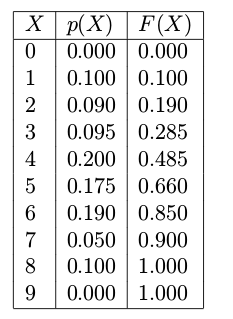
Table 1. Probability of digits observed in human random digit generation experiment
There is a method called randsample in Matlab that can implement the sampling process using the Table 1. See the code below.
%Note: The randsample doesn't defaultly exist in Octave-core package, install statistic package from http://octave.sourceforge.net/statistics/ before using randsample.

% probabilities for each digit

theta=[0.000; ... % digit 0

0.100; ... % digit 1

0.090; ... % digit 2

0.095; ... % digit 3

0.200; ... % digit 4

0.175; ... % digit 5

0.190; ... % digit 6

0.050; ... % digit 7

0.100; ... % digit 8

0.000];

seed = 1; rand( 'state' , seed );% fix the random number generator

K = 10000;% let's say we draw K random values

digitset = 0:9;

Y = randsample(digitset,K,true,theta);

figure( 1 ); clf;

counts = hist( Y , digitset );

bar( digitset , counts , 'k' );

xlim([-0.5 9.5]);

xlabel( 'Digit' );

ylabel( 'Frequency' );

title( 'Distribution of simulated draws of human digit generator' );

pause;
Instead of using the built-in functions such as randsample or mnrnd, it is helpful to consider how to implement the underlying sampling algorithm using the inverse transform method which is:
(1) Calculate $F(X)$.
(2) Sample u from Uniform(0,1).
(3) Get a sample $x^{i}$ of $P(X)$, which is $F(u)^{-1}$.
(4) Repeat (2) and (3) until we get enough samples.
Note: For discrete distributions, $F(X)^{-1}$ is discrete, the way to get a sample $x^{i}$ is illustrated below where $u=0.8,~x^{i}=6$ .

with continuous variables
This can be done with the following procedure:
(1) Draw U ∼ Uniform(0, 1).
(2) Set $X=F(U)^{-1}$
(3) Repeat
For example, we want to sample random numbers from the exponential distribution where its CDF is F (x|λ) = 1 − exp(−x/λ) . Then $F(u|\gamma)^{-1}=-log(1-u)\gamma$. Therefore replace $F(U)^{-1}$ with $F(u|\gamma)^{-1}$.
p=-log(1-unifrnd(0,1,10000,1))*2;

hist(p,30);
Reject Sampling
Applied situation: impossible/difficult to compute CDF of $P(X)$.
Advantage: unlike MCMC, it doesn't require of any “burn-in” period, i.e., all samples obtained during sampling can immediately be used as samples from the target distribution $p(\theta)$.

Based on the Figure above, the method is:
(1) Choose a proposal distribution q(θ) that is easy to sample from.
(2) Find a constant c such that cq(θ) ≥ p(θ) for all θ.
(3) Draw a proposal θ from q(θ).
(4) Draw a u from Uniform[0, cq(θ)].
(5) Reject the proposal if u > p(θ), accept otherwise. Actually, since u is sampled from Uniform[0, cq(θ)], it is equal to state like this " Reject if $u\in[p(\theta),cq(\theta)]$, accept otherwise".
(6) Repeat steps 3, 4, and 5 until desired number of samples is reached; each accepted sample $\theta$ is a draw from p(θ).
For example

then the code is
k=100000;%draw k samples

c=2;

theta_vec=unifrnd(0,1,k,1)%gen a proposal vector from q($\theta$)

cq_vec=c*unifpdf(theta_vec);%cq(theta) vector

p_vec=2*theta_vec;%p(theta) vector

u_vec=[];

for cq=cq_vec

u_vec=[u_vec;unifrnd(0,cq)];

end

r=theta_vec.*(u_vec<p_vec);

r(r==0)=[];%remove the “0” elements

hist(r,20);

MCMC Sampling
Before getting to know MCMC sampling, we first get to know Monte Carlo Integration and Markov Chain.


For example:
%Implement the Markov Chain involving x under Beta(200(0.9x^((t-1))+0.05),200(1-0.9x^((t-1)-0.05))

fa=inline('','x')%parameter a for beta

fb=inline('200*(1-0.9*x-0.05)','x');%parameter b for beta

no4mc=4;%4 markove chains

states=unifrnd(0,1,1,no4mc);%initial states

N=1000;%200 samples drawn from 4 chains

X=states;

for i=1:N

states=betarnd(fa(states),fb(states));

X=[X;states];

end;

plot(X);

pause;

Metroplis Sampling
MCMC and Bayesian Data Analysis(PPT在文件模块)的更多相关文章
- 《利用Python进行数据分析: Python for Data Analysis 》学习随笔
NoteBook of <Data Analysis with Python> 3.IPython基础 Tab自动补齐 变量名 变量方法 路径 解释 ?解释, ??显示函数源码 ?搜索命名 ...
- 深入浅出数据分析 Head First Data Analysis Code 数据与代码
<深入浅出数据分析>英文名为Head First Data Analysis Code, 这本书中提供了学习使用的数据和程序,原书链接由于某些原因不 能打开,这里在提供一个下载的链接.去下 ...
- 数据分析---《Python for Data Analysis》学习笔记【04】
<Python for Data Analysis>一书由Wes Mckinney所著,中文译名是<利用Python进行数据分析>.这里记录一下学习过程,其中有些方法和书中不同 ...
- 数据分析---《Python for Data Analysis》学习笔记【03】
<Python for Data Analysis>一书由Wes Mckinney所著,中文译名是<利用Python进行数据分析>.这里记录一下学习过程,其中有些方法和书中不同 ...
- 数据分析---《Python for Data Analysis》学习笔记【02】
<Python for Data Analysis>一书由Wes Mckinney所著,中文译名是<利用Python进行数据分析>.这里记录一下学习过程,其中有些方法和书中不同 ...
- 数据分析---《Python for Data Analysis》学习笔记【01】
<Python for Data Analysis>一书由Wes Mckinney所著,中文译名是<利用Python进行数据分析>.这里记录一下学习过程,其中有些方法和书中不同 ...
- Aspose是一个很强大的控件,可以用来操作word,excel,ppt等文件
Aspose是一个很强大的控件,可以用来操作word,excel,ppt等文件,用这个控件来导入.导出数据非常方便.其中Aspose.Cells就是用来操作Excel的,功能有很多.我所用的是最基本的 ...
- 《python for data analysis》第五章,pandas的基本使用
<利用python进行数据分析>一书的第五章源码与读书笔记 直接上代码 # -*- coding:utf-8 -*-# <python for data analysis>第五 ...
- 《python for data analysis》第四章,numpy的基本使用
<利用python进行数据分析>第四章的程序,介绍了numpy的基本使用方法.(第三章为Ipython的基本使用) 科学计算.常用函数.数组处理.线性代数运算.随机模块…… # -*- c ...
随机推荐
- Maven本地仓库及远程仓库
转载自:http://blog.csdn.net/wanghantong/article/details/36427433 Maven 仓库的分类: maven的仓库只有两大类:1.本地仓库 2.远程 ...
- Activiti开发环境配置
Ubuntu安装 1.下载Ubuntu安装镜像 http://www.ubuntu.com/download/ 2.制作ISO U盘安装镜像 不能用Ultraiso制作U盘启动镜像,新版的Ubunt ...
- Javascript--装饰器模式和观察者模式
装饰器模式 (function(){//装饰一棵树,装饰器模式通过对对象的属性进行改变来装饰对象.需要一个设置属性的方法 var tree={}; tree.decorate=function(){ ...
- Beat版本分工
柯晓鸿031302613:负责服务器的搭建,struts2框架的配置,后台与页面的连整合,部分后台接口,数据库连接查询接口,以及页面js的书写 比例:40% 洪腾飞031302608:负责主要界面的书 ...
- iOS"Request failed: unacceptable content-type: text/html"
接口访问出错了,用浏览器测试,发现可以正常返回数据. 下面是错误信息: 获取服务器响应出错 error=Error Domain=com.alamofire.error.serialization.r ...
- IOS系列swift语言之课时八
这节课需要讲的就是可选链,内存管理,引用计数,unowned解决 //: Playground - noun: a place where people can play import UIKit / ...
- 信鸽推送(XGPush)
先放入两个链接: iOS信鸽接入官方文档:http://developer.qq.com/wiki/xg/iOS接入/iOS%20SDK完整接入/iOS%20SDK完整接入.html 信鸽开放平台:h ...
- linux在home目录下使用ls命令卡死
linux在home目录下使用ls命令卡死,原因可能是mount的某个服务器挂掉或出啥问题了,这个时候umount掉就正常了,如果umount提示device is busy,这时可以使用强制卸载 ...
- Java中前台JSP请求Servlet实例(http+Servlet)
1.前台jsp代码 himily.jsp,定义了用户名和密码两个输入框,使用post方式提交:/order-web/HimilyServlet其中order-web为站点名称,HimilyServle ...
- ios调用系统相册、相机 显示中文标题、本地化多语言支持
因为调用系统相册.相机需要显示中文,所以搞了半天才知道是在Project->info->Custom ios Target Properties 添加 Localizations 并加入C ...