
Struts(十二):异常处理:exception-mapping元素
- 配置当前action的声明异常处理
1、exception-mapping元素中有2个属性
exception:指定需要捕获的异常类型
result:指定一个响应结果,该结果将在捕获到异常时被执行。即可以来自当前action的声明,也可以来自global-results声明。2、可以在视图上通过<s:property>标签显示异常消息。
基于上几个章节的例子开始往下写,修改save函数:
    public String save(){

        System.out.println("save");

        int val=10/0;

        return "success";

    }
此时访问http://localhost:8080/Struts_01/,输入信息点击“提交”按钮跳转到details.jsp,当访问save函数时,就跑出了异常信息:
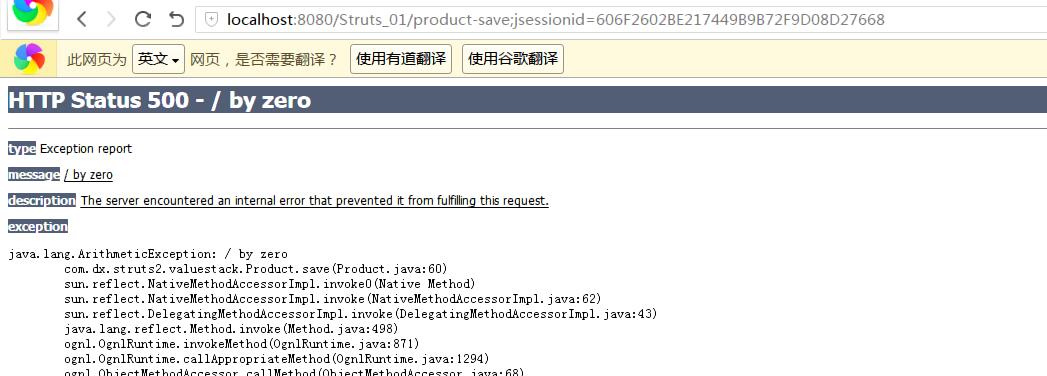
此时,我们发现异常信息并没有被合理的处理掉,比如出错了,我们让页面跳转到error.jsp该多好,其实struts2中通过配置struts.xml是可以实现的。
修改struts.xml:
<?xml version="1.0" encoding="UTF-8" ?>

<!DOCTYPE struts PUBLIC

    "-//Apache Software Foundation//DTD Struts Configuration 2.3//EN"

    "http://struts.apache.org/dtds/struts-2.3.dtd">

<struts>

    <!--

    <constant name="struts.action.extension" value="action" />

    <constant name="struts.enable.DynamicMethodInvocation" value="true" />

    -->

    <constant name="struts.ognl.allowStaticMethodAccess" value="true" />

    <constant name="struts.devMode" value="false" />

    <package name="default" namespace="/" extends="struts-default">

        <action name="product-save" class="com.dx.struts2.valuestack.Product" method="save">

            <exception-mapping result="error" exception="java.lang.ArithmeticException"></exception-mapping>

            <result name="error">/error.jsp</result>

            <result>/details.jsp</result>

        </action>

    </package>

    <!-- Add packages here -->

</struts>
添加在WebContent下添加error.jsp:
<%@ page language="java" contentType="text/html; charset=UTF-8" pageEncoding="UTF-8"%>

<!DOCTYPE html PUBLIC "-//W3C//DTD HTML 4.01 Transitional//EN" "http://www.w3.org/TR/html4/loose.dtd">

<html>

<head>

  <meta http-equiv="Content-Type" content="text/html; charset=UTF-8">

  <title>Insert title here</title>

</head>

<body>

  error

</body>

</html>
重启服务,重新访问页面,并提交参数,发现页面自动跳转到了error.jsp:
如果光跳转过来不太完美,如果可以显示错误信息不是更好,实际上通过EL或者s:property标签是可以实现的,修改error.jsp:
<%@ page language="java" contentType="text/html; charset=UTF-8" pageEncoding="UTF-8"%>

<%@ taglib prefix="s" uri="/struts-tags"%>

<!DOCTYPE html PUBLIC "-//W3C//DTD HTML 4.01 Transitional//EN" "http://www.w3.org/TR/html4/loose.dtd">

<html>

<head>

<meta http-equiv="Content-Type" content="text/html; charset=UTF-8">

<title>Insert title here</title>

</head>

<body>

    error<br/>

    <s:debug/>

    <s:property value="exception" /><br/>

    ${exception}<br/>

    ${exception.message}<br/>

    <s:property value="exception.message"/><br/>

    <s:property value="exceptionStack"/><br/>

    ${exceptionStack}

</body>

</html>
显示信息: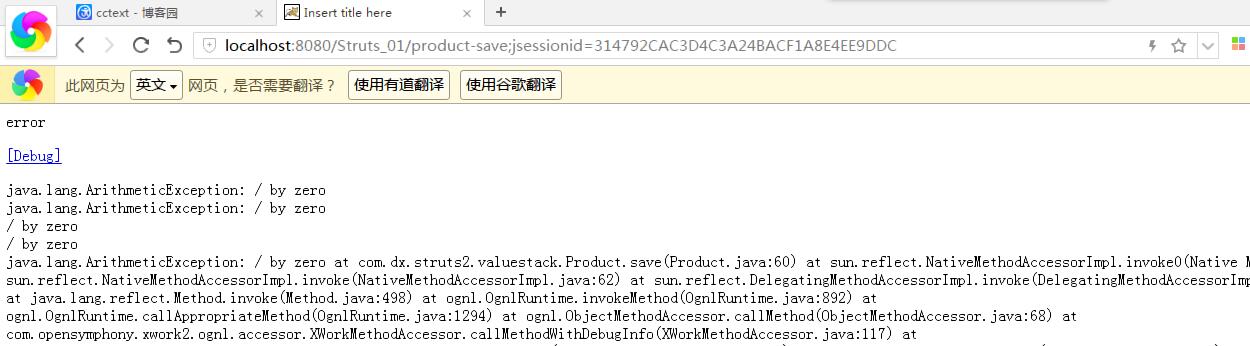
s:debug第一个元素类型为:com.opensymphony.xwork2.interceptor.ExceptionHolder
元素包含两个属性:exception和exceptionStack
- 可以通过global-exception-mappings元素为应用程序提供一个全局性的异常捕获映射。
1、但在global-exception-mappings元素下声明任何exception-mapping元素只能引用在global-results元素下声明的某个result元素。
只需要修改struts.xml即可,其他不需要变动:
<?xml version="1.0" encoding="UTF-8" ?>

<!DOCTYPE struts PUBLIC

    "-//Apache Software Foundation//DTD Struts Configuration 2.3//EN"

    "http://struts.apache.org/dtds/struts-2.3.dtd">

<struts>

    <!--

    <constant name="struts.action.extension" value="action" />

    <constant name="struts.enable.DynamicMethodInvocation" value="true" />

    -->

    <constant name="struts.ognl.allowStaticMethodAccess" value="true" />

    <constant name="struts.devMode" value="false" />

    <package name="default" namespace="/" extends="struts-default">

        <global-results>

            <result name="error">/error.jsp</result>

        </global-results>

        <global-exception-mappings>

            <exception-mapping result="error" exception="java.lang.ArithmeticException"></exception-mapping>

        </global-exception-mappings>

        <action name="product-save" class="com.dx.struts2.valuestack.Product" method="save">

            <!--

            <exception-mapping result="error" exception="java.lang.ArithmeticException"></exception-mapping>

            <result name="error">/error.jsp</result>

            -->

            <result>/details.jsp</result>

        </action>

    </package>

    <!-- Add packages here -->

</struts>
重新访问即可,其他内容不影响显示。
- 声明式异常处理机制由ExceptionMappingInterceptor拦截器负责处理。
1、当某个exception-mapping元素声明的异常被捕获到是,ExceptionMappingInterceptor拦截器就会向ValueStack中添加两个对象:
exception:表示被捕获异常的Exception对象
exceptionStack:包含着被捕获异常的栈2、什么地方注册这个拦截器?
struts-core.jar 下的struts-default.xml中<default-interceptor-ref name="defaultStack"/>
<interceptor name="exception" class="com.opensymphony.xwork2.interceptor.ExceptionMappingInterceptor"/>
com.opensymphony.xwork2.interceptor.ExceptionMappingInterceptor怎么向ValueStack中写入异常信息?
package com.opensymphony.xwork2.interceptor;

import com.opensymphony.xwork2.ActionInvocation;

import com.opensymphony.xwork2.config.entities.ExceptionMappingConfig;

import com.opensymphony.xwork2.util.logging.Logger;

import com.opensymphony.xwork2.util.logging.LoggerFactory;

import java.util.HashMap;

import java.util.List;

import java.util.Map;

/**

 * @author Matthew E. Porter (matthew dot porter at metissian dot com)

 * @author Claus Ibsen

 */

public class ExceptionMappingInterceptor extends AbstractInterceptor {

    protected static final Logger LOG = LoggerFactory.getLogger(ExceptionMappingInterceptor.class);

    protected Logger categoryLogger;

    protected boolean logEnabled = false;

    protected String logCategory;

    protected String logLevel;

    public boolean isLogEnabled() {

        return logEnabled;

    }

    public void setLogEnabled(boolean logEnabled) {

        this.logEnabled = logEnabled;

    }

    public String getLogCategory() {

        return logCategory;

    }

    public void setLogCategory(String logCatgory) {

        this.logCategory = logCatgory;

    }

    public String getLogLevel() {

        return logLevel;

    }

    public void setLogLevel(String logLevel) {

        this.logLevel = logLevel;

    }

    @Override

    public String intercept(ActionInvocation invocation) throws Exception {

        String result;

        try {

            result = invocation.invoke();

        } catch (Exception e) {

            if (isLogEnabled()) {

                handleLogging(e);

            }

            List<ExceptionMappingConfig> exceptionMappings = invocation.getProxy().getConfig().getExceptionMappings();

            ExceptionMappingConfig mappingConfig = this.findMappingFromExceptions(exceptionMappings, e);

            if (mappingConfig != null && mappingConfig.getResult()!=null) {

                Map parameterMap = mappingConfig.getParams();

                // create a mutable HashMap since some interceptors will remove parameters, and parameterMap is immutable

                invocation.getInvocationContext().setParameters(new HashMap<String, Object>(parameterMap));

                result = mappingConfig.getResult();

                publishException(invocation, new ExceptionHolder(e));

            } else {

                throw e;

            }

        }

        return result;

    }

    /**

     * Handles the logging of the exception.

     *

     * @param e  the exception to log.

     */

    protected void handleLogging(Exception e) {

        if (logCategory != null) {

            if (categoryLogger == null) {

                // init category logger

                categoryLogger = LoggerFactory.getLogger(logCategory);

            }

            doLog(categoryLogger, e);

        } else {

            doLog(LOG, e);

        }

    }

    /**

     * Performs the actual logging.

     *

     * @param logger  the provided logger to use.

     * @param e  the exception to log.

     */

    protected void doLog(Logger logger, Exception e) {

        if (logLevel == null) {

            logger.debug(e.getMessage(), e);

            return;

        }

        if ("trace".equalsIgnoreCase(logLevel)) {

            logger.trace(e.getMessage(), e);

        } else if ("debug".equalsIgnoreCase(logLevel)) {

            logger.debug(e.getMessage(), e);

        } else if ("info".equalsIgnoreCase(logLevel)) {

            logger.info(e.getMessage(), e);

        } else if ("warn".equalsIgnoreCase(logLevel)) {

            logger.warn(e.getMessage(), e);

        } else if ("error".equalsIgnoreCase(logLevel)) {

            logger.error(e.getMessage(), e);

        } else if ("fatal".equalsIgnoreCase(logLevel)) {

            logger.fatal(e.getMessage(), e);

        } else {

            throw new IllegalArgumentException("LogLevel [" + logLevel + "] is not supported");

        }

    }

    /**

     * @deprecated since 2.3.15 please use #findMappingFromExceptions directly instead

     */

    protected String findResultFromExceptions(List<ExceptionMappingConfig> exceptionMappings, Throwable t) {

        ExceptionMappingConfig result = findMappingFromExceptions(exceptionMappings, t);

        return result==null?null:result.getResult();

    }

    /**

     * Try to find appropriate {@link ExceptionMappingConfig} based on provided Throwable

     *

     * @param exceptionMappings list of defined exception mappings

     * @param t caught exception

     * @return appropriate mapping or null

     */

    protected ExceptionMappingConfig findMappingFromExceptions(List<ExceptionMappingConfig> exceptionMappings, Throwable t) {

        ExceptionMappingConfig config = null;

        // Check for specific exception mappings.

        if (exceptionMappings != null) {

            int deepest = Integer.MAX_VALUE;

            for (Object exceptionMapping : exceptionMappings) {

                ExceptionMappingConfig exceptionMappingConfig = (ExceptionMappingConfig) exceptionMapping;

                int depth = getDepth(exceptionMappingConfig.getExceptionClassName(), t);

                if (depth >= 0 && depth < deepest) {

                    deepest = depth;

                    config = exceptionMappingConfig;

                }

            }

        }

        return config;

    }

    /**

     * Return the depth to the superclass matching. 0 means ex matches exactly. Returns -1 if there's no match.

     * Otherwise, returns depth. Lowest depth wins.

     *

     * @param exceptionMapping  the mapping classname

     * @param t  the cause

     * @return the depth, if not found -1 is returned.

     */

    public int getDepth(String exceptionMapping, Throwable t) {

        return getDepth(exceptionMapping, t.getClass(), 0);

    }

    private int getDepth(String exceptionMapping, Class exceptionClass, int depth) {

        if (exceptionClass.getName().contains(exceptionMapping)) {

            // Found it!

            return depth;

        }

        // If we've gone as far as we can go and haven't found it...

        if (exceptionClass.equals(Throwable.class)) {

            return -1;

        }

        return getDepth(exceptionMapping, exceptionClass.getSuperclass(), depth + 1);

    }

    /**

     * Default implementation to handle ExceptionHolder publishing. Pushes given ExceptionHolder on the stack.

     * Subclasses may override this to customize publishing.

     *

     * @param invocation The invocation to publish Exception for.

     * @param exceptionHolder The exceptionHolder wrapping the Exception to publish.

     */

    protected void publishException(ActionInvocation invocation, ExceptionHolder exceptionHolder) {

        invocation.getStack().push(exceptionHolder);

    }

}
Struts(十二):异常处理:exception-mapping元素的更多相关文章
- python学习 (三十二) 异常处理
1 异常: def exceptionHandling(): try: a = b = d = a / b print(d) except ZeroDivisionError as ex: print ...
- PHP学习笔记三十二【Exception】
<?php // $fp=fopen("a.txt","r"); // echo "ok"; if(!file_exists(&quo ...
- WCF技术剖析之二十二: 深入剖析WCF底层异常处理框架实现原理[中篇]
原文:WCF技术剖析之二十二: 深入剖析WCF底层异常处理框架实现原理[中篇] 在[上篇]中,我们分别站在消息交换和编程的角度介绍了SOAP Fault和FaultException异常.在服务执行过 ...
- 异常处理—Exception(二)
在上一篇中"异常处理--Exception(一)"中,跟大家简单介绍了一下Exception,也使大家充分的了解了Exception管理在一个项目中的重要性,那如何在我们的项目中处 ...
- Python开发【第二十二篇】:Web框架之Django【进阶】
Python开发[第二十二篇]:Web框架之Django[进阶] 猛击这里:http://www.cnblogs.com/wupeiqi/articles/5246483.html 博客园 首页 ...
- (转)SpringMVC学习(十二)——SpringMVC中的拦截器
http://blog.csdn.net/yerenyuan_pku/article/details/72567761 SpringMVC的处理器拦截器类似于Servlet开发中的过滤器Filter, ...
- 二十二、OGNL的一些其他操作
二十二.OGNL的一些其他操作 投影 ?判断满足条件 动作类代码: ^ $ public class Demo2Action extends ActionSupport { public ...
- java之jvm学习笔记六-十二(实践写自己的安全管理器)(jar包的代码认证和签名) (实践对jar包的代码签名) (策略文件)(策略和保护域) (访问控制器) (访问控制器的栈校验机制) (jvm基本结构)
java之jvm学习笔记六(实践写自己的安全管理器) 安全管理器SecurityManager里设计的内容实在是非常的庞大,它的核心方法就是checkPerssiom这个方法里又调用 AccessCo ...
- Spring+SpringMVC+MyBatis深入学习及搭建(十二)——SpringMVC入门程序(一)
转载请注明出处:http://www.cnblogs.com/Joanna-Yan/p/6999743.html 前面讲到:Spring+SpringMVC+MyBatis深入学习及搭建(十一)——S ...
随机推荐
- 斗地主案例(利用集合/增强for等技术)
斗地主案例(利用集合/增强for等技术) package Task10; import java.util.ArrayList; import java.util.Collections; publi ...
- Spring Boot Junit单元测试
http://blog.csdn.net/catoop/article/details/50752964
- Linux Vim查找字符串
一.用/和?的区别:/后跟查找的字符串.vim会显示文本中第一个出现的字符串.?后跟查找的字符串.vim会显示文本中最后一个出现的字符串.二.注意事项:不管用/还是?查找到第一个字符串后,按回车,vi ...
- V-bind详细使用
v-bind 主要用于属性绑定,Vue官方提供了一个简写方式 :bind,例如: <!-- 完整语法 --> <a v-bind:href="url">& ...
- Android 使用shape定义不同控件的的颜色、背景色、边框色
Android 使用shape定义不同控件的的颜色.背景色.边框色 设置按钮的右边框和底边框颜色为红色,边框大小为3dp: 在drawable新建一个 buttonstyle.xml的文件,内容如下: ...
- ava集合---LinkedList源码解析
一.源码解析 public class LinkedList<E> extends AbstractSequentialList<E> implements List<E ...
- hibernate的一级和二级缓存
一级缓存就是Session级别的缓存,close后就没了. 二级缓存就是SessionFactory级别的缓存,全局缓存,要配置其他插件. 什么样的数据适合存放到第二级缓存中? 1.很少被修改的数据 ...
- WCF跨域解决方法及一些零碎的东西。
之前发过一篇随笔,说的WCF配置文件配置问题.里面也配了跨域支持,但是jsoncollback只支持Get请求,Post请求是解决不了,所以这里把真正的WCF跨域问题贴出来. 话不多说,直接帖配置文件 ...
- 简单的C语言编译器--词法分析器
1. 定义词法单元Tag 首先要将可能出现的词进行分类,可以有不同的分类方式.如多符一类:将所有逗号.分号.括号等都归为一类,或者一符一类,将一个符号归为一类.我这里采用的是一符一类的方式.C代码 ...
- string类的简洁版实现
说是原创,差不多算是转载了,我也是看了好多大牛的写法,大牛的建议,自己加一总结,形成代码: 实现一个简洁版的string类,我觉得,下面的也够了:另外需要参见另外的写法: http://blog.cs ...