
Python模块之pickle(列表,字典等复杂数据类型与二进制文件的转化)
1.pickle模块简介
The pickle module implements binary protocols for serializing and de-serializing a Python object structure。
大意是说:pickle模块是用来实现二进制存储对于python对象结构的的序列化和反序列化。
2.使用前导入模块
import pickle
3.创造要序列化的数据结构
如列表:my_list = [123,3.14,'小甲鱼',['another list',20]]
4.创建一个二进制文件
pick_file = open('D:\\test\\my_list.pkl','wb')
5.使用pickle的函数dump装入文件
pickle.dump(my_list,pick_file)
6.关闭打开的文件完成写入
pick_file.close()
7.运行结果,由于写入的是二进制文件,那么用文本打开肯定是乱码的

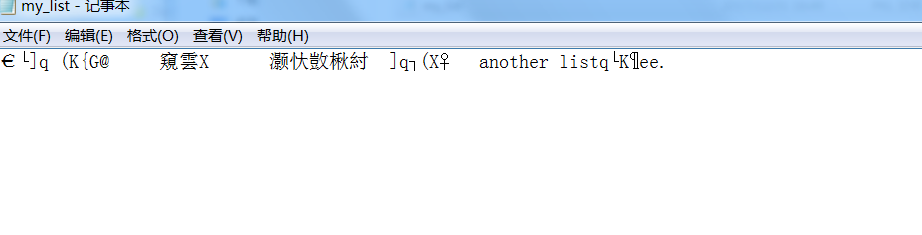
8.以指读方式打开刚才存储的二进制文件
pickfile = open('D:\\test\\my_list.pkl','rb')
9.读取文件内容到列表,怎么写入的怎么读取
listfile = pickle.load(pickfile)
10.查看读取结果,我们写入的内容又被我们读取出来了
>>> print(listfile)
[123, 3.14, '小甲鱼', ['another list', 20]]
11.介绍文档
NAME
pickle - Create portable serialized representations of Python objects.
DESCRIPTION
See module copyreg for a mechanism for registering custom picklers.
See module pickletools source for extensive comments.
Classes:
Pickler
Unpickler
Functions:
dump(object, file)
dumps(object) -> string
load(file) -> object
loads(string) -> object
Misc variables:
__version__
format_version
compatible_formats
FUNCTIONS
dump(obj, file, protocol=None, *, fix_imports=True)
Write a pickled representation of obj to the open file object file.
This is equivalent to ``Pickler(file, protocol).dump(obj)``, but may
be more efficient.
The optional *protocol* argument tells the pickler to use the given
protocol supported protocols are 0, 1, 2, 3 and 4. The default
protocol is 3; a backward-incompatible protocol designed for Python 3.
Specifying a negative protocol version selects the highest protocol
version supported. The higher the protocol used, the more recent the
version of Python needed to read the pickle produced.
The *file* argument must have a write() method that accepts a single
bytes argument. It can thus be a file object opened for binary
writing, an io.BytesIO instance, or any other custom object that meets
this interface.
If *fix_imports* is True and protocol is less than 3, pickle will try
to map the new Python 3 names to the old module names used in Python
2, so that the pickle data stream is readable with Python 2.
dumps(obj, protocol=None, *, fix_imports=True)
Return the pickled representation of the object as a bytes object.
The optional *protocol* argument tells the pickler to use the given
protocol; supported protocols are 0, 1, 2, 3 and 4. The default
protocol is 3; a backward-incompatible protocol designed for Python 3.
Specifying a negative protocol version selects the highest protocol
version supported. The higher the protocol used, the more recent the
version of Python needed to read the pickle produced.
If *fix_imports* is True and *protocol* is less than 3, pickle will
try to map the new Python 3 names to the old module names used in
Python 2, so that the pickle data stream is readable with Python 2.
load(file, *, fix_imports=True, encoding='ASCII', errors='strict')
Read and return an object from the pickle data stored in a file.
This is equivalent to ``Unpickler(file).load()``, but may be more
efficient.
The protocol version of the pickle is detected automatically, so no
protocol argument is needed. Bytes past the pickled object's
representation are ignored.
The argument *file* must have two methods, a read() method that takes
an integer argument, and a readline() method that requires no
arguments. Both methods should return bytes. Thus *file* can be a
binary file object opened for reading, an io.BytesIO object, or any
other custom object that meets this interface.
Optional keyword arguments are *fix_imports*, *encoding* and *errors*,
which are used to control compatibility support for pickle stream
generated by Python 2. If *fix_imports* is True, pickle will try to
map the old Python 2 names to the new names used in Python 3. The
*encoding* and *errors* tell pickle how to decode 8-bit string
instances pickled by Python 2; these default to 'ASCII' and 'strict',
respectively. The *encoding* can be 'bytes' to read these 8-bit
string instances as bytes objects.
loads(data, *, fix_imports=True, encoding='ASCII', errors='strict')
Read and return an object from the given pickle data.
The protocol version of the pickle is detected automatically, so no
protocol argument is needed. Bytes past the pickled object's
representation are ignored.
Optional keyword arguments are *fix_imports*, *encoding* and *errors*,
which are used to control compatibility support for pickle stream
generated by Python 2. If *fix_imports* is True, pickle will try to
map the old Python 2 names to the new names used in Python 3. The
*encoding* and *errors* tell pickle how to decode 8-bit string
instances pickled by Python 2; these default to 'ASCII' and 'strict',
respectively. The *encoding* can be 'bytes' to read these 8-bit
string instances as bytes objects.
Python模块之pickle(列表,字典等复杂数据类型与二进制文件的转化)的更多相关文章
- python模块之pickle、shelve、json
一 什么是序列化 序列化指的是将内存中的数据结构转化为一种中间格式,并存储到硬盘上. (反序列化:将硬盘上存储的中间格式数据再还原为内存中的数据结构) 二 为什么要序列化 持久保持状态 需知一个软件/ ...
- python模块--json \ pickle \ shelve \ XML模块
一.json模块 之前学习过的eval内置方法可以将一个字符串转成一个python对象,不过eval方法时有局限性的,对于普通的数据类型,json.loads和eval都能用,但遇到特殊类型的时候,e ...
- python中用json存储列表字典等文件操作
JSON字符串用json.dumps, json.loads JSON文件名用json.dump, json.load 由于需要在脚本重启后依旧能够记住之前所使用的列表内容, 故采用json存储列表文 ...
- python学习笔记(三)-列表&字典
列表: 一.列表操作"""Python内置的一种数据类型是列表:list.list是一种有序的集合,可以随时添加和删除其中的元素.比如,列出班里所有同学的名字,就可以用一 ...
- python 模块之-pickle
Pickle的问题和所有其他编程语言特有的序列化问题一样,就是它只能用于Python,并且可能不同版本的Python彼此都不兼容,因此,只能用Pickle保存那些不重要的数据,不能成功地反序列化也没关 ...
- python模块:pickle
"""Create portable serialized representations of Python objects. See module copyreg f ...
- Python字符串/元祖/列表/字典互转
#-*- coding:UTF-8 -*- #author:RXS002 #1.字典 dict = {'name':'Zara','age':7,'class':'First'} #字典转换为字符串, ...
- python中的字符串 列表 字典
字符串 一个有序的字符集合 不可变 1,可以使用for in语句进行迭代循环,返回元素 2,in类是于str.find()方法但是是返回布尔结果 str.find()返回 ...
- python模块之pickle
和json不同的是: json只支持str,int,tuple,list,dict. pickle支持python里所有的数据类型,但是只能在python里序列化,不跨平台,python独有. 代码示 ...
随机推荐
- geotrellis使用(三十五)Cesium加载geotrellis TMS瓦片
前言 做任何事情都不是想象中的那么简单.好久没有更新技术博客了,跟最近瞎忙有很大关系,虽说是瞎忙也抽空研究了些技术. 主要是前端渲染,像原生的WebGL和Cesium.WebGL写了几篇博客,自我感觉 ...
- Maven引入jar的总结
Overview:显示maven项目的一些基本信息 Dependencies:添加jar包的页面 Plugins:添加maven插件的页面.比如tomcat-maven-plugin等 Reporti ...
- win7下使用apache ab 比较测试node与 tomcat
最近在研究node,都说node单线程.事件环机制,高并发效率高,亲测一下,一探究竟 apache ab 安装 进入:http://httpd.apache.org/download.cgi#apac ...
- EntityFramework For Mysql 动态切换数据源
1.简介 在工作中遇到一个问题.项目有三个数据库(三个数据库表结构一样),用户可以选择使用哪个数据库.其实就是动态切换数据库连接. 2.EntityFramework For Mysql 先来简单的介 ...
- CNCC2017中的深度学习与跨媒体智能
CNCC2017中的深度学习与跨媒体智能 转载请注明作者:梦里茶 目录 机器学习与跨媒体智能 传统方法与深度学习 图像分割 小数据集下的深度学习 语音前沿技术 生成模型 基于贝叶斯的视觉信息编解码 珠 ...
- .bash_profile 加载
1.Debian默认的shell是Bash, 1.1 命令行 和 ssh 登录 ,首先读入 /etc/profile,这是对所有用户都有效的配置:然后依次寻找下面三个文件,这是针对当前用户的配置. ~ ...
- 微信小程序爬坑日记
新公司上手小程序.30天,从入门到现在,还没放弃... 虽然小程序发布出来快一年了,爬坑的兄弟们大多把坑都踩平了.而我一直停留在"Hello World"的学习阶段.一来没项目,只 ...
- video视频铺满
1. 因项目需求,要在公司官网加一段视频,达到的效果是视频平铺整个网页,大小随网页变化:网上找了许久才找了了这么一个生僻的属性,只需给video加这么个样式就可以了:object-fit: fill; ...
- HDU5983Pocket Cube
Pocket Cube Time Limit: 2000/1000 MS (Java/Others) Memory Limit: 65536/65536 K (Java/Others) Tota ...
- Java集合(5)一 HashMap与HashSet
目录 Java集合(1)一 集合框架 Java集合(2)一 ArrayList 与 LinkList Java集合(3)一 红黑树.TreeMap与TreeSet(上) Java集合(4)一 红黑树. ...