
your service shouldn’t know anything about HTTP headers, or gRPC error codes 干净架构 服务不应知道 HTTP头、gRPC错误码 服务仅知道服务相关的
Go kit - Frequently asked questions https://gokit.io/faq/
Services — What is a Go kit service?
Services are where all of the business logic is implemented. A service usually glues together multiple endpoints. In Go kit, services are typically modeled as interfaces, and implementations of those interfaces contain the business logic. Go kit services should strive to abide the Clean Architecture or the Hexagonal Architecture. That is, the business logic should have no knowledge of endpoint- or especially transport-domain concepts: your service shouldn’t know anything about HTTP headers, or gRPC error codes.
Clean Coder Blog https://blog.cleancoder.com/uncle-bob/2012/08/13/the-clean-architecture.html
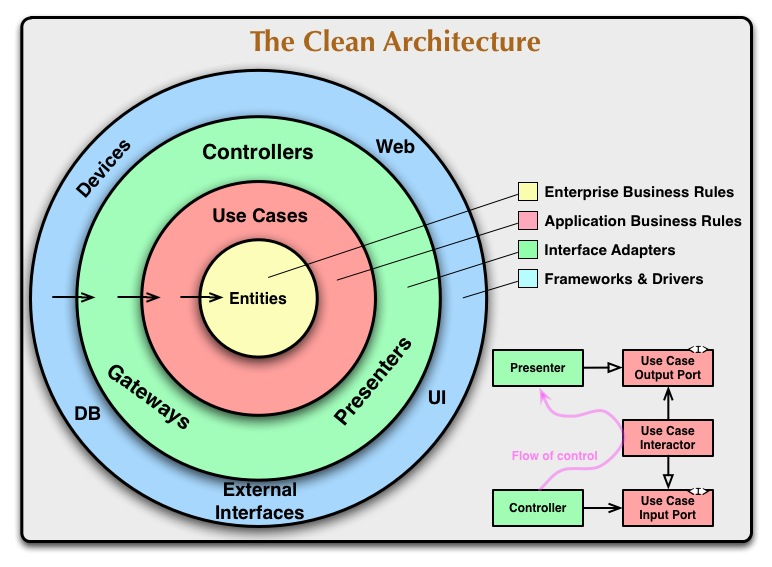
The Clean Architecture
Over the last several years we’ve seen a whole range of ideas regarding the architecture of systems. These include:
- Hexagonal Architecture (a.k.a. Ports and Adapters) by Alistair Cockburn and adopted by Steve Freeman, and Nat Pryce in their wonderful book Growing Object Oriented Software
- Onion Architecture by Jeffrey Palermo
- Screaming Architecture from a blog of mine last year
- DCI from James Coplien, and Trygve Reenskaug.
- BCE by Ivar Jacobson from his book Object Oriented Software Engineering: A Use-Case Driven Approach
Though these architectures all vary somewhat in their details, they are very similar. They all have the same objective, which is the separation of concerns. They all achieve this separation by dividing the software into layers. Each has at least one layer for business rules, and another for interfaces.
Each of these architectures produce systems that are:
- Independent of Frameworks. The architecture does not depend on the existence of some library of feature laden software. This allows you to use such frameworks as tools, rather than having to cram your system into their limited constraints.
- Testable. The business rules can be tested without the UI, Database, Web Server, or any other external element.
- Independent of UI. The UI can change easily, without changing the rest of the system. A Web UI could be replaced with a console UI, for example, without changing the business rules.
- Independent of Database. You can swap out Oracle or SQL Server, for Mongo, BigTable, CouchDB, or something else. Your business rules are not bound to the database.
- Independent of any external agency. In fact your business rules simply don’t know anything at all about the outside world.
The diagram at the top of this article is an attempt at integrating all these architectures into a single actionable idea.
The Dependency Rule
The concentric circles represent different areas of software. In general, the further in you go, the higher level the software becomes. The outer circles are mechanisms. The inner circles are policies.
The overriding rule that makes this architecture work is The Dependency Rule. This rule says that source code dependencies can only point inwards. Nothing in an inner circle can know anything at all about something in an outer circle. In particular, the name of something declared in an outer circle must not be mentioned by the code in the an inner circle. That includes, functions, classes. variables, or any other named software entity.
By the same token, data formats used in an outer circle should not be used by an inner circle, especially if those formats are generate by a framework in an outer circle. We don’t want anything in an outer circle to impact the inner circles.
Entities
Entities encapsulate Enterprise wide business rules. An entity can be an object with methods, or it can be a set of data structures and functions. It doesn’t matter so long as the entities could be used by many different applications in the enterprise.
If you don’t have an enterprise, and are just writing a single application, then these entities are the business objects of the application. They encapsulate the most general and high-level rules. They are the least likely to change when something external changes. For example, you would not expect these objects to be affected by a change to page navigation, or security. No operational change to any particular application should affect the entity layer.
Use Cases
The software in this layer contains application specific business rules. It encapsulates and implements all of the use cases of the system. These use cases orchestrate the flow of data to and from the entities, and direct those entities to use their enterprise wide business rules to achieve the goals of the use case.
We do not expect changes in this layer to affect the entities. We also do not expect this layer to be affected by changes to externalities such as the database, the UI, or any of the common frameworks. This layer is isolated from such concerns.
We do, however, expect that changes to the operation of the application will affect the use-cases and therefore the software in this layer. If the details of a use-case change, then some code in this layer will certainly be affected.
Interface Adapters
The software in this layer is a set of adapters that convert data from the format most convenient for the use cases and entities, to the format most convenient for some external agency such as the Database or the Web. It is this layer, for example, that will wholly contain the MVC architecture of a GUI. The Presenters, Views, and Controllers all belong in here. The models are likely just data structures that are passed from the controllers to the use cases, and then back from the use cases to the presenters and views.
Similarly, data is converted, in this layer, from the form most convenient for entities and use cases, into the form most convenient for whatever persistence framework is being used. i.e. The Database. No code inward of this circle should know anything at all about the database. If the database is a SQL database, then all the SQL should be restricted to this layer, and in particular to the parts of this layer that have to do with the database.
Also in this layer is any other adapter necessary to convert data from some external form, such as an external service, to the internal form used by the use cases and entities.
Frameworks and Drivers.
The outermost layer is generally composed of frameworks and tools such as the Database, the Web Framework, etc. Generally you don’t write much code in this layer other than glue code that communicates to the next circle inwards.
This layer is where all the details go. The Web is a detail. The database is a detail. We keep these things on the outside where they can do little harm.
Only Four Circles?
No, the circles are schematic. You may find that you need more than just these four. There’s no rule that says you must always have just these four. However, The Dependency Rule always applies. Source code dependencies always point inwards. As you move inwards the level of abstraction increases. The outermost circle is low level concrete detail. As you move inwards the software grows more abstract, and encapsulates higher level policies. The inner most circle is the most general.
Crossing boundaries.
At the lower right of the diagram is an example of how we cross the circle boundaries. It shows the Controllers and Presenters communicating with the Use Cases in the next layer. Note the flow of control. It begins in the controller, moves through the use case, and then winds up executing in the presenter. Note also the source code dependencies. Each one of them points inwards towards the use cases.
We usually resolve this apparent contradiction by using the Dependency Inversion Principle. In a language like Java, for example, we would arrange interfaces and inheritance relationships such that the source code dependencies oppose the flow of control at just the right points across the boundary.
For example, consider that the use case needs to call the presenter. However, this call must not be direct because that would violate The Dependency Rule: No name in an outer circle can be mentioned by an inner circle. So we have the use case call an interface (Shown here as Use Case Output Port) in the inner circle, and have the presenter in the outer circle implement it.
The same technique is used to cross all the boundaries in the architectures. We take advantage of dynamic polymorphism to create source code dependencies that oppose the flow of control so that we can conform to The Dependency Rule no matter what direction the flow of control is going in.
What data crosses the boundaries.
Typically the data that crosses the boundaries is simple data structures. You can use basic structs or simple Data Transfer objects if you like. Or the data can simply be arguments in function calls. Or you can pack it into a hashmap, or construct it into an object. The important thing is that isolated, simple, data structures are passed across the boundaries. We don’t want to cheat and pass Entities or Database rows. We don’t want the data structures to have any kind of dependency that violates The Dependency Rule.
For example, many database frameworks return a convenient data format in response to a query. We might call this a RowStructure. We don’t want to pass that row structure inwards across a boundary. That would violate The Dependency Rule because it would force an inner circle to know something about an outer circle.
So when we pass data across a boundary, it is always in the form that is most convenient for the inner circle.
Conclusion
Conforming to these simple rules is not hard, and will save you a lot of headaches going forward. By separating the software into layers, and conforming to The Dependency Rule, you will create a system that is intrinsically testable, with all the benefits that implies. When any of the external parts of the system become obsolete, like the database, or the web framework, you can replace those obsolete elements with a minimum of fuss.
your service shouldn’t know anything about HTTP headers, or gRPC error codes 干净架构 服务不应知道 HTTP头、gRPC错误码 服务仅知道服务相关的的更多相关文章
- Web service request SetParameters to Report Server http://host/reportserver failed. Error: 请求因 HTTP 状态 401 失败: Unauthorized
迁移CRM服务器完成后在访问CRM的内部报表时报错,在查看应用服务器的日志时发现报"Web service request SetParameters to Report Server ht ...
- Visual Studio 2012的Windows Service服务安装方式
windows服务应用程序是一种长期运行在操作系统后台的程序,它对于服务器环境特别适合,它没有用户界面,不会产生任何可视输出,任何用户输出都回被写进windows事件日志.计算机启动时,服务会自动开始 ...
- centos 7安装jdk并封装service服务
一.概述 有一个Spring Cloud的jar包,文件名为:RDS.jar.必须要jdk1.8版本,需要部署在 Centos 7.5的服务器上面,最好能设置开机自启动! 二.安装jdk 关闭防火墙 ...
- 小程序框架之逻辑层App Service
小程序开发框架的逻辑层使用 JavaScript 引擎为小程序提供开发者 JavaScript 代码的运行环境以及微信小程序的特有功能. 逻辑层将数据进行处理后发送给视图层,同时接受视图层的事件反馈. ...
- Linux服务加入systemctl|service管理
一.加入systemctl 1.添加 vim /usr/lib/systemd/system/user_timejob.service # copy to /usr/lib/systemd/syste ...
- Entity Framework 6 Recipes 2nd Edition(9-5)译->删除一个断开的实体
9-5. 删除一个断开的实体 问题 我们要把一个把WCF上取回的对象做上删除的标志. 解决方案 假设我们有如Figure 9-5所示实体的支付与票据的模型. Figure 9-5. 一个支付与票据的模 ...
- http2协议翻译(转)
超文本传输协议版本 2 IETF HTTP2草案(draft-ietf-httpbis-http2-13) 摘要 本规范描述了一种优化的超文本传输协议(HTTP).HTTP/2通过引进报头字段压缩以及 ...
- Linux运维之道(大量经典案例、问题分析,运维案头书,红帽推荐)
Linux运维之道(大量经典案例.问题分析,运维案头书,红帽推荐) 丁明一 编 ISBN 978-7-121-21877-4 2014年1月出版 定价:69.00元 448页 16开 编辑推荐 1 ...
- CMPP错误码说明
与中国移动代码的对应关系. MI::zzzzSMSC返回状态报告的状态值为EXPIREDMJ:zzzzSMSC返回状态报告的状态值为DELETEDMK:zzzzSMSC返回状态报告的状态值为UNDEL ...
随机推荐
- MySQL如何优雅的删除大表
前言 删除表,大家下意识想到的命令可能是直接使用DROP TABLE "表名",这是初生牛犊的做法,因为当要删除的表达空间到几十G,甚至是几百G的表时候.这样一条命令下去,MySQ ...
- 基于docker,consul,consul-template, registrator, nginx服务注册发现集群
介绍 该工程主要实现服务的自动注册发现,从而达到提高运维效率,做到服务的自动发现和动态扩展. 服务注册发现 服务启动后自动被发现 动态变更负载均衡 自动伸缩 工具 1.Registrator 这是 ...
- AWS中国区使用https访问部署在S3上的网站
问题描述 最近一个项目需要通过https的方式访问部署在S3上的网站,通过搜索引擎找到一篇文章,可以在AWS Global实现整个过程.但是目前AWS中国区有限制,CloudFront不能使用AWS ...
- 洛谷P4848 崂山白花蛇草水 权值线段树+KDtree
题目描述 神犇 \(Aleph\) 在 \(SDOI\ Round2\) 前立了一个 \(flag\):如果进了省队,就现场直播喝崂山白花蛇草水.凭借着神犇 \(Aleph\) 的实力,他轻松地进了山 ...
- 10分钟搞定让你困惑的 Jenkins 环境变量
前言 Jenkins, DevOps 技术栈的核心之一,CI/CD 离不开编写 Pipeline 脚本,上手 Jenkins ,简单查一下文档,你就应该不会被 agent,stages,step 这类 ...
- idea中maven的安装与配置
说明:类似maven安装和配置的帖子在网上有很多,本人也有做过参照,但是有些帖子的步骤跳跃性比较大,故此,本人整理了一下,给大家做个参考. 一.下载安装 一般都是在官网进行下载 https://mav ...
- PAT甲级 Perfect Sequence (25) 记忆化搜索
题目分析: 意思是要求对于一个给出的数组,我们在其中尽可能多选数字,使得所选数字的max <= min * p,而由于数据量较大直接二层循环不加优化实现是不现实的,由题意得知,对于数字序列的子序 ...
- Centos 7 下的KVM虚拟机
一 什么是KVM虚拟机: KVM虚拟机 Kernel-based Virtual Machine的简称,是一个开源的系统虚拟化模块,自Linux 2.6.20之后集成在Linux的各个主要发行版本中. ...
- Ansible User 模块添加单用户并ssh-key复制
Ansible User 模块添加单用户并ssh-key复制 1 Ansible 版本: ansible 2.9.6 config file = /etc/ansible/ansible.cfg co ...
- 20.java设计模式之解释器模式
基本需求 实现四则运算,如计算a+b-c+d的值 先输入表达式的形式,如a+b-c+d,要求表达式正确 再分别输出a,b,c,d的值 最后求出结果 传统方案 编写一个方法,接收表达式的形式,根据用户输 ...