
(原创)Stanford Machine Learning (by Andrew NG) --- (week 1) Linear Regression
Andrew NG的Machine learning课程地址为:https://www.coursera.org/course/ml
在Linear Regression部分出现了一些新的名词,这些名词在后续课程中会频繁出现:
| Cost Function | Linear Regression | Gradient Descent | Normal Equation | Feature Scaling | Mean normalization |
| 损失函数 | 线性回归 | 梯度下降 | 正规方程 | 特征归一化 | 均值标准化 |
Model Representation
- m: number of training examples
- x(i): input (features) of ith training example
- xj(i): value of feature j in ith training example
- y(i): “output” variable / “target” variable of ith training example
- n: number of features
- θ: parameters
- Hypothesis: hθ(x) = θ0 + θ1x1 + θ2x2 + … +θnxn
Cost Function
IDEA: Choose θso that hθ(x) is close to y for our training examples (x, y).
A.Linear Regression with One Variable Cost Function
Cost Function: 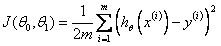
Goal: 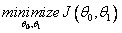
Contour Plot:
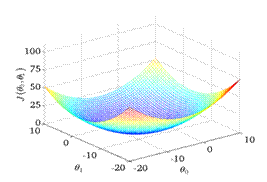
B.Linear Regression with Multiple Variable Cost Function
Cost Function: 
Goal: 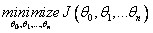
Gradient Descent
Outline
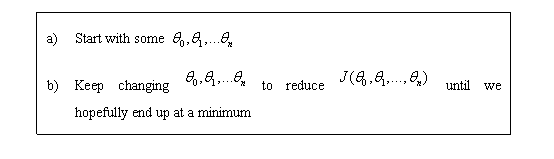
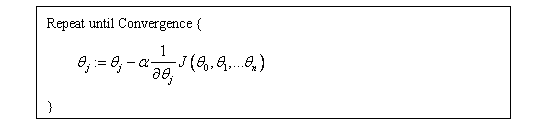
Gradient Descent Algorithm
迭代过程收敛图可能如下:
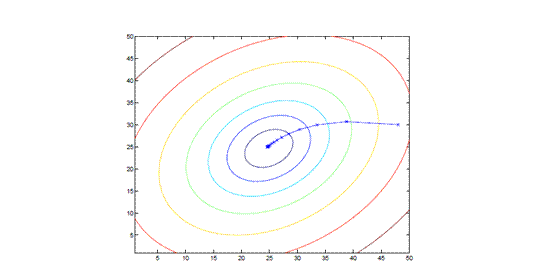
(此为等高线图,中间为最小值点,图中蓝色弧线为可能的收敛路径。)
Learning Rate α:
1) If α is too small, gradient descent can be slow to converge;
2) If α is too large, gradient descent may not decrease on every iteration or may not converge;
3) For sufficiently small α , J(θ) should decrease on every iteration;
Choose Learning Rate α: Debug, 0.001, 0.003, 0.006, 0.01, 0.03, 0.06, 0.1, 0.3, 0.6, 1.0;
“Batch” Gradient Descent: Each step of gradient descent uses all the training examples;
“Stochastic” gradient descent: Each step of gradient descent uses only one training examples.
Normal Equation
IDEA: Method to solve for θ analytically.
 for every j, then
Restriction: Normal Equation does not work when (XTX) is non-invertible.
PS: 当矩阵为满秩矩阵时,该矩阵可逆。列向量(feature)线性无关且行向量(样本)线性无关的个数大于列向量的个数(特征个数n).
Gradient Descent Algorithm VS. Normal Equation
Gradient Descent:
- Need to choose α;
- Needs many iterations;
- Works well even when n is large; (n > 1000 is appropriate)
Normal Equation:
- No need to choose α;
- Don’t need to iterate;
- Need to compute (XTX)-1 ;
- Slow if n is very large. (n < 1000 is OK)
Feature Scaling
IDEA: Make sure features are on a similar scale.
好处: 减少迭代次数,有利于快速收敛
Example: If we need to get every feature into approximately a -1 ≤ xi ≤ 1 range, feature values located in [-3, 3] or [-1/3, 1/3] fields are acceptable.
Mean normalization: 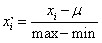
HOMEWORK
好了,既然看完了视频课程,就来做一下作业吧,下面是Linear Regression部分作业的核心代码:
1.computeCost.m/computeCostMulti.m
J=/(*m)*sum((theta'*X'-y').^2);
2.gradientDescent.m/gradientDescentMulti.m
h=X*theta-y;

v=X'*h;

v=v*alpha/m;

theta1=theta;

theta=theta-v;
(原创)Stanford Machine Learning (by Andrew NG) --- (week 1) Linear Regression的更多相关文章
- (原创)Stanford Machine Learning (by Andrew NG) --- (week 3) Logistic Regression & Regularization
coursera上面Andrew NG的Machine learning课程地址为:https://www.coursera.org/course/ml 我曾经使用Logistic Regressio ...
- (原创)Stanford Machine Learning (by Andrew NG) --- (week 10) Large Scale Machine Learning & Application Example
本栏目来源于Andrew NG老师讲解的Machine Learning课程,主要介绍大规模机器学习以及其应用.包括随机梯度下降法.维批量梯度下降法.梯度下降法的收敛.在线学习.map reduce以 ...
- (原创)Stanford Machine Learning (by Andrew NG) --- (week 8) Clustering & Dimensionality Reduction
本周主要介绍了聚类算法和特征降维方法,聚类算法包括K-means的相关概念.优化目标.聚类中心等内容:特征降维包括降维的缘由.算法描述.压缩重建等内容.coursera上面Andrew NG的Mach ...
- (原创)Stanford Machine Learning (by Andrew NG) --- (week 7) Support Vector Machines
本栏目内容来源于Andrew NG老师讲解的SVM部分,包括SVM的优化目标.最大判定边界.核函数.SVM使用方法.多分类问题等,Machine learning课程地址为:https://www.c ...
- (原创)Stanford Machine Learning (by Andrew NG) --- (week 9) Anomaly Detection&Recommender Systems
这部分内容来源于Andrew NG老师讲解的 machine learning课程,包括异常检测算法以及推荐系统设计.异常检测是一个非监督学习算法,用于发现系统中的异常数据.推荐系统在生活中也是随处可 ...
- (原创)Stanford Machine Learning (by Andrew NG) --- (week 4) Neural Networks Representation
Andrew NG的Machine learning课程地址为:https://www.coursera.org/course/ml 神经网络一直被认为是比较难懂的问题,NG将神经网络部分的课程分为了 ...
- (原创)Stanford Machine Learning (by Andrew NG) --- (week 1) Introduction
最近学习了coursera上面Andrew NG的Machine learning课程,课程地址为:https://www.coursera.org/course/ml 在Introduction部分 ...
- (原创)Stanford Machine Learning (by Andrew NG) --- (week 5) Neural Networks Learning
本栏目内容来自Andrew NG老师的公开课:https://class.coursera.org/ml/class/index 一般而言, 人工神经网络与经典计算方法相比并非优越, 只有当常规方法解 ...
- (原创)Stanford Machine Learning (by Andrew NG) --- (week 6) Advice for Applying Machine Learning & Machine Learning System Design
(1) Advice for applying machine learning Deciding what to try next 现在我们已学习了线性回归.逻辑回归.神经网络等机器学习算法,接下来 ...
随机推荐
- new操作符的内部运行解析
在加上new操作符,我们就能完成传统面向对象的class + new的方式创建对象,在Javascript中,我们将这类方式成为Pseudoclassical. 基于上面的例子,我们执行如下代码 ...
- Java多态的实现原理
1.多态的定义:指允许不同类的对象,对同一消息作出响应: 即同一消息可以根据发送对象的不同采用多种不同的行为方式: 2.多态的实现技术:动态绑定: 指在执行期间判断所引用对象的实际类型,根据其实际的类 ...
- linux和ubuntu防火墙相关命令
1.永久有效 开启: chkconfig iptables on 关闭: chkconfig iptables off 2.即刻生效 开启: service iptables start 关闭: se ...
- HDU 5117 Fluorescent
题目链接:HDU-5117 题意为有n盏灯,m个开关,每个开关控制着\( k_{i} \)灯.X为最后亮着的灯的个数,要求出\( E(X^{3} ) * 2^{M} mod (10^9 + 7) \) ...
- C基础 redis缓存访问
引言 先说redis安装, 这里采用的环境是. Linux version --generic (buildd@lgw01-) (gcc version (Ubuntu -14ubuntu2) ) # ...
- 关于eclipase出现的problems during content assist报错问题
解决办法: 把下面箭头指的地方改为上面箭头的指向
- c语言中数组,指针数组,数组指针,二维数组指针
1.数组和指针 ] = {,,,,};// 定义数组 // 1. 指针和数组的关系 int * pa = array; pa = array; // p[0] == *(p+0) == array[0 ...
- Restore IP Addresses——边界条件判定
Given a string containing only digits, restore it by returning all possible valid IP address combina ...
- 《The art of software testing》的一个例子
这几天一直在看一本书,<The art of software testing>,里面有一个例子挺有感触地,写出来和大家分享一下: [问题] 从输入对话框中读取三个整数值,这三个整数值代表 ...
- PHP7.3发布啦
作为PHP5的最后一个版本,也是目前使用最广泛的PHP版本,PHP 5.6始于公元2014年(不是1804年,嘿嘿),其第一个测试版PHP 5.6 alpha 1版于2014年1月发布.随机产生了第一 ...