
mybatis常用标签(转)
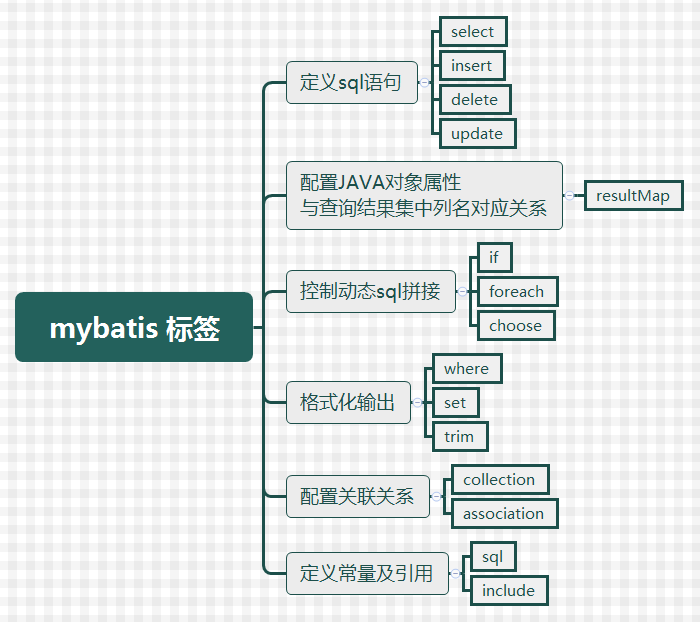
1. 定义sql语句
select 标签
属性介绍:
- id :唯一的标识符.
- parameterType:传给此语句的参数的全路径名或别名 例:com.test.poso.User或user
- resultType :语句返回值类型或别名。注意,如果是集合,那么这里填写的是集合的泛型,而不是集合本身(resultType 与resultMap 不能并用)
<select id="selectByPrimaryKey" resultMap="BaseResultMap" parameterType="Object">

        select * from student where id=#{id}

</select>
insert标签
属性介绍:
- id :唯一的标识符
- parameterType:传给此语句的参数的全路径名或别名 例:com.test.poso.User
<insert id="insert" parameterType="Object">

   insert into student

  <trim  prefix="("suffix=")"  suffixOverrides="," >

      <if test="name != null  "> NAME,  </if>

    </trim>

  <trim prefix="values("suffix=")"  suffixOverrides="," >

      <if test="name != null  ">  #{name},  </if>

    </trim>

</insert>
delete标签
属性同 insert
<delete id="deleteByPrimaryKey" parameterType="Object">

        delete from student where id=#{id}

</delete>
update标签
属性同 insert
2. 配置JAVA对象属性与查询结果集中列名对应关系
resultMap 标签的使用
基本作用:
- 建立SQL查询结果字段与实体属性的映射关系信息
- 查询的结果集转换为java对象,方便进一步操作。
- 将结果集中的列与java对象中的属性对应起来并将值填充进去
!注意:与java对象对应的列不是数据库中表的列名,而是查询后结果集的列名
<resultMap id="BaseResultMap" type="com.online.charge.platform.student.model.Student">

        <id property="id" column="id" />

        <result column="NAME" property="name" />

        <result column="HOBBY" property="hobby" />

        <result column="MAJOR" property="major" />

        <result column="BIRTHDAY" property="birthday" />

        <result column="AGE" property="age" />

</resultMap>

<!--查询时resultMap引用该resultMap -->

<select id="selectByPrimaryKey" resultMap="BaseResultMap" parameterType="Object">

        select id,name,hobby,major,birthday,age from student where id=#{id}

</select>
标签说明:
主标签:
- id:该resultMap的标志
- type:返回值的类名,此例中返回Studnet类
子标签:
- id:用于设置主键字段与领域模型属性的映射关系,此处主键为ID,对应id。
- result:用于设置普通字段与领域模型属性的映射关系
3. 动态sql拼接
if 标签
if标签通常用于WHERE语句、UPDATE语句、INSERT语句中,通过判断参数值来决定是否使用某个查询条件、判断是否更新某一个字段、判断是否插入某个字段的值。
<if test="name != null and name != ''">

         and NAME = #{name}

</if>
foreach 标签
foreach标签主要用于构建in条件,可在sql中对集合进行迭代。也常用到批量删除、添加等操作中。
    <!-- in查询所有,不分页 -->

    <select id="selectIn" resultMap="BaseResultMap">

        select name,hobby from student where id in

        <foreach item="item" index="index" collection="list" open="(" separator="," close=")">

            #{item}

        </foreach>

    </select>
属性介绍:
- collection:collection属性的值有三个分别是list、array、map三种,分别对应的参数类型为:List、数组、map集合。
- item :表示在迭代过程中每一个元素的别名
- index :表示在迭代过程中每次迭代到的位置(下标)
- open :前缀
- close :后缀
- separator :分隔符,表示迭代时每个元素之间以什么分隔
choose标签
有时候我们并不想应用所有的条件,而只是想从多个选项中选择一个。MyBatis提供了choose 元素,按顺序判断when中的条件出否成立,如果有一个成立,则choose结束。当choose中所有when的条件都不满则时,则执行 otherwise中的sql。类似于Java 的switch 语句,choose为switch,when为case,otherwise则为default。
if是与(and)的关系,而choose是或(or)的关系。
<select id="getStudentListChoose" parameterType="Student" resultMap="BaseResultMap">

    SELECT * from STUDENT WHERE 1=1

    <where>

        <choose>

            <when test="Name!=null and student!='' ">

                   AND name LIKE CONCAT(CONCAT('%', #{student}),'%')

            </when>

            <when test="hobby!= null and hobby!= '' ">

                    AND hobby = #{hobby}

            </when>

            <otherwise>

                    AND AGE = 15

            </otherwise>

        </choose>

    </where>

</select>
4. 格式化输出
where标签
当if标签较多时,这样的组合可能会导致错误。 如下:
<select id="getStudentListWhere" parameterType="Object" resultMap="BaseResultMap">

    SELECT * from STUDENT

        WHERE

        <if test="name!=null and name!='' ">

            NAME LIKE CONCAT(CONCAT('%', #{name}),'%')

        </if>

        <if test="hobby!= null and hobby!= '' ">

            AND hobby = #{hobby}

        </if>

</select>
当name值为null时,查询语句会出现 “WHERE AND” 的情况,解决该情况除了将"WHERE"改为“WHERE 1=1”之外,还可以利用where标签。这个“where”标签会知道如果它包含的标签中有返回值的话,它就插入一个‘where’。此外,如果标签返回的内容是以AND 或OR 开头的,则它会剔除掉。
<select id="getStudentListWhere" parameterType="Object" resultMap="BaseResultMap">

    SELECT * from STUDENT

       <where>

         <if test="name!=null and name!='' ">

            NAME LIKE CONCAT(CONCAT('%', #{name}),'%')

         </if>

         <if test="hobby!= null and hobby!= '' ">

            AND hobby = #{hobby}

         </if>

       </where>

</select>
set 标签
没有使用if标签时,如果有一个参数为null,都会导致错误。当在update语句中使用if标签时,如果最后的if没有执行,则或导致逗号多余错误。使用set标签可以将动态的配置set关键字,和剔除追加到条件末尾的任何不相关的逗号。
<update id="updateStudent" parameterType="Object">

    UPDATE STUDENT

       SET NAME = #{name},

           MAJOR = #{major},

           HOBBY = #{hobby}

     WHERE ID = #{id};

</update>

<update id="updateStudent" parameterType="Object">

    UPDATE STUDENT SET

        <if test="name!=null and name!='' ">

            NAME = #{name},

        </if>

        <if test="hobby!=null and hobby!='' ">

            MAJOR = #{major},

        </if>

        <if test="hobby!=null and hobby!='' ">

            HOBBY = #{hobby}

        </if>

    WHERE ID = #{id};

</update>
使用set+if标签修改后,如果某项为null则不进行更新,而是保持数据库原值。
<update id="updateStudent" parameterType="Object">

    UPDATE STUDENT

    <set>

        <if test="name!=null and name!='' ">

            NAME = #{name},

        </if>

        <if test="hobby!=null and hobby!='' ">

            MAJOR = #{major},

        </if>

        <if test="hobby!=null and hobby!='' ">

            HOBBY = #{hobby}

        </if>

    </set>

    WHERE ID = #{id};

</update>
trim标签
格式化输出,也可以通过trim标签设定或忽略前后缀来实现。
5. 配置关联关系
5.1 collection标签
5.2 association标签
6. 定义常量及引用
sql标签
当多种类型的查询语句的查询字段或者查询条件相同时,可以将其定义为常量,方便调用。为求<select>结构清晰也可将sql语句分解。
<!-- 查询字段 -->

    <sql id="Base_Column_List">

        ID,MAJOR,BIRTHDAY,AGE,NAME,HOBBY

    </sql>

 <!-- 查询条件 -->

    <sql id="Example_Where_Clause">

        where 1=1

        <trim suffixOverrides=",">

            <if test="id != null and id !=''">

                and id = #{id}

            </if>

            <if test="major != null and major != ''">

                and MAJOR = #{major}

            </if>

            <if test="birthday != null ">

                and BIRTHDAY = #{birthday}

            </if>

            <if test="age != null ">

                and AGE = #{age}

            </if>

            <if test="name != null and name != ''">

                and NAME = #{name}

            </if>

            <if test="hobby != null and hobby != ''">

                and HOBBY = #{hobby}

            </if>

            <if test="sorting != null">

                order by #{sorting}

            </if>

            <if test="sort!= null  and sort != '' ">

                order by ${sort}   ${order}

            </if>

        </trim>

    </sql>
include标签
用于引用定义的常量
<!-- 查询所有,不分页 -->

    <select id="selectAll" resultMap="BaseResultMap">

        SELECT

        <include refid="Base_Column_List" />

        FROM

        student

        <include refid="Example_Where_Clause" />

    </select>

<!-- 分页查询 -->

    <select id="select" resultMap="BaseResultMap">

        select * from (

            select tt.*,rownum as rowno from

                (

                    SELECT

                    <include refid="Base_Column_List" />

                    FROM

                    student

                    <include refid="Example_Where_Clause" />

                     ) tt

                     <where>

                            <if test="pageNum != null and rows != null">

                            and  rownum  <![CDATA[<=]]>#{page}*#{rows}

                         </if>

                    </where>

             ) table_alias

            where table_alias.rowno>#{pageNum}

    </select>

<!-- 根据条件删除 -->

    <delete id="deleteByEntity" parameterType="java.util.Map">

    DELETE  FROM   student

    <include refid="Example_Where_Clause" />

    </delete>
原文地址:https://blog.csdn.net/m0_38054145/article/details/81906343
mybatis常用标签(转)的更多相关文章
- MyBatis - 常用标签与动态Sql
MyBatis常用标签 ● 定义sql语句:select.insert.delete.update ● 配置JAVA对象属性与查询结构及中列明对应的关系:resultMap ● 控制动态sql拼接:i ...
- Mybatis 常用标签
MyBatis 的强大特性之一便是它的动态 SQL.如果你有使用 JDBC 或其他类似框架的经验,你就能体会到根据不同条件拼接 SQL 语句有多么痛苦.拼接的时候要确保不能忘了必要的空格,还要注意省掉 ...
- [Mybatis]Mybatis 常用标签及功能整理
Mybatis中生成动态SQL的标签有四类,分别是: if choose (when, otherwise) trim (where, set) foreach 1.if 当需要动态生成where条件 ...
- mybatis常用标签
1. 定义sql语句 1.1 select 标签 属性介绍: id :唯一的标识符. parameterType:传给此语句的参数的全路径名或别名 例:com.test.poso.User或user ...
- Mybatis常用标签使用
trim元素的主要功能是可以在自己包含的内容前加上某些前缀,也可以在其后加上某些后缀,与之对应的属性是prefix和suffix:可以把包含内容的首部某些内容覆盖,即忽略,也可以把尾部的某些内容覆盖, ...
- [刘阳Java]_MyBatis_映射文件的常用标签总结_第5讲
MyBatis中常用标签的总结,简单给出自己的总结 MyBatis映射文件中的标签使用介绍1.<select>:用于编写查询语句用的标签 id:表示当前<select>标签的唯 ...
- Mybatis 常用注解
Mybatis常用注解对应的目标和标签如表所示: 注解 目标 对应的XML标签 @CacheNamespace 类 <cache> @CacheNamespaceRef 类 <cac ...
- Mybatis foreach标签含义
背景 考虑以下场景: InfoTable(信息表): Name Gender Age Score 张三 男 21 90 李四 女 20 87 王五 男 22 92 赵六 女 19 94 孙七 女 23 ...
- MyBatis 常用写法
MyBatis 常用写法 1.forEach 循环 forEach 元素的属性主要有 item, idnex, collection, open, separator, close. collec ...
随机推荐
- unity lua require dofile loadfile 区别
oadfile,加载文件,编译文件,并且返回一个函数,不运行 dofile其实就是包装了Loadfile,根据loadfile的返回函数运行一遍 require加载文件的时候,不用带目录,有lua自己 ...
- 缩放 transform
转换属性 transform 转换是css3中的一个特征,可以实现元素的缩放,位移,变形. 作用: 使元素在位置或者形状上发生一定的改变. 属性: transform 属性值: scale:缩放(一般 ...
- Step By Step(Lua面向对象)
Step By Step(Lua面向对象) Lua中的table就是一种对象,但是如果直接使用仍然会存在大量的问题,见如下代码: 1 Account = {balance = 0}2 function ...
- 08.ElementUI 2.X 源码学习:源码剖析之工程化(三)
0x.00 前言 项目工程化系列文章链接如下,推荐按照顺序阅读文章 . 1️⃣ 源码剖析之工程化(一):项目概览.package.json.npm script 2️⃣ 源码剖析之工程化(二):项目构 ...
- Redis系列(五):消息队列
消息队列已经成为现在互联网服务端的标配组件,现在比较常用的消息中间件有RabbitMQ.Kafka.RocketMQ.ActiveMQ.说出来你可能不信,Redis作为一个缓存中间件,居然也提供了消息 ...
- 彻底搞懂彻底搞懂事件驱动模型 - Reactor
在高性能网络技术中,大家应该经常会看到Reactor模型.并且很多开源软件中都使用了这个模型,如:Redis.Nginx.Memcache.Netty等. 刚开始接触时可能一头雾水,这到底是个什么东东 ...
- 每天凌晨 2:00 将 mysql 数据库 testdb ,备份到文件中。
步骤:1, 首先编写一个 脚本 backupdb.sh#!/bin/bash #备份路径 BACKUP=/data/backup/sql/dy #当前时间 DATETIME=$(date +%Y-%m ...
- Java知识复习(四)
最近准备跳槽,又要好好复习基本知识了.过了个年,前面刚接触的springboot也只能先放放了.就先把自己复习了哪些罗列出来吧. Set里的元素是不能重复的,那么用什么方法来区分重复与否呢? 是用== ...
- STL----vector注意事项
开vector时要注意内存容易炸 最好的办法就是在开vector之后,对他进行一步操作 vector<int> a; a.resize(n); n就是你要开的数组的大小,此时数组里已经插入 ...
- ES6学习笔记之 this 详解
1.非箭头函数下的 this var obj = { x: 0, f1: function () { console.log(this.x); } } var f1 = obj.f1; var x = ...