
7.27考试总结(NOIP模拟25)[random·string·queue]
死亡的尽头,没有神
T1 random
解题思路
这波是找规律完胜了。。
lby dalao根据样例找出了正确的式子:\(\dfrac{n^2-1}{9}\)
然而,我这个菜鸡却推出了这样一个错误的式子:\(\dfrac{(n-1)^2\times 2^n}{n^2\times (n+1)}\)
那么哪个像正解呢,当然是我的这个了(虽然他一点道理没有)。。。
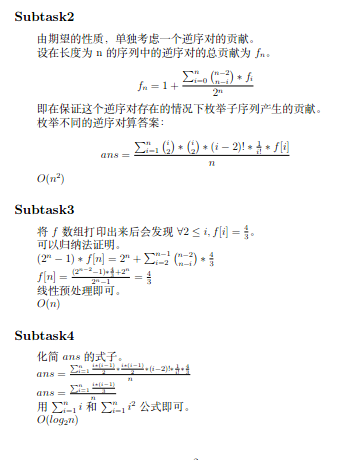
别的啥也不想说了,看一下官方题解吧。。。
code
#include<bits/stdc++.h>

#define int long long

using namespace std;

const int mod=998244353,INV_9=443664157;

int n,T;

signed main()

{

	scanf("%lld",&T);

	while(T--){

		scanf("%lld",&n);

		n=n%mod;

		printf("%lld\n",(n%mod*n%mod-1)*INV_9%mod);

	}

	return 0;

}
T2 string
解题思路
首先明确一下:是把前缀接在后缀后面。
这样就可以直接拼接对于每一个拼好的串维护一个 Hash 值,然后匹配就好了(40pts到手)
对于官方题解里的 Subtask3 其实是可以卡到 90pts 的,只要剪一下枝就好了。
只可惜我太菜只卡到了 80pts 。
思路还是和题解一样的维护每个串的 Hash 后,计算出在大串上作为后缀结尾和前缀开头的数量,分别记到 f 和 g 数组里。
\]
正解还是在求 f 和 g 数组,对于之前的操作有了一个优化。
先把 n 个串分别正反压入两个 Tire 树,然后就可以处理出每个位置的后缀或者前缀的数量。
然后在 Tire 树上 DFS 一遍就可以求出每一个的 Hash 值,然后的操作就与前面的差不多了,不过是加了一个二分优化。
注意要用不会自动排序的 unordered_map 以及在查找是否有值的时候用 find 函数,不要直接调用值。
code
40pts
#include<bits/stdc++.h>

#define int long long

using namespace std;

inline int read()

{

	int x=0,f=1;

	char ch=getchar();

	while(ch>'9'||ch<'0')

	{

		if(ch=='-')	f=-1;

		ch=getchar();

	}

	while(ch>='0'&&ch<='9')

	{

		x=(x<<1)+(x<<3)+(ch^48);

		ch=getchar();

	}

	return x*f;

}

const int N=2e5+10,M=1e3+10;

const unsigned long long base=13331ull;

int n,len,ans;

unsigned long long has[N],ha[N],p[N];

string s,ch[N];

signed main()

{

	cin>>s;

	len=s.size();

	s=" "+s;

	n=read();

	p[0]=1;

	for(int i=1;i<=len+1;i++)

		p[i]=p[i-1]*base;

	for(int i=1;i<=n;i++)

		cin>>ch[i];

	for(int i=1;i<s.size();i++)

		has[i]=has[i-1]*base+s[i];

	for(int i=1;i<=n;i++)

		for(int j=1;j<=n;j++)

		{

			string c=" "+ch[i]+ch[j];

			int fjx=ch[i].size(),le=c.size()-1;

			for(int k=1;k<=le;k++)

				ha[k]=ha[k-1]*base+c[k];

			for(int l=1;l<=fjx;l++)

				for(int r=fjx+1;r<=le;r++)

				{

					int lent=r-l+1;

					for(int k=1;k+lent-1<=len;k++)

					{

						int pos=k+lent-1;

						unsigned long long temp=has[pos]-has[k-1]*p[pos-k+1]+base*10;

						unsigned long long tmp=ha[r]-ha[l-1]*p[r-l+1]+base*10;

						if(temp==tmp)	ans++;

					}

				}

		}

	printf("%lld",ans);

	return 0;

}
80pts(最高90pts)
#include<bits/stdc++.h>

#define int long long

#define ull unsigned long long

using namespace std;

inline int read()

{

	int x=0,f=1;

	char ch=getchar();

	while(ch>'9'||ch<'0')

	{

		if(ch=='-')	f=-1;

		ch=getchar();

	}

	while(ch>='0'&&ch<='9')

	{

		x=(x<<1)+(x<<3)+(ch^48);

		ch=getchar();

	}

	return x*f;

}

const int N=1e5+10;

const ull base=131ull;

int n,len,ans,lent[N],f[N],g[N];

ull has[N],p[N];

vector<ull > ha[N];

char s[N],ch[N];

signed main()

{

	scanf("%s",s+1);

	len=strlen(s+1);

	scanf("%lld",&n);

	p[0]=1;

	for(int i=1;i<=len;i++)

		p[i]=p[i-1]*base;

	for(int i=1;i<=len;i++)

		has[i]=has[i-1]*base+s[i];

	for(int i=1;i<=n;i++)

	{

		scanf("%s",ch+1);

		lent[i]=strlen(ch+1);

		ha[i].push_back(0);

		for(int j=1;j<=lent[i];j++)

			ha[i].push_back(ha[i][j-1]*base+ch[j]);

	}

	for(int i=1;i<=len;i++)

		for(int j=1;j<=n;j++)

		{

			int le=lent[j];

			for(int k=1;k<=le;k++)

			{

				ull tmp1=ha[j][le]-ha[j][le-k]*p[k];

				ull tmp2=has[i]-has[i-k]*p[k];

				if(tmp1==tmp2)	f[i]++;

				else	break;

			}

			for(int k=1;k<=le;k++)

			{

				ull tmp1=ha[j][k];

				ull tmp2=has[i+k-1]-has[i-1]*p[k];

				if(tmp1==tmp2)	g[i]++;

				else	break;

			}

		}

	for(int i=1;i<=len;i++)

		ans+=f[i]*g[i+1];

	printf("%lld",ans);

	return 0;

}
正解
#include<bits/stdc++.h>

#define int long long

#define ull unsigned long long

#define f() cout<<"Pass"<<endl

using namespace std;

inline int read()

{

	int x=0,f=1;

	char ch=getchar();

	while(ch>'9'||ch<'0')

	{

		if(ch=='-')	f=-1;

		ch=getchar();

	}

	while(ch>='0'&&ch<='9')

	{

		x=(x<<1)+(x<<3)+(ch^48);

		ch=getchar();

	}

	return x*f;

}

const int N=1e5+10,M=5e5+10;

const ull base=1331;

vector<int> ch[N];

char s[N],c[N];

int len[N],n,lent,ans,f[N],g[N];

ull p[N],preh[N],sufh[N];

struct Tire

{

	int all,tre[M][30],val[M*30];

	unordered_map<ull,int> mp;

	Tire(){all=1;}

	void insert(int pos)

	{

		int rt=1;

		for(int i=0;i<len[pos];i++)

		{

			int num=ch[pos][i];

			if(!tre[rt][num])	tre[rt][num]=++all;

			rt=tre[rt][num];

			val[rt]++;

		}

	}

	void dfs(int x,ull cnt)

	{

		mp[cnt]=val[x];

		for(int i=1;i<=26;i++)

			if(tre[x][i])

			{

				val[tre[x][i]]+=val[x];

				dfs(tre[x][i],cnt*base+i);

			}

	}

}pre,suf;

signed main()

{

	scanf("%s",s+1);

	lent=strlen(s+1);

	n=read();

	for(int i=1;i<=n;i++)

	{

		scanf("%s",c+1);

		len[i]=strlen(c+1);

		for(int j=1;j<=len[i];j++)

			ch[i].push_back(c[j]-'a'+1);

	}

	for(int i=1;i<=n;i++)

		pre.insert(i);

	for(int i=1;i<=n;i++)

		reverse(ch[i].begin(),ch[i].end());

	for(int i=1;i<=n;i++)

		suf.insert(i);

	pre.dfs(1,0);

	suf.dfs(1,0);

	p[0]=1;

	for(int i=1;i<=lent;i++)

		p[i]=p[i-1]*base;

	for(int i=1;i<=lent;i++)

		preh[i]=preh[i-1]*base+s[i]-'a'+1;

	for(int i=lent;i>=1;i--)

		sufh[i]=sufh[i+1]*base+s[i]-'a'+1;

	for(int i=1;i<=lent;i++)

	{

		int temp=0,l=1,r=lent-i+1;

		if(pre.mp.find(s[i]-'a'+1)!=pre.mp.end())

		{

			while(l<=r)

			{

				int mid=(l+r)>>1;

				if(pre.mp.find(preh[i+mid-1]-preh[i-1]*p[mid])!=pre.mp.end())	l=mid+1,temp=mid;

				else	r=mid-1;

			}

			g[i]=pre.mp[preh[i+temp-1]-preh[i-1]*p[temp]];

		}

		temp=0;l=0,r=i;

		if(suf.mp.find(s[i]-'a'+1)!=suf.mp.end())

		{

			while(l<=r)

			{

				int mid=(l+r)>>1;

				if(suf.mp.find(sufh[i-mid+1]-sufh[i+1]*p[mid])!=suf.mp.end())	l=mid+1,temp=mid;

				else	r=mid-1;

			}

			f[i]=suf.mp[sufh[i-temp+1]-sufh[i+1]*p[temp]];

		}

	}

	for(int i=1;i<=lent;i++)

		ans+=f[i]*g[i+1];

	printf("%lld",ans);

	return 0;

}
T3 queen
解题思路
其实就是推式子,然后敲就行了。。
比较重要的就是一个柿子:\(\sum\limits_{i=1}^{n}i^2=\dfrac{n\times (n+1)\times (2n+1)}{6}\)
考场上推了一下 k=3 的以为 4以及以上的有非常难的一些东西就直接弃掉了。
考完之后看了一下 k=1 的情况没有取\(\bmod\),挂了20pts
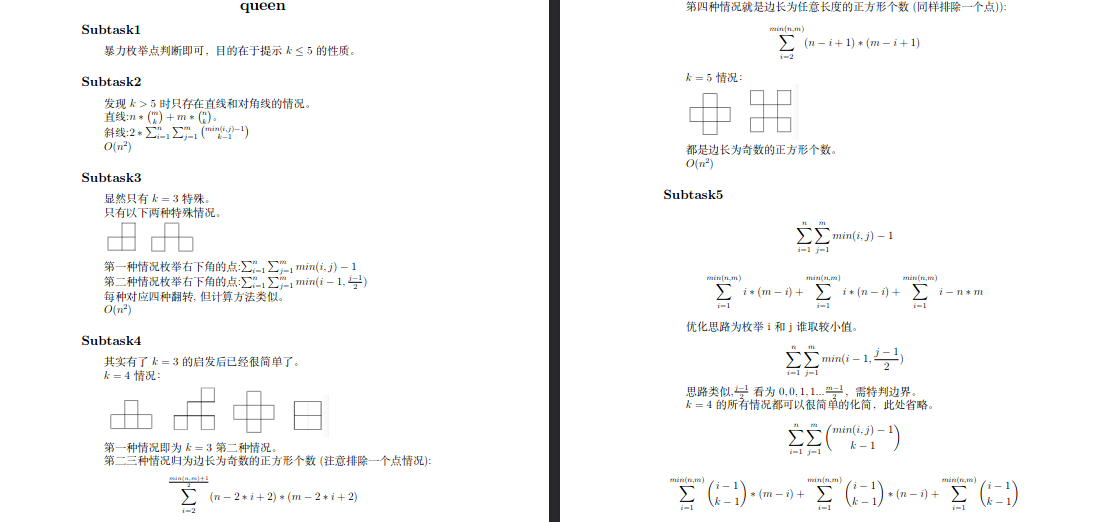
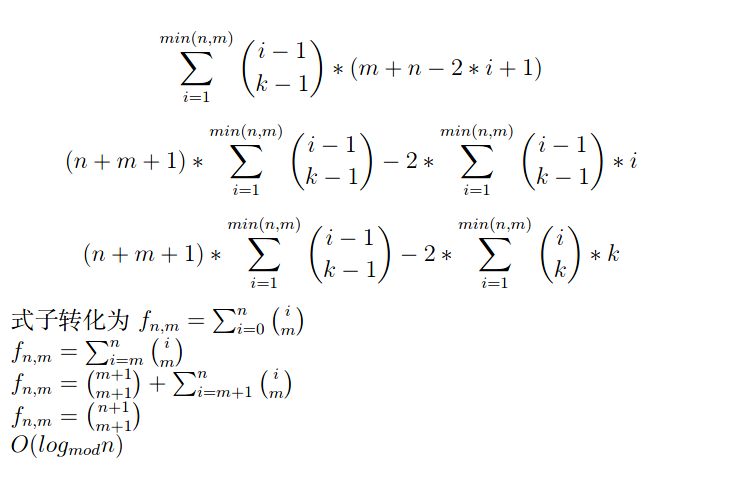
然后就是公式乱用,然后就是非常恶心的边界问题,官方题解写的就挺好:
code
80pts
#include<bits/stdc++.h>

#define int long long

using namespace std;

inline int read()

{

	int x=0,f=1;

	char ch=getchar();

	while(ch>'9'||ch<'0')

	{

		if(ch=='-')	f=-1;

		ch=getchar();

	}

	while(ch>='0'&&ch<='9')

	{

		x=(x<<1)+(x<<3)+(ch^48);

		ch=getchar();

	}

	return x*f;

}

const int N=1e3+10,mod=3e5+7;

int T,n,m,k,ans,c[N][N];

void get_C()

{

	c[0][0]=1;

	for(int i=1;i<N;i++)

	{

		c[i][0]=c[i][i]=1;

		for(int j=1;j<i;j++)

		{

			c[i][j]=(c[i-1][j-1]+c[i-1][j])%mod;

		}

	}

}

void solve()

{

	n=read();

	m=read();

	k=read();

	ans=0;

	if(k>m&&k>n)

	{

		cout<<0<<endl;

		return ;

	}

	if(k==1)

	{

		cout<<n*m%mod<<endl;

		return ;

	}

	if(m>n)	swap(n,m);

	ans=(c[n][k]*m%mod+c[m][k]*n%mod)%mod;

	for(int i=k;i<m;i++)

		ans=(ans+c[i][k]*4%mod)%mod;

	ans=(ans+2*c[m][k]%mod*(n-m+1)%mod)%mod;

	if(k==3)

	{

		for(int len=2;len<=m;len++)

			ans=(ans+(n-len+1)*(m-len+1)%mod*4%mod)%mod;

		for(int len=2;len<=n&&2*len-1<=m;len++)

			ans=(ans+(n-len+1)*(m-2*len+2)%mod*2%mod)%mod;

		for(int len=2;len<=m&&2*len-1<=n;len++)

			ans=(ans+(m-len+1)*(n-2*len+2)%mod*2%mod)%mod;

	}

	if(k==4)

	{

		for(int len=2;len<=m;len++)

			ans=(ans+(n-len+1)*(m-len+1)%mod)%mod;

		for(int len=2;len<=n&&2*len-1<=m;len++)

			ans=(ans+(n-len+1)*(m-2*len+2)%mod*2%mod)%mod;

		for(int len=2;len<=m&&2*len-1<=n;len++)

			ans=(ans+(m-len+1)*(n-2*len+2)%mod*2%mod)%mod;

		for(int len=1;2*len+1<=m;len++)

			ans=(ans+(m-2*len)*(n-2*len)%mod*5%mod)%mod;

	}

	if(k==5)

	{

		for(int len=1;2*len+1<=m;len++)

			ans=(ans+(m-2*len)*(n-2*len)%mod*2%mod)%mod;

	}

	printf("%lld\n",ans%mod);

}

signed main()

{

	T=read();

	get_C();

	while(T--)	solve();

	return 0;

}
正解(代码略丑)
#include<bits/stdc++.h>

#define int long long

#define f() cout<<"Pass"<<endl

using namespace std;

inline int read()

{

	int x=0,f=1;

	char ch=getchar();

	while(ch>'9'||ch<'0')

	{

		if(ch=='-')	f=-1;

		ch=getchar();

	}

	while(ch>='0'&&ch<='9')

	{

		x=(x<<1)+(x<<3)+(ch^48);

		ch=getchar();

	}

	return x*f;

}

const int N=1e3+10,mod=3e5+7;

int T,n,m,pn,pm,k,ans,jc[mod+10],inv[mod+10];

int ksm(int x,int y)

{

	int temp=1;

	while(y)

	{

		if(y&1)	temp=temp*x%mod;

		x=x*x%mod;

		y>>=1;

	}

	return temp%mod;

}

int work(int x,int y)

{

	if(y>x)	return 0;

	return jc[x]*ksm(jc[y],mod-2)%mod*ksm(jc[x-y],mod-2)%mod;

}

int C(int x,int y)

{

	if(y>x)	return 0;

	if(!x||!y)	return 1;

	return C(x/mod,y/mod)*work(x%mod,y%mod)%mod;

}

void solve()

{

	n=read();

	m=read();

	k=read();

	if(m<n)	swap(n,m);

	pn=(n-1)%mod+1;

	pm=(m-1)%mod+1;

	if(k>m&&k>n)

	{

		cout<<0<<endl;

		return ;

	}

	if(k==1)

	{

		cout<<pn*pm%mod<<endl;

		return ;

	}

	ans=(C(n,k)*pm%mod+C(m,k)*pn%mod+2*(m-n+1)%mod*C(n,k)%mod+4*C(n,k+1)%mod)%mod;

	if(k==3)

	{

		int tmp1=(min(m,n/2)-1)%mod+1,tmp2=(min(n,m/2)-1)%mod+1;

		n=pn;m=pm;

		ans=(ans+4ll*(m*n%mod*(n-1)%mod-(m+n)*(n-1)%mod*n%mod*ksm(2,mod-2)%mod+(n-1)*n%mod*(2*n-1)%mod*ksm(6,mod-2)%mod+2ll*mod)%mod)%mod;

		ans=(ans+2ll*(-tmp1*(tmp1+1)%mod*ksm(2,mod-2)%mod*(n+m*2)%mod+(tmp1+1)*tmp1%mod*(2*tmp1+1)%mod*ksm(6,mod-2)%mod*2ll%mod+n*m%mod*tmp1%mod+mod*2)%mod)%mod;

		ans=(ans+2ll*(-tmp2*(tmp2+1)%mod*ksm(2,mod-2)%mod*(m+n*2)%mod+(tmp2+1)*tmp2%mod*(2*tmp2+1)%mod*ksm(6,mod-2)%mod*2ll%mod+n*m%mod*tmp2%mod+mod*2)%mod)%mod;

	}

	if(k==4)

	{

		int tmp1=(min(m,n/2)-1)%mod+1,tmp2=(min(n,m/2)-1)%mod+1,temp1=(n-1)/2%mod,temp2=n/2%mod;

		n=pn;m=pm;

		ans=(ans+(m*n%mod*(n-1)%mod-(m+n)*(n-1)%mod*n%mod*ksm(2,mod-2)%mod+(n-1)*n%mod*(2*n-1)%mod*ksm(6,mod-2)%mod+2ll*mod)%mod)%mod;

		ans=(ans+2ll*(-tmp1*(tmp1+1)%mod*ksm(2,mod-2)%mod*(n+m*2)%mod+(tmp1+1)*tmp1%mod*(2*tmp1+1)%mod*ksm(6,mod-2)%mod*2ll%mod+n*m%mod*tmp1%mod+mod*2)%mod)%mod;

		ans=(ans+2ll*(-tmp2*(tmp2+1)%mod*ksm(2,mod-2)%mod*(m+n*2)%mod+(tmp2+1)*tmp2%mod*(2*tmp2+1)%mod*ksm(6,mod-2)%mod*2ll%mod+n*m%mod*tmp2%mod+mod*2)%mod)%mod;

		ans=(ans+4*(n*m%mod*temp1%mod+4*(temp1+1)%mod*temp1%mod*(2*temp1+1)%mod*ksm(6,mod-2)%mod-2*(n+m)%mod*temp1%mod*(temp1+1)%mod*ksm(2,mod-2)%mod+2*mod)%mod)%mod;

		ans=(ans+n*m%mod*temp2%mod+4*(temp2+1)%mod*temp2%mod*(2*temp2+1)%mod*ksm(6,mod-2)%mod-2*(n+m)%mod*temp2%mod*(temp2+1)%mod*ksm(2,mod-2)%mod+2*mod)%mod;

	}

	if(k==5)

	{

		int temp1=(n-1)/2%mod,temp2=n/2%mod;

		n=pn;m=pm;

		ans=(ans+n*m%mod*temp1%mod+4*(temp1+1)%mod*temp1%mod*(2*temp1+1)%mod*ksm(6,mod-2)%mod-2*(n+m)%mod*temp1%mod*(temp1+1)%mod*ksm(2,mod-2)%mod+2*mod)%mod;

		ans=(ans+n*m%mod*temp2%mod+4*(temp2+1)%mod*temp2%mod*(2*temp2+1)%mod*ksm(6,mod-2)%mod-2*(n+m)%mod*temp2%mod*(temp2+1)%mod*ksm(2,mod-2)%mod+2*mod)%mod;

	}

	printf("%lld\n",ans%mod);

}

void init()

{

	jc[0]=1;

	for(int i=1;i<=mod;i++)

		jc[i]=jc[i-1]*i%mod;

	inv[mod-1]=ksm(jc[mod-1],mod-2);

	inv[0]=inv[1]=1;

	for(int i=mod-2;i>=1;i--)

		inv[i]=inv[i+1]*(i+1)%mod;

}

signed main()

{

	T=read();

	init();

	while(T--)	solve();

	return 0;

}
7.27考试总结(NOIP模拟25)[random·string·queue]的更多相关文章
- 2021.7.27考试总结[NOIP模拟25]
罕见的改完了题 T1 random 一堆概率,一堆函数,一堆递归,一眼不可做, 但它只有一个参数,所以.. 熠神本着"只有20太难看"的心态,通过样例三个出规律,口胡了一波$\fr ...
- NOIP模拟「random·string·queen」
T1:random 我又来白剽博客了: 详细证明请看土哥 土哥写的不是很详细,我在这里详细写一下: 首先,对于f[n]的式子: 加一是那一个对的贡献,大C是选其余的几个数,\(2^ ...
- NOIP 模拟 $25\; \rm string$
题解 \(by\;zj\varphi\) 考虑对于母串的每个字符,它在匹配串中有多少前缀,多少后缀. 设 \(f_i\) 表示 \(i\) 位置匹配上的前缀,\(g_i\) 为后缀,那么答案为 \(\ ...
- 6.17考试总结(NOIP模拟8)[星际旅行·砍树·超级树·求和]
6.17考试总结(NOIP模拟8) 背景 考得不咋样,有一个非常遗憾的地方:最后一题少取膜了,\(100pts->40pts\),改了这么多年的错还是头一回看见以下的情景... T1星际旅行 前 ...
- 5.23考试总结(NOIP模拟2)
5.23考试总结(NOIP模拟2) 洛谷题单 看第一题第一眼,不好打呀;看第一题样例又一眼,诶,我直接一手小阶乘走人 然后就急忙去干T2T3了 后来考完一看,只有\(T1\)骗到了\(15pts\)[ ...
- 5.22考试总结(NOIP模拟1)
5.22考试总结(NOIP模拟1) 改题记录 T1 序列 题解 暴力思路很好想,分数也很好想\(QAQ\) (反正我只拿了5pts) 正解的话: 先用欧拉筛把1-n的素数筛出来 void get_Pr ...
- 2021.9.17考试总结[NOIP模拟55]
有的考试表面上自称NOIP模拟,背地里却是绍兴一中NOI模拟 吓得我直接文件打错 T1 Skip 设状态$f_i$为最后一次选$i$在$i$时的最优解.有$f_i=max_{j<i}[f_j+a ...
- [考试总结]noip模拟23
因为考试过多,所以学校的博客就暂时咕掉了,放到家里来写 不过话说,vscode的markdown编辑器还是真的很好用 先把 \(noip\) 模拟 \(23\) 的总结写了吧.. 俗话说:" ...
- 2021.7.29考试总结[NOIP模拟27]
T1 牛半仙的妹子图 做法挺多的,可以最小生成树或者最短路,复杂度O(cq),c是颜色数. 我考场上想到了原来做过的一道题影子,就用了并查集,把边权排序后一个个插入,记录权值的前缀和,复杂度mlogm ...
随机推荐
- 工作流Activiti框架中的LDAP组件使用详解!实现对工作流目录信息的分布式访问及访问控制
Activiti集成LDAP简介 企业在LDAP系统中保存了用户和群组信息,Activiti提供了一种解决方案,通过简单的配置就可以让activit连接LDAP 用法 要想在项目中集成LDAP,需要在 ...
- 在Visual Studio 中使用git——标记(Tag)管理(十)
在Visual Studio 中使用git--什么是Git(一) 在Visual Studio 中使用git--给Visual Studio安装 git插件(二) 在Visual Studio 中使用 ...
- 如果在num1的任何位置有一个数字的连续三倍,并且在num2中有一个数字的连续两倍,则返回1。 如果不是这样,则返回0
''' 它接受数字num1和num2,如果在num1的任何位置有一个数字的连续三倍,并且在num2中有一个数字的连续两倍,则返回1. 如果不是这样,则返回0 例子 triple_double(4519 ...
- 四、提高SSH服务安全
配置基本安全策略 [root@proxy ~]# vim /etc/ssh/sshd_config //调整sshd服务配置 .. .. Protocol 2 ...
- 【题解】Luogu P3123 [USACO15OPEN]贝茜说哞Bessie Goes Moo
Luogu P3123 [USACO15OPEN]贝茜说哞Bessie Goes Moo 题目描述 Farmer John and Bessie the cow love to exchange ma ...
- Ruby升级的最新方法/CocoaPods安装
今天安装cocoapods时候出现了下面的提示 Error installing pods:active support requires Ruby version >= 2.2.0//这个需求 ...
- redis淘汰+过期双向保证高可用 | redis 为什么那么快?
前言 redis和数据相比除了他们的结构型颠覆以外!还有他们存储位置也是不相同.传统数据库将数据存储在硬盘上每次数据操作都需要IO而Redis是将数据存储在内存上的.这里稍微解释下IO是啥意思.IO就 ...
- SpringCloud入门及创建分布式项目
1.了解微服务 1.1 什么是微服务 微服务是一种架构风格 一个应用拆分为一组小型服务 每个服务运行在自己的进程内,也就是可独立部署和升级 服务之间使用轻量级HTTP交互 服务围绕业务功能拆分 可以由 ...
- excel匹配函数vlookup和lookup
1.vlookup(查找的条件,查找的区域,满足查找条件后需要返回的值在选中的查找区域的第几列,精确匹配还是近似匹配(精确匹配为0或False表示,反之为1或True)) =VLOOKUP(J2,$G ...
- ABP Framework V4.4 RC 新增功能介绍
目录 新增功能概述 启动模板删除 EntityFrameworkCore.DbMigrations 项目 CMS-Kit 动态菜单管理 Razor引擎对文本模板的支持 DbContext/Entiti ...