
[poj P1475] Pushing Boxes
[poj P1475] Pushing Boxes
Time Limit: 2000MS Memory Limit: 131072K Special Judge
Description
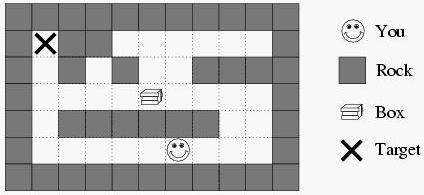
Imagine you are standing inside a two-dimensional maze composed of square cells which may or may not be filled with rock. You can move north, south, east or west one cell at a step. These moves are called walks.
One of the empty cells contains a box which can be moved to an adjacent free cell by standing next to the box and then moving in the direction of the box. Such a move is called a push. The box cannot be moved in any other way than by pushing, which means that if you push it into a corner you can never get it out of the corner again.One of the empty cells is marked as the target cell. Your job is to bring the box to the target cell by a sequence of walks and pushes. As the box is very heavy, you would like to minimize the number of pushes. Can you write a program that will work out the best such sequence?
Input
The input contains the descriptions of several mazes. Each maze description starts with a line containing two integers r and c (both <= 20) representing the number of rows and columns of the maze.Following this are r lines each containing c characters. Each character describes one cell of the maze. A cell full of rock is indicated by a `#' and an empty cell is represented by a `.'. Your starting position is symbolized by `S', the starting position of the box by `B' and the target cell by `T'.
Input is terminated by two zeroes for r and c.
Output
For each maze in the input, first print the number of the maze, as shown in the sample output. Then, if it is impossible to bring the box to the target cell, print ``Impossible.''.Otherwise, output a sequence that minimizes the number of pushes. If there is more than one such sequence, choose the one that minimizes the number of total moves (walks and pushes). If there is still more than one such sequence, any one is acceptable.
Print the sequence as a string of the characters N, S, E, W, n, s, e and w where uppercase letters stand for pushes, lowercase letters stand for walks and the different letters stand for the directions north, south, east and west.
Output a single blank line after each test case.
Sample Input
1 7
SB....T
1 7
SB..#.T
7 11
###########
#T##......#
#.#.#..####
#....B....#
#.######..#
#.....S...#
###########
8 4
....
.##.
.#..
.#..
.#.B
.##S
....
###T
0 0
Sample Output
Maze #1
EEEEE

Maze #2
Impossible.

Maze #3
eennwwWWWWeeeeeesswwwwwwwnNN

Maze #4
swwwnnnnnneeesssSSS
Source
又是一道变态的搜索题。。。
真心烦。。。
好吧,这其实也算蛮经典的吧,只是非常容易写挂。
要么WA,要么TLE。。
主要由于这题的特殊性,即人只能“推”箱子,而不是箱子自己走。
这就涉及到两个对象。处理起来稍稍复杂。
但是可不要用一些看似很优秀的算法(排除真的很优秀的可能),因为这题可能会有很多数据分分钟叉掉一个又一个idea。
比如下面的数据:
4 5
...T#
.#.B.
.#.#.
..S..
这是discuss里面的一组好数据。
还有比如:
10 12
############
#.......####
#...###.#T.#
#.#..##.#..#
#.#...#.#.##
#.#.#.B.....
#######.#.#.
#S####..#...
#......#####
############
特别是第二组,人必须先绕道箱子左边,然后推过头一点,再绕到箱子右边,推到T的正下方,再绕到箱子下面,把箱子推进去。
那么,我就用vis[人][箱子]记录某种状态是否可达,然后用个优先队列维护,以保证最优。
然后题目还说,先保证推箱子次数最小,再在这个限制下使得走路次数最小。
然后。。还有诸多的细节,需要自己注意一下。。
code:
 %:pragma GCC optimize()
 #include<cstdio>
 #include<cstring>
 #include<algorithm>
 #include<queue>
 #define id(x,y) (((x)-1)*m+(y))
 using namespace std;
 ;
 ][]={-,,,,,-,,};
 ]={'n','s','w','e'};
 ]={'N','S','W','E'};
 int n,m,Maz,pre[N*N*N*N]; char a[N][N],fp[N*N*N*N]; bool vis[N*N][N*N];
 ];
 struct state {
     int man,box,s1,s2,dfn;
     state() {}
     state(int _man,int _box,int _s1,int _s2,int _dfn):man(_man),box(_box),s1(_s1),s2(_s2),dfn(_dfn) {}
     bool operator < (const state &u) const {
         return s1==u.s1?s2>u.s2:s1>u.s1;
     }
 };
 void put(int dfn) {
     ) return;
     put(pre[dfn]);
     printf("%c",fp[dfn]);
 }
 void bfs() {
     memset(vis,,].z][ori[].z]=;
     priority_queue <state> q; while (!q.empty()) q.pop();
     state cur,nxt; ,tag=;
     q.push(state(ori[].z,ori[].z,,,));
     while (!q.empty()) {
         cur=q.top(),q.pop();
         ].x,ori[].y)) {tag=; put(cur.dfn); puts(""); break;}
         ; i<; i++) {
             x=(cur.man-)/m+,y=(cur.man-)%m+;
             x0=x+fl[i][],y0=y+fl[i][];
             ||x0>n||y0<||y0>m) continue;
             if (a[x0][y0]=='#') continue;
             if (id(x0,y0)==cur.box) {
                 x=x0+fl[i][],y=y0+fl[i][];
                 ||x>n||y<||y>m) continue;
                 if (a[x][y]=='#') continue;
                 if (vis[id(x0,y0)][id(x,y)]) continue;
                 vis[id(x0,y0)][id(x,y)]=;
                 pre[++dfn]=cur.dfn,fp[dfn]=pus[i];
                 nxt.man=id(x0,y0),nxt.box=id(x,y);
                 nxt.s1=cur.s1+,nxt.s2=cur.s2,nxt.dfn=dfn;
                 q.push(nxt);
             }else {
                 if (vis[id(x0,y0)][cur.box]) continue;
                 vis[id(x0,y0)][cur.box]=;
                 pre[++dfn]=cur.dfn,fp[dfn]=wal[i];
                 nxt.man=id(x0,y0),nxt.box=cur.box;
                 nxt.s1=cur.s1,nxt.s2=cur.s2+,nxt.dfn=dfn;
                 q.push(nxt);
             }
         }
     }
     if (!tag) puts("Impossible.");
 }
 int main() {
     Maz=;
     while (scanf("%d%d",&n,&m)!=EOF,n|m) {
         Maz++;
         ; i<=n; i++) {
             scanf();
             ; j<=m; j++) {
                 ].x=i,ori[].y=j; else
                 ].x=i,ori[].y=j; else
                 ].x=i,ori[].y=j;
             }
         }
         ; i<=; i++) ori[i].z=id(ori[i].x,ori[i].y);
         printf("Maze #%d\n",Maz);
         bfs();
         puts("");
     }
     ;
 }
[poj P1475] Pushing Boxes的更多相关文章
- (poj 1475) Pushing Boxes
Imagine you are standing inside a two-dimensional maze composed of square cells which may or may not ...
- POJ 1475 Pushing Boxes 搜索- 两重BFS
题目地址: http://poj.org/problem?id=1475 两重BFS就行了,第一重是搜索箱子,第二重搜索人能不能到达推箱子的地方. AC代码: #include <iostrea ...
- poj 1475 Pushing Boxes 推箱子(双bfs)
题目链接:http://poj.org/problem?id=1475 一组测试数据: 7 3 ### .T. .S. #B# ... ... ... 结果: //解题思路:先判断盒子的四周是不是有空 ...
- poj 1475 || zoj 249 Pushing Boxes
http://poj.org/problem?id=1475 http://acm.zju.edu.cn/onlinejudge/showProblem.do?problemId=249 Pushin ...
- Pushing Boxes(广度优先搜索)
题目传送门 首先说明我这个代码和lyd的有点不同:可能更加复杂 既然要求以箱子步数为第一关键字,人的步数为第二关键字,那么我们可以想先找到箱子的最短路径.但单单找到箱子的最短路肯定不行啊,因为有时候不 ...
- 『Pushing Boxes 双重bfs』
Pushing Boxes Description Imagine you are standing inside a two-dimensional maze composed of square ...
- POJ1475 Pushing Boxes(双搜索)
POJ1475 Pushing Boxes 推箱子,#表示墙,B表示箱子的起点,T表示箱子的目标位置,S表示人的起点 本题没有 Special Judge,多解时,先最小化箱子被推动的次数,再最小化 ...
- HDU 1475 Pushing Boxes
Pushing Boxes Time Limit: 2000ms Memory Limit: 131072KB This problem will be judged on PKU. Original ...
- Pushing Boxes POJ - 1475 (嵌套bfs)
Imagine you are standing inside a two-dimensional maze composed of square cells which may or may not ...
随机推荐
- MySQL5.7 虚拟列实现表达式或函数索引
MySQL5.7 虚拟列实现表达式或函数索引 http://www.linuxidc.com/Linux/2015-11/125162.htm https://dev.mysql.com/doc/re ...
- mongoose findByIdAndUpdate不执行的解决方法
请参考Mongoose的文档 1.findOneAndUpdate([query], [doc], [options], [callback]) 有callback传递才执行. 2.exec是prom ...
- 58.Less介绍及其与Sass的差异
Less英文官网需要开启VPN才能正常访问,如果你无法打开Less官网,建议您移步到Alexis Sellier领导的团队所译的中文官网Less中文. ——大漠 事实证明,Less——以及Sass对于 ...
- IT人员如何开好站立会议
一.来由 软件开发的过程却又是一个离不开协作.沟通的过程.一个缺乏良好协作,沟通.理解和目标一致的软件团队,是很难高质高效的交付的. 敏捷的众多实践中,有一个为了提升团队协作的经典实践:站立会议 二. ...
- vim 命令学习(高级篇)
[1]打开文件方式 (1)vim +n filename 作用:打开文件,并定位到第n行 例如:vim +103 2019-02-26-errorrepeat.txt 效果:打开2019-02-26- ...
- function(){}、var fun=function(){}和function fun(){}的区别
一.基本定义 1.函数声明:使用function声明函数,并指定函数名. function fun() { // ...... } 2.函数表达式:使用function声明函数,但未指定函数名,将匿名 ...
- 用javaScript获取页面元素值
用JavaScript获取页面元素常见的三种方法: getElementById() ...
- axios、ajax、fetch三者的区别
1.ajax:是指一种创建交互式网页应用的网页开发技术,并且可以做到无需重新加载整个网页的情况下,能够更新部分网页,也叫作局部更新 优缺点: 1)局部更新 2)原生支持,不需要任何插件 3)原生支持, ...
- Java正则表达式草稿程序*2
1.成绩统计. 输入文件input.txt: 张三 语文12 数学31 英语11 李四 语文22 数学22 英语22 王五 语文33 数学33 英语33 期待输出output.txt: 张三 语文12 ...
- HDU 4283 You Are the One ——区间dp
参考了许多大佬 尤其是https://blog.csdn.net/woshi250hua/article/details/7973824这一篇 ,最后我再加一点我的见解. 大意是 给定一个序列,序列 ...