
HDU 2489 Minimal Ratio Tree (DFS枚举+最小生成树Prim)
Minimal Ratio Tree
Time Limit : 2000/1000ms (Java/Other) Memory Limit : 32768/32768K (Java/Other)
Total Submission(s) : 12 Accepted Submission(s) : 7
Font: Times New Roman | Verdana | Georgia
Font Size: ← →
Problem Description
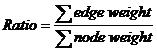
Given a complete graph of n nodes with all nodes and edges weighted, your task is to find a tree, which is a sub-graph of the original graph, with m nodes and whose ratio is the smallest among all the trees of m nodes in the graph.
Input
All the weights of both nodes and edges (except for the ones on the diagonal of the matrix) are integers and in the range of [1, 100].
The figure below illustrates the first test case in sample input. Node 1 and Node 3 form the minimal ratio tree. 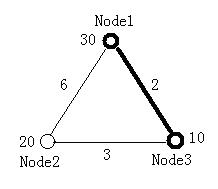
Output
Sample Input
3 2

30 20 10

0 6 2

6 0 3

2 3 0

2 2

1 1

0 2

2 0

0 0
Sample Output
1 3

1 2
#include <iostream>

#include<cstdio>

#include<cstring>

#include<climits>

using namespace std;

int a[],f[],p[];

int mp[][];

bool vis[];

int i,j,n,m;

double ans;

void prim() //最小生成树

{

    bool vis[];

    int dis[];

    int sumnode,sumedge=,k;

    memset(vis,,sizeof(vis));

    vis[]=;

    sumnode=p[a[]];

    for(int i=;i<=m;i++) dis[i]=mp[a[]][a[i]];

    for(int i=;i<m;i++)

    {

        int minn=INT_MAX;

        for(int j=;j<=m;j++)

        {

            if (!vis[j] && dis[j]<minn)

            {

                minn=dis[j];

                k=j;

            }

        }

            vis[k]=;

            sumedge+=minn;

            sumnode+=p[a[k]];

            for(int j=;j<=m;j++)

                if (!vis[j] && dis[j]>mp[a[k]][a[j]])

                        dis[j]=mp[a[k]][a[j]];

    }

    double w=sumedge*1.0/sumnode;

    if (w<ans)  //把最优解存放在f数组中

    {

        ans=w;

        for(int i=;i<=m;i++)

            f[i]=a[i];

    }

  return;

}

void dfs(int k,int num)//dfs暴力枚举m个节点是哪几个存在a数组中

{

    if (num==m)

    {

        prim();

        return;

    }

    if (k>n) return;

    if (!vis[k])

    {

        vis[k]=;

        a[num+]=k;

        dfs(k+,num+);

        vis[k]=;

    }

    dfs(k+,num);

    return;

}

int main()

{

    while(scanf("%d%d",&n,&m))

    {

        if (n== && m==) break;

        for(i=;i<=n;i++) scanf("%d",&p[i]);

        for(i=;i<=n;i++)

            for(j=;j<=n;j++)

               scanf("%d",&mp[i][j]);

        memset(vis,,sizeof(vis));

        ans=INT_MAX*1.0;

        dfs(,);

        for(i=;i<m;i++) printf("%d ",f[i]);

        printf("%d\n",f[m]);

    }

    return ;

}
HDU 2489 Minimal Ratio Tree (DFS枚举+最小生成树Prim)的更多相关文章
- HDU 2489 Minimal Ratio Tree(dfs枚举+最小生成树)
想到枚举m个点,然后求最小生成树,ratio即为最小生成树的边权/总的点权.但是怎么枚举这m个点,实在不会.网上查了一下大牛们的解法,用dfs枚举,没想到dfs还有这么个作用. 参考链接:http:/ ...
- HDU 2489 Minimal Ratio Tree (dfs+Prim最小生成树)
题目链接:http://acm.hdu.edu.cn/showproblem.php?pid=2489 Problem Description For a tree, which nodes and ...
- HDU 2489 Minimal Ratio Tree(暴力+最小生成树)(2008 Asia Regional Beijing)
Description For a tree, which nodes and edges are all weighted, the ratio of it is calculated accord ...
- HDU 2489 Minimal Ratio Tree 最小生成树+DFS
Minimal Ratio Tree Time Limit: 2000/1000 MS (Java/Others) Memory Limit: 32768/32768 K (Java/Other ...
- HDU 2489 Minimal Ratio Tree(prim+DFS)
Minimal Ratio Tree Time Limit: 2000/1000 MS (Java/Others) Memory Limit: 32768/32768 K (Java/Other ...
- hdu 2489 Minimal Ratio Tree
http://acm.hdu.edu.cn/showproblem.php?pid=2489 这道题就是n个点中选择m个点形成一个生成树使得生成树的ratio最小.暴力枚举+最小生成树. #inclu ...
- hdu2489 Minimal Ratio Tree dfs枚举组合情况+最小生成树
#include <stdio.h> #include <set> #include <string.h> #include <algorithm> u ...
- Minimal Ratio Tree HDU - 2489
Minimal Ratio Tree HDU - 2489 暴力枚举点,然后跑最小生成树得到这些点时的最小边权之和. 由于枚举的时候本来就是按照字典序的,不需要额外判. 错误原因:要求输出的结尾不能有 ...
- HDU2489 Minimal Ratio Tree 【DFS】+【最小生成树Prim】
Minimal Ratio Tree Time Limit: 2000/1000 MS (Java/Others) Memory Limit: 32768/32768 K (Java/Other ...
随机推荐
- Python 邮件发送
python发送各类邮件的主要方法 python中email模块使得处理邮件变得比较简单,今天着重学习了一下发送邮件的具体做法,这里写写自己的的心得,也请高手给些指点. 一.相关模块介绍 ...
- python 日历
上章总结了python中time模块的使用,这次总结日历模块 calendar >>> import calendar >>> cal = calendar.mon ...
- wordpress建站过程1
使用wordpress我们需要理解一些概念: 1.WordPress是一种使用PHP语言开发的博客平台,它的程序是由php构成的,所以想要使用word press必须会php. 2.Wordpress ...
- 关于C++数组的几点讨论
数组名为何物? int main() { , , , , }; int *pnumber = number; cout << sizeof(number) << endl; c ...
- Chapter 1 First Sight——33
At that moment, the bell rang loudly, making me jump, and Edward Cullen was out of his seat. 在这个时候,铃 ...
- 第四十五节,logging日志模块
用于便捷记录日志且线程安全的模块 单文件日志 basicConfig()模块函数 功能:创建日志文件和写日志模式[有参] 使用方法:模块名称.basicConfig(filename="日志 ...
- LeetCode OJ 220.Contains Duplicate 3
Given an array of integers, find out whether there are two distinct indices i and j in the array suc ...
- dede 转 帝国
1.转换栏目 insert into ak_enewsclass (classid,bclassid,classname,myorder,classpath,intro,classpagekey) s ...
- ubuntu下 编译Caffe的Matlab接口
一般情况下不愿意使用Caffe的Matlab接口,总觉得Linux版的Matlab很难配置,但是现在搞目标检测,得到的源码是使用的Caffe的Matlab接口,只能硬着头皮上了. (1)修改caffe ...
- 使用SQL Server 2000索引视图提高性能
什么是索引视图? 许多年来,Microsoft? SQL Server? 一直都提供创建虚拟表(称为视图)的功能.在过去,这些视图主要有两种用途: 提供安全机制,将用户限制在一个或多个基表中的数据的某 ...