
【Yom框架】漫谈个人框架的设计之二:新的IRepository接口+搜索和排序解耦(+基于Castle实现)
经过了上篇IRepository和IRepository<T>的讨论【文章地址为:http://www.cnblogs.com/yomho/p/3296759.html】
我选择了IRepository作为我重构框架的仓储接口
一、接口定义
新的IRepository接口设计如下:
 namespace Yom.NFramework2_0

 {

     public interface IRepository<TCompositeKey>

         where TCompositeKey : IEquatable<string>

     {

         #region 实体操作接口

         T FindBy<T>(TCompositeKey primaryKey) where T : IEntity;

         IEnumerable<T> FindAll<T>() where T : IEntity;

         IEnumerable<T> FindAll<T>(IWhere[] where) where T : IEntity;

         IEnumerable<T> FindAll<T>(IWhere[] where, IOrder[] order) where T : IEntity;

         IEnumerable<T> FindAll<T>(int pageIndex, int pageSize, IWhere[] where, IOrder[] order, out int count) where T : IEntity;

         void Add<T>(T entity) where T : IEntity;

         void Delete<T>(T entity) where T : IEntity;

         void DeleteAll<T>() where T : IEntity;

         void DeleteAll<T>(IWhere[] where) where T : IEntity;

         void DeleteAll<T>(string where) where T : IEntity;

         void DeleteAll<T>(IEnumerable<TCompositeKey> pkValues) where T : IEntity;

         void Update<T>(T entity) where T : IEntity;

         bool Exists<T>(TCompositeKey primaryKey) where T : IEntity;

         #endregion

         #region 静态方法接口

         int ExecuteSql(string sql, params System.Data.IDataParameter[] ps);

         object ExecuteScalar(string sql, params System.Data.IDataParameter[] ps);

         System.Data.DataTable ExecuteDataTable(string sql, params System.Data.IDataParameter[] ps);

         #endregion

     }

 }
其中IEntity和IWhere以及IOrder的设计接口如下:
public interface IEntity

    {

    }

public interface IOrder

    {

    }

public interface IWhere

    {

    }

public interface ICompositeKey : IEquatable<string>

    {

    }
ICompositeKey为组合主键接口
为什么ICompositeKey要继承为IEquatable<string>这个接口呢?
因为IEquatable<string>是string的基类,且string为不能继承的类,
所以目的是和string兼容,经过处理可以变成一个string类,从而可以兼容普通的非组合主键。
(此文不讲组合主键的实现原理,展示组合主键接口只是让大家看看组合主键实现解耦的方法)
二、嫁接Castle实现搜索以及排序
很多人不知道怎么把自己的IRepository接口的排序和搜索对象解耦,
在用不同的ORM实现IRepository接口的时候总不知道怎么弄排序和搜索
下面就来看我怎么把Castle的排序和搜索用IOrder以及IWhere解耦的
首先是IOrder -> NHibernate.Expression.Order 的变身
 namespace Yom.NFramework2_0.CastleExtend

 {

     public class OrderBase : NHibernate.Expression.Order, Yom.NFramework2_0.IOrder

     {

         public OrderBase(string propertyName, bool ascending) : base(propertyName, ascending) {

         }

     }

 }
这个很简单,OrderBase一下子就变成了NHibernate.Expression.Order
那么IWhere是否可以顺利完成像IOrder这种变身么?
研究后发现:Castle是用NHibernate.Expression.Expression的静态方法创建查询对象的
静态方法都是返回NHibernate.Expression.AbstractCriterion抽象类或者ICriterion接口
可以继承这个抽象对象或者接口吧,这样就可以实现变身了!!!
但如果真要这样做,必然有抽象方法要实现,这实在是一个下下策(想嫁接个接口和抽象类不容易吖)
那有没有直接实现NHibernate.Expression.AbstractCriterion抽象类的类呢?
反正我是没有找到,但是Castle肯定有,如果找到这么个类,就可以像IOrder一样实现嫁接,现在没有发现只能想他法。
最后我对WhereBase的变身是:
 namespace Yom.NFramework2_0.CastleExtend

 {

     public class WhereBase : Yom.NFramework2_0.IWhere

     {

         public NHibernate.Expression.ICriterion Instance

         {

             get;

             set;

         }

         public override string ToString()

         {

             return Instance.ToString();

         }

         #region 废弃代码

         //public static void AllEq(WhereBase where, System.Collections.IDictionary propertyNameValues)

         //{

         //    where.Instance = NHibernate.Expression.Expression.AllEq(propertyNameValues);

         //}

         //public static void And(WhereBase where, WhereBase whereA, WhereBase whereB)

         //{

         //    where.Instance = NHibernate.Expression.Expression.And(whereA.Instance, whereB.Instance);

         //}

         //public static void Between(WhereBase where, string propertyName, object lo, object hi)

         //{

         //    where.Instance = NHibernate.Expression.Expression.Between(propertyName, lo, hi);

         //}

         //public static void Eq(WhereBase where, string propertyName, object value) {

         //    where.Instance = NHibernate.Expression.Expression.Eq(propertyName, value);

         //}

         //public static void EqProperty(WhereBase where, string propertyName, string otherPropertyName)

         //{

         //    where.Instance = NHibernate.Expression.Expression.EqProperty(propertyName, otherPropertyName);

         //}

         //public static void Ge(WhereBase where, string propertyName, object value)

         //{

         //    where.Instance = NHibernate.Expression.Expression.Ge(propertyName, value);

         //}

         //public static void GeProperty(WhereBase where, string propertyName, string otherPropertyName)

         //{

         //    where.Instance = NHibernate.Expression.Expression.GeProperty(propertyName, otherPropertyName);

         //}

         //public static void Gt(WhereBase where, string propertyName, object value)

         //{

         //    where.Instance = NHibernate.Expression.Expression.Gt(propertyName, value);

         //}

         //public static void GtProperty(WhereBase where, string propertyName, string otherPropertyName)

         //{

         //    where.Instance = NHibernate.Expression.Expression.GtProperty(propertyName, otherPropertyName);

         //}

         //public static void IdEq(WhereBase where, object value)

         //{

         //    where.Instance = NHibernate.Expression.Expression.IdEq(value);

         //}

         //public static void In(WhereBase where, string propertyName, System.Collections.ICollection values)

         //{

         //    where.Instance = NHibernate.Expression.Expression.In(propertyName, values);

         //}

         //public static void InG<T>(WhereBase where, string propertyName, ICollection<T> values)

         //{

         //    where.Instance = NHibernate.Expression.Expression.InG<T>(propertyName, values);

         //}

         //public static void InsensitiveLike(WhereBase where, string propertyName, object value)

         //{

         //    where.Instance = NHibernate.Expression.Expression.InsensitiveLike(propertyName, value);

         //}

         //public static void IsEmpty(WhereBase where, string propertyName)

         //{

         //    where.Instance = NHibernate.Expression.Expression.IsEmpty(propertyName);

         //}

         //public static void propertyName(WhereBase where, string propertyName)

         //{

         //    where.Instance = NHibernate.Expression.Expression.IsNotEmpty(propertyName);

         //}

         //public static void IsNotNull(WhereBase where, string propertyName)

         //{

         //    where.Instance = NHibernate.Expression.Expression.IsNotNull(propertyName);

         //}

         //public static void IsNull(WhereBase where, string propertyName)

         //{

         //    where.Instance = NHibernate.Expression.Expression.IsNull(propertyName);

         //}

         //public static void Le(WhereBase where, string propertyName, object value)

         //{

         //    where.Instance = NHibernate.Expression.Expression.Le(propertyName, value);

         //}

         //public static void LeProperty(WhereBase where, string propertyName, string otherPropertyName)

         //{

         //    where.Instance = NHibernate.Expression.Expression.LeProperty(propertyName, otherPropertyName);

         //}

         //public static void Like(WhereBase where, string propertyName, string value, NHibernate.Expression.MatchMode matchModes)

         //{

         //    where.Instance = NHibernate.Expression.Expression.Like(propertyName, value, matchModes);

         //}

         //public static void Lt(WhereBase where, string propertyName, object value)

         //{

         //    where.Instance = NHibernate.Expression.Expression.Lt(propertyName, value);

         //}

         //public static void LtProperty(WhereBase where, string propertyName, string otherPropertyName)

         //{

         //    where.Instance = NHibernate.Expression.Expression.LtProperty(propertyName, otherPropertyName);

         //}

         //public static void Not(WhereBase where)

         //{

         //    where.Instance = NHibernate.Expression.Expression.Not(where.Instance);

         //}

         //public static void NotEqProperty(WhereBase where, string propertyName, string otherPropertyName)

         //{

         //    where.Instance = NHibernate.Expression.Expression.NotEqProperty(propertyName, otherPropertyName);

         //}

         //public static void Or(WhereBase where, WhereBase whereA, WhereBase whereB)

         //{

         //    where.Instance = NHibernate.Expression.Expression.Or(whereA.Instance, whereB.Instance);

         //}

         //public static void Sql(WhereBase where, string sql)

         //{

         //    where.Instance = NHibernate.Expression.Expression.Sql(sql);

         //}

         #endregion

     }

 }
最好注释也去掉,这样的好处是别人开发的可以不管ORM是用什么第三方框架,直接调用WhereBase静态方法(代理模式)
WhereBase直接携带了Castle的搜索接口ICriterion,
在RepositoryBase有个这么个方法转换IWhere为Castle的搜索对象
 #region 其他方法

         NHibernate.Expression.ICriterion[] IWhere2ICriterion(IWhere[] where)

         {

             if (where == null) {

                 return null;

             }

             NHibernate.Expression.ICriterion[] wheres = new NHibernate.Expression.ICriterion[where.Length];

             for (var i = ; i < where.Length; i++)

             {

                 wheres[i] = (where[i] as WhereBase).Instance;

             }

             return wheres;

         }

         #endregion
这样就可以完美地实现搜索和排序的解耦
仓储基类有个方法实现如下:
 public IEnumerable<T> FindAll<T>(IWhere[] where) where T : IEntity

         {

             if (where == null) {

                 return FindAll<T>();

             }

             return Castle.ActiveRecord.ActiveRecordBase<T>.FindAll(IWhere2ICriterion(where));

         }
三、总结:
1:搜索和排序的解耦不算是个难题
2: 实现的仓储基类可以通过IoC注入实例化,这样可以插拔式更换ORM
3: 定义的仓储接口和实现最好放在不同的类库,以更好的解耦
四、后记:Repository实现仓储--Castle实现
 namespace Yom.NFramework2_0.CastleExtend

 {

     public abstract class EntityBase : Castle.ActiveRecord.ActiveRecordBase, Yom.NFramework2_0.IEntity

     {

     }

 }
实体基类嫁接
 namespace Yom.NFramework2_0

 {

     public interface ISinglePrimaryKeyRepository : IRepository<string>

     {

     }

 }
非组合主键仓储扩展
 namespace Yom.NFramework2_0.CastleExtend

 {

     public class CastleSinglePrimaryKeyRepository : ISinglePrimaryKeyRepository//, System.Configuration.IConfigurationSectionHandler

     {

         #region IRepository<string> 成员

         #region 实体相关操作

         public T FindBy<T>(string primaryKey) where T : IEntity

         {

             return Castle.ActiveRecord.ActiveRecordBase<T>.Find(primaryKey);

         }

         public IEnumerable<T> FindAll<T>() where T : IEntity

         {

             return Castle.ActiveRecord.ActiveRecordBase<T>.FindAll();

         }

         public IEnumerable<T> FindAll<T>(IWhere[] where) where T : IEntity

         {

             if (where == null) {

                 return FindAll<T>();

             }

             return Castle.ActiveRecord.ActiveRecordBase<T>.FindAll(IWhere2ICriterion(where));

         }

         public IEnumerable<T> FindAll<T>(IWhere[] where, IOrder[] order) where T : IEntity

         {

             if (order == null)

             {

                 if (where == null)

                 {

                     return Castle.ActiveRecord.ActiveRecordBase<T>.FindAll();

                 }

                 else

                 {

                     return Castle.ActiveRecord.ActiveRecordBase<T>.FindAll(IWhere2ICriterion(where));

                 }

             }

             else if (where == null)

             {

                 return Castle.ActiveRecord.ActiveRecordBase<T>.FindAll(order as NHibernate.Expression.Order[]);

             }

             return Castle.ActiveRecord.ActiveRecordBase<T>.FindAll(order as NHibernate.Expression.Order[], IWhere2ICriterion(where));

         }

         public IEnumerable<T> FindAll<T>(int pageIndex, int pageSize, IWhere[] where, IOrder[] order, out int count) where T : IEntity

         {

             if (where == null)

             {

                 count = Castle.ActiveRecord.ActiveRecordMediator.Count(typeof(T));

                 if (order == null) {

                     return Castle.ActiveRecord.ActiveRecordBase<T>.SlicedFindAll(pageIndex * pageSize, pageSize);

                 }else{

                     return Castle.ActiveRecord.ActiveRecordBase<T>.SlicedFindAll(pageIndex * pageSize, pageSize, order as NHibernate.Expression.Order[]);

                 }

             }

             else

             {

                 count = Castle.ActiveRecord.ActiveRecordMediator.Count(typeof(T), IWhere2ICriterion(where));

                 if (order == null) {

                     return Castle.ActiveRecord.ActiveRecordBase<T>.SlicedFindAll(pageIndex * pageSize, pageSize, IWhere2ICriterion(where));

                 }

             }

             return Castle.ActiveRecord.ActiveRecordBase<T>.SlicedFindAll(pageIndex * pageSize, pageSize, order as NHibernate.Expression.Order[], IWhere2ICriterion(where));

         }

         public void Add<T>(T entity) where T : IEntity

         {

             using (Castle.ActiveRecord.TransactionScope tran = new Castle.ActiveRecord.TransactionScope())

             {

                 (entity as Castle.ActiveRecord.ActiveRecordBase).CreateAndFlush();

                 tran.VoteCommit();

             }

         }

         public void Delete<T>(T entity) where T : IEntity

         {

             using (Castle.ActiveRecord.TransactionScope tran = new Castle.ActiveRecord.TransactionScope())

             {

                 (entity as Castle.ActiveRecord.ActiveRecordBase).DeleteAndFlush();

                 tran.VoteCommit();

             }

         }

         public void DeleteAll<T>() where T : IEntity

         {

             using (Castle.ActiveRecord.TransactionScope tran = new Castle.ActiveRecord.TransactionScope())

             {

                 Castle.ActiveRecord.ActiveRecordBase<T>.DeleteAll();

                 tran.VoteCommit();

             }

         }

         public void DeleteAll<T>(IWhere[] where) where T : IEntity

         {

             IEnumerable<T> entities;

             if (where == null)

             {

                 entities = this.FindAll<T>();

             }

             else

             {

                 entities = this.FindAll<T>(where);

             }

             if (entities != null)

             {

                 using (Castle.ActiveRecord.TransactionScope tran = new Castle.ActiveRecord.TransactionScope())

                 {

                     foreach (T entity in entities) {

                         this.Delete<T>(entity);

                     }

                     tran.VoteCommit();

                 }

             }

         }

         public void DeleteAll<T>(string where) where T : IEntity

         {

             using (Castle.ActiveRecord.TransactionScope tran = new Castle.ActiveRecord.TransactionScope())

             {

                 Castle.ActiveRecord.ActiveRecordBase<T>.DeleteAll(where);

                 tran.VoteCommit();

             }

         }

         public void DeleteAll<T>(IEnumerable<string> pkValues) where T : IEntity

         {

             using (Castle.ActiveRecord.TransactionScope tran = new Castle.ActiveRecord.TransactionScope())

             {

                 Castle.ActiveRecord.ActiveRecordBase<T>.DeleteAll(pkValues);

                 tran.VoteCommit();

             }

         }

         public void Update<T>(T entity) where T : IEntity

         {

             using (Castle.ActiveRecord.TransactionScope tran = new Castle.ActiveRecord.TransactionScope())

             {

                 (entity as Castle.ActiveRecord.ActiveRecordBase).UpdateAndFlush();

                 tran.VoteCommit();

             }

         }

         public bool Exists<T>(string primaryKey) where T : IEntity

         {

             return Castle.ActiveRecord.ActiveRecordBase<T>.Exists<string>(primaryKey);

         }

         #endregion

         #region ado执行sql

         public int ExecuteSql(string sql, params System.Data.IDataParameter[] ps)

         {

             using (System.Data.IDbCommand cmd = Castle.ActiveRecord.ActiveRecordMediator.GetSessionFactoryHolder().CreateSession(typeof(CastleSinglePrimaryKeyRepository)).Connection.CreateCommand())

             {

                 cmd.CommandText = sql;

                 if (ps != null && ps.Length > )

                 {

                     foreach (System.Data.IDataParameter p in ps)

                     {

                         cmd.Parameters.Add(p);

                     }

                 }

                 return cmd.ExecuteNonQuery();

             }

         }

         public object ExecuteScalar(string sql, params System.Data.IDataParameter[] ps)

         {

             using (System.Data.IDbCommand cmd = Castle.ActiveRecord.ActiveRecordMediator.GetSessionFactoryHolder().CreateSession(typeof(CastleSinglePrimaryKeyRepository)).Connection.CreateCommand())

             {

                 cmd.CommandText = sql;

                 if (ps != null && ps.Length > )

                 {

                     foreach (System.Data.IDataParameter p in ps)

                     {

                         cmd.Parameters.Add(p);

                     }

                 }

                 return cmd.ExecuteScalar();

             }

         }

         public System.Data.DataTable ExecuteDataTable(string sql, params System.Data.IDataParameter[] ps)

         {

             using (System.Data.IDbCommand cmd = Castle.ActiveRecord.ActiveRecordMediator.GetSessionFactoryHolder().CreateSession(typeof(CastleSinglePrimaryKeyRepository)).Connection.CreateCommand())

             {

                 cmd.CommandText = sql;

                 if (ps != null && ps.Length > )

                 {

                     foreach (System.Data.IDataParameter p in ps)

                     {

                         cmd.Parameters.Add(p);

                     }

                 }

                 System.Data.DataTable result = new System.Data.DataTable();

                 result.Load(cmd.ExecuteReader(System.Data.CommandBehavior.CloseConnection));

                 return result;

             }

         }

         #endregion

         #endregion

         #region 其他方法

         NHibernate.Expression.ICriterion[] IWhere2ICriterion(IWhere[] where)

         {

             if (where == null) {

                 return null;

             }

             NHibernate.Expression.ICriterion[] wheres = new NHibernate.Expression.ICriterion[where.Length];

             for (var i = ; i < where.Length; i++)

             {

                 wheres[i] = (where[i] as WhereBase).Instance;

             }

             return wheres;

         }

         #endregion

     }

 }
Castle实现IReposoitory
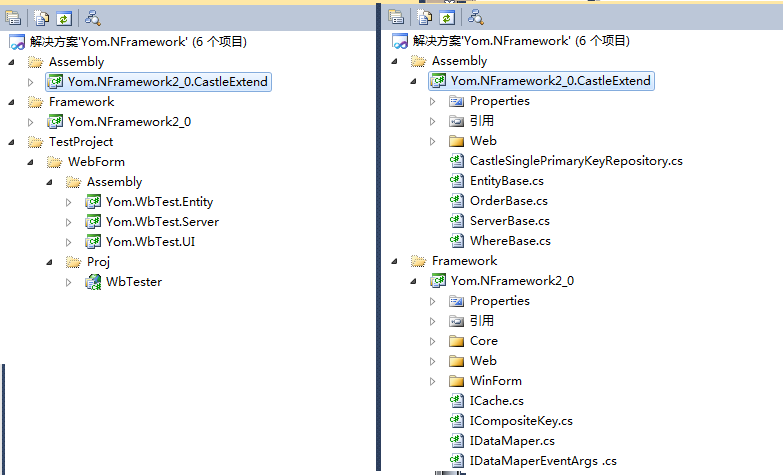
五、项目开发的层次结构
【Yom框架】漫谈个人框架的设计之二:新的IRepository接口+搜索和排序解耦(+基于Castle实现)的更多相关文章
- JAVA经常使用集合框架使用方法具体解释基础篇二之Colletion子接口List
接着上一篇,接着讲讲集合的知识.上一篇讲了Collection接口.它能够说是集合的祖先了,我们这一篇就说说它的子孙们. 一.Collection的子接口 List:有序(存入和取出的顺序一致).元素 ...
- 【Yom框架】漫谈个人框架的设计之一:是IRepository还是IRepository<T>?
前言 ...
- 基于ZedBoard的Webcam设计(一):USB摄像头(V4L2接口)的图片采集【转】
转自:http://www.cnblogs.com/surpassal/archive/2012/12/19/zed_webcam_lab1.html 一直想把USB摄像头接到Zedboard上,搭建 ...
- 【Yom框架】漫谈个人框架的设计之三:业务接口+UI层的设计(基于Castle实现的Repository)
Repository层设计的文章见:[http://www.cnblogs.com/yomho/p/3297042.html] 一.概要设计 上面Reposity 应该为 Repository 特 ...
- 从MVC框架看MVC架构的设计
尽管MVC早已不是什么新鲜话题了,但是从近些年一些优秀MVC框架的设计上,我们还是会发现MVC在架构设计上的一些新亮点.本文将对传统MVC架构中的一些弊病进行解读,了解一些优秀MVC框架是如何化解这些 ...
- 从MVC框架看MVC架构的设计(转)
尽管MVC早已不是什么新鲜话题了,但是从近些年一些优秀MVC框架的设计上,我们还是会发现MVC在架构设计上的一些新亮点.本文将对传统MVC架构中的一些弊病进行解读,了解一些优秀MVC框架是如何化解这些 ...
- 基于SSH框架的考勤管理系统的设计与实现
基于SSH框架的考勤管理系统的设计与实现
- 基于python的接口测试框架设计(二)配置一些参数及文件
基于python的接口测试框架设计(二)配置一些参数及文件 我这里需要基于我的项目配置的主要是登陆参数.以及baseURL ,把这些放在单独的文件里 毕竟导入的时候方便了一些 首先是url 图略 建 ...
- 好的框架需要好的 API 设计 —— API 设计的六个原则
说到框架设计,打心底都会觉得很大很宽泛,而 API 设计是框架设计中的重要组成部分.相比于有很多大佬都认可的面向对象的六大原则.23 种常见的设计模式来说,API 设计确实缺少行业公认的原则或者说设计 ...
随机推荐
- linux_vim_快捷键
1.vim ~/.vimrc 进入配置文件 如果不知道vimrc文件在哪,可使用 :scriptnames 来查看 set nu #行号 set tabstop=4 #一个tab为4个空格长度 set ...
- Android测试流量的几种方法
1. tcpdump + wireshark 1.1 tcpdump抓包 注意:Android设备使用tcpdump需要root权限 tcpdump是一个在Unix-like系统中通用的网络抓包工具, ...
- C# 使用摄像头拍照 支持Win7 64位
原文:C# 使用摄像头拍照 支持Win7 64位 So, how do we capture an image from a WebCam? Once you download the source ...
- C# Parse和Convert的区别分析
原文:C# Parse和Convert的区别分析 大家都知道在进行类型转换的时候有连个方法供我们使用就是Convert.to和*.Parse,但是疑问就是什么时候用C 什么时候用P 通俗的解释大家都知 ...
- Cocos2d-x之MenuItem
***************************************转载请注明出处:http://blog.csdn.net/lttree************************** ...
- Android NDK的C++11标准支持
C++11于Android NDK它已被支持,本文介绍了如何NDK添加C++11支持标准. 在开源项目Cocos2d-x于,他已经加入C++11支持标准. 1.改动Application.mk文件,加 ...
- 图数据库 Titan 高速入门
尤其在互联网世界,图计算越来越受到人们的关注,而图计算相关的软件也越来越丰富.本文将高速展示 Titan这个open source 的图数据库. 注:本文的操作主要基于Titan 官方的两篇文档: - ...
- MVC验证07-自定义Model级别验证
原文:MVC验证07-自定义Model级别验证 在一般的自定义验证特性中,我们通过继承ValidationAttribute,实现IClientValidatable,只能完成对某个属性的自定义验证. ...
- 【Unity Shaders】Mobile Shader Adjustment —— 为手机定制Shader
本系列主要參考<Unity Shaders and Effects Cookbook>一书(感谢原书作者),同一时候会加上一点个人理解或拓展. 这里是本书全部的插图.这里是本书所需的代码和 ...
- sql分页查询公式
分页查询公式: select top PageRow(每页显示的数据行数) from 表名 where 主键 not in(select top PageRow*(当前页数-1) 主键 from ...