
谣言检测()《Data Fusion Oriented Graph Convolution Network Model for Rumor Detection》
论文信息
论文标题:Data Fusion Oriented Graph Convolution Network Model for Rumor Detection
论文作者:Erxue Min, Yu Rong, Yatao Bian, Tingyang Xu, Peilin Zhao, Junzhou Huang,Sophia Ananiadou
论文来源:2020,IEEE Transactions on Network and Service Management
论文地址:download
论文代码:download
1 Introduction
本文不仅考虑了用户的基本信息和文本内容等静态特征,还考虑了谣言传播关系等动态特征。我们还对特征融合模块和池化模块进行了优化,使模型具有更好的性能。
本文贡献:
- Considering the real dataset from social media, we extract static features such as users’ basic information and text contents, as well as dynamic features such as rumor propagation relations, and propose the data fusion method.
- GCN is introduced into the rumor detection task, which represents the rumor propagation mode. And we propose to select the suitable graph convolution operator to update the node vectors, and improve the feature fusion and pooling module.
- Experiments based on Sina Weibo dataset validate the performance of the propsed GCN-based model for rumor detection.
2 Main
整体框架如下:
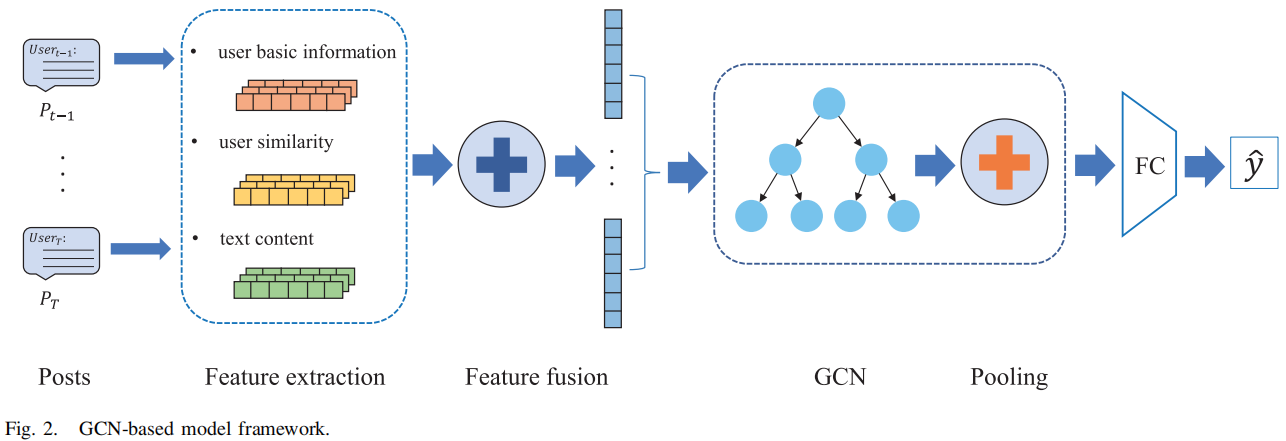
主要包括如下四个模块:
- the feature extraction module
- the feature fusion module
- the graph convolution module
- the pooling module
2.1.1 Features of User Basic Information
常见的 User basic information:
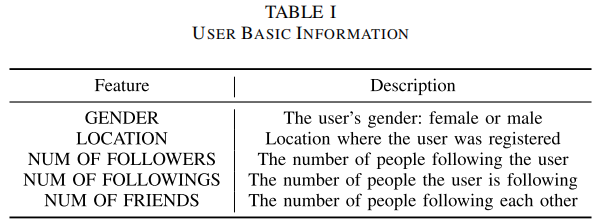
加入这些特征的原因:如 gender 为 女的情况下,是谣言的概率更高。
特征预处理:
对于 gender 采用 One-hot 向量;
对于追随者特征,采用的是 Min-Max normalization ,但是这对于普通用户(如拥有 follower 小的用户)用以造成大部分的数值为 $0$,所以本文采用 $\text{log}$ 处理,如下:
$x^{*}=\left\{\begin{array}{ll}\frac{\log x-\log x_{\min }}{\log x_{\max }-\log x_{\min }} & x>0 \\0 & x=0\end{array}\right\} \quad\quad\quad(2)$
其中,$x$ 代表归一化前的追随者数量,$x^{*} $ 表示标准化值,$x_{\min }$ 和 $x_{\max }$ 表示中的最小和最大追随者数量。
2.1.2 User Similarity Feature
考虑用户相似性,首先构造一个 user-event matrix $M$,其中 User 有 $N_{1}$ 个,event 有 $N_{2}$ 个,所以 $M \in N_{1} \times N_{2}$ 。可以预见的是 $M$ 是一个稀疏矩阵,所以本文采用 SVD 分解:
$A=U \Sigma V^{T}\quad\quad\quad(3)$
其中 $A$ 为需要分解的矩阵,$U$ 为左奇异值矩阵,$\Sigma$ 为对角矩阵,对角元素为奇异值,$V$ 为右奇异值矩阵。根据奇异值分解在推荐系统中的应用思想,我们可以取前 $N$ 个奇异值,计算 $\Sigma$ 与 $U$ 之间的点积,得到用户的向量表示,从而实现降维的目的。最后,每个用户都将有一个 $N$ 维的向量表示。两个用户向量之间的距离越近,它们共同参与的事件的数量就越多。基于同样的思想,还可以构建 users-users 之间的矩阵,矩阵元素表示两个用户都参与的事件的数量。然后使用相同的方法为用户生成另一组向量特征,并将基于用户-事件矩阵分解为用户相似性特征的向量相结合。
2.1.3 Representation of Text Content
使用 $BERT_{base}$ Chinese model 提取文本表示。
2.1.4 Feature Fusion Module
$\begin{array}{l}\mu \leftarrow \frac{1}{m} \sum\limits_{i=0}^{m} h_{i} \\\sigma^{2} \leftarrow \frac{1}{m} \sum\limits_{i=0}^{m}\left(h_{i}-\mu\right)^{2} \\\hat{h}_{l} \leftarrow \frac{h_{i}-\mu}{\sqrt{\sigma^{2}+\varepsilon}} \\w_{i} \leftarrow \gamma \hat{h}_{i}+\beta\end{array}$
其中,$\gamma$ 和 $\beta$ 是可学习参数。
最后再执行 concat 。
2.1.5 Graph Convolution Module
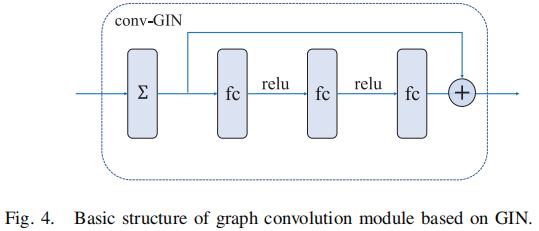
GCN 可以编码局部图的结构和节点特征。其正向传播公式如下:
$H^{(l+1)}=\sigma\left(\tilde{D}^{-\frac{1}{2}} \tilde{A} \tilde{D}^{-\frac{1}{2}} H^{(l)} W^{(l)}\right) \quad\quad\quad(8)$
$w_{v}^{k}=N N^{k}\left(\left(1+\varepsilon^{k}\right) \cdot w_{v}^{k-1}+\sum\limits _{u \in N(v)} w_{u}^{k-1}\right)$
2.1.6 Pooling Module
常见的池化操作包括 average pooling 和 maximum pooling,分别如 $\text{Eq.11}$ $\text{Eq.12}$ 所示:
$\begin{array}{l}h_{G}=\frac{1}{m} \sum\limits _{i=0}^{m} \widetilde{w_{i}} \\h_{G}=\max \left(\widetilde{w_{0}}, \widetilde{w_{1}}, \ldots, \widetilde{w_{m}}\right)\end{array}$
平均池化是为了获得图中所有节点的平均向量作为图向量,最大池化是选择此维度中所有节点的最大值作为每个维度的输出。
Note:一种新的池化方案,先将节点的表示向量按值降序排列后,选择顶部的 $k$ 个节点,拼接 $k$ 节点向量后,采用一维卷积法进行特征压缩,压缩后的向量为最终的图表示。
本文采取的池化过程:将GIN 每层的输入进行concat ,然后使用 Note 中的池化策略。
$h_{G}=\operatorname{Pooling}\left(\text { Concat }\left(\left\{\widetilde{w_{v}^{k}} \mid k=0,1, \ldots, K\right\}\right) \mid v \in V\right)$
3 Experiment
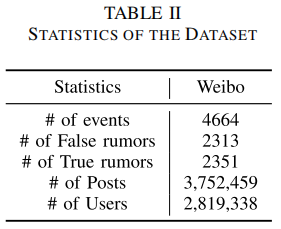
Dataset
Results
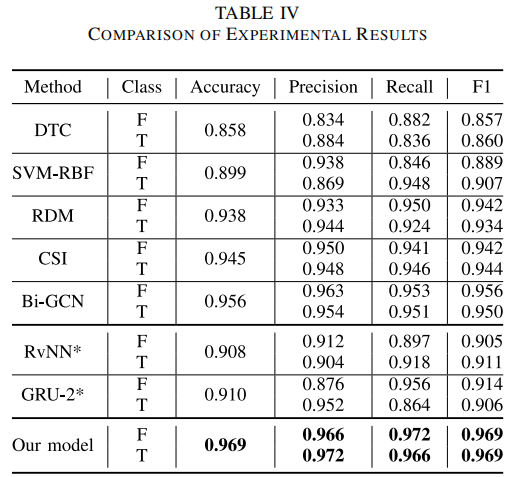
谣言检测()《Data Fusion Oriented Graph Convolution Network Model for Rumor Detection》的更多相关文章
- 谣言检测——《MFAN: Multi-modal Feature-enhanced Attention Networks for Rumor Detection》
论文信息 论文标题:MFAN: Multi-modal Feature-enhanced Attention Networks for Rumor Detection论文作者:Jiaqi Zheng, ...
- 论文解读(FedGAT)《Federated Graph Attention Network for Rumor Detection》
论文信息 论文标题:Federated Graph Attention Network for Rumor Detection论文作者:Huidong Wang, Chuanzheng Bai, Ji ...
- 谣言检测(ClaHi-GAT)《Rumor Detection on Twitter with Claim-Guided Hierarchical Graph Attention Networks》
论文信息 论文标题:Rumor Detection on Twitter with Claim-Guided Hierarchical Graph Attention Networks论文作者:Erx ...
- 谣言检测(PSIN)——《Divide-and-Conquer: Post-User Interaction Network for Fake News Detection on Social Media》
论文信息 论文标题:Divide-and-Conquer: Post-User Interaction Network for Fake News Detection on Social Media论 ...
- 谣言检测()——《Debunking Rumors on Twitter with Tree Transformer》
论文信息 论文标题:Debunking Rumors on Twitter with Tree Transformer论文作者:Jing Ma.Wei Gao论文来源:2020,COLING论文地址: ...
- 谣言检测(PLAN)——《Interpretable Rumor Detection in Microblogs by Attending to User Interactions》
论文信息 论文标题:Interpretable Rumor Detection in Microblogs by Attending to User Interactions论文作者:Ling Min ...
- 谣言检测(RDEA)《Rumor Detection on Social Media with Event Augmentations》
论文信息 论文标题:Rumor Detection on Social Media with Event Augmentations论文作者:Zhenyu He, Ce Li, Fan Zhou, Y ...
- 谣言检测()《Rumor Detection with Self-supervised Learning on Texts and Social Graph》
论文信息 论文标题:Rumor Detection with Self-supervised Learning on Texts and Social Graph论文作者:Yuan Gao, Xian ...
- 目标检测系列 --- RCNN: Rich feature hierarchies for accurate object detection and semantic segmentation Tech report
目标检测系列 --- RCNN: Rich feature hierarchies for accurate object detection and semantic segmentation Te ...
- 谣言检测——(PSA)《Probing Spurious Correlations in Popular Event-Based Rumor Detection Benchmarks》
论文信息 论文标题:Probing Spurious Correlations in Popular Event-Based Rumor Detection Benchmarks论文作者:Jiayin ...
随机推荐
- 6.14 YZBOI模拟赛solution
\(6.14\ YZBOI\)模拟赛\(solution\) 本来不想写题解来着...毕竟是自己找的题还是写一写吧 上午为了整活,就把赛制改成\(IOI\)赛制了,于是乎拯救了大家的\(70pts\) ...
- CMAKE编译时如何自动下载第三方库并解压、安装到指定目录
GreatSQL社区原创内容未经授权不得随意使用,转载请联系小编并注明来源. 导语 在日常开发过程中难免会使用到第三方库或者需要将部分库分离另外存储,如果将库与代码放在一起难免会造成工程庞大,此时就可 ...
- python中文官方文档记录
随笔记录 python3.10中文官方文档百度网盘链接:https://pan.baidu.com/s/18XBjPzQTrZa5MLeFkT2whw?pwd=1013 提取码:1013 1.pyth ...
- Luogu3803 【模板】多项式乘法(FFT)
为什么我这么弱 其实FFT也挺水的,一点数学基础加上细心即可.细节·技巧挺多. 递归 在TLE的边缘苦苦挣扎 #include <iostream> #include <cstdio ...
- Redis 13 事务
参考源 https://www.bilibili.com/video/BV1S54y1R7SB?spm_id_from=333.999.0.0 版本 本文章基于 Redis 6.2.6 概述 Redi ...
- Excel 文本函数(二):CONCATENATE 和 CONCAT
在 Excel 2016.Excel Mobile 和 Excel 网页版中,CONCATENATE 函数已替换为 CONCAT 函数. CONCATENATE 函数只能拼接单个单元格或文本字符,不能 ...
- 爬虫简介与excel表格操作
爬虫简介与excel表格操作 re模块简介 1.在python中使用正则表达式的话那么re模块就是选择之一 import re # 导入re模块 2.在re模块中使用findall找到所有我们给他的值 ...
- Jamie and Tree (dfs序 + 最近公共祖先LCA)
题面 题解 我们求它子树的权值和,一般用dfs序把树拍到线段树上做. 当它换根时,我们就直接把root赋值就行了,树的结构不去动它. 对于第二个操作,我们得到的链和根的相对位置有三种情况: 设两点为A ...
- 无密码正向直连内网linux目标机复现
无密码正向直连内网linux目标机复现 文章来自sxf大佬klion https://mp.weixin.qq.com/s/GPPvci8qKuvc5d3Q7Cer7Q 场景说明 前期通过一些 Rce ...
- 【java】学习路径37-练习:任意文件的复制
使用字节完成复制 import java.io.FileInputStream; import java.io.FileOutputStream; import java.io.IOException ...