
一致性检验评价方法kappa
最近在做眼底图像的无监督分类,使用的数据集辣子kaggle的Diabetic Retinopathy,简称DR,中文称糖尿病型眼底疾病。
最后的评估方法是二次加权kappa。以前没接触过,网上也没有具体的介绍,在这里简单谈谈我的理解,如有错误欢迎指出。
简介
Kappa指数用来衡量两个模型对同一张图片进行判断时,判断结果一致的程度,结果范围从0~1,1表示评价完全相同,0表示评价完全相反。
一般用模型获得相同评价的数量与基于可能性的期望是否有差别来分析,当两个模型相同评价的数量和基于可能性期望的数量基本一样时,kappa的值就接近于1。
举个栗子,模型A和基准的kappa:
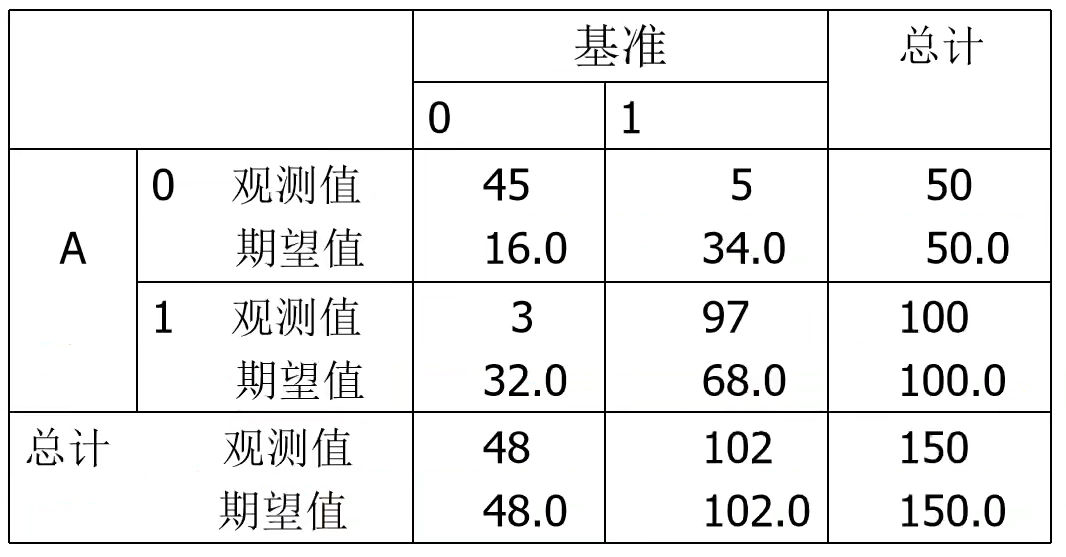
kappa = (p0-pe) / (n-pe)
其中,P0 = 对角线单元中观测值的总和;pe = 对角线单元中期望值的总和。
根据kappa的计算方法分为简单kappa(simple kappa)和加权kappa(weighted kappa),加权kappa又分为linear weighted kappa和quadratic weighted kappa。
weighted kappa
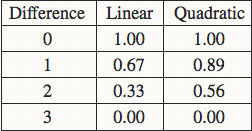
关于linear还是quadratic weighted kappa的选择,取决于你的数据集中不同class之间差异的意义。比如对于眼底图像识别的数据,class=0为健康,class=4为疾病晚期非常严重,所以对于把class=0预测成4的行为所造成的惩罚应该远远大于把class=0预测成class=1的行为,使用quadratic的话0->4所造成的惩罚就等于16倍的0->1的惩罚。如下图是一个四分类的两个计算方法的比较。
Python实现
参考:https://github.com/benhamner/Metrics/blob/master/Python/ml_metrics/quadratic_weighted_kappa.py
#! /usr/bin/env python2.7

import numpy as np

def confusion_matrix(rater_a, rater_b, min_rating=None, max_rating=None):

    """

    Returns the confusion matrix between rater's ratings

    """

    assert(len(rater_a) == len(rater_b))

    if min_rating is None:

        min_rating = min(rater_a + rater_b)

    if max_rating is None:

        max_rating = max(rater_a + rater_b)

    num_ratings = int(max_rating - min_rating + 1)

    conf_mat = [[0 for i in range(num_ratings)]

                for j in range(num_ratings)]

    for a, b in zip(rater_a, rater_b):

        conf_mat[a - min_rating][b - min_rating] += 1

    return conf_mat

def histogram(ratings, min_rating=None, max_rating=None):

    """

    Returns the counts of each type of rating that a rater made

    """

    if min_rating is None:

        min_rating = min(ratings)

    if max_rating is None:

        max_rating = max(ratings)

    num_ratings = int(max_rating - min_rating + 1)

    hist_ratings = [0 for x in range(num_ratings)]

    for r in ratings:

        hist_ratings[r - min_rating] += 1

    return hist_ratings

def quadratic_weighted_kappa(rater_a, rater_b, min_rating=None, max_rating=None):

    """

    Calculates the quadratic weighted kappa

    quadratic_weighted_kappa calculates the quadratic weighted kappa

    value, which is a measure of inter-rater agreement between two raters

    that provide discrete numeric ratings.  Potential values range from -1

    (representing complete disagreement) to 1 (representing complete

    agreement).  A kappa value of 0 is expected if all agreement is due to

    chance.

    quadratic_weighted_kappa(rater_a, rater_b), where rater_a and rater_b

    each correspond to a list of integer ratings.  These lists must have the

    same length.

    The ratings should be integers, and it is assumed that they contain

    the complete range of possible ratings.

    quadratic_weighted_kappa(X, min_rating, max_rating), where min_rating

    is the minimum possible rating, and max_rating is the maximum possible

    rating

    """

    rater_a = np.array(rater_a, dtype=int)

    rater_b = np.array(rater_b, dtype=int)

    assert(len(rater_a) == len(rater_b))

    if min_rating is None:

        min_rating = min(min(rater_a), min(rater_b))

    if max_rating is None:

        max_rating = max(max(rater_a), max(rater_b))

    conf_mat = confusion_matrix(rater_a, rater_b,

                                min_rating, max_rating)

    num_ratings = len(conf_mat)

    num_scored_items = float(len(rater_a))

    hist_rater_a = histogram(rater_a, min_rating, max_rating)

    hist_rater_b = histogram(rater_b, min_rating, max_rating)

    numerator = 0.0

    denominator = 0.0

    for i in range(num_ratings):

        for j in range(num_ratings):

            expected_count = (hist_rater_a[i] * hist_rater_b[j]

                              / num_scored_items)

            d = pow(i - j, 2.0) / pow(num_ratings - 1, 2.0)

            numerator += d * conf_mat[i][j] / num_scored_items

            denominator += d * expected_count / num_scored_items

    return 1.0 - numerator / denominator

def linear_weighted_kappa(rater_a, rater_b, min_rating=None, max_rating=None):

    """

    Calculates the linear weighted kappa

    linear_weighted_kappa calculates the linear weighted kappa

    value, which is a measure of inter-rater agreement between two raters

    that provide discrete numeric ratings.  Potential values range from -1

    (representing complete disagreement) to 1 (representing complete

    agreement).  A kappa value of 0 is expected if all agreement is due to

    chance.

    linear_weighted_kappa(rater_a, rater_b), where rater_a and rater_b

    each correspond to a list of integer ratings.  These lists must have the

    same length.

    The ratings should be integers, and it is assumed that they contain

    the complete range of possible ratings.

    linear_weighted_kappa(X, min_rating, max_rating), where min_rating

    is the minimum possible rating, and max_rating is the maximum possible

    rating

    """

    assert(len(rater_a) == len(rater_b))

    if min_rating is None:

        min_rating = min(rater_a + rater_b)

    if max_rating is None:

        max_rating = max(rater_a + rater_b)

    conf_mat = confusion_matrix(rater_a, rater_b,

                                min_rating, max_rating)

    num_ratings = len(conf_mat)

    num_scored_items = float(len(rater_a))

    hist_rater_a = histogram(rater_a, min_rating, max_rating)

    hist_rater_b = histogram(rater_b, min_rating, max_rating)

    numerator = 0.0

    denominator = 0.0

    for i in range(num_ratings):

        for j in range(num_ratings):

            expected_count = (hist_rater_a[i] * hist_rater_b[j]

                              / num_scored_items)

            d = abs(i - j) / float(num_ratings - 1)

            numerator += d * conf_mat[i][j] / num_scored_items

            denominator += d * expected_count / num_scored_items

    return 1.0 - numerator / denominator

def kappa(rater_a, rater_b, min_rating=None, max_rating=None):

    """

    Calculates the kappa

    kappa calculates the kappa

    value, which is a measure of inter-rater agreement between two raters

    that provide discrete numeric ratings.  Potential values range from -1

    (representing complete disagreement) to 1 (representing complete

    agreement).  A kappa value of 0 is expected if all agreement is due to

    chance.

    kappa(rater_a, rater_b), where rater_a and rater_b

    each correspond to a list of integer ratings.  These lists must have the

    same length.

    The ratings should be integers, and it is assumed that they contain

    the complete range of possible ratings.

    kappa(X, min_rating, max_rating), where min_rating

    is the minimum possible rating, and max_rating is the maximum possible

    rating

    """

    assert(len(rater_a) == len(rater_b))

    if min_rating is None:

        min_rating = min(rater_a + rater_b)

    if max_rating is None:

        max_rating = max(rater_a + rater_b)

    conf_mat = confusion_matrix(rater_a, rater_b,

                                min_rating, max_rating)

    num_ratings = len(conf_mat)

    num_scored_items = float(len(rater_a))

    hist_rater_a = histogram(rater_a, min_rating, max_rating)

    hist_rater_b = histogram(rater_b, min_rating, max_rating)

    numerator = 0.0

    denominator = 0.0

    for i in range(num_ratings):

        for j in range(num_ratings):

            expected_count = (hist_rater_a[i] * hist_rater_b[j]

                              / num_scored_items)

            if i == j:

                d = 0.0

            else:

                d = 1.0

            numerator += d * conf_mat[i][j] / num_scored_items

            denominator += d * expected_count / num_scored_items

    return 1.0 - numerator / denominator

def mean_quadratic_weighted_kappa(kappas, weights=None):

    """

    Calculates the mean of the quadratic

    weighted kappas after applying Fisher's r-to-z transform, which is

    approximately a variance-stabilizing transformation.  This

    transformation is undefined if one of the kappas is 1.0, so all kappa

    values are capped in the range (-0.999, 0.999).  The reverse

    transformation is then applied before returning the result.

    mean_quadratic_weighted_kappa(kappas), where kappas is a vector of

    kappa values

    mean_quadratic_weighted_kappa(kappas, weights), where weights is a vector

    of weights that is the same size as kappas.  Weights are applied in the

    z-space

    """

    kappas = np.array(kappas, dtype=float)

    if weights is None:

        weights = np.ones(np.shape(kappas))

    else:

        weights = weights / np.mean(weights)

    # ensure that kappas are in the range [-.999, .999]

    kappas = np.array([min(x, .999) for x in kappas])

    kappas = np.array([max(x, -.999) for x in kappas])

    z = 0.5 * np.log((1 + kappas) / (1 - kappas)) * weights

    z = np.mean(z)

    return (np.exp(2 * z) - 1) / (np.exp(2 * z) + 1)

def weighted_mean_quadratic_weighted_kappa(solution, submission):

    predicted_score = submission[submission.columns[-1]].copy()

    predicted_score.name = "predicted_score"

    if predicted_score.index[0] == 0:

        predicted_score = predicted_score[:len(solution)]

        predicted_score.index = solution.index

    combined = solution.join(predicted_score, how="left")

    groups = combined.groupby(by="essay_set")

    kappas = [quadratic_weighted_kappa(group[1]["essay_score"], group[1]["predicted_score"]) for group in groups]

    weights = [group[1]["essay_weight"].irow(0) for group in groups]

    return mean_quadratic_weighted_kappa(kappas, weights=weights)
一致性检验评价方法kappa的更多相关文章
- 多准则决策模型-TOPSIS评价方法-源码
? 1 2 3 4 5 6 7 8 9 10 11 12 13 14 15 16 17 18 19 20 21 22 23 24 25 26 27 28 29 30 31 32 33 34 35 36 ...
- 自动文档摘要评价方法:Edmundson,ROUGE
自动文档摘要评价方法大致分为两类: (1)内部评价方法(Intrinsic Methods):提供参考摘要,以参考摘要为基准评价系统摘要的质量.系统摘要与参考摘要越吻合, 质量越高. (2)外部评价方 ...
- 全参考视频质量评价方法(PSNR,SSIM)以及与MOS转换模型
转载处:http://blog.csdn.NET/leixiaohua1020/article/details/11694369 最常用的全参考视频质量评价方法有以下2种: PSNR(峰值信噪比):用 ...
- 图像质量评价方法PSNR+SSIM&&评估指标SROCC,PLCC
update:2018-04-07 今天发现ssim的计算里面有高斯模糊,为了快速计算,先对每个小块进行计算,然后计算所有块的平均值.可以参考源代码实现,而且代码实现有近似的在里面!matlab中中图 ...
- 机器学习评价方法 - Recall & Precision
刚开始看这方面论文的时候对于各种评价方法特别困惑,还总是记混,不完全统计下,备忘. 关于召回率和精确率,假设二分类问题,正样本为x,负样本为o: 准确率存在的问题是当正负样本数量不均衡的时候: 精心设 ...
- 视频质量评价方法:VQM
如何确定一个视频质量的好坏一直以来都是个棘手的问题.目前常用的方法就是通过人眼来直接观看,但是由于人眼的主观性及观看人员的单体差异性,对于同样的视频质量,不同的人的感受是不一样的.为此多个研究机构提出 ...
- 多标签图像分类任务的评价方法-mAP
http://blog.sina.com.cn/s/blog_9db078090102whzw.html 多标签图像分类(Multi-label Image Classification)任务中图片的 ...
- logistic regression评价方法
1.sensitivity,也叫recall,true positive rate,含义是预测为正向的case中对的(true positive)和所有事实为正向的case的比例. 2.specifi ...
- 【一致性检验指标】Kappa(cappa)系数
1 定义 百度百科的定义: 它是通过把所有地表真实分类中的像元总数(N)乘以混淆矩阵对角线(Xkk)的和,再减去某一类地表真实像元总数与被误分成该类像元总数之积对所有类别求和的结果,再除以总像元数的平 ...
随机推荐
- Docker 镜像 层结构理解
镜像到底是什么.镜像的层结构又是什么 通过docker history命令进行分析,镜像是一种其他镜像+文件+命令的组合. 这些镜像的加载.文件导入创建.命令是存在顺序关系的,所以也引出了层的概念. ...
- Spring源码之@Configuration注解解析
1.前言 Spring注解开发中,我们只需求要类上加上@Configuration注解,然后在类中的方法上面加上@Bean注解即可完成Spring Bean组件的注册.相较于之前的xml配置文件定 ...
- IDEA配置scala
IDEA中配置scala 准备:先下好IDEA和scala安装包,配置好jdk环境 scala不想去官网下载的可以直接去百度网盘下载 链接: 链接:https://pan.baidu.com/s/17 ...
- C#控制树莓派入门
何为树莓派 许久没有写博客了,十二月份西安疫情的影响,居家隔离了一个多月,在其期间,学习了一下树莓派,觉得硬件还是挺有意思的,刚好也看到了巨硬有提供使用c#用来开发树莓派应用的解决方案叫Net Iot ...
- 渗透测试工具篇之目录扫描工具dirmap
(一)dirmap介绍 一个高级web目录扫描工具,功能将会强于DirBuster.Dirsearch.cansina.御剑 (二)dirmap安装 打开浏览器输入https://github.com ...
- IP网络性能测试工具——Renix Perf
一.Renix Perf 基于软件的网络及应用服务性能测试工具 · 双臂测试 · 单臂测试 通过测试端点产生网络流量对网络性能进行测量 · TCP.UDP.PING · 语音.视频.HTTP.FTP. ...
- 用Smartbi与Tableau制作仪表盘有什么不同?
随着数据应用程度的加深,用户.尤其是业务部门用户越来越希望能够了解业务表现数据更深层次的原因.导致到越来越多的业务人员参于数据分析.这样传统的BI就面临新模式的挑战了.哪我们即然花大量时间授人以鱼,为 ...
- 零售BI:为什么说零售行业非上一套企业BI系统不可?
如果你要问为什么现在越来越多的零售企业都会在公司上一套企业BI系统,这边文章就能解答你的疑惑. 2016年10月,马云在云栖大会上提出了"新零售"概念.在新零售时代,数字化转型打通 ...
- 【ASP.NET Core】绑定到 CancellationToken 对象
负责管理 HTTP 请求上下文的 HttpContext 对象有一个名为 RequestAborted 的属性.据其名思其义,就是可用来表示客户端请求是否已取消. 果然,它的类型是 Cancellat ...
- hadoop分布式集群部署①
Linux系统的安装和配置.(在VM虚拟机上) 一:安装虚拟机VMware Workstation 14 Pro 以上,虚拟机软件安装完成. 二:创建虚拟机. 三:安装CentOS系统 (1)上面步 ...