
MOEAD实现、基于分解的多目标进化、 切比雪夫方法-(python完整代码)
确定某点附近的点
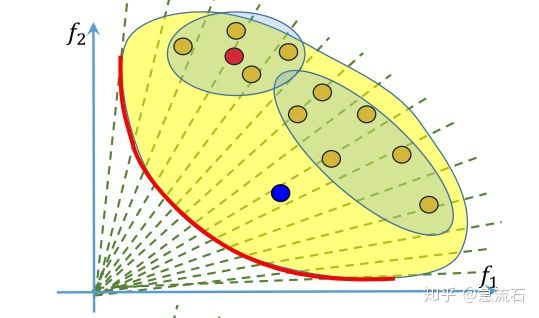
答:每个解对应的是一组权重,即子问题,红点附近的四个点,也就是它的邻居怎么确定呢?由权重来确定,算法初始化阶段就确定了每个权重对应的邻居,也就是每个子问题的邻居子问题。权重的邻居通过欧式距离来判断。取最近的几个。
取均匀分布向量
https://www.cnblogs.com/Twobox/p/16408751.html
MOEAD实现
算法理解与流程
https://www.zhihu.com/question/263555181?sort=created
其中两个回答都挺好的
1. 输入N m

# N表示取点密度 m表示问题维度

1.1 输入 T

# 表示取最近的T个作为邻居

2. 生成均匀分布权重向量

2.1 计算每个权重向量之间的欧拉距离

3. 权重向量个数即为:初始种群个数

4. 初始化种群,每个个体一一对应权重

4.1 更具权重之间距离,取前T个作为邻居person

5. EP = 空

# 维护成最优前沿

6. 计算最初的全局最优Z

# 把每个带入f1 f2中,取最小值 z1 z2

7. 开始循环N代

    7.1对于每个个体,在领域中选取2个个体进行交叉变异,获得2个新个体

    7.1.1更新全局解z

    7.2在领域中随机选择2个个体,用新个与旧个体进行对比

    # 新个体带入子目标问题,直接对比值即可

    7.3如果更优,则替换旧个体dna

    7.4更新EP

    # 如果有别接收的新解,将新解与EP每一个进行比较,删除被新解支配的,如果新解没有被旧解支配,那么加入EP
代码实现设计
# 分析
需要维护的数据结构:
某个体最近的T位邻居: 可以考虑采用对象列表即可
均匀分布的权重向量:一个二维ndarray数组即可
权重向量与个体对应关系:个体对象,直接保存权重向量数组
权重向量之间的距离矩阵:开局初始化,不变的
EP list,里面的个体是对象的引用
z list
目标函数集合,F list domain list # 接口设计
class Person
attribute:
dns:一维ndarray
weight_vector: 一维ndarray
neighbor: list<Person>
o_func:Objective_Function 目标函数
function:
mutation
cross_get_two_new_dna:返回2段新dna
compare#与子代比较
accept_new_dna
choice_two_person:p1,p2
class Moead_Util
attribute:
N
M
T:
o_func:Objective_Function
pm:变异概率 EP:[dna1,dna2,..]
weight_vectors:二维数组
Euler_distance:二维数组
pip_size
Z:[] # 这里面元素为一维ndarray数组,即dna,即解 function:
init_mean_vector:二维数组
init_Euler_distance:二维数组
init_population:[]
init_Z:一维属猪 update_ep
update_Z class Objective_Function:
attribute:
F:[]
domain:[[0,1],[],[]]
function:
get_one_function:Objective_Function
Person.py
 1 import numpy as np

 2

 3

 4 class Person:

 5     def __init__(self, dna):

 6         self.dna = dna

 7         self.weight_vector = None

 8         self.neighbor = None

 9         self.o_func = None  # 目标函数

10

11         self.dns_len = len(dna)

12

13     def set_info(self, weight_vector, neighbor, o_func):

14         self.weight_vector = weight_vector

15         self.neighbor = neighbor

16         self.o_func = o_func# 目标函数

17

18     def mutation_dna(self, one_dna):

19         i = np.random.randint(0, self.dns_len)

20         low = self.o_func.domain[i][0]

21         high = self.o_func.domain[i][1]

22         new_v = np.random.rand() * (high - low) + low

23         one_dna[i] = new_v

24         return one_dna

25

26     def mutation(self):

27         i = np.random.randint(0, self.dns_len)

28         low = self.o_func.domain[i][0]

29         high = self.o_func.domain[i][1]

30         new_v = np.random.rand() * (high - low) + low

31         self.dna[i] = new_v

32

33     @staticmethod

34     def cross_get_two_new_dna(p1, p2):

35         # 单点交叉

36         cut_i = np.random.randint(1, p1.dns_len - 1)

37         dna1 = p1.dna.copy()

38         dna2 = p2.dna.copy()

39         temp = dna1[cut_i:].copy()

40         dna1[cut_i:] = dna2[cut_i:]

41         dna2[cut_i:] = temp

42         return dna1, dna2

43

44     def compare(self, son_dna):

45         F = self.o_func.f_funcs

46         f_x_son_dna = []

47         f_x_self = []

48         for f in F:

49             f_x_son_dna.append(f(son_dna))

50             f_x_self.append(f(self.dna))

51         fit_son_dna = np.array(f_x_son_dna) * self.weight_vector

52         fit_self = np.array(f_x_self) * self.weight_vector

53         return fit_son_dna.sum() - fit_self.sum()

54

55     def accept_new_dna(self, new_dna):

56         self.dna = new_dna

57

58     def choice_two_person(self):

59         neighbor = self.neighbor

60         neighbor_len = len(neighbor)

61         idx = np.random.randint(0, neighbor_len, size=2)

62         p1 = self.neighbor[idx[0]]

63         p2 = self.neighbor[idx[1]]

64         return p1, p2
Objective_Function
 1 from collections import defaultdict

 2

 3 import numpy as np

 4

 5

 6 def zdt4_f1(x_list):

 7     return x_list[0]

 8

 9

10 def zdt4_gx(x_list):

11     sum = 1 + 10 * (10 - 1)

12     for i in range(1, 10):

13         sum += x_list[i] ** 2 - 10 * np.cos(4 * np.pi * x_list[i])

14     return sum

15

16

17 def zdt4_f2(x_list):

18     gx_ans = zdt4_gx(x_list)

19     if x_list[0] < 0:

20         print("????: x_list[0] < 0:", x_list[0])

21     if gx_ans < 0:

22         print("gx_ans < 0", gx_ans)

23     if (x_list[0] / gx_ans) <= 0:

24         print("x_list[0] / gx_ans<0:", x_list[0] / gx_ans)

25

26     ans = 1 - np.sqrt(x_list[0] / gx_ans)

27     return ans

28

29 def zdt3_f1(x):

30     return x[0]

31

32

33 def zdt3_gx(x):

34     if x[:].sum() < 0:

35         print(x[1:].sum(), x[1:])

36     ans = 1 + 9 / 29 * x[1:].sum()

37     return ans

38

39

40 def zdt3_f2(x):

41     g = zdt3_gx(x)

42     ans = 1 - np.sqrt(x[0] / g) - (x[0] / g) * np.sin(10 * np.pi * x[0])

43     return ans

44

45

46 class Objective_Function:

47     function_dic = defaultdict(lambda: None)

48

49     def __init__(self, f_funcs, domain):

50         self.f_funcs = f_funcs

51         self.domain = domain

52

53     @staticmethod

54     def get_one_function(name):

55         if Objective_Function.function_dic[name] is not None:

56             return Objective_Function.function_dic[name]

57

58         if name == "zdt4":

59             f_funcs = [zdt4_f1, zdt4_f2]

60             domain = [[0, 1]]

61             for i in range(9):

62                 domain.append([-5, 5])

63             Objective_Function.function_dic[name] = Objective_Function(f_funcs, domain)

64             return Objective_Function.function_dic[name]

65

66         if name == "zdt3":

67             f_funcs = [zdt3_f1, zdt3_f2]

68             domain = [[0, 1] for i in range(30)]

69             Objective_Function.function_dic[name] = Objective_Function(f_funcs, domain)

70             return Objective_Function.function_dic[name]
Moead_Util.py
  1 import numpy as np

  2

  3 from GA.MOEAD.Person import Person

  4

  5

  6 def distribution_number(sum, m):

  7     # 取m个数,数的和为N

  8     if m == 1:

  9         return [[sum]]

 10     vectors = []

 11     for i in range(1, sum - (m - 1) + 1):

 12         right_vec = distribution_number(sum - i, m - 1)

 13         a = [i]

 14         for item in right_vec:

 15             vectors.append(a + item)

 16     return vectors

 17

 18

 19 class Moead_Util:

 20     def __init__(self, N, m, T, o_func, pm):

 21         self.N = N

 22         self.m = m

 23         self.T = T  # 邻居大小限制

 24         self.o_func = o_func

 25         self.pm = pm  # 变异概率

 26

 27         self.Z = np.zeros(shape=m)

 28

 29         self.EP = []  # 前沿

 30         self.EP_fx = []  # ep对应的目标值

 31         self.weight_vectors = None  # 均匀权重向量

 32         self.Euler_distance = None  # 欧拉距离矩阵

 33         self.pip_size = -1

 34

 35         self.pop = None

 36         # self.pop_dna = None

 37

 38     def init_mean_vector(self):

 39         vectors = distribution_number(self.N + self.m, self.m)

 40         vectors = (np.array(vectors) - 1) / self.N

 41         self.weight_vectors = vectors

 42         self.pip_size = len(vectors)

 43         return vectors

 44

 45     def init_Euler_distance(self):

 46         vectors = self.weight_vectors

 47         v_len = len(vectors)

 48

 49         Euler_distance = np.zeros((v_len, v_len))

 50         for i in range(v_len):

 51             for j in range(v_len):

 52                 distance = ((vectors[i] - vectors[j]) ** 2).sum()

 53                 Euler_distance[i][j] = distance

 54

 55         self.Euler_distance = Euler_distance

 56         return Euler_distance

 57

 58     def init_population(self):

 59         pop_size = self.pip_size

 60         dna_len = len(self.o_func.domain)

 61         pop = []

 62         pop_dna = np.random.random(size=(pop_size, dna_len))

 63         # 初始个体的 dna

 64         for i in range(pop_size):

 65             pop.append(Person(pop_dna[i]))

 66

 67         # 初始个体的 weight_vector, neighbor, o_func

 68         for i in range(pop_size):

 69             # weight_vector, neighbor, o_func

 70             person = pop[i]

 71             distance = self.Euler_distance[i]

 72             sort_arg = np.argsort(distance)

 73             weight_vector = self.weight_vectors[i]

 74             # neighbor = pop[sort_arg][:self.T]

 75             neighbor = []

 76             for i in range(self.T):

 77                 neighbor.append(pop[sort_arg[i]])

 78

 79             o_func = self.o_func

 80             person.set_info(weight_vector, neighbor, o_func)

 81         self.pop = pop

 82         # self.pop_dna = pop_dna

 83

 84         return pop

 85

 86     def init_Z(self):

 87         Z = np.full(shape=self.m, fill_value=float("inf"))

 88         for person in self.pop:

 89             for i in range(len(self.o_func.f_funcs)):

 90                 f = self.o_func.f_funcs[i]

 91                 # f_x_i:某个体,在第i目标上的值

 92                 f_x_i = f(person.dna)

 93                 if f_x_i < Z[i]:

 94                     Z[i] = f_x_i

 95

 96         self.Z = Z

 97

 98     def get_fx(self, dna):

 99         fx = []

100         for f in self.o_func.f_funcs:

101             fx.append(f(dna))

102         return fx

103

104     def update_ep(self, new_dna):

105         # 将新解与EP每一个进行比较,删除被新解支配的

106         # 如果新解没有被旧解支配,则保留

107         new_dna_fx = self.get_fx(new_dna)

108         accept_new = True  # 是否将新解加入EP

109         # print(f"准备开始循环: EP长度{len(self.EP)}")

110         for i in range(len(self.EP) - 1, -1, -1):  # 从后往前遍历

111             old_ep_item = self.EP[i]

112             old_fx = self.EP_fx[i]

113             # old_fx = self.get_fx(old_ep_item)

114             a_b = True  # 老支配行

115             b_a = True  # 新支配老

116             for j in range(len(self.o_func.f_funcs)):

117                 if old_fx[j] < new_dna_fx[j]:

118                     b_a = False

119                 if old_fx[j] > new_dna_fx[j]:

120                     a_b = False

121             # T T : fx相等      直接不改变EP

122             # T F :老支配新     留老,一定不要新,结束循环.

123             # F T :新支配老     留新,一定不要这个老,继续循环

124             # F F : 非支配关系   不操作,循环下一个

125             # TF为什么结束循环,FT为什么继续循环,你们可以琢磨下

126             if a_b:

127                 accept_new = False

128                 break

129             if not a_b and b_a:

130                 if len(self.EP) <= i:

131                     print(len(self.EP), i)

132                 del self.EP[i]

133                 del self.EP_fx[i]

134                 continue

135

136         if accept_new:

137             self.EP.append(new_dna)

138             self.EP_fx.append(new_dna_fx)

139         return self.EP, self.EP_fx

140

141     def update_Z(self, new_dna):

142         new_dna_fx = self.get_fx(new_dna)

143         Z = self.Z

144         for i in range(len(self.o_func.f_funcs)):

145             if new_dna_fx[i] < Z[i]:

146                 Z[i] = new_dna_fx[i]

147         return Z
实现.py
import random

import numpy as np

from GA.MOEAD.Moead_Util import Moead_Util

from GA.MOEAD.Objective_Function import Objective_Function

from GA.MOEAD.Person import Person

import matplotlib.pyplot as plt

def draw(x, y):

    plt.scatter(x, y, s=10, c="grey")  # s 点的大小  c 点的颜色 alpha 透明度

    plt.show()

iterations = 1000  # 迭代次数

N = 400

m = 2

T = 40

o_func = Objective_Function.get_one_function("zdt3")

pm = 0.5

moead = Moead_Util(N, m, T, o_func, pm)

moead.init_mean_vector()

moead.init_Euler_distance()

pop = moead.init_population()

moead.init_Z()

for i in range(iterations):

    print(i, len(moead.EP))

    for person in pop:

        p1, p2 = person.choice_two_person()

        d1, d2 = Person.cross_get_two_new_dna(p1, p2)

        if np.random.rand() < pm:

            p1.mutation_dna(d1)

        if np.random.rand() < pm:

            p1.mutation_dna(d2)

        moead.update_Z(d1)

        moead.update_Z(d2)

        t1, t2 = person.choice_two_person()

        if t1.compare(d1) < 0:

            t1.accept_new_dna(d1)

            moead.update_ep(d1)

        if t2.compare(d1) < 0:

            t2.accept_new_dna(d2)

            moead.update_ep(d1)

# 输出结果画图

EP_fx = np.array(moead.EP_fx)

x = EP_fx[:, 0]

y = EP_fx[:, 1]

draw(x, y)
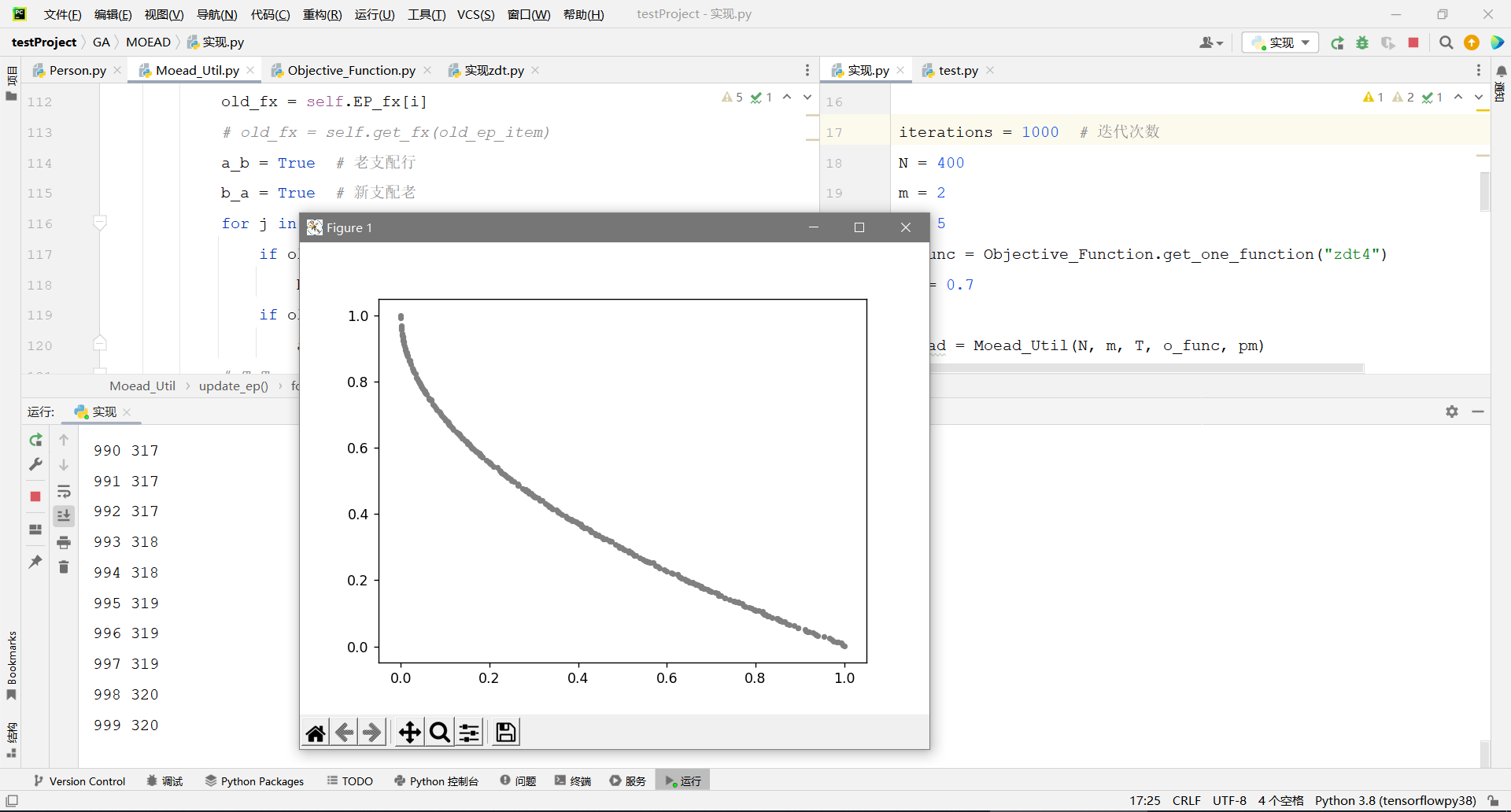
效果-ZDT4
本文原创作者:湘潭大学-魏雄,未经许可禁止转载
MOEAD实现、基于分解的多目标进化、 切比雪夫方法-(python完整代码)的更多相关文章
- 【毕业设计】基于Android的家校互动平台开发(内含完整代码和所有文档)——爱吖校推(你关注的,我们才推)
☆ 写在前面 之前答应大家的毕业答辩之后把所有文档贡献出来,现在答辩已过,LZ信守承诺,把所有文档开源到了GitHub(这个地址包含所有的代码和文档以及PPT,外层为简单的代码).还望喜欢的朋友们,不 ...
- AAAI2019 | 基于区域分解集成的目标检测 论文解读
Object Detection based on Region Decomposition and Assembly AAAI2019 | 基于区域分解集成的目标检测 论文解读 作者 | 文永亮 学 ...
- 基于深度学习的目标检测技术演进:R-CNN、Fast R-CNN,Faster R-CNN
基于深度学习的目标检测技术演进:R-CNN.Fast R-CNN,Faster R-CNN object detection我的理解,就是在给定的图片中精确找到物体所在位置,并标注出物体的类别.obj ...
- #Deep Learning回顾#之基于深度学习的目标检测(阅读小结)
原文链接:https://www.52ml.net/20287.html 这篇博文主要讲了深度学习在目标检测中的发展. 博文首先介绍了传统的目标检测算法过程: 传统的目标检测一般使用滑动窗口的框架,主 ...
- 第十九节、基于传统图像处理的目标检测与识别(词袋模型BOW+SVM附代码)
在上一节.我们已经介绍了使用HOG和SVM实现目标检测和识别,这一节我们将介绍使用词袋模型BOW和SVM实现目标检测和识别. 一 词袋介绍 词袋模型(Bag-Of-Word)的概念最初不是针对计算机视 ...
- 开源项目(9-0)综述--基于深度学习的目标跟踪sort与deep-sort
基于深度学习的目标跟踪sort与deep-sort https://github.com/Ewenwan/MVision/tree/master/3D_Object_Detection/Object_ ...
- 基于层级表达的高效网络搜索方法 | ICLR 2018
论文基于层级表达提出高效的进化算法来进行神经网络结构搜索,通过层层堆叠来构建强大的卷积结构.论文的搜索方法简单,从实验结果看来,达到很不错的准确率,值得学习 来源:[晓飞的算法工程笔记] 公众号 ...
- [信安Presentation]一种基于GPU并行计算的MD5密码解密方法
-------------------paper--------------------- 一种基于GPU并行计算的MD5密码解密方法 0.abstract1.md5算法概述2.md5安全性分析3.基 ...
- 一种基于RBAC模型的动态访问控制改进方法
本发明涉及一种基于RBAC模型的动态访问控制改进方法,属于访问控制领域.对原有RBAC模型进行了权限的改进和约束条件的改进,具体为将权限分为静态权限和动态权限,其中静态权限是非工作流的权限,动态权限是 ...
随机推荐
- Selenium3自动化测试【27】Frame的操作
本篇文章内容摘要 " 讲解Python3+Selenium3如何处理Frame窗体" 同步视频知识与系列知识内容,可关注:[公众号]:柒哥测试:[WX]:Lee-890;[视频号] ...
- go源码阅读 - sync/rwmutex
相比于Mutex来说,RWMutex锁的粒度更细,使用RWMutex可以并发读,但是不能并发读写,或者写写. 1. sync.RWMutex的结构 type RWMutex struct { // 互 ...
- 2021.08.06 P4392 Sound静音问题(ST表)
2021.08.06 P4392 Sound静音问题(ST表) [P4392 BOI2007]Sound 静音问题 - 洛谷 | 计算机科学教育新生态 (luogu.com.cn) 题意: 序列a,求 ...
- 数据传输POST心法分享,做前端的你还解决不了这个bug?
背景 随时随地给大家提供技术支持的葡萄又来了.这次的事情是这样的,提供demo属于是常规操作,但是前两天客户突然反馈压缩传输模块抛出异常,具体情况是压缩内容传输到服务端后无法解压. 由于代码没有发生任 ...
- JSP标签、JSTL标签、EL表达
JSP页面转发,附带数据 <jsp:forward page="/jsptag2.jsp"> <jsp:param name="name" v ...
- ReLabel:自动将ImageNet转化成多标签数据集,更准确地有监督训练 | 2021新文
人工标注数据集中普遍存在噪声,ReLabel能够自动且低成本地将原本的单标签数据集转化为多标签数据集,并且提出配合random crop使用的高效LabelPooling方法,能够更准确地指导分类网络 ...
- ClickHouse 对付单表上亿条记录分组查询秒出, OLAP应用秒杀其他数据库
1. 启动并下载一个clickhouse-server, By default, starting above server instance will be run as default user ...
- mmsegmentation中构造自己的数据集和数据加载部分,跑现有demo
在mmsegmentation中训练自己的数据集 先在mmse/dataset下创建一个python文件,我的名字是my_thermal_dataset.py 在其中填写下面内容 这里要注意,在设置s ...
- 以rem为单位,数值较小,border-radius:50%部分浏览器渲染不圆方法
元素使用rem做单位且较小时,对于border-radius:50%在部分浏览器不圆解决方法: 1.将原来宽高扩大至两倍(.1rem --> .2rem),再使用transform:scale( ...
- 5分钟了解二叉树之AVL树
转载请注明出处:https://www.cnblogs.com/morningli/p/16033733.html AVL树是带有平衡条件的二叉查找树,其每个节点的左子树和右子树的高度最多相差1.为了 ...