
jgroup 概述--官方文档
原文地址:http://www.jgroups.org/manual/html/ch01.html#
Chapter 1. Overview
Group communication uses the terms group and member. Members are part of a group. In the more common terminology, a member is a node and a group is a cluster. We use these terms interchangeably.
A node is a process, residing on some host. A cluster can have one or more nodes belonging to it. There can be multiple nodes on the same host, and all may or may not be part of the same cluster. Nodes can of course also run on different hosts.
JGroups is toolkit for reliable group communication. Processes can join a group, send messages to all members or single members and receive messages from members in the group. The system keeps track of the members in every group, and notifies group members when a new member joins, or an existing member leaves or crashes. A group is identified by its name. Groups do not have to be created explicitly; when a process joins a non-existing group, that group will be created automatically. Processes of a group can be located on the same host, within the same LAN, or across a WAN. A member can be part of multiple groups.
The architecture of JGroups is shown in Figure 1.1, “The architecture of JGroups”.
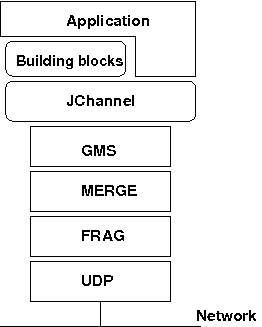 |
Figure 1.1. The architecture of JGroups
It consists of 3 parts: (1) the Channel used by application programmers to build reliable group communication applications, (2) the building blocks, which are layered on top of the channel and provide a higher abstraction level and (3) the protocol stack, which implements the properties specified for a given channel.
This document describes how to install and use JGroups, ie. the Channel API and the building blocks. The targeted audience is application programmers who want to use JGroups to build reliable distributed programs that need group communication.
A channel is connected to a protocol stack. Whenever the application sends a message, the channel passes it on to the protocol stack, which passes it to the topmost protocol. The protocol processes the message and the passes it down to the protocol below it. Thus the message is handed from protocol to protocol until the bottom (transport) protocol puts it on the network. The same happens in the reverse direction: the transport protocol listens for messages on the network. When a message is received it will be handed up the protocol stack until it reaches the channel. The channel then invokes the receive() callback in the application to deliver the message.
When an application connects to the channel, the protocol stack will be started, and when it disconnects the stack will be stopped. When the channel is closed, the stack will be destroyed, releasing its resources.
The following three sections give an overview of channels, building blocks and the protocol stack.
1.1. Channel
To join a group and send messages, a process has to create a channel and connect to it using the group name (all channels with the same name form a group). The channel is the handle to the group. While connected, a member may send and receive messages to/from all other group members. The client leaves a group by disconnecting from the channel. A channel can be reused: clients can connect to it again after having disconnected. However, a channel allows only 1 client to be connected at a time. If multiple groups are to be joined, multiple channels can be created and connected to. A client signals that it no longer wants to use a channel by closing it. After this operation, the channel cannot be used any longer.
Each channel has a unique address. Channels always know who the other members are in the same group: a list of member addresses can be retrieved from any channel. This list is called a view. A process can select an address from this list and send a unicast message to it (also to itself), or it may send a multicast message to all members of the current view (also including itself). Whenever a process joins or leaves a group, or when a crashed process has been detected, a new view is sent to all remaining group members. When a member process is suspected of having crashed, a suspicion message is received by all non-faulty members. Thus, channels receive regular messages, and view and suspicion notifications.
The properties of a channel are typically defined in an XML file, but JGroups also allows for configuration through simple strings, URIs, DOM trees or even programmatically.
The Channel API and its related classes is described in Chapter 3, API.
1.2. Building Blocks
Channels are simple and primitive. They offer the bare functionality of group communication, and have been designed after the simple model of sockets, which are widely used and well understood. The reason is that an application can make use of just this small subset of JGroups, without having to include a whole set of sophisticated classes, that it may not even need. Also, a somewhat minimalistic interface is simple to understand: a client needs to know about 5 methods to be able to create and use a channel.
Channels provide asynchronous message sending/reception, somewhat similar to UDP. A message sent is essentially put on the network and the send() method will return immediately. Conceptual requests, orresponses to previous requests, are received in undefined order, and the application has to take care of matching responses with requests.
JGroups offers building blocks that provide more sophisticated APIs on top of a Channel. Building blocks either create and use channels internally, or require an existing channel to be specified when creating a building block. Applications communicate directly with the building block, rather than the channel. Building blocks are intended to save the application programmer from having to write tedious and recurring code, e.g. request-response correlation, and thus offer a higher level of abstraction to group communication.
Building blocks are described in Chapter 4, Building Blocks.
1.3. The Protocol Stack
The protocol stack containins a number of protocol layers in a bidirectional list. All messages sent and received over the channel have to pass through all protocols. Every layer may modify, reorder, pass or drop a message, or add a header to a message. A fragmentation layer might break up a message into several smaller messages, adding a header with an id to each fragment, and re-assemble the fragments on the receiver's side.
The composition of the protocol stack, i.e. its protocols, is determined by the creator of the channel: an XML file defines the protocols to be used (and the parameters for each protocol). The configuration is then used to create the stack.
Knowledge about the protocol stack is not necessary when only using channels in an application. However, when an application wishes to ignore the default properties for a protocol stack, and configure their own stack, then knowledge about what the individual layers are supposed to do is needed.
jgroup 概述--官方文档的更多相关文章
- 转:ArcGIS API For JavaScript官方文档(二十)之图形和要素图层——①Graphics概述
原文地址:ArcGIS API For JavaScript官方文档(二十)之图形和要素图层——①Graphics概述 ArcGIS JavaScript API允许在地图上绘制graphic(图形) ...
- 【苦读官方文档】2.Android应用程序基本原理概述
官方文档原文地址 应用程序原理 Android应用程序是通过Java编程语言来写.Android软件开发工具把你的代码和其它数据.资源文件一起编译.打包成一个APK文件,这个文档以.apk为后缀,保存 ...
- Orleans 框架3.0 官方文档中文版系列一 —— 概述
关于这个翻译文档的一些说明: 之前逛博客园的时候,看见有个园友在自己的博客上介绍Orleans. 觉得Orleans 是个好东西. 当时心想:如果后面有业务需要的时候可以用用Orleans框架. 当真 ...
- 【AutoMapper官方文档】DTO与Domin Model相互转换(上)
写在前面 AutoMapper目录: [AutoMapper官方文档]DTO与Domin Model相互转换(上) [AutoMapper官方文档]DTO与Domin Model相互转换(中) [Au ...
- Spark官方文档 - 中文翻译
Spark官方文档 - 中文翻译 Spark版本:1.6.0 转载请注明出处:http://www.cnblogs.com/BYRans/ 1 概述(Overview) 2 引入Spark(Linki ...
- Spark SQL 官方文档-中文翻译
Spark SQL 官方文档-中文翻译 Spark版本:Spark 1.5.2 转载请注明出处:http://www.cnblogs.com/BYRans/ 1 概述(Overview) 2 Data ...
- spring官方文档中文版
转 http://blog.csdn.net/tangtong1/article/details/51326887 spring官方文档:http://docs.spring.io/spring/do ...
- .NET Framework 版本和依赖关系[微软官方文档]
.NET Framework 版本和依赖关系 微软官方文档: https://docs.microsoft.com/zh-cn/dotnet/framework/migration-guide/ver ...
- 《KAFKA官方文档》入门指南(转)
1.入门指南 1.1简介 Apache的Kafka™是一个分布式流平台(a distributed streaming platform).这到底意味着什么? 我们认为,一个流处理平台应该具有三个关键 ...
随机推荐
- 对象指针与this指针
对象指针分为三大类 [1]指向对象的指针 [2]指向对象成员的指针(数据类) [3]指向对象成员的指针(函数类) #include<iostream> using namespace st ...
- webstorm下设置sass
关于sass,就不想多说什么了.只要你有css基础,十分钟入门好吗.可以参考下资料:http://www.w3cplus.com/sassguide/ 今天想说的是webStorm下如何实现sass自 ...
- wireshark http过程
一直研究lighttpd源码,顺便看下网络编程,不说太多,开始吧 第一步 设置wireshark过滤规则 tcp.port eq 81 ,然后开始捕捉 第二步 http://183.61.16.16 ...
- Javascript手记-垃圾收集
如果有人问.net的垃圾回收,大家会马上想到gc,那如果有人问你javascript如何进行内存管理的呢?挠挠头,一口香瓜,听我细细道来! javascript具有自动垃圾收集机制,执行环境会负责管理 ...
- c#调用c++ dll的几种类型(转)
http://www.sosuo8.com/article-2012/dllleixingzhuanhuan.htm 在合作开发时,C#时常需要调用C++DLL,当传递参数时时常遇到问题,尤其是传 ...
- 取消本地SVN文件夹与服务器关联
问题:之前建了一个SVN代码库,同步了代码上去,但中途发现建库时的规则搞错了,就把服务器上的库给删了重建,然后改变本地代码的svn服务器关联地址,但使用Relocate一直报错. 错误有两种情况:1. ...
- 第二百八十六天 how can I 坚持
bug不断啊,头疼. 今天早上到的倒是挺早. 中午吃的黄焖鸡,晚上加了会班. 勇江的鱼都死了,杨建的还剩3条,晚上到家都快十点了,还洗了衣服,没捞出来呢, 希望可以请下来假吧. 晾上衣服睡觉.
- Python 发送邮件包含附件报表示例
之前需要用Python发送报表邮件,在网上找了下资料,基本上符合要求了. 相关的示例如下,懂python的人应该都知道. from email.mime.text import MIMEText fr ...
- Java设计模式系列之中介者模式
中介者模式(Mediator)的定义 用一个中介对象来封装一系列的对象交互.中介者使各对象不需要显式地相互引用,从而使其耦合松散,而且可以独立地改变它们之间的交互. 中介者模式(Mediator)的适 ...
- HDU 5660 jrMz and angles (暴力枚举)
jrMz and angles 题目链接: http://acm.hust.edu.cn/vjudge/contest/123316#problem/E Description jrMz has tw ...