
PyTorch程序练习(二):循环神经网络的PyTorch实现
一、RNN实现
结构原理

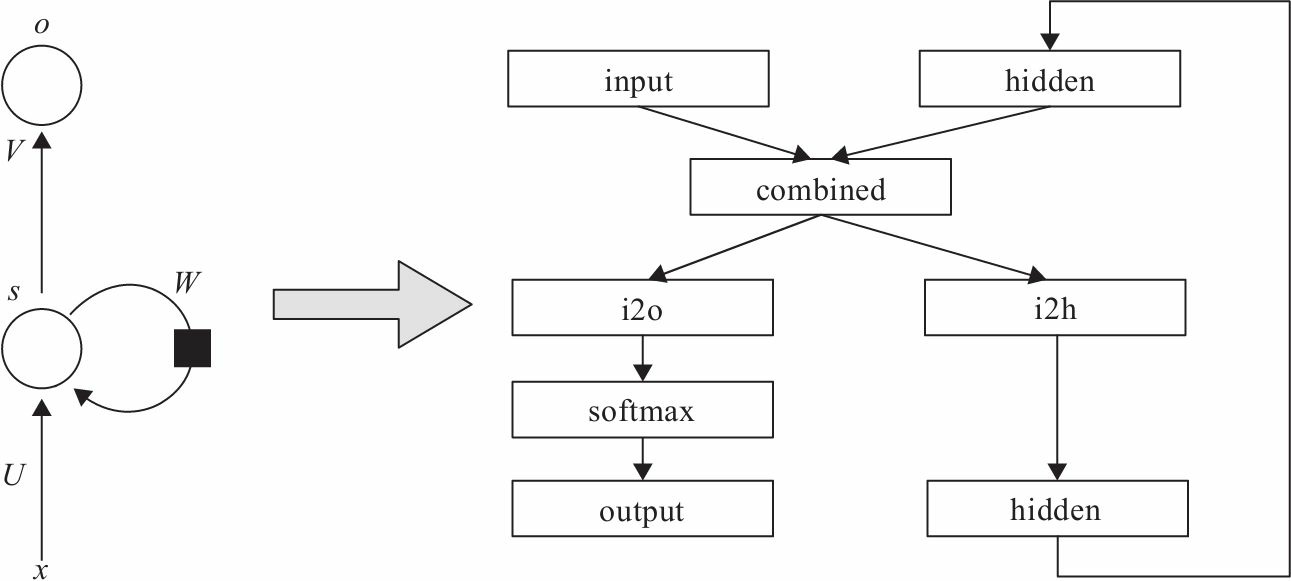
代码实现
import torch

import torch.nn as nn

class RNN(nn.Module):

    def __init__(self, input_size, hidden_size, output_size):

        super(RNN, self).__init__()

        self.hidden_size = hidden_size

        self.i2h = nn.Linear(input_size + hidden_size, hidden_size)

        self.i2o = nn.Linear(input_size + hidden_size, output_size)

        self.softmax = nn.LogSoftmax(dim=1)

    def forward(self, input, hidden):

        combined = torch.cat((input, hidden), 1)

        hidden = self.i2h(combined)     #全连接层

        output: object = self.i2o(combined)

        output = self.softmax(output)

        return output, hidden

    def initHidden(self):

        return torch.zeros(1, self.hidden_size)
二、LSTM实现
结构原理
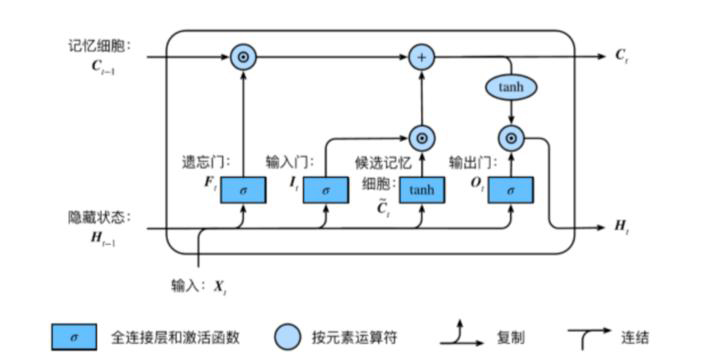

封装好的LSTM
import torch

import torch.nn as nn

class LSTMTagger(nn.Module):

    def __init__(self, embedding_dim, hidden_dim, vocab_size, tagset_size):

        super(LSTMTagger, self).__init__()

        self.hidden_dim = hidden_dim

        self.word_embeddings = nn.Embedding(vocab_size, embedding_dim)

        # LSTM以word_embeddings作为输入, 输出维度为 hidden_dim 的隐藏状态值

        self.lstm = nn.LSTM(embedding_dim, hidden_dim)

        # 线性层将隐藏状态空间映射到标注空间

        self.hidden2tag = nn.Linear(hidden_dim, tagset_size)

        self.hidden = self.init_hidden()

    def init_hidden(self):

        # 一开始并没有隐藏状态所以要先初始化一个

        # 各个维度的含义是 (num_layers, minibatch_size, hidden_dim)

        return (torch.zeros(1, 1, self.hidden_dim),

                torch.zeros(1, 1, self.hidden_dim))

    def forward(self, sentence):

        embeds = self.word_embeddings(sentence)

        lstm_out, self.hidden = self.lstm(embeds.view(len(sentence), 1, -1), self.hidden)

        tag_space = self.hidden2tag(lstm_out.view(len(sentence), -1))

        tag_scores = F.log_softmax(tag_space, dim=1)

        return tag_scores
未封装的LSTM
import torch

import torch.nn as nn

class LSTMCell(nn.Module):

    def __init__(self, input_size, hidden_size, cell_size, output_size):

        super(LSTMCell, self).__init__()

        self.hidden_size = hidden_size

        self.cell_size = cell_size

        self.gate = nn.Linear(input_size + hidden_size, cell_size)  # 门:线性全连接层

        self.output = nn.Linear(hidden_size, output_size)

        self.sigmoid = nn.Sigmoid()

        self.tanh = nn.Tanh()

        self.softmax = nn.LogSoftmax(dim=1)

    def forward(self, input, hidden, cell):

        combined = torch.cat((input, hidden), 1)        #维度上连接

        f_gate = self.sigmoid(self.gate(combined))      #遗忘门

        i_gate = self.sigmoid(self.gate(combined))      #输入门

        o_gate = self.sigmoid(self.gate(combined))      #输出门

        z_state = self.tanh(self.gate(combined))

        cell = torch.add(torch.mul(cell, f_gate), torch.mul(z_state, i_gate))

        """

        cell长期记忆细胞:(cell·f_gate)+(z_state·i_gate)

        遗忘门经过sigmoid后,值在[0,1]之间:

            当f_gate趋于0时,和cell矩阵相乘后,记忆细胞为0,忘记长期记忆;

            当f_gate区域1时,cell全部输入,作为长期记忆。

        """

        hidden = torch.mul(self.tanh(cell), o_gate)     #隐藏层:长期记忆细胞cell先过一层tanh激活函数,然后和输出门o_gate矩阵相乘

        output = self.output(hidden)    #隐藏层作为输出层的输出

        output = self.softmax(output)

        return output, hidden, cell

    def initHidden(self):

        return torch.zeros(1, self.hidden_size)

    def initCell(self):

        return torch.zeros(1, self.cell_size)
三、GRU实现
结构原理


代码实现
import torch

import torch.nn as nn

class GRUCell(nn.Module):

    def __init__(self, input_size, hidden_size, output_size):

        super(GRUCell, self).__init__()

        self.hidden_size = hidden_size

        self.gate = nn.Linear(input_size + hidden_size, hidden_size)

        self.output = nn.Linear(hidden_size, output_size)

        self.sigmoid = nn.Sigmoid()

        self.tanh = nn.Tanh()

        self.softmax = nn.LogSoftmax(dim=1)

    def forward(self, input, hidden):

        combined = torch.cat((input, hidden), 1)

        z_gate = self.sigmoid(self.gate(combined))      #重置门

        r_gate = self.sigmoid(self.gate(combined))      #更新门

        combined01 = torch.cat((input, torch.mul(hidden, r_gate)), 1)

        h1_state = self.tanh(self.gate(combined01))

        h_state = torch.add(torch.mul((1 - z_gate), hidden), torch.mul(h1_state, z_gate))

        output = self.output(h_state)

        output = self.softmax(output)

        return output, h_state

    def initHidden(self):

        return torch.zeros(1, self.hidden_size)
四、程序分析
1、RNN(Recurrent Natural Network,循环神经网络)
PyTorch提供了两个版本的循环神经网络接口,单元版的输入是每个时间步,或循环神经网络的一个循环,而封装版的是一个序列。
2、LSTM(Long Short-TermMemory,长短时记忆网络)
LSTM是在RNN基础上增加了长时间记忆功能,具体通过增加一个状态C及利用3个门(Gate)实现对信息的更精准控制。
LSTM比标准的RNN多了3个线性变换,多出的3个线性变换的权重合在一起是RNN的4倍,偏移量也是RNN的4倍。所以,LSTM的参数个数是RNN的4倍。
除了参数的区别外,隐含状态除h0外,多了一个c0,两者形状相同,都是(num_layers*num_directions,batch,hidden_size),它们合在一起构成了LSTM的隐含状态。所以,LSTM的输入隐含状态为(h0,c0),输出的隐含状态为(hn,cn),其他输入与输出与RNN相同。
3、GRU(Gated Recurrent Unit,门控循环单元)
GRU网络结构与LSTM基本相同,主要区别是LSTM共有3个门,两个隐含状态;而GRU只有两个门,一个隐含状态。其参数是标准RNN的3倍。
PyTorch程序练习(二):循环神经网络的PyTorch实现的更多相关文章
- [Pytorch框架] 2.5 循环神经网络
文章目录 2.5 循环神经网络 2.5.1 RNN简介 RNN的起因 为什么需要RNN RNN都能做什么 2.5.2 RNN的网络结构及原理 RNN LSTM GRU 2.5.3 循环网络的向后传播( ...
- Pytorch循环神经网络LSTM时间序列预测风速
#时间序列预测分析就是利用过去一段时间内某事件时间的特征来预测未来一段时间内该事件的特征.这是一类相对比较复杂的预测建模问题,和回归分析模型的预测不同,时间序列模型是依赖于事件发生的先后顺序的,同样大 ...
- pytorch循环神经网络实现回归预测 代码
pytorch循环神经网络实现回归预测 学习视频:莫烦python # RNN for classification import torch import numpy as np import to ...
- 『PyTorch』第十弹_循环神经网络
RNN基础: 『cs231n』作业3问题1选讲_通过代码理解RNN&图像标注训练 TensorFlow RNN: 『TensotFlow』基础RNN网络分类问题 『TensotFlow』基础R ...
- 神经网络架构PYTORCH-初相识(3W)
who? Python是基于Torch的一种使用Python作为开发语言的开源机器学习库.主要是应用领域是在自然语言的处理和图像的识别上.它主要的开发者是Facebook人工智能研究院(FAIR)团队 ...
- MINIST深度学习识别:python全连接神经网络和pytorch LeNet CNN网络训练实现及比较(三)
版权声明:本文为博主原创文章,欢迎转载,并请注明出处.联系方式:460356155@qq.com 在前两篇文章MINIST深度学习识别:python全连接神经网络和pytorch LeNet CNN网 ...
- 解决运行pytorch程序多线程问题
当我使用pycharm运行 (https://github.com/Joyce94/cnn-text-classification-pytorch ) pytorch程序的时候,在Linux服务器 ...
- 神经网络架构PYTORCH-几个概念
使用Pytorch之前,有几个概念需要弄清楚. 什么是Tensors(张量)? 这个概念刚出来的时候,物理科班出身的我都感觉有点愣住了,好久没有接触过物理学的概念了. 这个概念,在物理学中怎么解释呢? ...
- PyTorch专栏(二)
专栏目录: 第一章:PyTorch之简介与下载 PyTorch简介 PyTorch环境搭建 第二章:PyTorch之60min入门 PyTorch 入门 PyTorch 自动微分 PyTorch 神经 ...
- NLP与深度学习(二)循环神经网络
1. 循环神经网络 在介绍循环神经网络之前,我们先考虑一个大家阅读文章的场景.一般在阅读一个句子时,我们是一个字或是一个词的阅读,而在阅读的同时,我们能够记住前几个词或是前几句的内容.这样我们便能理解 ...
随机推荐
- 从SAP CRM上传设备到SAP ERP
文档<Step by step to download equipment from ERP with hierarchy>描述了从ERP复制设备到CRM的步骤.默认情况下,ERP中的设备 ...
- Competition Set - AtCoder II
这里记录的是这个账号的比赛情况. ABC310 2023-7-15 Solved:6/8 1973->2053 七场ABC,两场打得蛮烂的,都因为AT炸掉Unrated了:另外五场全部满Perf ...
- 01、Java 安全-反序列化基础
Java 反序列化基础 1.ObjectOutputStream 与 ObjectInputStream类 1.1.ObjectOutputStream类 java.io.ObjectOutputSt ...
- 一键自动化博客发布工具,用过的人都说好(cnblogs篇)
cnblogs和其他的博客平台相比会比较复杂,需要设置的项目也比较多一些,弄懂了cnblogs的实现方式,那么你应该对selenium的整个框架使用已经烂熟于心了. 除了正常的标题,内容,摘要之外,c ...
- Ubuntu空间不足,如何扩容
扩容多少看自己需求 点击确定然后打开虚拟机 使用工具的第一种方法 使用Ubuntu自带的disk,直接搜软件disk,点击进去 选择自己要扩容的磁盘 点击设置,选择resize 你要扩容到多少就拖动到 ...
- 🔥🔥httpsok-谷歌免费SSL证书如何申请
httpsok-谷歌免费SSL证书如何申请 使用场景: 部署CDN证书.OSS云存储证书 证书类型: 单域名 多域名 通配符域名 混合域名 证书厂商: ZeroSSL Let's Encrypt Go ...
- $KMP$学习记
<不浪漫罪名>--王杰 没有花 这刹那被破坏吗 无野火都会温暖吗 无烟花一起庆祝好吗 若爱恋 仿似戏剧那样假 如布景一切都美化 连相拥都参照主角吗 你说我未能定时 令你每天欢笑一次 我没说 ...
- 谈谈 JVM 垃圾回收机制
前言 垃圾回收需要思考三件事情,哪些内存需要回收?什么时候回收?如何回收? 一.哪些内存需要回收 JVM 的内存区域中,程序计数器.虚拟机栈和本地方法栈的生命周期是随线程而生,随线程而灭的.这几个区域 ...
- EDP .Net开发框架--自动化日志
平台下载地址:https://gitee.com/alwaysinsist/edp 自动化日志不需要额外调用日志相关功能即可无感实现程序集方法调用的日志记录. 创建业务逻辑处理类 public cla ...
- pod(六):初始化容器Init Containers
目录 一.系统环境 二.前言 三.初始化容器Init Containers 3.1 何为初始化容器Init Containers 3.2 Init Containers与普通容器的不同之处 3.3 I ...