
POJ 3519 Minimal Backgammon
| Time Limit: 5000MS | Memory Limit: 65536K | |||
| Total Submissions: 1195 | Accepted: 700 | Special Judge | ||
Description
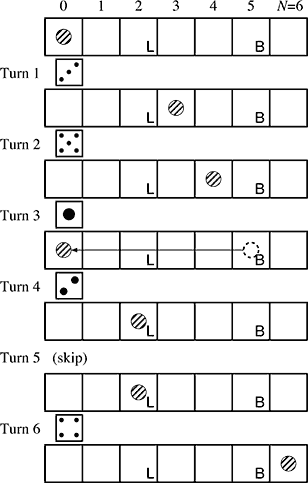 Figure 2: An example game |
Here is a very simple variation of the game backgammon, named “Minimal Backgammon”. The game is played by only one player, using only one of the dice and only one checker (the token used by the player).
The game board is a line of (N + 1) squares labeled as 0 (the start) to N (the goal). At the beginning, the checker is placed on the start (square 0). The aim of the game is to bring the checker to the goal (square N). The checker proceeds as many squares as the roll of the dice. The dice generates six integers from 1 to 6 with equal probability.
The checker should not go beyond the goal. If the roll of the dice would bring the checker beyond the goal, the checker retreats from the goal as many squares as the excess. For example, if the checker is placed at the square (N − 3), the roll “5” brings the checker to the square (N − 2), because the excess beyond the goal is 2. At the next turn, the checker proceeds toward the goal as usual.
Each square, except the start and the goal, may be given one of the following two special instructions.
Lose one turn (labeled “L” in Figure 2)
If the checker stops here, you cannot move the checker in the next turn.Go back to the start (labeled “B” in Figure 2)
If the checker stops here, the checker is brought back to the start.
Given a game board configuration (the size N, and the placement of the special instructions), you are requested to compute the probability with which the game succeeds within a given number of turns.
Input
The input consists of multiple datasets, each containing integers in the following format.
N T L B
Lose1
⋯
LoseL
Back1
⋯
BackB
N is the index of the goal, which satisfies 5 ≤ N ≤ 100. T is the number of turns. You are requested to compute the probability of success within T turns. T satisfies 1 ≤ T ≤ 100. L is the number of squares marked “Lose one turn”, which satisfies 0 ≤ L ≤ N − 1. B is the number of squares marked “Go back to the start”, which satisfies 0 ≤ B ≤ N − 1. They are separated by a space.
Losei’s are the indexes of the squares marked “Lose one turn”, which satisfy 1 ≤ Losei ≤ N − 1. All Losei’s are distinct, and sorted in ascending order. Backi’s are the indexes of the squares marked “Go back to the start”, which satisfy 1 ≤ Backi ≤ N − 1. All Backi’s are distinct, and sorted in ascending order. No numbers occur both in Losei’s and Backi’s.
The end of the input is indicated by a line containing four zeros separated by a space.
Output
For each dataset, you should answer the probability with which the game succeeds within the given number of turns. The output should not contain an error greater than 0.00001.
Sample Input
6 1 0 0

7 1 0 0

7 2 0 0

6 6 1 1

2

5

7 10 0 6

1

2

3

4

5

6

0 0 0 0
Sample Output
0.166667

0.000000

0.166667

0.619642

0.000000
题目大意:第一行输入N,T,L,B,表示总共有编号为0-N的一排格子,N号格子为目标格子,其中有L个格子走到那些格子上要停止一次,B个格子,走到那些格子上就要直接返回到0号格子,紧接着输入L个数字表示要停止一次的格子的编号,后面是B个数字,表示要返回到0号格子的格子的编号,每一轮抛一枚骰子,骰子上是多少就前进几步,如果超出了编号为N的格子,则开始后退,问在T轮之内到达目标格子的概率。
解题方法:概率DP,dp[i][j]代表第i轮走到第j号格子的概率。
#include <stdio.h>

#include <string.h>

#include <iostream>

using namespace std;

double dp[][];//dp[i][j]代表第i轮走到第j号格子的概率

int main()

{

    int Back[], Lose[], N, T, L, B, index;

    while(scanf("%d%d%d%d", &N, &T, &L, &B) != EOF)

    {

        if (N ==  && T ==  && L ==  && B == )

        {

            break;

        }

        memset(dp, , sizeof(dp));

        memset(Back, , sizeof(Back));

        memset(Lose, , sizeof(Lose));

        for (int i = ; i < L; i++)

        {

            scanf("%d", &index);

            Lose[index] = ;//要停止一次的格子的编号

        }

        for (int i = ; i < B; i++)

        {

            scanf("%d", &index);

            Back[index] = ;//要返回的格子的编号

        }

        dp[][] = ;

        for (int i = ; i < T; i++)

        {

            for (int j = N - ; j >= ; j--)

            {

                if (dp[i][j] == )//如果第i轮到达j号格子的概率为0,则直接忽略

                {

                    continue;

                }

                if (Back[j] == )

                {//走到j号格子要返回0号格子,则第i步走到0号格子的概率加上dp[i][j]

                    dp[i][] += dp[i][j];

                }

                else

                {

                    if (Lose[j] == )//如果走到j号格子要停止一次,直接跳过第i + 1轮

                    {

                        for (int k = ; k <= ; k++)

                        {

                            if (j + k <= N)

                            {

                                dp[i + ][j + k] += dp[i][j] / ;

                            }

                            else

                            {//如果走到超过最大值N,则从N开始后退

                                dp[i + ][ * N - j - k] += dp[i][j] / ;

                            }

                        }

                    }

                    else

                    {

                        for (int k = ; k <= ; k++)

                        {

                            if (j + k <= N)

                            {

                                dp[i + ][j + k] += dp[i][j] / ;

                            }

                            else

                            {

                                dp[i + ][ * N - j - k] += dp[i][j] / ;

                            }

                        }

                    }

                }

            }

        }

        double ans = ;

        //从第1轮到第T轮到达终点的概率之和,因为每一轮都有可能到达终点

        for (int i = ; i <= T; i++)

        {

            ans += dp[i][N];

        }

        printf("%.6f\n", ans);

    }

    return ;

}
POJ 3519 Minimal Backgammon的更多相关文章
- {POJ}{3925}{Minimal Ratio Tree}{最小生成树}
题意:给定完全无向图,求其中m个子节点,要求Sum(edge)/Sum(node)最小. 思路:由于N很小,枚举所有可能的子节点可能情况,然后求MST,memset()在POJ G++里面需要cstr ...
- POJ 1815 Friendship
Friendship Time Limit: 2000MS Memory Limit: 20000K Total Submissions: 10626 Accepted: 2949 Descr ...
- [ACM训练] 算法初级 之 搜索算法 之 广度优先算法BFS (POJ 3278+1426+3126+3087+3414)
BFS算法与树的层次遍历很像,具有明显的层次性,一般都是使用队列来实现的!!! 常用步骤: 1.设置访问标记int visited[N],要覆盖所有的可能访问数据个数,这里设置成int而不是bool, ...
- POJ 1325 Machine Schedule——S.B.S.
Machine Schedule Time Limit: 1000MS Memory Limit: 10000K Total Submissions: 13731 Accepted: 5873 ...
- POJ 1236 Network of Schools(Tarjan缩点)
Network of Schools Time Limit: 1000MS Memory Limit: 10000K Total Submissions: 16806 Accepted: 66 ...
- poj 1266 Cover an Arc.
http://poj.org/problem?id=1266 Cover an Arc. Time Limit: 1000MS Memory Limit: 10000K Total Submiss ...
- POJ 3414 Pots
Pots Time Limit:1000MS Memory Limit:65536KB 64bit IO Format:%I64d & %I64u Submit Status ...
- poj 2594 Treasure Exploration (二分匹配)
Treasure Exploration Time Limit: 6000MS Memory Limit: 65536K Total Submissions: 6558 Accepted: 2 ...
- poj 1651 Multiplication Puzzle (区间dp)
题目链接:http://poj.org/problem?id=1651 Description The multiplication puzzle is played with a row of ca ...
随机推荐
- [异常] MyEclipse Deploy点不开 An internal error occurred during: "Launching MVC on Tomcat 6.x". java.lang.NullPointerException
>_<" 今天做struts时,工程写好了,可是点击MyEclipse上面的Delopy不会跳出常规的窗口,导致各种坑~ >_<" 如果直接运行还出现下面的 ...
- [stm32] 利用uC-BmpCvt软件生成uc-gui可调用的bmp图片
>_<:学习贴图[bmp图]:首先找一张bmp格式的图片,然后下载uC-BmpCvt软件,打开改图片 >_<:然后点击Image-Conver-Into-Best Palatt ...
- iOS YSDropdownMagnify 下拉放大,向上导航显示
要实现的效果如上.在实际开发中,我们会使用到三种方式来实现. 通过隐藏导航栏,自定义导航View 改变原生导航栏背景透明 原生导航栏通过添加背景图片改变 个人是比较喜欢第二种. github下载地址: ...
- JavaScript-冒泡排序
随机生成10个不重复的100以内的整数放入数组,并排序后进行打印<br /> 如: for(var i=0;i<9;i++) { for(var j=i+1;j<9;j++) ...
- 【设计模式】Java版设计模式的类图汇总
Abstract Factory Intent: Provide an interface for creating families of related or dependent objects ...
- paip.网页右键复制菜单限制解除解决方案
paip.网页右键复制菜单限制解除解决方案 作者Attilax 艾龙, EMAIL:1466519819@qq.com 来源:attilax的专栏 地址:http://blog.csdn.net ...
- 看大众点评V9新版如何为O2O止血 带领行业下半场回归理性
前不久,美团点评CEO王兴提出的“中国互联网进入下半场”观点一直在持续发酵,并引发了整个互联网圈对于进入下半场该如何改革,如何迎战的深刻反思.在互联网的上半场,大家依托的是人口红利,但是到了下半场,用 ...
- javaweb学习总结(十五)——JSP基础语法
任何语言都有自己的语法,JAVA中有,JSP虽然是在JAVA上的一种应用,但是依然有其自己扩充的语法,而且在JSP中,所有的JAVA语句都可以使用. 一.JSP模版元素 JSP页面中的HTML内容称之 ...
- python常用sql语句
#coding=utf-8 import MySQLdb conn = MySQLdb.Connect(host = '127.0.0.1',port=3306,user='root',passwd= ...
- js 停止事件冒泡 阻止浏览器的默认行为(阻止超连接 # )
在前端开发工作中,由于浏览器兼容性等问题,我们会经常用到“停止事件冒泡”和“阻止浏览器默认行为”. 1..停止事件冒泡 JavaScript代码 //如果提供了事件对象,则这是一个非IE浏览器if ( ...