
Matlab实现线性回归和逻辑回归: Linear Regression & Logistic Regression
原文:http://blog.csdn.net/abcjennifer/article/details/7732417
本讲内容:
Matlab 实现各种回归函数
=========================
基本模型
Y=θ0+θ1X1型---线性回归(直线拟合)
解决过拟合问题---Regularization
Y=1/(1+e^X)型---逻辑回归(sigmod 函数拟合)
在解决拟合问题的解决之前,我们首先回忆一下线性回归和逻辑回归的基本模型。
设待拟合参数 θn*1 和输入参数[ xm*n, ym*1 ] 。
对于各类拟合我们都要根据梯度下降的算法,给出两部分:
① cost function(指出真实值y与拟合值h<hypothesis>之间的距离):给出cost function 的表达式,每次迭代保证cost function的量减小;给出梯度gradient,即cost function对每一个参数θ的求导结果。
function [ jVal,gradient ] = costFunction ( theta )
② Gradient_descent(主函数):用来运行梯度下降算法,调用上面的cost function进行不断迭代,直到最大迭代次数达到给定标准或者cost function返回值不再减小。
function [optTheta,functionVal,exitFlag]=Gradient_descent( )
线性回归:拟合方程为hθ(x)=θ0x0+θ1x1+…+θnxn,当然也可以有xn的幂次方作为线性回归项(如 ),这与普通意义上的线性不同,而是类似多项式的概念。
其cost function 为: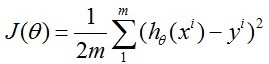
逻辑回归:拟合方程为hθ(x)=1/(1+e^(θTx)),其cost function 为:
cost function对各θj的求导请自行求取,看第三章最后一图,或者参见后文代码。
后面,我们分别对几个模型方程进行拟合,给出代码,并用matlab中的fit函数进行验证。
在Matlab 线性拟合 & 非线性拟合中我们已经讲过如何用matlab自带函数fit进行直线和曲线的拟合,非常实用。而这里我们是进行ML课程的学习,因此研究如何利用前面讲到的梯度下降法(gradient descent)进行拟合。
 function [ jVal,gradient ] = costFunction2( theta )

 %COSTFUNCTION2 Summary of this function goes here

 %   linear regression -> y=theta0 + theta1*x

 %   parameter: x:m*n  theta:n*   y:m*   (m=,n=)

 %

 %Data

 x=[;;;];

 y=[1.1;2.2;2.7;3.8];

 m=size(x,);

 hypothesis = h_func(x,theta);

 delta = hypothesis - y;

 jVal=sum(delta.^);

 gradient()=sum(delta)/m;

 gradient()=sum(delta.*x)/m;

 end
其中,h_func是hypothesis的结果:
 function [res] = h_func(inputx,theta)

 %H_FUNC Summary of this function goes here

 %   Detailed explanation goes here

 %cost function

 res= theta()+theta()*inputx;function [res] = h_func(inputx,theta)

 end
Gradient_descent:
 function [optTheta,functionVal,exitFlag]=Gradient_descent( )

 %GRADIENT_DESCENT Summary of this function goes here

 %   Detailed explanation goes here

   options = optimset('GradObj','on','MaxIter',);

   initialTheta = zeros(,);

   [optTheta,functionVal,exitFlag] = fminunc(@costFunction2,initialTheta,options);

 end
result:
 >> [optTheta,functionVal,exitFlag] = Gradient_descent()

 Local minimum found.

 Optimization completed because the size of the gradient is less than

 the default value of the function tolerance.

 <stopping criteria details>

 optTheta =

     0.3000

     0.8600

 functionVal =

     0.0720

 exitFlag =
 function [ parameter ] = checkcostfunc(  )

 %CHECKC2 Summary of this function goes here

 %   check if the cost function works well

 %   check with the matlab fit function as standard

 %check cost function

 x=[;;;];

 y=[1.1;2.2;2.7;3.8];

 EXPR= {'x',''};

 p=fittype(EXPR);

 parameter=fit(x,y,p);

 end
运行结果:
 >> checkcostfunc()

 ans =

      Linear model:

      ans(x) = a*x + b

      Coefficients (with % confidence bounds):

        a =        0.86  (0.4949, 1.225)

        b =         0.3  (-0.6998, 1.3)
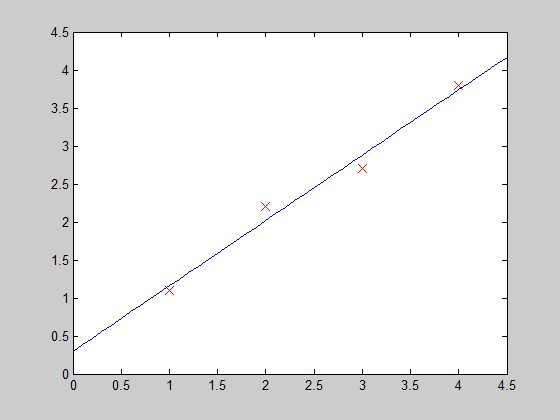
和我们的结果一样。下面画图:
 function PlotFunc( xstart,xend )

 %PLOTFUNC Summary of this function goes here

 %   draw original data and the fitted

 %===================cost function ====linear regression

 %original data

 x1=[;;;];

 y1=[1.1;2.2;2.7;3.8];

 %plot(x1,y1,'ro-','MarkerSize',);

 plot(x1,y1,'rx','MarkerSize',);

 hold on;

 %fitted line - 拟合曲线

 x_co=xstart:0.1:xend;

 y_co=0.3+0.86*x_co;

 %plot(x_co,y_co,'g');

 plot(x_co,y_co);

 hold off;

 end
过拟合问题解决方法我们已在第三章中讲过,利用Regularization的方法就是在cost function中加入关于θ的项,使得部分θ的值偏小,从而达到fit效果。
在每次迭代中,按照gradient descent的方法更新参数θ:θ(i)-=gradient(i),其中gradient(i)是J(θ)对θi求导的函数式,在此例中就有gradient(1)=2*(theta(1)-5), gradient(2)=2*(theta(2)-5)。
函数costFunction, 定义jVal=J(θ)和对两个θ的gradient:
 function [ jVal,gradient ] = costFunction( theta )

 %COSTFUNCTION Summary of this function goes here

 %   Detailed explanation goes here

 jVal= (theta()-)^+(theta()-)^;

 gradient = zeros(,);

 %code to compute derivative to theta

 gradient() =  * (theta()-);

 gradient() =  * (theta()-);

 end
Gradient_descent,进行参数优化
 function [optTheta,functionVal,exitFlag]=Gradient_descent( )

 %GRADIENT_DESCENT Summary of this function goes here

 %   Detailed explanation goes here

  options = optimset('GradObj','on','MaxIter',);

  initialTheta = zeros(,)

  [optTheta,functionVal,exitFlag] = fminunc(@costFunction,initialTheta,options);

 end
matlab主窗口中调用,得到优化厚的参数(θ1,θ2)=(5,5)
  [optTheta,functionVal,exitFlag] = Gradient_descent()

 initialTheta =

 Local minimum found.

 Optimization completed because the size of the gradient is less than

 the default value of the function tolerance.

 <stopping criteria details>

 optTheta =

 functionVal =

 exitFlag =
第四部分:Y=1/(1+e^X)型---逻辑回归(sigmod 函数拟合)
hypothesis function:
 function [res] = h_func(inputx,theta)

 %cost function

 tmp=theta()+theta()*inputx;%m*

 res=./(+exp(-tmp));%m*

 end
cost function:
 function [ jVal,gradient ] = costFunction3( theta )

 %COSTFUNCTION3 Summary of this function goes here

 %   Logistic Regression

 x=[-;      -;     -;     ;      ;      ;     ];

 y=[0.01;    0.05;   0.3;    0.45;   0.8;    1.1;    0.99];

 m=size(x,);

 %hypothesis  data

 hypothesis = h_func(x,theta);

 %jVal-cost function  &  gradient updating

 jVal=-sum(log(hypothesis+0.01).*y + (-y).*log(-hypothesis+0.01))/m;

 gradient()=sum(hypothesis-y)/m;   %reflect to theta1

 gradient()=sum((hypothesis-y).*x)/m;    %reflect to theta

 end
Gradient_descent:
 function [optTheta,functionVal,exitFlag]=Gradient_descent( )

  options = optimset('GradObj','on','MaxIter',);

  initialTheta = [;];

  [optTheta,functionVal,exitFlag] = fminunc(@costFunction3,initialTheta,options);

 end
运行结果:
  [optTheta,functionVal,exitFlag] = Gradient_descent()

 Local minimum found.

 Optimization completed because the size of the gradient is less than

 the default value of the function tolerance.

 <stopping criteria details>

 optTheta =

     0.3526

     1.7573

 functionVal =

     0.2498

 exitFlag =
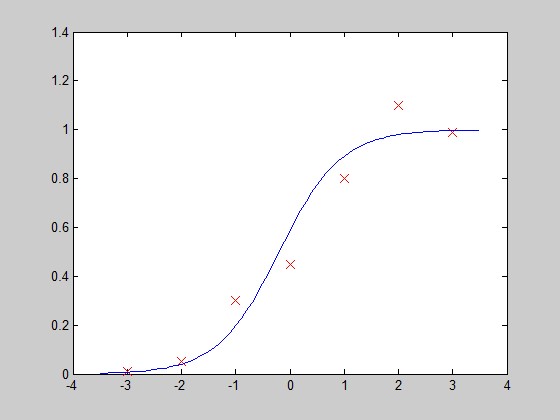
画图验证:
Matlab实现线性回归和逻辑回归: Linear Regression & Logistic Regression的更多相关文章
- 逻辑回归模型(Logistic Regression)及Python实现
逻辑回归模型(Logistic Regression)及Python实现 http://www.cnblogs.com/sumai 1.模型 在分类问题中,比如判断邮件是否为垃圾邮件,判断肿瘤是否为阳 ...
- 斯坦福机器学习视频笔记 Week3 逻辑回归与正则化 Logistic Regression and Regularization
我们将讨论逻辑回归. 逻辑回归是一种将数据分类为离散结果的方法. 例如,我们可以使用逻辑回归将电子邮件分类为垃圾邮件或非垃圾邮件. 在本模块中,我们介绍分类的概念,逻辑回归的损失函数(cost fun ...
- 斯坦福CS229机器学习课程笔记 part2:分类和逻辑回归 Classificatiion and logistic regression
Logistic Regression 逻辑回归 1.模型 逻辑回归解决的是分类问题,并且是二元分类问题(binary classification),y只有0,1两个取值.对于分类问题使用线性回归不 ...
- 分类和逻辑回归(Classification and logistic regression)
分类问题和线性回归问题问题很像,只是在分类问题中,我们预测的y值包含在一个小的离散数据集里.首先,认识一下二元分类(binary classification),在二元分类中,y的取值只能是0和1.例 ...
- 逻辑回归(分类问题)(Logistic Regression、罗杰斯特回归)
逻辑回归:问题只有两项,即{0, 1}.一般而言,回归问题是连续模型,不用在分类问题上,且噪声较大,但如果非要引入,那么采用逻辑回归模型. 对于一般训练集: 参数系统为: 逻辑回归模型为: ...
- 吴恩达机器学习笔记22-正则化逻辑回归模型(Regularized Logistic Regression)
针对逻辑回归问题,我们在之前的课程已经学习过两种优化算法:我们首先学习了使用梯度下降法来优化代价函数
- 机器学习算法笔记1_2:分类和逻辑回归(Classification and Logistic regression)
形式: 採用sigmoid函数: g(z)=11+e−z 其导数为g′(z)=(1−g(z))g(z) 如果: 即: 若有m个样本,则似然函数形式是: 对数形式: 採用梯度上升法求其最大值 求导: 更 ...
- 逻辑回归原理 面试 Logistic Regression
逻辑回归是假设数据服从独立且服从伯努利分布,多用于二分类场景,应用极大似然估计构造损失函数,并使用梯度下降法对参数进行估计.
- 吴恩达深度学习:2.9逻辑回归梯度下降法(Logistic Regression Gradient descent)
1.回顾logistic回归,下式中a是逻辑回归的输出,y是样本的真值标签值 . (1)现在写出该样本的偏导数流程图.假设这个样本只有两个特征x1和x2, 为了计算z,我们需要输入参数w1.w2和b还 ...
随机推荐
- nginx自学
需要了解的linux的命令: linux的命令:netstat -antnetstat -antp(天假了参数P)ps aux | grep 80kill -9 2985 号进程pkill -9 ht ...
- 重构笔记---MEF框架(下)
概述 上一篇介绍了MEF的一个很简单很基本的应用,实现了MEF框架并展示了MEF框架的一些基本的要求和设置,这些基础知识很重要,接下来我们分析一下如何扩展或增强MEF框架内容. 增强的Contract ...
- Intelli IDEA 14.04开发版+注册码
Idea,一款比较出色的IDE开发工具,懂她的人,自然懂得. 本版本-14.04+注册码 注册界面 注册码: Name:happy KEY: ...
- beta版本工作百分比
1.附上github上,beta阶段的整体工作情况 2.beta版本分工情况: 马凛凛 031302620(组长):主要负责任务分配和规划,编码工作主要是系统的“实时编辑”功能,以及服务器的配置和部署 ...
- 使用Struts2和jQuery EasyUI实现简单CRUD系统(转载汇总)
使用Struts2和jQuery EasyUI实现简单CRUD系统(一)——从零开始,ajax与Servlet的交互 使用Struts2和jQuery EasyUI实现简单CRUD系统(二)——aja ...
- python 条件判断和循环
一.条件判断 if if age>= 18: 记住在判断语句后面要加上 : 还有要注意他的缩进 age = 20if age >= 18: print 'your age ...
- 搭建OpenWrt开发环境(包括编译过程)
OpenWrt是一个高度模块化.高度自动化的嵌入式linux发行版,其编译和安装过程比普通的linux发行版而言,要简单太多了.如果您是新手,您那恐惧的心大可放到肚子里,呵呵.对于新手来说最麻烦的恐怕 ...
- SQLHelper初实现---杨中科版(易懂,代码多点)
public class SQLHelper { //获取连接字符串,,引用Configurationl类库,并引用命名空间using System.Configuration; private st ...
- maven初学(二)archeType插件使用
archeType是一个maven插件,它的主要功能是根据模板来创建工程结构 创建工程结构: 1,创建工程目录 2,输入命令:mvn archetype:generate 3,选择需要的archety ...
- Java设计模式-单例模式(Singleton)
单例对象(Singleton)是一种常用的设计模式.在Java应用中,单例对象能保证在一个JVM中,该对象只有一个实例存在.这样的模式有几个好处: 1.某些类创建比较频繁,对于一些大型的对象,这是一笔 ...