
SQLSERVER数据库死锁与优化杂谈
死锁杂谈
当数据库死锁时,SqlServer会释放一个优先级较低的锁,让另一个事务运行;所以,即时去捕捉数据库死锁,是挺不容易的。
如果,数据库死锁比较长时间,那么死锁是可以被捕捉的。
可以用SqlServer活动监视器来查看,哪些进程锁了数据库。
首先打开SqlServer活动监视器,然后可以看到,界面里有进程,查看资源,数据文件I/O,最近消耗大量资源的查询四项。
四项显示内容如下:
进程:在进程里可以看到哪些进程被阻塞,查看属性【阻塞者】可以看到,【阻塞者】的会话ID。
等待资源:等待资源里有一些锁,可以看看那些锁累计等待时间较多。
数据文件I/O:数据文件I/O记录一些数据库MDF,LDF的读写速度。
最近消耗大量资源的查询:记录一些消耗资源较大的SQL查询。
查询进程里被死锁的会话ID,然后执行下面的SQL,进行解锁。
declare @spid int Set @spid = 518 --锁表进程会话ID

declare @sql varchar(1000)

set @sql='kill '+cast(@spid as varchar)

exec(@sql)
也可以用下面SQL语句查询死锁进程,这样查询死锁进程,定位比较快。
select  request_session_id spid,  OBJECT_NAME(resource_associated_entity_id) tableName

from  sys.dm_tran_locks where  resource_type='OBJECT'
优化杂谈
最近消耗大量资源的查询也可以用SQL查询。
下面SQL是查询最耗时的前10条SQL语句。
SELECT TOP 10 total_worker_time / 1000 AS [自编译以来执行所用的CPU时间总量(ms-毫秒)],

total_elapsed_time/1000 as [完成执行此计划所用的总时间],

total_elapsed_time / execution_count/1000 as [平均完成执行此计划所用时间],

execution_count  as [上次编译以来所执行的次数],

creation_time as [编译计划的时间],

deqs.total_worker_time / deqs.execution_count / 1000 AS [平均使用CPU时间(ms)],

last_execution_time AS [上次开始执行计划的时间],

total_physical_reads [编译后在执行期间所执行的物理读取总次数],

total_logical_reads/execution_count [平均逻辑读次数],

min_worker_time /1000 AS [单次执行期间所用的最小CPU时间(ms)],

max_worker_time / 1000 AS [单次执行期间所用的最大 CPU 时间(ms)],

SUBSTRING(dest.text, deqs.statement_start_offset / 2 + 1,

(CASE WHEN deqs.statement_end_offset = -1 THEN DATALENGTH(dest.text) ELSE deqs.statement_end_offset END - deqs.statement_start_offset) / 2 + 1) AS [执行SQL],

dest.text as [完整SQL],

db_name(dest.dbid) as [数据库名称],

object_name(dest.objectid, dest.dbid) as [对象名称]

,deqs.plan_handle [查询所属的已编译计划]

FROM sys.dm_exec_query_stats deqs WITH(NOLOCK)

CROSS APPLY sys.dm_exec_sql_text(deqs.sql_handle) AS dest --平均使用CPU时间降序

ORDER BY (deqs.total_worker_time / deqs.execution_count / 1000) DESC
在SqlServer活动监视器里,查看资源等待。
通常可以看到等待类别是Latch的排在最上面,如下图:
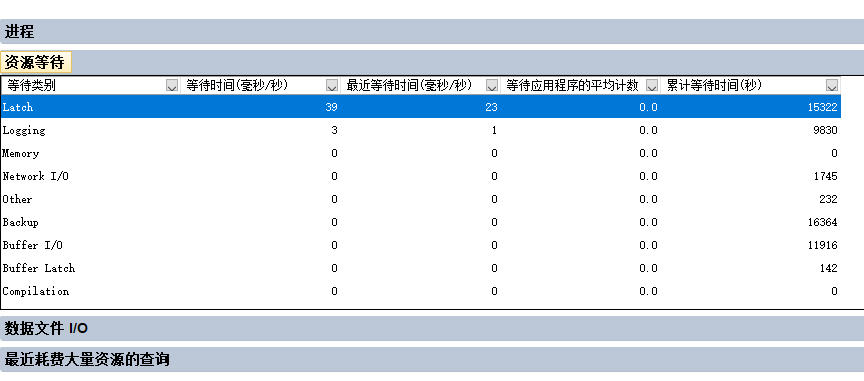
Latch 【闩锁】虽然是一种轻量级的锁,但等待的锁越多,肯定越影响数据库性能。
执行下面SQL,查看下哪些Latch比较耗资源。
SELECT * FROM sys.dm_os_latch_stats
查询结果如下图所示:
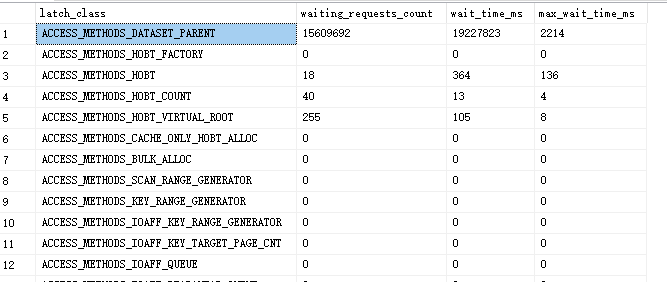
从结果中可以看到各种锁类型的请求的次数,等待时间,最大等待时间(毫秒)。
但这些锁类型都是英文简写,需要使用下面表格查询它们的真实意义。
通过对比表格,我们发现了最消耗资源的ACCESS_METHODS_DATASET_PARENT锁的意义是并发操作时资源访问的锁。那么想降低并发操作,就可以减少ACCESS_METHODS_DATASET_PARENT锁的资源消耗了。
| Latch class | Description |
|---|---|
| ALLOC_CREATE_RINGBUF | Used internally by SQL Server to initialize the synchronization of the creation of an allocation ring buffer. |
| ALLOC_CREATE_FREESPACE_CACHE | Used to initialize the synchronization of internal freespace caches for heaps. |
| ALLOC_CACHE_MANAGER | Used to synchronize internal coherency tests. |
| ALLOC_FREESPACE_CACHE | Used to synchronize the access to a cache of pages with available space for heaps and binary large objects (BLOBs). Contention on latches of this class can occur when multiple connections try to insert rows into a heap or BLOB at the same time. You can reduce this contention by partitioning the object. Each partition has its own latch. Partitioning will distribute the inserts across multiple latches. |
| ALLOC_EXTENT_CACHE | Used to synchronize the access to a cache of extents that contains pages that are not allocated. Contention on latches of this class can occur when multiple connections try to allocate data pages in the same allocation unit at the same time. This contention can be reduced by partitioning the object of which this allocation unit is a part. |
| ACCESS_METHODS_DATASET_PARENT | Used to synchronize child dataset access to the parent dataset during parallel operations. |
| ACCESS_METHODS_HOBT_FACTORY | Used to synchronize access to an internal hash table. |
| ACCESS_METHODS_HOBT | Used to synchronize access to the in-memory representation of a HoBt. |
| ACCESS_METHODS_HOBT_COUNT | Used to synchronize access to a HoBt page and row counters. |
| ACCESS_METHODS_HOBT_VIRTUAL_ROOT | Used to synchronize access to the root page abstraction of an internal B-tree. |
| ACCESS_METHODS_CACHE_ONLY_HOBT_ALLOC | Used to synchronize worktable access. |
| ACCESS_METHODS_BULK_ALLOC | Used to synchronize access within bulk allocators. |
| ACCESS_METHODS_SCAN_RANGE_GENERATOR | Used to synchronize access to a range generator during parallel scans. |
| ACCESS_METHODS_KEY_RANGE_GENERATOR | Used to synchronize access to read-ahead operations during key range parallel scans. |
| APPEND_ONLY_STORAGE_INSERT_POINT | Used to synchronize inserts in fast append-only storage units. |
| APPEND_ONLY_STORAGE_FIRST_ALLOC | Used to synchronize the first allocation for an append-only storage unit. |
| APPEND_ONLY_STORAGE_UNIT_MANAGER | Used for internal data structure access synchronization within the fast append-only storage unit manager. |
| APPEND_ONLY_STORAGE_MANAGER | Used to synchronize shrink operations in the fast append-only storage unit manager. |
| BACKUP_RESULT_SET | Used to synchronize parallel backup result sets. |
| BACKUP_TAPE_POOL | Used to synchronize backup tape pools. |
| BACKUP_LOG_REDO | Used to synchronize backup log redo operations. |
| BACKUP_INSTANCE_ID | Used to synchronize the generation of instance IDs for backup performance monitor counters. |
| BACKUP_MANAGER | Used to synchronize the internal backup manager. |
| BACKUP_MANAGER_DIFFERENTIAL | Used to synchronize differential backup operations with DBCC. |
| BACKUP_OPERATION | Used for internal data structure synchronization within a backup operation, such as database, log, or file backup. |
| BACKUP_FILE_HANDLE | Used to synchronize file open operations during a restore operation. |
| BUFFER | Used to synchronize short term access to database pages. A buffer latch is required before reading or modifying any database page. Buffer latch contention can indicate several issues, including hot pages and slow I/Os.
This latch class covers all possible uses of page latches. sys.dm_os_wait_stats makes a difference between page latch waits that are caused by I/O operations and read and write operations on the page. |
| BUFFER_POOL_GROW | Used for internal buffer manager synchronization during buffer pool grow operations. |
| DATABASE_CHECKPOINT | Used to serialize checkpoints within a database. |
| CLR_PROCEDURE_HASHTABLE | Internal use only. |
| CLR_UDX_STORE | Internal use only. |
| CLR_DATAT_ACCESS | Internal use only. |
| CLR_XVAR_PROXY_LIST | Internal use only. |
| DBCC_CHECK_AGGREGATE | Internal use only. |
| DBCC_CHECK_RESULTSET | Internal use only. |
| DBCC_CHECK_TABLE | Internal use only. |
| DBCC_CHECK_TABLE_INIT | Internal use only. |
| DBCC_CHECK_TRACE_LIST | Internal use only. |
| DBCC_FILE_CHECK_OBJECT | Internal use only. |
| DBCC_PERF | Used to synchronize internal performance monitor counters. |
| DBCC_PFS_STATUS | Internal use only. |
| DBCC_OBJECT_METADATA | Internal use only. |
| DBCC_HASH_DLL | Internal use only. |
| EVENTING_CACHE | Internal use only. |
| FCB | Used to synchronize access to the file control block. |
| FCB_REPLICA | Internal use only. |
| FGCB_ALLOC | Use to synchronize access to round robin allocation information within a filegroup. |
| FGCB_ADD_REMOVE | Use to synchronize access to filegroups for add, drop, grow, and shrink file operations. |
| FILEGROUP_MANAGER | Internal use only. |
| FILE_MANAGER | Internal use only. |
| FILESTREAM_FCB | Internal use only. |
| FILESTREAM_FILE_MANAGER | Internal use only. |
| FILESTREAM_GHOST_FILES | Internal use only. |
| FILESTREAM_DFS_ROOT | Internal use only. |
| LOG_MANAGER | Internal use only. |
| FULLTEXT_DOCUMENT_ID | Internal use only. |
| FULLTEXT_DOCUMENT_ID_TRANSACTION | Internal use only. |
| FULLTEXT_DOCUMENT_ID_NOTIFY | Internal use only. |
| FULLTEXT_LOGS | Internal use only. |
| FULLTEXT_CRAWL_LOG | Internal use only. |
| FULLTEXT_ADMIN | Internal use only. |
| FULLTEXT_AMDIN_COMMAND_CACHE | Internal use only. |
| FULLTEXT_LANGUAGE_TABLE | Internal use only. |
| FULLTEXT_CRAWL_DM_LIST | Internal use only. |
| FULLTEXT_CRAWL_CATALOG | Internal use only. |
| FULLTEXT_FILE_MANAGER | Internal use only. |
| DATABASE_MIRRORING_REDO | Internal use only. |
| DATABASE_MIRRORING_SERVER | Internal use only. |
| DATABASE_MIRRORING_CONNECTION | Internal use only. |
| DATABASE_MIRRORING_STREAM | Internal use only. |
| QUERY_OPTIMIZER_VD_MANAGER | Internal use only. |
| QUERY_OPTIMIZER_ID_MANAGER | Internal use only. |
| QUERY_OPTIMIZER_VIEW_REP | Internal use only. |
| RECOVERY_BAD_PAGE_TABLE | Internal use only. |
| RECOVERY_MANAGER | Internal use only. |
| SECURITY_OPERATION_RULE_TABLE | Internal use only. |
| SECURITY_OBJPERM_CACHE | Internal use only. |
| SECURITY_CRYPTO | Internal use only. |
| SECURITY_KEY_RING | Internal use only. |
| SECURITY_KEY_LIST | Internal use only. |
| SERVICE_BROKER_CONNECTION_RECEIVE | Internal use only. |
| SERVICE_BROKER_TRANSMISSION | Internal use only. |
| SERVICE_BROKER_TRANSMISSION_UPDATE | Internal use only. |
| SERVICE_BROKER_TRANSMISSION_STATE | Internal use only. |
| SERVICE_BROKER_TRANSMISSION_ERRORS | Internal use only. |
| SSBXmitWork | Internal use only. |
| SERVICE_BROKER_MESSAGE_TRANSMISSION | Internal use only. |
| SERVICE_BROKER_MAP_MANAGER | Internal use only. |
| SERVICE_BROKER_HOST_NAME | Internal use only. |
| SERVICE_BROKER_READ_CACHE | Internal use only. |
| SERVICE_BROKER_WAITFOR_MANAGER | Used to synchronize an instance level map of waiter queues. One queue exists per database ID, Database Version, and Queue ID tuple. Contention on latches of this class can occur when many connections are: In a WAITFOR(RECEIVE) wait state; calling WAITFOR(RECEIVE); exceeding the WAITFOR timeout; receiving a message; committing or rolling back the transaction that contains the WAITFOR(RECEIVE); You can reduce the contention by reducing the number of threads in a WAITFOR(RECEIVE) wait state. |
| SERVICE_BROKER_WAITFOR_TRANSACTION_DATA | Internal use only. |
| SERVICE_BROKER_TRANSMISSION_TRANSACTION_DATA | Internal use only. |
| SERVICE_BROKER_TRANSPORT | Internal use only. |
| SERVICE_BROKER_MIRROR_ROUTE | Internal use only. |
| TRACE_ID | Internal use only. |
| TRACE_AUDIT_ID | Internal use only. |
| TRACE | Internal use only. |
| TRACE_CONTROLLER | Internal use only. |
| TRACE_EVENT_QUEUE | Internal use only. |
| TRANSACTION_DISTRIBUTED_MARK | Internal use only. |
| TRANSACTION_OUTCOME | Internal use only. |
| NESTING_TRANSACTION_READONLY | Internal use only. |
| NESTING_TRANSACTION_FULL | Internal use only. |
| MSQL_TRANSACTION_MANAGER | Internal use only. |
| DATABASE_AUTONAME_MANAGER | Internal use only. |
| UTILITY_DYNAMIC_VECTOR | Internal use only. |
| UTILITY_SPARSE_BITMAP | Internal use only. |
| UTILITY_DATABASE_DROP | Internal use only. |
| UTILITY_DYNAMIC_MANAGER_VIEW | Internal use only. |
| UTILITY_DEBUG_FILESTREAM | Internal use only. |
| UTILITY_LOCK_INFORMATION | Internal use only. |
| VERSIONING_TRANSACTION | Internal use only. |
| VERSIONING_TRANSACTION_LIST | Internal use only. |
| VERSIONING_TRANSACTION_CHAIN | Internal use only. |
| VERSIONING_STATE | Internal use only. |
| VERSIONING_STATE_CHANGE | Internal use only. |
| KTM_VIRTUAL_CLOCK | Internal use only. |
DBCC杂谈
DBCC 语句是SQL Server 的数据库控制台命令,共有以下四种类型。
维护:对数据库、索引或文件组进行维护的任务。
杂项:杂项任务,如启用跟踪标志或从内存中删除 DLL。
信息:收集并显示各种类型信息的任务。
验证:对数据库、表、索引、目录、文件组或数据库页的分配进行的验证操作。
DBCC shrinkdatabase
DBCC shrinkdatabase用于收缩数据库,SQL语句如下:
DBCC shrinkdatabase (N'库名' , 1)
执行结果如下:
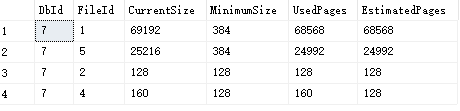
各字段含义如下:
DbId:数据库引擎试图收缩的文件的数据库标识号。
FileId:数据库引擎尝试收缩的文件的文件标识号。
CurrentSize:文件当前占用的 8 KB 页数。
MinimumSize:文件最低可以占用的 8 KB 页数。 这与文件的最小大小或最初创建时的大小相对应。
UsedPages:文件当前使用的 8 KB 页数。
EstimatedPages:数据库引擎估计文件能够收缩到的 8 KB 页数。
如果收缩不成功,可以查看下数据库是否有可以收缩的空间。
SQL如下:
SELECT name ,size/128.0 - CAST(FILEPROPERTY(name, 'SpaceUsed') AS int)/128.0 AS AvailableSpaceInMB

FROM sys.database_files;
如果有空间还收缩不成功,则可能是别原因。
数据库日志杂谈
SqlServer数据库日志对执行的SQL语句进行了加密,所以,在日志里,我们看不到真正执行的SQL语句。
如果想查看SQL语句,需要借助一些工具,如ApexSQLLog。
不过,虽然看不到SQL语句,也可以通过日志看出一些数据库问题,比如,可以查看数据库执行了多少次插入,更新等操作。
查看数据库日志的SQL如下:
SELECT * FROM [sys].[fn_dblog](NULL,NULL)
查询结果如下:

查询结果各字段含义如下:
|
Operation |
Context |
解释 |
|
LOP_SET_BITS |
LCX_DIFF_MAP |
设置位图,资料: 差异(Differential)备份:只备份上次完整备份后,做修改的部分。备份单位是区(Extent)。意味着某个区内即使只有一页做了变动,则在差异备份里会被体现.差异备份依靠一个BitMap进行维护,一个Bit对应一个区,自上次完整备份后,被修改的区会被置为1,而BitMap中被置为1对应的区会被差异备份所备份。而到下一次完整备份后,BitMap中所有的Bit都会被重置为0 而这个BitMap在数据库第7页: DCM页 差异变更(Differential Changed Map,DCM)页面他跟踪一个文件中的哪一个区在最新一次完整数据库备份之后被修改过。SQLSERVER用在增量备份时只对已发生数据变更的分区进行增量备份即可 |
| LOP_BEGIN_XACT | 事务开始 | |
| LOP_MODIFY_ROW | LCX_HEAP | 修改堆表中的某一行记录 |
| LOP_PREP_XACT | 准备启动数据库 | |
| LOP_COMMIT_XACT | 提交事务 | |
| LOP_MODIFY_ROW | LCX_BOOT_PAGE | 修改数据库启动页 |
| LOP_MODIFY_HEADER | LCX_PFS | 修改PFS页的页头部信息 |
| LOP_INSERT_ROWS | LCX_CLUSTERED | 插入数据到聚集索引的索引页 |
| LOP_INSERT_ROWS | LCX_INDEX_LEAF | 插入数据到索引的叶子节点即数据页 |
| LOP_FORMAT_PAGE | LCX_CLUSTERED | 重新组织聚集索引 |
| LOP_DELETE_SPLIT | LCX_CLUSTERED | 删除聚集索引表的一行记录引起页拆分 |
| LOP_MODIFY_HEADER | LCX_HEAP | 修改堆表的某页的页头信息 |
| LOP_BEGIN_CKPT | LCX_NULL | 检查点开始 |
| LOP_END_CKPT | LCX_NULL | 检查点结束 |
| LOP_SET_FREE_SPACE | LCX_PFS | 修改PFS页设置那个数据页是空闲的 |
| LOP_ROOT_CHANGE | LCX_CLUSTERED | 聚集索引的根节点改变 |
| LOP_INSERT_ROWS | LCX_HEAP | 插入数据到堆表 |
| LOP_FORMAT_PAGE | LCX_HEAP | 格式化堆里的数据页 |
| LOP_LOCK_XACT | 在事务里获取锁 | |
| LOP_FORMAT_PAGE | LCX_HEAP | 格式化堆里的数据页 |
----------------------------------------------------------------------------------------------------
注:此文章为原创,任何形式的转载都请联系作者获得授权并注明出处!
若您觉得这篇文章还不错,请点击下方的【推荐】,非常感谢!

SQLSERVER数据库死锁与优化杂谈的更多相关文章
- 查询Sqlserver数据库死锁的一个存储过程(转)
使用sqlserver作为数据库的应用系统,都避免不了有时候会产生死锁, 死锁出现以后,维护人员或者开发人员大多只会通过sp_who来查找死锁的进程,然后用sp_kill杀掉.利用sp_who ...
- 查询Sqlserver数据库死锁的一个存储过程
From:http://www.cnblogs.com/mzhanker/archive/2011/06/04/2072739.html 使用sqlserver作为数据库的应用系统,都避免不了有时候会 ...
- 查询Sqlserver数据库死锁的一个存储过程(转)
链接 :http://www.cnblogs.com/mzhanker/archive/2011/06/04/2072739.html 使用sqlserver作为数据库的应用系统,都避免不了有时候会产 ...
- SqlServer定时备份数据库和定时杀死数据库死锁解决
上周五组长对我说了一句要杀死数据库的死锁进程,有时候同一时刻不停写入数据库会造成这种情况的发生,因为自己对数据库不是很熟悉,突然组长说了我也就决定一定要倒腾一下,不然自己怎么提高呢?现在不研究,说不定 ...
- 【转载】 Sqlserver查看数据库死锁的SQL语句
在Sqlsever数据库中,有时候操作数据库过程中会进行锁表操作,在锁表操作的过程中,有时候会出现死锁的情况出现,这时候可以使用SQL语句来查询数据库死锁情况,主要通过系统数据库Master数据库来查 ...
- MySQL 性能优化-数据库死锁监控
MySQL性能优化-数据库死锁监控 by:授客 QQ:1033553122 1)表锁定 通过检查 table_locks_waited 和 table_locks_immediate 状态变量来分析表 ...
- SQLSERVER查询数据库死锁的存储过程
USE [IdentityDemo] GO /****** Object: StoredProcedure [dbo].[sp_who_lock] Script Date: 2019/1/17 10: ...
- SqlServer 数据库引擎优化顾问优化数据库
现在一直在做的项目,数据量相对也不小,开始的时候没有觉得,因为是刚开始,数据量还很小,在程序使用过程中速度还挺快,但是随着数据量的不停的增长,发现程序越来越慢,甚至出现了超时的问题,因此要对程序和数据 ...
- sqlserver 数据库阻塞和死锁
参考原文:http://blog.csdn.net/ha196200/article/details/44985597 (1) 数据库阻塞: 假设第一个连接T1占有且没有释放资源,第二个连接T2请求同 ...
随机推荐
- 浅谈面试中的OOD面向对象设计问题
转载自:http://baozitraining.org/blog/Object-oriented-design-question/ OO设计问题是电面或者onsite中常考的问题,尤其对以Java为 ...
- margin-right没有效果的问题
margin-right其实有效果的,只是在默认即标准流的情况的下显示不出来效果.如果脱离标准流呢?想到这个,就立马在css文件中加了一个:float:right;然后在测试的时候就能看到margin ...
- IDEA安装教程
1.下载安装程序A,链接:https://pan.baidu.com/s/1IAsGDbApfyNsHuS7_m0rdw 密码:fthp 2.下载一个配置程序B,下载安装之后,暂时不用管,之后会用到. ...
- Python:怎样用线程将任务并行化?
如果待处理任务满足: 可拆分,即任务可以被拆分为多个子任务,或任务是多个相同的任务的集合: 任务不是CPU密集型的,如任务涉及到较多IO操作(如文件读取和网络数据处理) 则使用多线程将任务并行运行,能 ...
- HTML结构及基础语法
一.HTML结构 <!DOCTYPE html><html lang="en"><head> <meta charset="UT ...
- Generator的正确打开方式
前两年大量的在写Generator+co,用它来写一些类似同步的代码但实际上,Generator并不是被造出来干这个使的,不然也就不会有后来的async.await了Generator是一个可以被暂停 ...
- 关于eclipse的一些问题
解决Eclipse,MyEclipse出现An error has occurred,See error log for more details的错误 方法1. 在"开始"--& ...
- Diffie-Hellman密钥协商算法
一.概述 Diffie-Hellman密钥协商算法主要解决秘钥配送问题,本身并非用来加密用的:该算法其背后有对应数学理论做支撑,简单来讲就是构造一个复杂的计算难题,使得对该问题的求解在现实的时间内无法 ...
- PAT1039: Course List for Student
1039. Course List for Student (25) 时间限制 200 ms 内存限制 65536 kB 代码长度限制 16000 B 判题程序 Standard 作者 CHEN, Y ...
- CentOS6.5系统挂载NTFS分区的硬盘
下载rpmforge,下载对应的版本,就是对应CentOS版本,还有32位与64位也要对应上.rpmforge拥有4000多种CentOS的软件包,被CentOS社区认为是最安全也是最稳定的一个软件仓 ...