
STL之空间配置器allocator
摘要
C++STL的空间配置器将内存的分配、释放,对象的构造、析构都分开执行,内存分配由alloc::allocate()负责,内存的释放由alloc::deallocate()负责;对象的构造由::construct()负责,对象的析构由::destroy()负责。
构造和析构:construct()和destroy()
下面为源码和注释:
#include <new.h>	//使用placement new

//使用placement new在已经分配的内存上构造对象

template <class T1, class T2>

inline void construct(T1* p, const T2& value) {

  new (p) T1(value);

}

//第一个版本,接受一个指针

//调用对象的析构函数,它需要有non-trivial destructor

template <class T>

inline void destroy(T* pointer) {

    pointer->~T();

}

//第二个版本

//针对迭代器为char*和wchar_t*的特化版本

inline void destroy(char*, char*) {}

inline void destroy(wchar_t*, wchar_t*) {}

//接受两个迭代器,找出元素的类型

template <class ForwardIterator>

inline void destroy(ForwardIterator first, ForwardIterator last) {

  __destroy(first, last, value_type(first));

}

//判断元素的类型是否有trivial destructor

template <class ForwardIterator, class T>

inline void __destroy(ForwardIterator first, ForwardIterator last, T*) {

  typedef typename __type_traits<T>::has_trivial_destructor trivial_destructor;

  __destroy_aux(first, last, trivial_destructor());

}

//元素的类型有non-trivial destructor

template <class ForwardIterator>

inline void

__destroy_aux(ForwardIterator first, ForwardIterator last, __false_type) {

  for ( ; first < last; ++first)

    destroy(&*first);

}

//元素的类型有trivial destructor

template <class ForwardIterator>

inline void __destroy_aux(ForwardIterator, ForwardIterator, __true_type) {}
空间的配置和释放: std::alloc
在内存配置方面,STL分为两级配置器,当请求的内存大于128bytes的时候调用第一级配置器,当请求的内存小于等于128bytes的时候调用第二级配置器。如图:
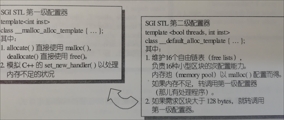
第一级配置器源码:
template <int inst>

class __malloc_alloc_template

{

private:

	//调用malloc函数不成功后调用

	static void *oom_malloc(size_t);

	//调用realloc函数不成功后调用

	static void *oom_realloc(void *, size_t);

	//类似于C++的set_new_handle错误处理函数一样,如果不设置,在内存不足时,返回THROW_BAD_ALLOC

	#ifndef __STL_STATIC_TEMPLATE_MEMBER_BUG

		static void (* __malloc_alloc_oom_handler)();

	#endif

	public:

	//直接调用malloc来分配内存

	static void * allocate(size_t n)

	{

	 void *result = malloc(n);

	 if (0 == result) result = oom_malloc(n);  //如果分配失败,则调用oom_malloc()

	 return result;

	}

 	//第一级配置器直接调用free来释放内存

	static void deallocate(void *p, size_t /* n */)

	{

		free(p);

	}

	//直接调用reallloc来分配内存

	static void * reallocate(void *p, size_t /* old_sz */, size_t new_sz)

	{

	 void * result = realloc(p, new_sz);

	 if (0 == result) result = oom_realloc(p, new_sz);  //如果realloc分配不成功,调用oom_realloc()

	 return result;

	}

	//异常处理函数,即内存分配失败后的处理

	static void (* set_malloc_handler(void (*f)()))()

	{

	 void (* old)() = __malloc_alloc_oom_handler;

	 __malloc_alloc_oom_handler = f;

	 return(old);

	}

};

// 以下是针对内存分配失败后的处理

//首先,将__malloc_alloc_oom_handler的默认值设为0

template <int inst>

void (* __malloc_alloc_template<inst>::__malloc_alloc_oom_handler)() = 0;

#endif

template <int inst>

void * __malloc_alloc_template<inst>::oom_malloc(size_t n)

{

	void (* my_malloc_handler)();

	void *result;

	for (;;) {  // 不断地尝试释放、再配置、再释放、再配置

		my_malloc_handler = __malloc_alloc_oom_handler;

		if (0 == my_malloc_handler) { __THROW_BAD_ALLOC; }  //这里是当没有设置处理函数的时候,直接抛出异常

		(*my_malloc_handler)();   // 调用处理例程,尝试释放内存

		result = malloc(n);  	  // 再重新分配内存

		if (result) return(result);  // 如果分配成功则返回指针

	}

}

template <int inst>

void * __malloc_alloc_template<inst>::oom_realloc(void *p, size_t n)

{

	void (* my_malloc_handler)();

	void *result;

	for (;;) {  //不断地尝试释放、再配置、再释放、再配置

		my_malloc_handler = __malloc_alloc_oom_handler;

		if (0 == my_malloc_handler) { __THROW_BAD_ALLOC; } //这里是当没有设置处理函数的时候,直接抛出异常

		(*my_malloc_handler)();  // 调用处理例程,尝试释放内存

		result = realloc(p, n);  // 再重新分配内存

		if (result) return(result);  // 如果分配成功则返回指针

	}

}
第二级配置器源码:
enum {__ALIGN = 8};   //小型区块的上调边界

enum {__MAX_BYTES = 128};  //小型区块的上限

enum {__NFREELISTS = __MAX_BYTES/__ALIGN};   //free-lists个数

//第一参数用于多线程,这里不做讨论。

template <bool threads, int inst>

class __default_alloc_template

{

private:

	// 此函数将bytes的边界上调至8的倍数

	static size_t ROUND_UP(size_t bytes)

	{

	return (((bytes) + __ALIGN-1) & ~(__ALIGN - 1));

	}

private:

	union obj

	{

	union obj * free_list_link;

	char client_data[1];

	};

private:

	//16个free-lists

	static obj * __VOLATILE free_list[__NFREELISTS];

	// 根据待待分配的空间大小, 在free_list中选择合适的大小

	static  size_t FREELIST_INDEX(size_t bytes)

	{

	return (((bytes) + __ALIGN-1)/__ALIGN - 1);

	}

	// 返回一个大小为n的对象,并可能加入大小为n的其它区块到free-lists

	static void *refill(size_t n);

	// 配置一大块空间,可容纳nobjs个大小为“size”的区块

	// 如果配置nobjs个区块有所不便,nobjs可能会降低,所以需要用引用传递

	static char *chunk_alloc(size_t size, int &nobjs);

	// 内存池

	static char *start_free;      // 内存池起始点,只在chunk_alloc()中变化

	static char *end_free;        // 内存池结束点,只在chunk_alloc()中变化

	static size_t heap_size;      // 已经在堆上分配的空间大小

public:

	static void* allocate(size_t n);// 空间配置函数

	static void deallocate(void *p, size_t n); // 空间释放函数

	static void* reallocate(void* p, size_t old_sz , size_t new_sz); //空间重新配置函数

}

// 一些静态成员变量的初始化

// 内存池起始位置

template <bool threads, int inst>

char *__default_alloc_template<threads, inst>::start_free = 0;

// 内存池结束位置

template <bool threads, int inst>

char *__default_alloc_template<threads, inst>::end_free = 0;

// 已经在堆上分配的空间大小

template <bool threads, int inst>

size_t __default_alloc_template<threads, inst>::heap_size = 0;

// 内存池容量索引数组

template <bool threads, int inst>

__default_alloc_template<threads, inst>::obj * __VOLATILE

__default_alloc_template<threads, inst> ::free_list[__NFREELISTS ] =

	{0, 0, 0, 0, 0, 0, 0, 0, 0, 0, 0, 0, 0, 0, 0, 0, };

// The 16 zeros are necessary to make version 4.1 of the SunPro

// compiler happy.  Otherwise it appears to allocate too little

// space for the array.

public:

  //空间配置函数allocate()

  static void * allocate(size_t n)

  {

  	//指向freelist的指针

    obj * __VOLATILE * my_free_list;

    obj * __RESTRICT result;

	//区块size大于128就调用一级配置器,n已被上调至8的倍数

    if (n > (size_t) __MAX_BYTES) {

        return(malloc_alloc::allocate(n));

    }

    //寻找freelists中适当的一个

    my_free_list = free_list + FREELIST_INDEX(n);

    result = *my_free_list;

    //没有找到可用的freelist,就重新填充freelist

    if (result == 0) {

        void *r = refill(ROUND_UP(n));

        return r;

    }

    //调整freelist

    *my_free_list = result -> free_list_link;

    return (result);

  };

  	//空间释放函数deallocate()

  	//p不能为nullptr

  static void deallocate(void *p, size_t n)

  {

    obj *q = (obj *)p;

    obj * __VOLATILE * my_free_list;

	//如果大于128就调用第一级的释放函数

    if (n > (size_t) __MAX_BYTES) {

        malloc_alloc::deallocate(p, n);

        return;

    }

    //找到对应的freelist

    my_free_list = free_list + FREELIST_INDEX(n);

	//调整freelist,回收区块

    q -> free_list_link = *my_free_list;

    *my_free_list = q;

  }

} ;

//内存池函数chunk_allco()

template <bool threads, int inst>

char*

__default_alloc_template<threads, inst>::chunk_alloc(size_t size, int& nobjs)

{

    char * result;

    //所需容量

    size_t total_bytes = size * nobjs;

    //内存池剩余容量

    size_t bytes_left = end_free - start_free;

	//如果余量足够

    if (bytes_left >= total_bytes) {

        result = start_free;

        start_free += total_bytes;

        return(result);

    }

    //余量不能完全满足需求,但至少能供应1个区块

    else if (bytes_left >= size) {

      	//计算能供应的最多节点个数

        nobjs = bytes_left/size;

        total_bytes = size * nobjs;

        result = start_free;

        //调整内存池开始位置

        start_free += total_bytes;

        return(result);

    } else {

        //余量严重不足

        size_t bytes_to_get = 2 * total_bytes + ROUND_UP(heap_size >> 4);

        // 将剩余内存分配给指定的free_list[FREELIST_INDEX(bytes_left)]

        if (bytes_left > 0) {

            //内存池还有一些零头

            //寻找适当的freelist

            obj * __VOLATILE * my_free_list =

                        free_list + FREELIST_INDEX(bytes_left);

			//调整freelist,将内存池中剩余内存编入

            ((obj *)start_free) -> free_list_link = *my_free_list;

            *my_free_list = (obj *)start_free;

        }

        //用malloc配置空间,补充内存池

        start_free = (char *)malloc(bytes_to_get);

        //malloc失败

        if (0 == start_free) {

            int i;

            obj * __VOLATILE * my_free_list, *p;

            // Try to make do with what we have.  That can't

            // hurt.  We do not try smaller requests, since that tends

            // to result in disaster on multi-process machines.

            //不打算配置更小区块,那在多进程机器上会有灾难,无法让其他进程获取内存

            //检查freelist中的可用空间,且区块足够大

            for (i = size; i <= __MAX_BYTES; i += __ALIGN) {

                my_free_list = free_list + FREELIST_INDEX(i);

                p = *my_free_list;

                if (0 != p) {

                    //有可用空间,将其加入内存池

                    *my_free_list = p -> free_list_link;

                    start_free = (char *)p;

                    end_free = start_free + i;

                    //内存池更新完毕,重新分配内存

                    return(chunk_alloc(size, nobjs));

                    //任何剩余零头将被编入适当的freelist以备用

                    // Any leftover piece will eventually make it to the

                    // right free list.

                }

            }

            //分配失败,就调用一级分配器分配,期待异常处理函数提供帮助

	    end_free = 0;	// In case of exception.

            start_free = (char *)malloc_alloc::allocate(bytes_to_get);

            // This should either throw an

            // exception or remedy the situation.  Thus we assume it

            // succeeded.

        }

        heap_size += bytes_to_get;

        end_free = start_free + bytes_to_get;

        //内存池更新完毕,重新分配内存

        return(chunk_alloc(size, nobjs));

    }

}

//重新填充freelists

template <bool threads, int inst>

void* __default_alloc_template<threads, inst>::refill(size_t n)

{

 	//20个区块

    int nobjs = 20;

    //调用chunk_alloc(),尝试取nobjs个区块作为freelist的新节点

    //nobjs为引用传递

    char * chunk = chunk_alloc(n, nobjs);

    obj * __VOLATILE * my_free_list;

    obj * result;

    obj * current_obj, * next_obj;

    int i;

	//若内存池只够分配1个区块,直接返回,freelist无新节点

    if (1 == nobjs) return(chunk);

    //否则,定位freelist,准备纳入新节点

    my_free_list = free_list + FREELIST_INDEX(n);

    	//在chunk这段空间建立freelist

      result = (obj *)chunk;

    	//略过第一个小区块

      *my_free_list = next_obj = (obj *)(chunk + n);

    //将freelist的各个节点串接起来

    //从第一个开始,第0个返回给客户

    for (i = 1; ; i++) {

        current_obj = next_obj;

        next_obj = (obj *)((char *)next_obj + n);

        if (nobjs - 1 == i) {

            //尾节点指针域为nullptr

            current_obj -> free_list_link = 0;

            break;

        } else {

            current_obj -> free_list_link = next_obj;

        }

      }

    //串接完成并返回

    return(result);

}
STL之空间配置器allocator的更多相关文章
- C++ STL学习之 空间配置器(allocator)
众所周知,一般情况下,一个程序包括数据结构和相应的算法,而数据结构作为存储数据的组织形式,与内存空间有着密切的联系. 在C++ STL中,空间配置器便是用来实现内存空间(一般是内存,也可以是硬盘等空间 ...
- C++ 空间配置器(allocator)
C++ 空间配置器(allocator) 在STL中,Memory Allocator 处于最底层的位置,为一切的 Container 提供存储服务,是一切其他组件的基石.对于一般使用 STL 的用户 ...
- STL的空间配置器std_alloc 笔记
STL的空间配置器std_alloc 笔记 C++的内存分配基本操作是 ::operator new(),内存释放是 ::operator delete(),这里个全局函数相当于C的malloc和fr ...
- 带你深入理解STL之空间配置器(思维导图+源码)
前不久把STL细看了一遍,由于看得太"认真",忘了做笔记,归纳和总结这步漏掉了.于是为了加深印象,打算重看一遍,并记录下来里面的一些实现细节.方便以后能较好的复习它. 以前在项目中 ...
- 《STL源码剖析》chapter2空间配置器allocator
为什么不说allocator是内存配置器而说是空间配置器,因为空间不一定是内存,也可以是磁盘或其他辅助介质.是的,你可以写一个allocator,直接向硬盘取空间.sgi stl提供的配置器,配置的对 ...
- STL 之 空间配置器(allocator)
一.SGI 标准的空间配置器,std::allocator SGI也定义了一个符合部分标准,名为allocator的配置器,但是它自己不使用,也不建议我们使用,主要原因是效率不佳. 它只是把C++的操 ...
- STL源码剖析 — 空间配置器(allocator)
前言 以STL的实现角度而言,第一个需要介绍的就是空间配置器,因为整个STL的操作对象都存放在容器之中. 你完全可以实现一个直接向硬件存取空间的allocator. 下面介绍的是SGI STL提供的配 ...
- STL学习笔记:空间配置器allocator
allocator必要接口: allocator::value_type allocator::pointer allocator::const_pointer allocator::referenc ...
- STL源码剖析——空间配置器Allocator#1 构造与析构
以STL的运用角度而言,空间配置器是最不需要介绍的东西,因为它扮演的是幕后的角色,隐藏在一切容器的背后默默工作.但以STL的实现角度而言,最应该首先介绍的就是空间配置器,因为这是这是容器展开一切运作的 ...
随机推荐
- XXE(外部实体注入攻击)
利用XXE漏洞可以进行拒绝服务攻击.文件读取.命令代码执行.SQL(XSS)注入.内外扫描端口和入侵内网站点等,内网探测和入侵是利用XXE中支持的协议进行内网主机和端口的发现,可以理解为使用XXE进行 ...
- iOS 逆向工程(工具介绍)- 学习整理(转)
一.class-dump 简介:顾名思义,就是用来导出目标对象的class信息的工具,私有方法声明也能导出来. 原理:利用 Objective-C语言的 runtime 特性,将存 在Mach-O 文 ...
- js json 排序
/* json:需要排序的json key:排序项 */ function JsonSort(json, key) { //console.log(json); for (var j = 1, jl ...
- presto-gateway nodejs client
目前已经有了好几个presto nodejs 的client,为了方便presto-gateway 的连接,修改了一个现有的nodejs client 可以方便的连接presto-gateway 原理 ...
- nginx之升级openssl及自定义nginx版本
favicon.ico浏览器图标配置 favicon.ico 文件是浏览器收藏网址时显示的图标,当客户端使用浏览器问页面时,浏览器会自己主动发起请求获取页面的favicon.ico文件,但是当浏览器请 ...
- android常见错误之 No resource found that matches the given name
新手上路,还希望大神多多照顾,刚自学android,遇到很多困难.其中就有这个问题,不知道你们遇到过没有,反正我是很头痛. No resource found that matches the giv ...
- GC(一)内存管理与垃圾回收
参考文章: 内存分配.GC原理与垃圾收集器:http://www.importnew.com/23035.html g1垃圾回收器:http://blog.jobbole.com/109170/ cm ...
- No Suitable Driver Found For Jdbc
今天出现编码出现了No suitable driver found for jdbc,又是找遍了网上的资料,基本上都说是三个问题: 一是:连接URL格式出现了问题(Connection conn ...
- springboot(1)@SpringBootApplication
首先来看下Spring Boot项目中的运行类,基本上每个项目都会有该启动类: @SpringBootApplication public class Application { public sta ...
- Log4j 1.x版 引发线程blocked死锁问题(2008)
1. https://blog.csdn.net/zl378837964/article/details/84884934 2. 去掉debug