
C# 优先级队列
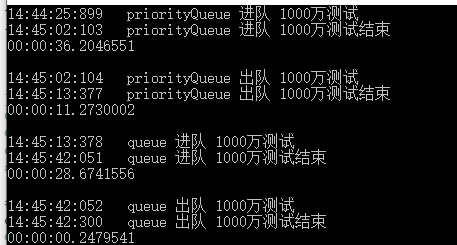
前6行是优先队列,后6行是C#原生的queue
Min Heap Priority Queue
The above code is not really a true Priority Queue as it does not allow duplicate keys; also, the SortedList on which it is based does not have O(log n) insertions and removals for random data as a true Priority Queue does. The below code implements a true Min Heap Priority Queue:
namespace PriorityQ {
  using KeyT = UInt32;
  using System;
  using System.Collections.Generic;
  using System.Linq;
  class Tuple<K, V> { // for DotNet 3.5 without Tuple's
    public K Item1; public V Item2;
    public Tuple(K k, V v) { Item1 = k; Item2 = v; }
    public override string ToString() {
      return "(" + Item1.ToString() + ", " + Item2.ToString() + ")";
    }
  }
  class MinHeapPQ<V> {
    private struct HeapEntry {
      public KeyT k; public V v;
      public HeapEntry(KeyT k, V v) { this.k = k; this.v = v; }
    }
    private List<HeapEntry> pq;
    private MinHeapPQ() { this.pq = new List<HeapEntry>(); }
    ; } }
    private int sz {
      get {
        var cnt = pq.Count;
        ) ?  : cnt - ;
      }
    }
    private Tuple<KeyT, V> pkmn {
      get {
        ) return null;
        else {
          ];
          return new Tuple<KeyT, V>(mn.k, mn.v);
        }
      }
    }
    private void psh(KeyT k, V v) { // add extra very high item if none
      ) pq.Add(new HeapEntry(UInt32.MaxValue, v));
      ]); // copy bottom item...
      ; ni > ; i >>= , ni >>= ) {
        ];
        ] = t; else break;
      }
      pq[i - ] = new HeapEntry(k, v);
    }
    private void siftdown(KeyT k, V v, int ndx) {
      ; var i = ndx;
      ; ni < cnt; ni = ni + ni + ) {
        ].k;
        var nk = k;
        if (k > lk) { i = ni; nk = lk; }
        ; i = ni; }
        if (i != oi) pq[oi] = pq[i]; else break;
      }
      pq[i] = new HeapEntry(k, v);
    }
    private void rplcmin(KeyT k, V v) {
      ) siftdown(k, v, );
    }
    private void dltmin() {
      ;
      ) pq.Clear();
      else {
        var lkv = pq[lsti];
        pq.RemoveAt(lsti); siftdown(lkv.k, lkv.v, );
      }
    }
    private void reheap(int i) {
      ;
      if (lfti < sz) {
        ; reheap(lfti); reheap(rghti);
        var ckv = pq[i]; siftdown(ckv.k, ckv.v, i);
      }
    }
    private void bld(IEnumerable<Tuple<KeyT, V>> sq) {
      var sqm = from e in sq
                select new HeapEntry(e.Item1, e.Item2);
      pq = sqm.ToList<HeapEntry>();
      var sz = pq.Count;
      ) {
        ];
        pq.Add(new HeapEntry(KeyT.MaxValue, lkv.v));
        reheap();
      }
    }
    private IEnumerable<Tuple<KeyT, V>> sq() {
      return from e in pq
             where e.k != KeyT.MaxValue
             select new Tuple<KeyT, V>(e.k, e.v); }
    private void adj(Func<KeyT, V, Tuple<KeyT, V>> f) {
      ;
      ; i < cnt; ++i) {
        var e = pq[i];
        var r = f(e.k, e.v);
        pq[i] = new HeapEntry(r.Item1, r.Item2);
      }
      reheap();
    }
    public static MinHeapPQ<V> empty { get { return new MinHeapPQ<V>(); } }
    public static bool isEmpty(MinHeapPQ<V> pq) { return pq.mt; }
    public static int size(MinHeapPQ<V> pq) { return pq.sz; }
    public static Tuple<KeyT, V> peekMin(MinHeapPQ<V> pq) { return pq.pkmn; }
    public static MinHeapPQ<V> push(KeyT k, V v, MinHeapPQ<V> pq) {
      pq.psh(k, v); return pq; }
    public static MinHeapPQ<V> replaceMin(KeyT k, V v, MinHeapPQ<V> pq) {
      pq.rplcmin(k, v); return pq; }
    public static MinHeapPQ<V> deleteMin(MinHeapPQ<V> pq) { pq.dltmin(); return pq; }
    public static MinHeapPQ<V> merge(MinHeapPQ<V> pq1, MinHeapPQ<V> pq2) {
      return fromSeq(pq1.sq().Concat(pq2.sq())); }
    public static MinHeapPQ<V> adjust(Func<KeyT, V, Tuple<KeyT, V>> f, MinHeapPQ<V> pq) {
      pq.adj(f); return pq; }
    public static MinHeapPQ<V> fromSeq(IEnumerable<Tuple<KeyT, V>> sq) {
      var pq = new MinHeapPQ<V>(); pq.bld(sq); return pq; }
    public static Tuple<Tuple<KeyT, V>, MinHeapPQ<V>> popMin(MinHeapPQ<V> pq) {
      var rslt = pq.pkmn; if (rslt == null) return null;
      pq.dltmin(); return new Tuple<Tuple<KeyT, V>, MinHeapPQ<V>>(rslt, pq); }
    public static IEnumerable<Tuple<KeyT, V>> toSeq(MinHeapPQ<V> pq) {
      for (; !pq.mt; pq.dltmin()) yield return pq.pkmn; }
    public static IEnumerable<Tuple<KeyT, V>> sort(IEnumerable<Tuple<KeyT, V>> sq) {
      return toSeq(fromSeq(sq)); }
  }
}
The above class code offers a full set of static methods and properties:
 1.  "empty" to create a new empty queue,
 2.  "isEmpty" to test if a queue is empty,
 3.  "size" to get the number of elements in the queue,
 4.  "peekMin" to retrieve the lowest priority key/value pair entry as a Tuple (possibly null for empty queues),
 5.  "push" to insert an entry,
 6.  "deleteMin" to remove the lowest priority entry,
 7.  "replaceMin" to replace the lowest priority and adjust the queue according to the value (faster than a "deleteMin" followed by a "push"),
 8.  "adjust" to apply a function to every key/value entry pair and reheapify the result,
 9.  "merge" to merge two queues into a single reheapified result,
 10. "fromSeq" to build a queue from a sequence of key/value pair tuples,
 11. "popMin" which is a convenience function combining a "peekMin" with a "deleteMin", returning null if the queue is empty and a tuple of the result otherwise,
 12. "toSeq" to output an ordered sequence of the queue contents as Tuple's of the key/value pairs, and
 13. "sort" which is a convenience function combining "fromSeq" followed by "toSeq".
The first four are all O(1) and the remainder O(log n) except "adjust" and "fromSeq" are O(n), "merge" is O(m + n) where m and n are the sizes of the two queues, and "toSeq" and "sort" are O(n log n); "replaceMin" is still O(log n) but faster than a "deleteMin" followed by a "push" by a constant factor.
Note that the Key type "KeyT" is not generic in order to give better comparison efficiency than using generic comparison using the IComparible interface but can be changed to different numeric types using the "using KeyT = ???" type alias.
The above code can be tested as per the page specification by the following code:
static void Main(string[] args) {
      Tuple<uint, string>[] ins = { new Tuple<uint,string>(3u, "Clear drains"),
                                    new Tuple<uint,string>(4u, "Feed cat"),
                                    new Tuple<uint,string>(5u, "Make tea"),
                                    new Tuple<uint,string>(1u, "Solve RC tasks"),
                                    new Tuple<uint,string>(2u, "Tax return") };

      var spq = ins.Aggregate(MinHeapPQ<string>.empty, (pq, t) => MinHeapPQ<string>.push(t.Item1, t.Item2, pq));
      foreach (var e in MinHeapPQ<string>.toSeq(spq)) Console.WriteLine(e); Console.WriteLine();

      foreach (var e in MinHeapPQ<string>.sort(ins)) Console.WriteLine(e); Console.WriteLine();

      var npq = MinHeapPQ<string>.fromSeq(ins);
      foreach (var e in MinHeapPQ<string>.toSeq(MinHeapPQ<string>.merge(npq, npq)))
        Console.WriteLine(e); Console.WriteLine();

      var npq = MinHeapPQ<string>.fromSeq(ins);
      foreach (var e in MinHeapPQ<string>.toSeq(MinHeapPQ<string>.merge(npq, npq)))
        Console.WriteLine(e);

      foreach (var e in MinHeapPQ<string>.toSeq(MinHeapPQ<string>.adjust((k, v) => new Tuple<uint,string>(6u - k, v), npq)))
        Console.WriteLine(e); Console.WriteLine();
    }
It tests building the queue the slow way using repeated "push"'s - O(n log n), the faster "fromSeq" (included in the "sort") - O(n), and also tests the "merge" and "adjust" methods.
The output of the above test is as follows:
- Output:
(1, Solve RC tasks)
(2, Tax return)
(3, Clear drains)
(4, Feed cat)
(5, Make tea)

(1, Solve RC tasks)
(2, Tax return)
(3, Clear drains)
(4, Feed cat)
(5, Make tea)

(1, Solve RC tasks)
(1, Solve RC tasks)
(2, Tax return)
(2, Tax return)
(3, Clear drains)
(3, Clear drains)
(4, Feed cat)
(4, Feed cat)
(5, Make tea)
(5, Make tea)

(1, Make tea)
(2, Feed cat)
(3, Clear drains)
(4, Tax return)
(5, Solve RC tasks)

再贴上自己写的一点扩展方法
    public static class MinHeapPQEX
    {
        /// <summary>
        /// 创建一个空的优先级队列O(1)
        /// </summary>
        /// <typeparam name="T"></typeparam>
        /// <returns></returns>
        public static PriorityQueue<T> CreatPriorityQueue<T>()
        {
            return PriorityQueue<T>.empty;
        }

        /// <summary>
        /// 进队 O(log n)
        /// </summary>
        /// <typeparam name="T"></typeparam>
        /// <param name="pq"></param>
        /// <param name="priority"></param>
        /// <param name="model"></param>
        public static void Enqueue<T>(this PriorityQueue<T> pq, UInt32 priority, T model)
        {
            PriorityQueue<T>.push(priority, model, pq);
        }

        /// <summary>
        /// 出队  peek+delete
        /// </summary>
        /// <typeparam name="T"></typeparam>
        /// <param name="pq"></param>
        /// <returns></returns>
        public static T Dequeue<T>(this PriorityQueue<T> pq)
        {
            return PriorityQueue<T>.popMin(pq).Item1.Item2;
        }

        /// <summary>
        /// 检索,但不出队 O(1)
        /// </summary>
        /// <typeparam name="T"></typeparam>
        /// <param name="pq"></param>
        /// <returns></returns>
        public static T Peek<T>(this PriorityQueue<T> pq)
        {
            return PriorityQueue<T>.peekMin(pq).Item2;
        }

        /// <summary>
        /// 判断队列是否为空 O(1)
        /// </summary>
        /// <typeparam name="T"></typeparam>
        /// <param name="pq"></param>
        /// <returns></returns>
        public static bool IsEmpty<T>(this PriorityQueue<T> pq)
        {
            return PriorityQueue<T>.isEmpty(pq);
        }

        /// <summary>
        /// 统计 O(1)
        /// </summary>
        /// <typeparam name="T"></typeparam>
        /// <param name="pq"></param>
        /// <returns></returns>
        public static int Count<T>(this PriorityQueue<T> pq)
        {
            return PriorityQueue<T>.size(pq);
        }

        /// <summary>
        /// 删除即将出队的元素
        /// </summary>
        /// <typeparam name="T"></typeparam>
        /// <param name="pq"></param>
        public static void Delete<T>(this PriorityQueue<T> pq)
        {
            PriorityQueue<T>.deleteMin(pq);
        }
    }
C# 优先级队列的更多相关文章
- 体验Rabbitmq强大的【优先级队列】之轻松面对现实业务场景
说到队列的话,大家一定不会陌生,但是扯到优先级队列的话,还是有一部分同学是不清楚的,可能是不知道怎么去实现吧,其实呢,,,这东西已 经烂大街了...很简单,用“堆”去实现的,在我们系统中有一个订单催付 ...
- Java中的队列Queue,优先级队列PriorityQueue
队列Queue 在java5中新增加了java.util.Queue接口,用以支持队列的常见操作.该接口扩展了java.util.Collection接口. Queue使用时要尽量避免Collecti ...
- 如何基于RabbitMQ实现优先级队列
概述 由于种种原因,RabbitMQ到目前为止,官方还没有实现优先级队列,只实现了Consumer的优先级处理. 但是,迫于种种原因,应用层面上又需要优先级队列,因此需求来了:如何为RabbitMQ加 ...
- ACM/ICPC 之 优先级队列+设置IO缓存区(TSH OJ-Schedule(任务调度))
一个裸的优先级队列(最大堆)题,但也有其他普通队列的做法.这道题我做了两天,结果发现是输入输出太过频繁,一直只能A掉55%的数据,其他都是TLE,如果将输入输出的数据放入缓存区,然后满区输出,可以将I ...
- java中PriorityQueue优先级队列使用方法
优先级队列是不同于先进先出队列的另一种队列.每次从队列中取出的是具有最高优先权的元素. PriorityQueue是从JDK1.5开始提供的新的数据结构接口. 如果不提供Comparator的话,优先 ...
- stl的优先级队列
#include <iostream> #include <vector> #include <queue> using namespace std; class ...
- 【python cookbook】【数据结构与算法】5.实现优先级队列
问题:要实现一个队列,它能够以给定的优先级对元素排序,且每次pop操作时都会返回优先级最高的那个元素: 解决方案:采用heapq模块实现一个简单的优先级队列 # example.py # # Exam ...
- POJ 2227 The Wedding Juicer (优先级队列+bfs+dfs)
思路描述来自:http://hi.baidu.com/perfectcai_/item/701f2efa460cedcb0dd1c820也可以参考黑书P89的积水. 题意:Farmer John有一个 ...
- 《Java数据结构与算法》笔记-CH4-6优先级队列
/** * 优先级队列 * 效率:插入O(n),删除O(1).第12章介绍如何通过堆来改进insert时间 */ class PriorityQueue { private int maxSize; ...
- STL学习系列七:优先级队列priority_queue容器
1.简介 最大值优先级队列.最小值优先级队列 优先级队列适配器 STL priority_queue 用来开发一些特殊的应用,请对stl的类库,多做扩展性学习 这里给个例子: #include< ...
随机推荐
- 用户之间imp的问题
今天同事说申请了一个从生产导出的dump文件,须要导入測试库进行測试. 之前做的基本都是本库导出,本库导入的操作,比如:imp test/***@test tables=tbl_fuel file=H ...
- Deepin下python安装uwsgi报错: Python.h:没有那个文件或目录
解决方法是安装python-dev,这是Python的头文件和静态库包 正在读取软件包列表... 完成正在分析软件包的依赖关系树 正在读取状态信息... 完成 下列软件包是自动 ...
- 【u009】瑞瑞的木板
Time Limit: 1 second Memory Limit: 128 MB [问题描述] 瑞瑞想要亲自修复在他的一个小牧场周围的围栏.他测量栅栏并发现他需要N(1≤N≤20,000)根木板,每 ...
- mysql修改root密码百分百解决你的问题
原文:mysql修改root密码百分百解决你的问题 1.MySQL版本8.0.4之后修改密码 ALTER USER 'root'@'localhost' IDENTIFIED WITH mysql_n ...
- swift菜鸟入门视频教程-01-基础部分
本人自己录制的swift菜鸟入门,欢迎大家拍砖,有什么问题能够在这里留言. 主要内容: 常量和变量 凝视 分号 整数 浮点数 类型安全和类型判断 数值型字面量 数值型类型转换 类型别名 布尔值 元组 ...
- 自动化部署脚本,给每一台主机装上JDK,且配好环境变量
centos6.7 当我们有很多台主机,想在每台机器上都安装一样的某些软件,当然,一台机器一台机器安装也是可以的,但是如果有一键安装所有机器上的软件那是不是很激动人心呢! 首先我们需要制作一台服务器, ...
- MySQL执行计划分析
原文:MySQL执行计划分析 一. 执行计划能告诉我们什么? SQL如何使用索引 联接查询的执行顺序 查询扫描的数据函数 二. 执行计划中的内容 SQL执行计划的输出可能为多行,每一行代表对一个数据库 ...
- 【33.33%】【codeforces 608C】Chain Reaction
time limit per test2 seconds memory limit per test256 megabytes inputstandard input outputstandard o ...
- TEdit,TMemo背景透明(SetWindowLong(WS_EX_TRANSPARENT)增加透明风格)
The component below works perfectly, except for the following problem: 1) Saves the component below ...
- C++技术问题总结-第0篇 类型转换
从今天開始,对C++经常使用技术做个总结. 參考书籍:<C++Primer>.<C++对象模型>.<设计模式>.<Windows核心编程>.<ST ...