
神经网络 (2)- Alexnet Training on MNIST
Win10 Anaconda下配置tensorflow+jupyter notebook环境
1.安装anaconda
到Anaconda官网下载,我是用的是Anaconda3-4.8.0版本(Python3对应的是Anaconda3,Python2对应的是Anaconda2),根据需要下载即可。下载好之后点击exe文件安装没什么好讲的。
唯一需要特别说明的是,安装的过程中要把添加路径到环境中选项选中!安装完成之后到命令行输入命令验证是否成功安装:
conda --version
- 安装tensorflow 官方步骤创建环境,
If you installed a TensorFlow as it said in official documentation: https://www.tensorflow.org/versions/r0.10/get_started/os_setup.html#overview
I mean creating an environment called tensorflow and tested your installation in python, but TensorFlow can not be imported in jupyter, you have to install jupyter in your tensorflow environment too:
conda install jupyter notebook
After that I run a jupyter and it can import TensorFlow too:
jupyter notebook
AlexNet 识别MNIST
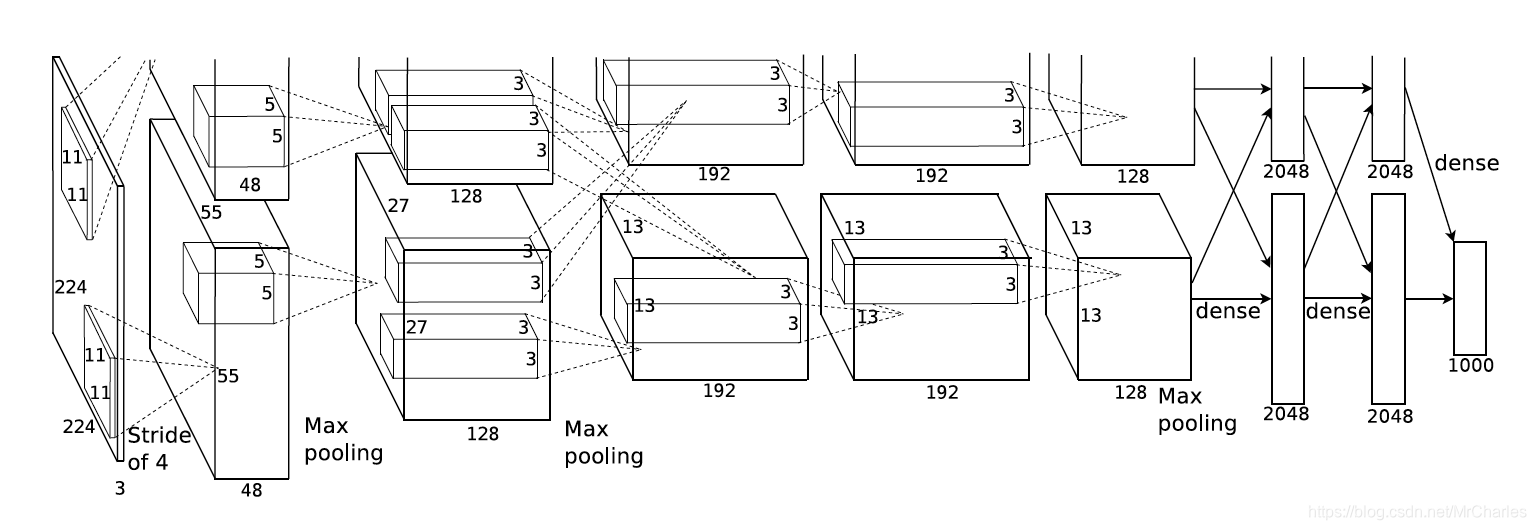
以上是AlexNet的结构,上下其实是一样的,共同用一套参数。 Similar structure to LeNet, AlexNet has more filters per layer, deeper and stacked. There are 5 convolutional layers, 3 fully connected layers and with Relu applied after each of them, and dropout applied before the first and second fully connected layer.AlexNet是2012年ImageNet比赛的冠军,虽然过去了很长时间,但是作为深度学习中的经典模型,AlexNet不但有助于我们理解其中所使用的很多技巧,而且非常有助于提升我们使用深度学习工具箱的熟练度。
from tensorflow.examples.tutorials.mnist import input_data

mnist = input_data.read_data_sets("/tmp/data/", one_hot=True)

import tensorflow as tf

#

learning_rate = 0.001

training_iters = 200000

batch_size = 64

display_step = 20

#

n_input = 784 #

n_classes = 10 #

dropout = 0.8 # Dropout

#

x = tf.placeholder(tf.float32, [None, n_input])

y = tf.placeholder(tf.float32, [None, n_classes])

keep_prob = tf.placeholder(tf.float32)

#

def conv2d(name, l_input, w, b):

    return tf.nn.relu(tf.nn.bias_add(tf.nn.conv2d(l_input, w, strides=[1, 1, 1, 1], padding='SAME'),b), name=name)

#

def max_pool(name, l_input, k):

    return tf.nn.max_pool(l_input, ksize=[1, k, k, 1], strides=[1, k, k, 1], padding='SAME', name=name)

#

def norm(name, l_input, lsize=4):

    return tf.nn.lrn(l_input, lsize, bias=1.0, alpha=0.001 / 9.0, beta=0.75, name=name)

#

def alex_net(_X, _weights, _biases, _dropout):

    #

    _X = tf.reshape(_X, shape=[-1, 28, 28, 1])

    #

    conv1 = conv2d('conv1', _X, _weights['wc1'], _biases['bc1'])

    #

    pool1 = max_pool('pool1', conv1, k=2)

    #

    norm1 = norm('norm1', pool1, lsize=4)

    # Dropout

    norm1 = tf.nn.dropout(norm1, _dropout)

    #

    conv2 = conv2d('conv2', norm1, _weights['wc2'], _biases['bc2'])

    #

    pool2 = max_pool('pool2', conv2, k=2)

    #

    norm2 = norm('norm2', pool2, lsize=4)

    # Dropout

    norm2 = tf.nn.dropout(norm2, _dropout)

    #

    conv3 = conv2d('conv3', norm2, _weights['wc3'], _biases['bc3'])

    conv4 = conv2d('conv4', conv3, _weights['wc4'], _biases['bc4'])

    conv5 = conv2d('conv5', conv4, _weights['wc5'], _biases['bc5'])

    pool5 = max_pool('pool5', conv5, k=2)

    #

    norm5 = norm('norm5', pool5, lsize=4)

    # Dropout

    norm5 = tf.nn.dropout(norm5, _dropout)

    #

    dense1 = tf.reshape(norm5, [-1, _weights['wd1'].get_shape().as_list()[0]])

    dense1 = tf.nn.relu(tf.matmul(dense1, _weights['wd1']) + _biases['bd1'], name='fc1')

    #

    dense2 = tf.nn.relu(tf.matmul(dense1, _weights['wd2']) + _biases['bd2'], name='fc2') # Relu activation

    #

    out = tf.matmul(dense2, _weights['out']) + _biases['out']

    return out

#

weights = {

    'wc1': tf.Variable(tf.random_normal([11, 11, 1, 64])),

    'wc2': tf.Variable(tf.random_normal([5, 5, 64, 192])),

    'wc3': tf.Variable(tf.random_normal([3, 3, 192, 384])),

    'wc4': tf.Variable(tf.random_normal([3, 3, 384, 256])),

    'wc5': tf.Variable(tf.random_normal([3, 3, 256, 256])),

    'wd1': tf.Variable(tf.random_normal([4*4*256, 1024])),

    'wd2': tf.Variable(tf.random_normal([1024, 1024])),

    'out': tf.Variable(tf.random_normal([1024, 10]))

}

biases = {

    'bc1': tf.Variable(tf.random_normal([64])),

    'bc2': tf.Variable(tf.random_normal([192])),

    'bc3': tf.Variable(tf.random_normal([384])),

    'bc4': tf.Variable(tf.random_normal([256])),

    'bc5': tf.Variable(tf.random_normal([256])),

    'bd1': tf.Variable(tf.random_normal([1024])),

    'bd2': tf.Variable(tf.random_normal([1024])),

    'out': tf.Variable(tf.random_normal([n_classes]))

}

#

pred = alex_net(x, weights, biases, keep_prob)

#

cost = tf.reduce_mean(tf.nn.softmax_cross_entropy_with_logits(logits=pred, labels=y))

optimizer = tf.train.AdamOptimizer(learning_rate=learning_rate).minimize(cost)

#

correct_pred = tf.equal(tf.argmax(pred,1), tf.argmax(y,1))

accuracy = tf.reduce_mean(tf.cast(correct_pred, tf.float32))

#

init = tf.initialize_all_variables()

#

with tf.Session() as sess:

    sess.run(init)

    step = 1

    # Keep training until reach max iterations

    while step * batch_size < training_iters:

        batch_xs, batch_ys = mnist.train.next_batch(batch_size)

        #

        sess.run(optimizer, feed_dict={x: batch_xs, y: batch_ys, keep_prob: dropout})

        if step % display_step == 0:

            #

            acc = sess.run(accuracy, feed_dict={x: batch_xs, y: batch_ys, keep_prob: 1.})

            #

            loss = sess.run(cost, feed_dict={x: batch_xs, y: batch_ys, keep_prob: 1.})

            print ("Iter " + str(step*batch_size) + ", Minibatch Loss= " + "{:.6f}".format(loss) + ", Training Accuracy= " + "{:.5f}".format(acc))

        step += 1

    print ("Optimization Finished!")

    #

    print ("Testing Accuracy:", sess.run(accuracy, feed_dict={x: mnist.test.images[:256], y: mnist.test.labels[:256], keep_prob: 1.}))
神经网络 (2)- Alexnet Training on MNIST的更多相关文章
- 利用CNN神经网络实现手写数字mnist分类
题目: 1)In the first step, apply the Convolution Neural Network method to perform the training on one ...
- 第十六节,卷积神经网络之AlexNet网络实现(六)
上一节内容已经详细介绍了AlexNet的网络结构.这节主要通过Tensorflow来实现AlexNet. 这里做测试我们使用的是CIFAR-10数据集介绍数据集,关于该数据集的具体信息可以通过以下链接 ...
- 卷积神经网络之AlexNet
由于受到计算机性能的影响,虽然LeNet在图像分类中取得了较好的成绩,但是并没有引起很多的关注. 知道2012年,Alex等人提出的AlexNet网络在ImageNet大赛上以远超第二名的成绩夺冠,卷 ...
- 第十五节,卷积神经网络之AlexNet网络详解(五)
原文 ImageNet Classification with Deep ConvolutionalNeural Networks 下载地址:http://papers.nips.cc/paper/4 ...
- 卷积神经网络之AlexNet网络模型学习
ImageNet Classification with Deep Convolutional Neural Networks 论文理解 在ImageNet LSVRC-2010上首次使用大型深度卷 ...
- 吴裕雄 PYTHON 神经网络——TENSORFLOW 无监督学习处理MNIST手写数字数据集
# 导入模块 import numpy as np import tensorflow as tf import matplotlib.pyplot as plt # 加载数据 from tensor ...
- TensorFlow实战:Chapter-4(CNN-2-经典卷积神经网络(AlexNet、VGGNet))
转载自:http://blog.csdn.net/u011974639/article/details/76146822 项目:https://www.cs.toronto.edu/~frossard ...
- 学习笔记TF057:TensorFlow MNIST,卷积神经网络、循环神经网络、无监督学习
MNIST 卷积神经网络.https://github.com/nlintz/TensorFlow-Tutorials/blob/master/05_convolutional_net.py .Ten ...
- 卷积神经网络CNN识别MNIST数据集
这次我们将建立一个卷积神经网络,它可以把MNIST手写字符的识别准确率提升到99%,读者可能需要一些卷积神经网络的基础知识才能更好的理解本节的内容. 程序的开头是导入TensorFlow: impor ...
随机推荐
- this和super差异
<三> this和super差异 1)super(参数):调用基类中的某一个构造函数(应该为构造函数中的第一条语句) 2)this(参数):调用本类中另一种形成的构造函数(应该为构造函数中 ...
- js登陆验证错误不刷新页面
验证函数返回 false;返回到onclickonclick 其实也是一个函数.. 所以需要加 return;
- 8-vim-移动命令-03-段落切换和括号切换
1.段落切换 vi使用空行来区分段落 在程序开发时,通常一段功能相关的代码会写在一起--之间没有空行 命令 功能 { 上一段 } 下一段 2.括号切换 在程序世界中,() [] {}使用频率很高,而且 ...
- WebServer Project-01-反射
简介 上网浏览网页,离不开服务器,客户请求页面,服务器响应页面,响应的内容是根据每个web请求来产生动态内容的,其内部即启动多个线程来产生不同内容.这种请求响应的交互,都是基于HTTP协议的. 当然现 ...
- 搭建一个自己的SVN服务器
其实方法非常简单,点点鼠标就好了. 上网搜索“VisualSVN Server”,一般来说都是会找到 https://www.visualsvn.com/server/ 这个网站的. 点击上边的Dow ...
- element ui设置表格表头高度和每一行的高度
填坑记录:今天用element ui的表格组件做用户信息展示,直接拉取的官网的代码过来,发现表头和每一行都太高了,如下: 因为第一次使用element ui的表格组件,不太清楚会遇到这样的坑,以为能轻 ...
- Dubbo在安全机制方面是如何解决的
Dubbo在安全机制方面是如何解决的 Dubbo通过Token令牌防止用户绕过注册中心直连,然后在注册中心上管理授权.Dubbo还提供服务黑白名单,来控制服务所允许的调用方.
- mfc中的_T
mfc 中的字符串表示常用_T,意为text,定义为宏定义,可以方便的定义所有字符串为UNICODE(16位,长字符)或者ANSI(8位,短字符). 如果对于所有的字符串定义了_T并且定义了预处理标志 ...
- IDEA使用的JDK版本1.9换成1.8后,在IDEA中需要改的配置
今天上午上课spring5使用注解方式的时候,发现jdk9不兼容,果断换jdk8 步骤如下 一.查看Project中的jdk 1.检查Project SDK:中jdk 版本是否为1.8版本 2.检查P ...
- 异或空间求基(模板)——hdu3949
输出样例有点问题的.. #include<bits/stdc++.h> using namespace std; #define ll unsigned long long #define ...