
hdfs源码分析第一弹
1. hdfs定义
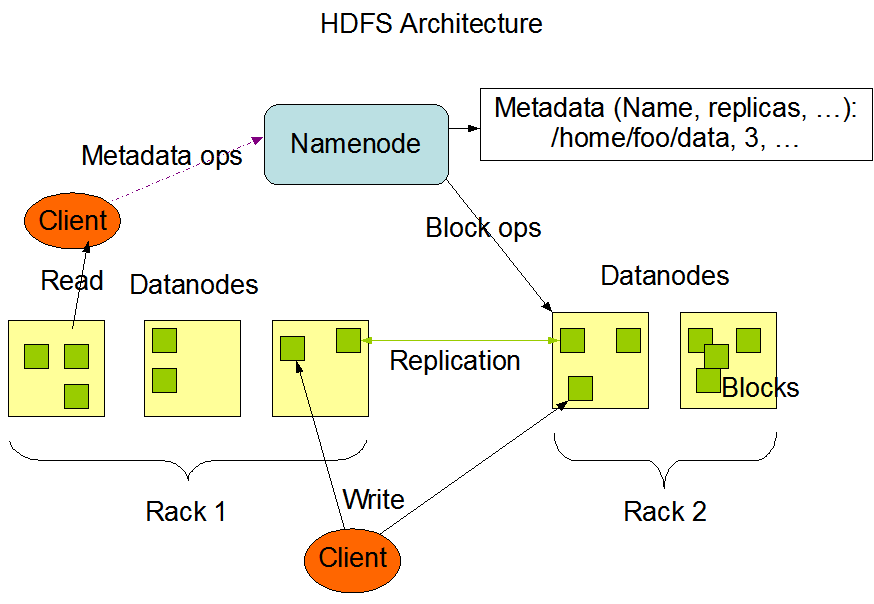
HDFS is the primary distributed storage used by Hadoop applications. A HDFS cluster primarily consists of a NameNode that manages the file system metadata and DataNodes that store the actual data.
2. hdfs架构
3. hdfs实例
作为文件系统,文件的读写才是核心:
/**

 * Licensed to the Apache Software Foundation (ASF) under one

 * or more contributor license agreements.  See the NOTICE file

 * distributed with this work for additional information

 * regarding copyright ownership.  The ASF licenses this file

 * to you under the Apache License, Version 2.0 (the

 * "License"); you may not use this file except in compliance

 * with the License.  You may obtain a copy of the License at

 *

 *     http://www.apache.org/licenses/LICENSE-2.0

 *

 * Unless required by applicable law or agreed to in writing, software

 * distributed under the License is distributed on an "AS IS" BASIS,

 * WITHOUT WARRANTIES OR CONDITIONS OF ANY KIND, either express or implied.

 * See the License for the specific language governing permissions and

 * limitations under the License.

 */

import java.io.File;

import java.io.IOException;

import org.apache.hadoop.conf.Configuration;

import org.apache.hadoop.fs.FileSystem;

import org.apache.hadoop.fs.FSDataInputStream;

import org.apache.hadoop.fs.FSDataOutputStream;

import org.apache.hadoop.fs.Path;

public class HadoopDFSFileReadWrite {

  static void usage () {

    System.out.println("Usage : HadoopDFSFileReadWrite <inputfile> <output file>");

    System.exit(1);

  }

  static void printAndExit(String str) {

    System.err.println(str);

    System.exit(1);

  }

  public static void main (String[] argv) throws IOException {

    Configuration conf = new Configuration();

    FileSystem fs = FileSystem.get(conf);

    if (argv.length != 2)

      usage();

    // Hadoop DFS deals with Path

    Path inFile = new Path(argv[0]);

    Path outFile = new Path(argv[1]);

    // Check if input/output are valid

    if (!fs.exists(inFile))

      printAndExit("Input file not found");

    if (!fs.isFile(inFile))

      printAndExit("Input should be a file");

    if (fs.exists(outFile))

      printAndExit("Output already exists");

    // Read from and write to new file

    FSDataInputStream in = fs.open(inFile);

    FSDataOutputStream out = fs.create(outFile);

    byte buffer[] = new byte[256];

    try {

      int bytesRead = 0;

      while ((bytesRead = in.read(buffer)) > 0) {

        out.write(buffer, 0, bytesRead);

      }

    } catch (IOException e) {

      System.out.println("Error while copying file");

    } finally {

      in.close();

      out.close();

    }

  }

}
上述示例,将一个文件的内容复制到另一个文件中,具体步骤如下:
第一步:创建一个文件系统实例,给该实例传递新的配置。
Configuration conf = new Configuration();

FileSystem fs = FileSystem.get(conf);
第二步:获取文件路径
// Hadoop DFS deals with Path

    Path inFile = new Path(argv[0]);

    Path outFile = new Path(argv[1]);

    // Check if input/output are valid

    if (!fs.exists(inFile))

      printAndExit("Input file not found");

    if (!fs.isFile(inFile))

      printAndExit("Input should be a file");

    if (fs.exists(outFile))

      printAndExit("Output already exists");
第三步:打开文件输入输出流,将输入流写到输出流中:
    // Read from and write to new file

    FSDataInputStream in = fs.open(inFile);

    FSDataOutputStream out = fs.create(outFile);

    byte buffer[] = new byte[256];

    try {

      int bytesRead = 0;

      while ((bytesRead = in.read(buffer)) > 0) {

        out.write(buffer, 0, bytesRead);

      }

    } catch (IOException e) {

      System.out.println("Error while copying file");

    } finally {

      in.close();

      out.close();

    }
上面文件读写功能涉及到了文件系统FileSystem、配置文件Configuration、输入流/输出流FSDataInputStream/FSDataOutputStream
4. 基本概念分析
4.1 文件系统
文件系统的层次结构如下所示:
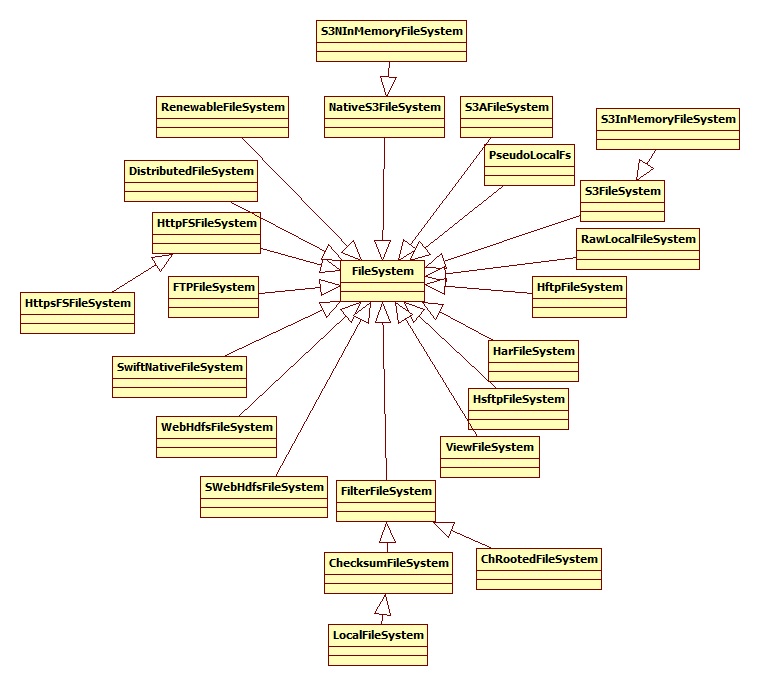
文件系统有两个重要的分支,一个是分布式文件系统,另一个是“本地”(映射到本地连接的磁盘)文件系统,本地磁盘适用于比较少的hadoop实例和测试。绝大部分情况下使用分布式文件系统,hadoop 分布式文件系统使用多个机器的系统,但对用户来说只有一个磁盘。它的容错性和大容量性使它非常有用。
4.2 配置文件
配置文件的层次结构如下:
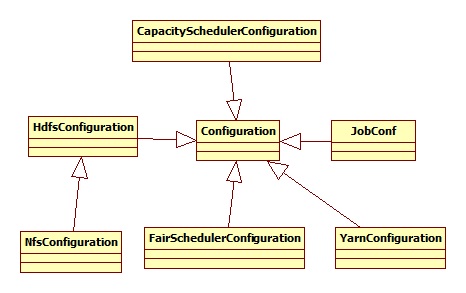
我们关注的是HdfsConfiguration,其涉及到的配置文件有hdfs-default.xml和hdfs-site.xml:
  static {

    addDeprecatedKeys();

    // adds the default resources

    Configuration.addDefaultResource("hdfs-default.xml");

    Configuration.addDefaultResource("hdfs-site.xml");

  }
4.3 输入/输出流
输入/输出流和文件系统相对应,先看一下输入流:
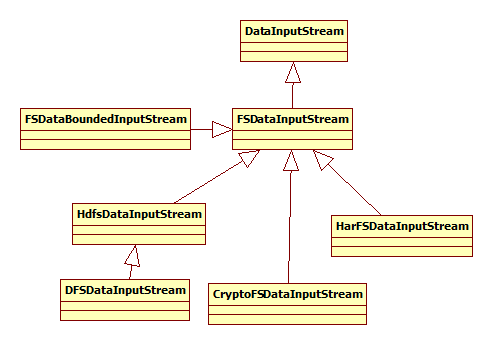
其中,HdfsDataInputStream是FSDataInputStream的实现,其构造函数为:
  public HdfsDataInputStream(DFSInputStream in) throws IOException {

    super(in);

  }
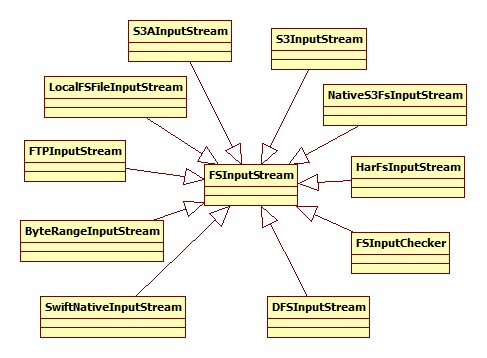
DFSInputStream层次结构如下图所示:
在了解一下输出流:
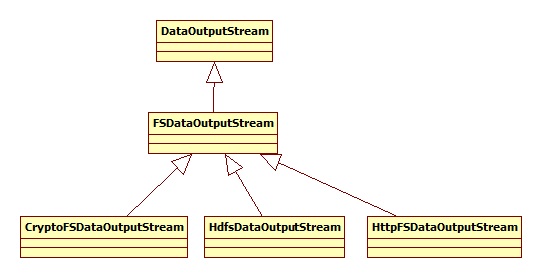
其中,重点是HdfsDataOutputStream,其构造函数为:
  public HdfsDataOutputStream(DFSOutputStream out, FileSystem.Statistics stats,

      long startPosition) throws IOException {

    super(out, stats, startPosition);

  }
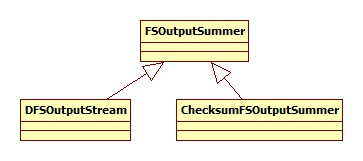
DFSOutputStream 的层次结构为:
参考文献:
【1】http://hadoop.apache.org/docs/r2.6.0/hadoop-project-dist/hadoop-hdfs/HdfsUserGuide.html
【2】http://hadoop.apache.org/docs/r2.6.0/hadoop-project-dist/hadoop-hdfs/HdfsDesign.html
【3】http://wiki.apache.org/hadoop/HadoopDfsReadWriteExample
【4】http://blog.csdn.net/gaoxingnengjisuan/article/details/11177049
hdfs源码分析第一弹的更多相关文章
- hdfs源码分析第二弹
以写文件为例,串联整个流程的源码: FSDataOutputStream out = fs.create(outFile); 1. DistributedFileSystem 继承并实现了FileSy ...
- HDFS源码分析数据块校验之DataBlockScanner
DataBlockScanner是运行在数据节点DataNode上的一个后台线程.它为所有的块池管理块扫描.针对每个块池,一个BlockPoolSliceScanner对象将会被创建,其运行在一个单独 ...
- HDFS源码分析之UnderReplicatedBlocks(二)
UnderReplicatedBlocks还提供了一个数据块迭代器BlockIterator,用于遍历其中的数据块.它是UnderReplicatedBlocks的内部类,有三个成员变量,如下: // ...
- HDFS源码分析EditLog之获取编辑日志输入流
在<HDFS源码分析之EditLogTailer>一文中,我们详细了解了编辑日志跟踪器EditLogTailer的实现,介绍了其内部编辑日志追踪线程EditLogTailerThread的 ...
- HDFS源码分析心跳汇报之BPServiceActor工作线程运行流程
在<HDFS源码分析心跳汇报之数据结构初始化>一文中,我们了解到HDFS心跳相关的BlockPoolManager.BPOfferService.BPServiceActor三者之间的关系 ...
- HDFS源码分析心跳汇报之数据块增量汇报
在<HDFS源码分析心跳汇报之BPServiceActor工作线程运行流程>一文中,我们详细了解了数据节点DataNode周期性发送心跳给名字节点NameNode的BPServiceAct ...
- HDFS源码分析心跳汇报之数据结构初始化
在<HDFS源码分析心跳汇报之整体结构>一文中,我们详细了解了HDFS中关于心跳的整体结构,知道了BlockPoolManager.BPOfferService和BPServiceActo ...
- HDFS源码分析DataXceiver之整体流程
在<HDFS源码分析之DataXceiverServer>一文中,我们了解到在DataNode中,有一个后台工作的线程DataXceiverServer.它被用于接收来自客户端或其他数据节 ...
- HDFS源码分析之UnderReplicatedBlocks(一)
http://blog.csdn.net/lipeng_bigdata/article/details/51160359 UnderReplicatedBlocks是HDFS中关于块复制的一个重要数据 ...
随机推荐
- 20155330 2016-2017-2《Java程序设计》课程总结
20155330 2016-2017-2<Java程序设计>课程总结 目录 每周作业链接汇总 实验报告链接汇总 代码托管 课堂项目实践 课程收获与不足 问卷调查 给出你的总结中涉及到的链接 ...
- jsp+servlet+javabean开发web项目
一.介绍: 项目依赖包:jdbc数据库包 jsp+servlet+javabean开发web项目,是最接近web项目原生运行原理的. 但是,jsp内容混乱,项目结构复杂时,代码会混乱 二.运行原理: ...
- day1 ORM
ORM对象关系映射 映射关系: 表名 <-------> 类名 字段 <-------> 属性 表记录 <------->类实例对象 class Customer( ...
- day1 HTML - <head>
1.html是什么? 超文本标记语言(Hypertext Markup Language,HTML) <!DOCTYPE html> <html lang="en" ...
- 12、Java并发编程:阻塞队列
Java并发编程:阻塞队列 在前面几篇文章中,我们讨论了同步容器(Hashtable.Vector),也讨论了并发容器(ConcurrentHashMap.CopyOnWriteArrayList), ...
- jaron插件的用法
一.dict字典插件的基本用法: <%@ taglib prefix="dict" uri="http://www.evan.jaron.com/tags/dict ...
- Introduction to Locking in SQL Server
Locking is a major part of every RDBMS and is important to know about. It is a database functionalit ...
- selenium自动化之定位多个元素
前面我们讲的都是如何定位单个元素,下面讲下怎么去定位多个元素,并且输出文本. 以百度为例:获取标红的这一组元素的文本 这里我用到的是xpath来定位的://div[@id="u1" ...
- Python单元测试--unittest(一)
unittest模块是Python中自带的一个单元测试模块,我们可以用来做代码级的单元测试. 在unittest模块中,我们主要用到的有四个子模块,他们分别是: 1)TestCase:用来写编写逐条的 ...
- python 的入门
时光匆匆,大一的时间过的很快,从大一上学期学的c开始,就感觉出c的结构很复杂,但是不可否认,学习c和汇编等涉及到系统底层知识才会有可能开发出属于自己知识产权的东西,然而,python以其简约性,丰富的 ...