
78. Subsets(M) & 90. Subsets II(M) & 131. Palindrome Partitioning
Given a set of distinct integers, nums, return all possible subsets.

Note: The solution set must not contain duplicate subsets.

For example,

If nums = [,,], a solution is:

[

  [],

  [],

  [],

  [,,],

  [,],

  [,],

  [,],

  []

]
class Solution

{

public:

    vector<vector<int>> subsets(vector<int>& nums)

    {

        const size_t n = nums.size();

        vector<int> v;

        vector<vector<int> > result;

        for (int i = ; i < <<n; ++i)

        {

            for (int j = ; j < n; ++j)

            {

              if(i &  << j) v.push_back(nums[j]);

            }

            result.push_back(v);

            v.clear();

        }

        return result;

    }

};
3ms
迭代,增量构造.没看懂
http://www.cnblogs.com/TenosDoIt/p/3451902.html
class Solution {

public:

    vector<vector<int> > subsets(vector<int> &S) {

        sort(S.begin(), S.end());

        vector<vector<int> > result();

        for (auto elem : S) {

            result.reserve(result.size() * );

            auto half = result.begin() + result.size();

            copy(result.begin(), half, back_inserter(result));

            for_each(half, result.end(), [&elem](decltype(result[]) &e){

                e.push_back(elem);

            });

        }

        return result;

    }

};
3ms
位向量法
class Solution {

public:

    vector<vector<int> > subsets(vector<int> &S) {

        sort(S.begin(), S.end()); //

        vector<vector<int> > result;

        vector<bool> selected(S.size(), false);

        subsets(S, selected, , result);

        return result;

    }

private:

    static void subsets(const vector<int> &S, vector<bool> &selected, int step,

                        vector<vector<int> > &result) {

        if (step == S.size()) {

            vector<int> subset;

            for (int i = ; i < S.size(); i++) {

                if (selected[i]) subset.push_back(S[i]);

            }

            result.push_back(subset);

            return;

        }

        //S[step]

        selected[step] = false;

        subsets(S, selected, step + , result);

        //S[step]

        selected[step] = true;

        subsets(S, selected, step + , result);

    }

};

6ms
class Solution {

public:

    vector<vector<int> > subsets(vector<int> &S) {

        sort(S.begin(), S.end()); //

        vector<vector<int> > result;

        vector<int> path;

        subsets(S, path, , result);

        return result;

    }

private:

    static void subsets(const vector<int> &S, vector<int> &path, int step,

                        vector<vector<int> > &result) {

        if (step == S.size()) {

            result.push_back(path);

            return;

        }

        //S[step]

        subsets(S, path, step + , result);

        //S[step]

        path.push_back(S[step]);

        subsets(S, path, step + , result);

        path.pop_back();

    }

};

6ms
Iterative

This problem can also be solved iteratively. Take [, , ] in the problem statement as an example. The process of generating all the subsets is like:

Initially: [[]]

Adding the first number to all the existed subsets: [[], []];

Adding the second number to all the existed subsets: [[], [], [], [, ]];

Adding the third number to all the existed subsets: [[], [], [], [, ], [], [, ], [, ], [, , ]].

Have you got the idea :-)

The code is as follows.

class Solution {

public:

    vector<vector<int>> subsets(vector<int>& nums) {

        sort(nums.begin(), nums.end());

        vector<vector<int>> subs(, vector<int>());

        for (int i = ; i < nums.size(); i++) {

            int n = subs.size();

            for (int j = ; j < n; j++) {

                subs.push_back(subs[j]);

                subs.back().push_back(nums[i]);

            }

        }

        return subs;

    }

};

 // Recursion.

 class Solution {

 public:

     vector<vector<int> > subsets(vector<int> &S) {

         vector<vector<int> > res;

         vector<int> out;

         sort(S.begin(), S.end());

         getSubsets(S, , out, res);

         return res;

     }

     void getSubsets(vector<int> &S, int pos, vector<int> &out, vector<vector<int> > &res) {

         res.push_back(out);

         for (int i = pos; i < S.size(); ++i) {

             //if (i != pos && S[i] == S[i-1]) continue;//subsets II

             out.push_back(S[i]);

             getSubsets(S, i + , out, res);

             out.pop_back();

             //while (S[i] == S[i + 1]) ++i; //subsets II

         }

     }

 };

#include <bits/stdc++.h>

using namespace std;

class Solution {

public:

    vector<vector<int> > subsetsWithDup(vector<int> &S) {

        sort(S.begin(), S.end()); // ????

        vector<vector<int> > result;

        vector<int> path;

        dfs(S, S.begin(), path, result);

        for (int i = ; i < result.size(); ++i) {

            for (int j = ; j < result[i].size(); ++j) {

                printf("%d ", result[i][j]);

            }printf("\n");

        }

        return result;

    }

private:

    static void dfs(const vector<int> &S, vector<int>::iterator start,

                    vector<int> &path, vector<vector<int> > &result) {

        result.push_back(path);

        printf("@@@@@@@@@@Line:%d start:%d\n", __LINE__, *start);

        for (auto i = start; i < S.end(); i++) {

            printf("i:%d\n", *i);

            if (i != start && *i == *(i-))

            {

                printf("Continue****LINE:%d start:%d i:%d\n", __LINE__, *start, *i);

                continue;

            }

            path.push_back(*i);

            dfs(S, i + , path, result); for(auto xx : path) printf("BEFORE:%d ", xx);

            printf("\nLINE:%d start:%d i:%d\n", __LINE__, *start, *i);

            path.pop_back(); for (auto xx : path) printf("AFTER:%d ", xx); printf("\n");

        }

    }

};

int main(int argc, char *argv[])

{

    vector<int> v{,,};

    Solution sn;

    sn.subsetsWithDup(v);

    //printf("%d %d\n",v[0],v.size());

    return ;

}
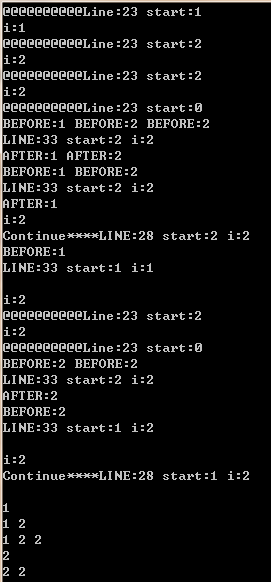
This structure might apply to many other backtracking questions, but here I am just going to demonstrate Subsets, Permutations, and Combination Sum.
Subsets : https://leetcode.com/problems/subsets/
public List<List<Integer>> subsets(int[] nums) {

    List<List<Integer>> list = new ArrayList<>();

    Arrays.sort(nums);

    backtrack(list, new ArrayList<>(), nums, );

    return list;

}

private void backtrack(List<List<Integer>> list , List<Integer> tempList, int [] nums, int start){

    list.add(new ArrayList<>(tempList));

    for(int i = start; i < nums.length; i++){

        tempList.add(nums[i]);

        backtrack(list, tempList, nums, i + );

        tempList.remove(tempList.size() - );

    }

}
Subsets II (contains duplicates) : https://leetcode.com/problems/subsets-ii/
public List<List<Integer>> subsetsWithDup(int[] nums) {

    List<List<Integer>> list = new ArrayList<>();

    Arrays.sort(nums);

    backtrack(list, new ArrayList<>(), nums, );

    return list;

}

private void backtrack(List<List<Integer>> list, List<Integer> tempList, int [] nums, int start){

    list.add(new ArrayList<>(tempList));

    for(int i = start; i < nums.length; i++){

        if(i > start && nums[i] == nums[i-]) continue; // skip duplicates

        tempList.add(nums[i]);

        backtrack(list, tempList, nums, i + );

        tempList.remove(tempList.size() - );

    }

}
Permutations : https://leetcode.com/problems/permutations/
public List<List<Integer>> permute(int[] nums) {

   List<List<Integer>> list = new ArrayList<>();

   // Arrays.sort(nums); // not necessary

   backtrack(list, new ArrayList<>(), nums);

   return list;

}

private void backtrack(List<List<Integer>> list, List<Integer> tempList, int [] nums){

   if(tempList.size() == nums.length){

      list.add(new ArrayList<>(tempList));

   } else{

      for(int i = ; i < nums.length; i++){

         if(tempList.contains(nums[i])) continue; // element already exists, skip

         tempList.add(nums[i]);

         backtrack(list, tempList, nums);

         tempList.remove(tempList.size() - );

      }

   }

}
Permutations II (contains duplicates) : https://leetcode.com/problems/permutations-ii/
public List<List<Integer>> permuteUnique(int[] nums) {

    List<List<Integer>> list = new ArrayList<>();

    Arrays.sort(nums);

    backtrack(list, new ArrayList<>(), nums, new boolean[nums.length]);

    return list;

}

private void backtrack(List<List<Integer>> list, List<Integer> tempList, int [] nums, boolean [] used){

    if(tempList.size() == nums.length){

        list.add(new ArrayList<>(tempList));

    } else{

        for(int i = ; i < nums.length; i++){

            if(used[i] || i >  && nums[i] == nums[i-] && !used[i - ]) continue;

            used[i] = true;

            tempList.add(nums[i]);

            backtrack(list, tempList, nums, used);

            used[i] = false;

            tempList.remove(tempList.size() - );

        }

    }

}
Combination Sum : https://leetcode.com/problems/combination-sum/
public List<List<Integer>> combinationSum(int[] nums, int target) {

    List<List<Integer>> list = new ArrayList<>();

    Arrays.sort(nums);

    backtrack(list, new ArrayList<>(), nums, target, );

    return list;

}

private void backtrack(List<List<Integer>> list, List<Integer> tempList, int [] nums, int remain, int start){

    if(remain < ) return;

    else if(remain == ) list.add(new ArrayList<>(tempList));

    else{

        for(int i = start; i < nums.length; i++){

            tempList.add(nums[i]);

            backtrack(list, tempList, nums, remain - nums[i], i); // not i + 1 because we can reuse same elements

            tempList.remove(tempList.size() - );

        }

    }

}
Combination Sum II (can't reuse same element) : https://leetcode.com/problems/combination-sum-ii/
public List<List<Integer>> combinationSum2(int[] nums, int target) {

    List<List<Integer>> list = new ArrayList<>();

    Arrays.sort(nums);

    backtrack(list, new ArrayList<>(), nums, target, );

    return list;

}

private void backtrack(List<List<Integer>> list, List<Integer> tempList, int [] nums, int remain, int start){

    if(remain < ) return;

    else if(remain == ) list.add(new ArrayList<>(tempList));

    else{

        for(int i = start; i < nums.length; i++){

            if(i > start && nums[i] == nums[i-]) continue; // skip duplicates

            tempList.add(nums[i]);

            backtrack(list, tempList, nums, remain - nums[i], i + );

            tempList.remove(tempList.size() - );

        }

    }

}
Palindrome Partitioning : https://leetcode.com/problems/palindrome-partitioning/
public List<List<String>> partition(String s) {

   List<List<String>> list = new ArrayList<>();

   backtrack(list, new ArrayList<>(), s, );

   return list;

}

public void backtrack(List<List<String>> list, List<String> tempList, String s, int start){

   if(start == s.length())

      list.add(new ArrayList<>(tempList));

   else{

      for(int i = start; i < s.length(); i++){

         if(isPalindrome(s, start, i)){

            tempList.add(s.substring(start, i + ));

            backtrack(list, tempList, s, i + );

            tempList.remove(tempList.size() - );

         }

      }

   }

}

public boolean isPalindrome(String s, int low, int high){

   while(low < high)

      if(s.charAt(low++) != s.charAt(high--)) return false;

   return true;

}
/*Without any crap! Hit the road!

Since we have to collect all the possible sets that meet the requirements -> a palindrome; so traversing the whole possible paths will be definitely the case -> using DFS and backtracking seems to be on the table.

try from the start index of the string till any index latter and then check its validity - a palindrome? from the start index till the ending?

if so, we need to store it in a stack for latter collection and then traverse further starting from the previous ending index exclusively and begin the checking again and on and on till the start index is beyond the string;

at that time we are to collect the palindromes along the paths.

Several stuff should be specified:

checking whether a string is palindrome is quite simple in C using pointer;

using DP might not help a lot since the checking process is quite fast while DP will require extra work to record and space allocation and so on.

In the end, let's check its space and time consumption:

space cost O(n*2^n) -> one set of palindrome will take about O(n) but the amount of sets is dependent on the original string itself.

time cost O(n*2^n) -> collecting them while using the space to store them so the space and time cost should be linearly proportional; since the range can be varied a lot depending on the actual provided string so the performance might not be a problem. by LHearen
4ms in us. 72ms in cn.

*/

void traverse(char* s, int len, int begin, char** stack, int top, char**** arrs, int** colSizes, int* returnSize)

{

    if(begin == len) //there is nothing left, collect the strings of a set;

    {

        *returnSize += ;

        *colSizes = (int*)realloc(*colSizes, sizeof(int)*(*returnSize));

        int size = top+;

        (*colSizes)[*returnSize-] = size;

        *arrs = (char***)realloc(*arrs, sizeof(char**)*(*returnSize));

        (*arrs)[*returnSize-] = (char**)malloc(sizeof(char*)*size);

        for(int i = ; i < size; i++)

            (*arrs)[*returnSize-][i] = stack[i];

        return ;

    }

    for(int i = begin; i < len; i++) //check each string that begin with s[begin];

    {

        int l=begin, r=i;

        while(l<r && s[l]==s[r]) l++, r--;

        if(l >= r) //it's a palindrome;

        {

            int size = i-begin+;

            char *t = (char*)malloc(sizeof(char)*(size+));

            *t = '\0';

            strncat(t, s+begin, size);

            stack[top+] = t;

            traverse(s, len, i+, stack, top+, arrs, colSizes, returnSize); //collect the left;

        }

    }

}

char*** partition(char* s, int** colSizes, int* returnSize)

{

    if(!*s) return NULL;

    int len = strlen(s);

    *returnSize = ;

    *colSizes = (char*)malloc(sizeof(char));

    char*** arrs = (char***)malloc(sizeof(char**));

    char** stack = (char**)malloc(sizeof(char*)*len);

    int top = -;

    traverse(s, strlen(s), , stack, top, &arrs, colSizes, returnSize);

    return arrs;

}
public class Solution {

    public List<List<String>> partition(String s) {

        List<List<String>> res = new ArrayList<>();

        boolean[][] dp = new boolean[s.length()][s.length()];

        for(int i = 0; i < s.length(); i++) {

            for(int j = 0; j <= i; j++) {

                if(s.charAt(i) == s.charAt(j) && (i - j <= 2 || dp[j+1][i-1])) {

                    dp[j][i] = true;

                }

            }

        }

        helper(res, new ArrayList<>(), dp, s, 0);

        return res;

    }

    private void helper(List<List<String>> res, List<String> path, boolean[][] dp, String s, int pos) {

        if(pos == s.length()) {

            res.add(new ArrayList<>(path));

            return;

        }

        for(int i = pos; i < s.length(); i++) {

            if(dp[pos][i]) {

                path.add(s.substring(pos,i+1));

                helper(res, path, dp, s, i+1);

                path.remove(path.size()-1);

            }

        }

    }

}

/*

The normal dfs backtracking will need to check each substring for palindrome, but a dp array can be used to record the possible break for palindrome before we start recursion.

Edit:

Sharing my thought process:

first, I ask myself that how to check if a string is palindrome or not, usually a two point solution scanning from front and back. Here if you want to get all the possible palindrome partition, first a nested for loop to get every possible partitions for a string, then a scanning for all the partitions. That's a O(n^2) for partition and O(n^2) for the scanning of string, totaling at O(n^4) just for the partition. However, if we use a 2d array to keep track of any string we have scanned so far, with an addition pair, we can determine whether it's palindrome or not by justing looking at that pair, which is this line if(s.charAt(i) == s.charAt(j) && (i - j <= 2 || dp[j+1][i-1])). This way, the 2d array dp contains the possible palindrome partition among all.

second, based on the prescanned palindrome partitions saved in dp array, a simple backtrack does the job. Java DP + DFS solution by yfcheng

*/
bool isPalin(char* s, int end);

void helper(char* s, char*** ret, int** colS, int* retS, char** cur, int k );

char*** partition(char* s, int** colS, int* retS)

{

  *retS = ;

  if(s == NULL || !strcmp(s, "")) return NULL;

  /* I know ... I hate static mem alloc as well */

  *colS = (int*)malloc(sizeof(int)*);

  char*** ret = (char***)malloc(sizeof(char**) * );

  int len = strlen(s)+;

  char** cur = (char**)malloc(sizeof(char*) * );

  for(int i = ; i<; i++)

    cur[i] = (char*)malloc(len);

  /* backtracking starting from s[0] */

  helper(s, ret, colS, retS, cur, );

  return ret;

}

void helper(char* s, char*** ret, int** colS, int* retS, char** cur, int k )

{

  /* termination if already at the end of string s

     we found a partition */

  if(*s == )

  {

    ret[*retS] = (char**)malloc(sizeof(char*)*k);

    for(int i = ; i<k; i++)

    {

      ret[*retS][i] = (char*)malloc(strlen(cur[i]) + );

      strcpy(ret[*retS][i], cur[i]);

    }

    (*colS)[(*retS)++] = k;

    return;

  }

  /* explore next */

  int len = strlen(s);

  for(int i = ; i < len; i++)

  {

    if(isPalin(s, i))

    {

      /* put it into the cur list  */

      strncpy(cur[k], s, i+);

      cur[k][i+] = '\0';

      /* backtracking */

      helper(s+i+, ret, colS, retS, cur, k+);

    }

  }

}

bool isPalin(char* s, int end)

{

  /* printf("error: start %d, end %d\n", start, end); */

  if(end < )          return false;

  int start = ;

  while(end > start)

  {

    if(s[start] != s[end]) return false;

    start++;   end--;

  }

  return true;

}

// by  zcjsword Created at: September 11, 2015 5:12 AM
char*** result;

int head;

int check(char* s,int left,int right){

    while(s[left]==s[right]){

        left++,right--;

    }

    return left>=right;

}

int getResult(char* s,int left,int right,int path[],int index,int* colSize){

    //printf("%d %d\n",left,right);

    if(left>right){

        char** list=(char**)malloc(sizeof(char*));

        int h=;

        for(int i=index-;i>;i--){

            char* tmp=(char*)malloc(sizeof(char)*(path[i-]-path[i]+));

            int count=;

            for(int j=path[i];j<path[i-];j++){

                tmp[count++]=s[j];

            }

            tmp[count]='\0';

            list[h++]=tmp;

            list=(char**)realloc(list,sizeof(char*)*(h+));

        }

        colSize[head]=h;

        result[head++]=list;

        result=(char***)realloc(result,sizeof(char**)*(head+));

    }

    for(int i=right;i>=left;i--){

        if(check(s,i,right)){

            path[index]=i;

            getResult(s,left,i-,path,index+,colSize);

        }

    }

    return ;

}

char*** partition(char* s, int** columnSizes, int* returnSize) {

    result=(char***)malloc(sizeof(char**));

    head=;

    int path[];

    *columnSizes=(int*)malloc(sizeof(int)*);

    path[]=strlen(s);

    getResult(s,,path[]-,path,,*columnSizes);

    *returnSize=head;

     return result;

}

// 28ms example
#define MAXCOL 1000

void DFS(char *s,int startIndex,char **temp_result,char ***result,

         int len,int** columnSizes, int* returnSize)

{

    int i,j;

    if(startIndex >= len)

    {

        for(i = ;i < (*columnSizes)[*returnSize];i ++)

        {

            for(j = ;temp_result[i][j] != '\0';j ++)

            {

                result[*returnSize][i][j] = temp_result[i][j];

            }

            result[*returnSize][i][j] = '\0';

        }

        *returnSize += ;

        (*columnSizes)[*returnSize] = (*columnSizes)[*returnSize-];

    }

    for(i = startIndex;i < len;i ++)

    {

        int left = startIndex;

        int right = i;

        while(left <= right && s[left]==s[right])

        {

            left ++;

            right --;

        }

        if(left >= right)

        {

            strncpy(temp_result[(*columnSizes)[*returnSize]],s+startIndex,i - startIndex + );

            temp_result[(*columnSizes)[*returnSize]][i - startIndex + ] = '\0';

            (*columnSizes)[*returnSize] += ;

            //printf("OK\n");

            DFS(s,i+,temp_result,result,len,columnSizes,returnSize);

            (*columnSizes)[*returnSize] -= ;

        }

    }

}

char*** partition(char* s, int** columnSizes, int* returnSize) {

    int i,j,k;

    int len = strlen(s);

    char ***result = malloc(MAXCOL*sizeof(char**));

    for(i = ;i < MAXCOL;i ++)

    {

        result[i] = malloc(len*sizeof(char*));

        for(j = ;j < len;j ++)

        {

            result[i][j] = malloc(len*sizeof(char));

        }

    }

    char **temp_result = malloc(len*sizeof(char*));

    for(i = ;i < len;i ++)

    {

        temp_result[i] = malloc(len*sizeof(char));

    }

    *columnSizes = calloc(MAXCOL,sizeof(int));

    *returnSize = ;

    DFS(s,,temp_result,result,len,columnSizes,returnSize);

    return result;

}

// 52ms example
78. Subsets(M) & 90. Subsets II(M) & 131. Palindrome Partitioning的更多相关文章
- leetcode 131. Palindrome Partitioning 、132. Palindrome Partitioning II
131. Palindrome Partitioning substr使用的是坐标值,不使用.begin()..end()这种迭代器 使用dfs,类似于subsets的题,每次判断要不要加入这个数 s ...
- Leetcode 22. Generate Parentheses Restore IP Addresses (*) 131. Palindrome Partitioning
backtracking and invariant during generating the parathese righjt > left (open bracket and cloas ...
- leetcode 78. Subsets 、90. Subsets II
第一题是输入数组的数值不相同,第二题是输入数组的数值有相同的值,第二题在第一题的基础上需要过滤掉那些相同的数值. level代表的是需要进行选择的数值的位置. 78. Subsets 错误解法: cl ...
- 131. Palindrome Partitioning(回文子串划分 深度优先)
Given a string s, partition s such that every substring of the partition is a palindrome. Return all ...
- [LeetCode] 131. Palindrome Partitioning 回文分割
Given a string s, partition s such that every substring of the partition is a palindrome. Return all ...
- Leetcode 131. Palindrome Partitioning
Given a string s, partition s such that every substring of the partition is a palindrome. Return all ...
- 131. Palindrome Partitioning
题目: Given a string s, partition s such that every substring of the partition is a palindrome. Return ...
- [leetcode]131. Palindrome Partitioning字符串分割成回文子串
Given a string s, partition s such that every substring of the partition is a palindrome. Return all ...
- 【LeetCode】131. Palindrome Partitioning
Palindrome Partitioning Given a string s, partition s such that every substring of the partition is ...
随机推荐
- 四、MYSQL的数据类型
类型选择原则 1.储存空间越少越好: 2.简单就好:例如整型比字符串更简单: 3.尽量避免null: 一.整数类型 1.有tinyint(8位).SMALLINT(16位).MEDIUMINT(24位 ...
- Synchronous/Asynchronous:任务的同步异步,以及asynchronous callback异步回调
两个线程执行任务有同步和异步之分,看了Quora上的一些问答有了更深的认识. When you execute something synchronously, you wait for it to ...
- fis入门-单文件编译之文件优化(optimize)
FIS(Front-end Integrated Solution ),是百度的前端集成解决方案.最近几天在研究前端构建的东西,就顺便了解了下,果断各种高大上,可以到FIS官网围观感受一下.如果对fi ...
- Jmeter(四)_16个逻辑控制器详解
循环控制器: 指定其子节点运行的次数,可以使用具体的数值,也可以设置为变量 1:勾选永远:表示一直循环下去 2:如果同时设置了线程组的循环次数和循环控制器的循环次数,那循环控制器的子节点运行的次数为两 ...
- 【翻译】Brewer's CAP Theorem CAP定理
Brewer's CAP Theorem 原文地址:http://www.julianbrowne.com/article/brewers-cap-theorem Brewer’s (CAP) The ...
- nginx反向代理tomcat应用,struts2网站程序redirect时导致请求地址错误的解决方法
一个使用struts2的网站在登录页面需要进行redirect跳转,大致如下: <package name="admin" extends="httl-defaul ...
- What is the difference between WinRT, UWP and WPF?
在学习UWP的过程中确实有这个迷惑,在此分享一下. UWP (Universal Windows platform), Metro and WinRT are all result of Micros ...
- 2013 C#单元测试
首先安装Unit Test Generator. 点击拓展和更新——>联机搜索Unit Test Generator 新建项目 新建一个测试类 add函数 选定test 类名 ——>右键 ...
- Winform设置托盘程序,托盘显示
1.拖一个NotifyIcon,一个ContextMenuStrip控件到主窗体中 2.设置notifyIcon1,一个contextMenuStrip1(如下图) Icon为托盘图标,Text托盘显 ...
- 获取select的 text
JS获取select的value和text值的简单实例 感谢 3lian8 的投递 时间:2014-02-27 来源:三联教程 本篇文章主要是对JS获取select的value和text值的简单实例进 ...