
SRS之SrsRtmpConn::publishing详解
1. SrsRtmpConn::publishing
int SrsRtmpConn::publishing(SrsSource* source)

{

    int ret = ERROR_SUCCESS;

    /* 在配置文件中配置了 refer_publish 配置项才会进行 refer check */

    if ((ret = refer->check(req->pageUrl, _srs_config->get_refer_pubish(req->vhost)))

        != ERROR_SUCCESS) {

        srs_error("check publish_refer failed. ret=%d", ret);

        return ret;

    }

    srs_verbose("check publish_refer success.");

    /* 若配置文件中使能了 http_hooks 配置项,则调用该函数,否则忽略 */

    if ((ret = http_hooks_on_publish()) != ERROR_SUCCESS) {

        srs_error("http hook on_publish failed. ret=%d", ret);

        return ret;

    }

    /* 若配置文件中没有配置 mode 配置项,则返回 false */

    bool vhost_is_edge = _srs_config->get_vhost_is_edge(req->vhost);

    if ((ret = acquire_publish(source, vhost_is_edge)) == ERROR_SUCCESS) {

        // use isolate thread to recv,

        // @see: https://github.com/ossrs/srs/issues/237

        SrsPublishRecvThread trd(rtmp, req,

            st_netfd_fileno(stfd), 0, this, source,

            client_type != SrsRtmpConnFlashPublish,

            vhost_is_edge);

        srs_info("start to publish stream %s success", req->stream.c_str());

        /* 该函数会启动接收推流数据的线程 recv,然后当前线程会循环进入休眠,并在醒来

         * 后更新状态信息 */

        ret = do_publishing(source, &trd);

        // stop isolate recv thread

        trd.stop();

    }

    if (ret != ERROR_SYSTEM_STREAM_BUSY) {

        release_publish(source, vhost_is_edge);

    }

    /* whatever the acquire publish, always release publish.

     * when the acquire error in the middle-way, the publish state changed,

     * but failed, so we must cleanup it.

     * @see https://github.com/ossrs/srs/issues/474: srs_librtmp推送后返回错误码1009

     * @remark when stream is busy, should never release it. */

    http_hooks_on_unpublish();

    return ret;

}
2. SrsRtmpConn::acquire_publish
int SrsRtmpConn::acquire_publish(SrsSource* source, bool is_edge)

{

    int ret = ERROR_SUCCESS;

    /* 检测是否可以进行 publish */

    if (!source->can_publish(is_edge)) {

        ret = ERROR_SYSTEM_STREAM_BUSY;

        srs_warn("stream %s is already publishing. ret=%d",

            req->get_stream_url().c_str(), ret);

        return ret;

    }

    // when edge, ignore the publish event, directly proxy it.

    if (is_edge) {

        if ((ret = source->on_edge_start_publish()) != ERROR_SUCCESS) {

            srs_error("notice edge start publish stream failed. ret=%d", ret);

            return ret;

        }

    } else {

        /* 通知可以进行 publish */

        if ((ret = source->on_publish()) != ERROR_SUCCESS) {

            srs_error("notify publish failed. ret=%d", ret);

            return ret;

        }

    }

    return ret;

}
2.1 SrsSource::can_publish
bool SrsSource::can_publish(bool is_edge)

{

    /* 当为 edge 时,检测当前 edge 的状态,只要不为 SrsEdgeStatePublish,即可进行 publish */

    if (is_edge) {

        return publish_edge->can_publish();

    }

    /* 默认初始化时为 true */

    return _can_publish;

}
2.2 SrsSource::on_publish
/**

 * publish stream event notify.

 * @param _req the request from client, the source will deep copy it,

 *        for when reload the request of client maybe invalid.

 */

int SrsSource::on_publish()

{

    int ret = ERROR_SUCCESS;

    // update the request object.

    srs_assert(_req);

    /* 若当前线程上下文的id与_source_id不一致,表明id改变了,需要更新_source_id,

     * 并通知所有的 consumers */

    /* whatever, the publish thread is the source or edge source,

     * save its id to source id */

    on_source_id_changed(_srs_context->get_id);

    /* the mix queue to correct the timestamp for mix_correct algorithm */

    /* reset the mix queue. */

    mix_queue->clear();

    /* detect the monotonically again. */

    is_monotonically_increase = true;

    last_packet_time = 0;

    /* create forwarders: 需要配置文件中配置 forward 配置项,否则忽略该函数 */

    if ((ret = create_forwarders()) != ERROR_SUCCESS) {

        srs_error("create forwarders failed. ret=%d", ret);

        return ret;

    }

    // TODO: FIXME: use initialize to set req.

#ifdef SRS_AUTO_TRANSCODE

    if ((ret = encoder->on_publish(_req)) != ERROR_SUCCESS) {

        srs_error("start encoder failed. ret=%d", ret);

        return ret;

    }

#endif

    // TODO: FIXME: use initialize to set req.

#ifdef SRS_AUTO_HLS

    if ((ret = hls->on_publish(_req, false)) != ERROR_SUCCESS) {

        srs_error("start hls failed. ret=%d", ret);

        return ret;

    }

#endif

    // TODO: FIXME: use initialize to set req.

#ifdef SRS_AUTO_DVR

    if ((ret = dvr->on_publish(_req)) != ERROR_SUCCESS) {

        srs_error("start dvr failed. ret=%d", ret);

        return ret;

    }

#endif

#ifdef SRS_AUTO_HDS

    if ((ret = hds->on_publish(_req)) != ERROR_SUCCESS) {

        srs_error("start hds failed. ret=%d", ret);

        return ret;

    }

#endif

    // notify the handler.

    srs_assert(handler);

    /* handler 指向子类 SrsServer,因此调用子类实现的 on_publish */

    if ((ret = handler->on_publish(this, _req)) != ERROR_SUCCESS) {

        srs_error("handle on publish failed. ret=%d", ret);

        return ret;

    }

    /* 更新 stat 中的值 */

    SrsStatistic* stat = SrsStatistic::instance();

    stat->on_stream_publish(_req, _source_id);

    return ret;

}
2.2.1 SrsSource::on_source_id_changed
/**

 * source id changed

 * @id: 当前线程的 id

 */

int SrsSource::on_source_id_changed(int id)

{

    int ret = ERROR_SUCCESS;

    if (_source_id == id) {

        return ret;

    }

    if (_pre_source_id == -1) {

        _pre_source_id = id;

    } else if (_pre_source_id != _source_id) {

        _pre_source_id = _source_id;

    }

    /* source id,

     * for publish, it's the publish client id.

     * for edge, it's the edge ingest id.

     * when source id changed, for example, the edge reconnect,

     * invoke the on_source_id_changed() to let all clients know.

     */

    _source_id = id;

    /* SrsConsumer: the consumer for SrsSource, that is a play client. */

    /* notice all consumer */

    std::vector<SrsConsumer*>::iterator it;

    for (it = consumers.begin(); it != consumers.end(); ++it) {

        SrsConsumer* consumer = *it;

        consumer->update_source_id();

    }

    retrn ret;

}
2.2.2 SrsServer::on_publish
int SrsServer::on_publish(SrsSource* s, SrsRequest* r)

{

    int ret = ERROR_SUCCESS;

    /* 暂时忽略,没有启用 */

#ifdef SRS_AUTO_HTTP_SERVER

    if ((ret = http_server->http_mount(s, r)) != ERROR_SUCCESS) {

        return ret;

    }

#endif

    return ret;

}
3. SrsPublishRecvThread 构造
/**

 * the publish recv thread got message and callback the souorce method

 * to process message.

 */

SrsPublishRecvThread::SrsPublishRecvThread(

    SrsRtmpServer* rtmp_sdk,

    SrsRequest* _req, int mr_sock_fd, int timeout_ms,

    SrsRtmpConn* conn, SrsSource* source, bool is_fmle, bool is_edge

): trd(this, rtmp_sdk, timeout_ms)

{

    rtmp = rtmp_sdk;

    _conn = conn;

    /* the params for conn callback. */

    _source = source;

    _is_fmle = is_fmle;

    _is_edge = is_edge;

    /* the recv thread error code. */

    recv_error_code = ERROR_SUCCESS;

    /* the msgs already got. */

    _nb_msgs = 0;

    /* The video frames we got. */

    video_frames = 0;

    /* the error timeout cond

     * @see https://github.com/ossrs/srs/issues/244 */

    error = st_cond_new();

    /* merged context id. */

    ncid = cid = 0;

    req = _req;

    mr_fd = mr_sock_fd;

    // the mr settings,

    // @see https://github.com/ossrs/srs/issues/241

    mr = _srs_config->get_mr_enabled(req->vhost);

    mr_sleep = _srs_config->get_mr_sleep_ms(req->vhost);

    realtime = _srs_config->get_realtime_enabled(req->vhost);

    /* for reload handler to register itself,

     * when config service do the reload, callback the handler. */

    _srs_config->subscribe(this);

}
该 SrsPublishRecvThread 类中同时有一个 SrsRecvThread 类的成员 trd,因此会同时构造 SrsRecvThread 类。
3.1 SrsRecvThread 构造函数
/**

 * the recv thread, use message handler to handle each received message.

 */

SrsRecvThread::SrsRecvThread(ISrsMessageHandler* msg_handler,

    SrsRtmpServer* rtmp_sdk, int timeout_ms)

{

    timeout = timeout_ms;

    /* handler 指向子类 SrsPublishRecvThread 的指针对象 */

    handler = msg_handler;

    rtmp = rtmp_sdk;

    /* 构造一个可重复使用的线程:recv */

    trd = new SrsReusableThread2("recv", this);

}
3.2 SrsReusableThread2 构造函数
SrsReusableThread2::SrsReusableThread2(const char* n, ISrsReusableThread2Handler* h,

    int64_t interval_us)

{

    /* 指向子类 SrsRecvThread 的指针对象 */

    handler = h;

    /* 构造一个 SrsThread 类,该类代表一个线程 */

    pthread = new internal::SrsThread(n, this, interval_us, true);

}
4. SrsRtmpConn::do_publishing
int SrsRtmpConn::do_publishing(SrsSource* source, SrsPublishRecvThread* trd)

{

    int ret = ERROR_SUCCESS;

    /**

     * SrsPithyPrint:

     * the stage is used for a collection of object to do print,

     * the print time in a stage is constant and not changed,

     * that is, we always got one message to print every specified time.

     *

     * for example, stage #1 for all play clients, print time is 3s,

     * if there is 1client, it will print every 3s.

     * if there is 10clients, random select one to print every 3s.

     * Usage:

     *     SrsPithyPrint* pprint = SrsPithyPrint::create_rtmp_play();

     *     SrsAutoFree(SrsPithyPrint, pprint);

     *     while (true) {

     *         pprint->elapse();

     *         if (pprint->can_print()) {

     *             // print pithy message.

     *             // user can get the elapse time by: pprint->age()

     *         }

     *         // read and write RTMP messages.

     *     }

     */

    SrsPithyPrint* pprint = SrsPithyPrint::create_rtmp_publish();

    SrsAutoFree(SrsPithyPrint, pprint);

    /* 构建并启动一个专门用于接收客户端推流数据的 recv 线程 */

    // start isolate recv thread.

    if ((ret = trd->start()) != ERROR_SUCCESS) {

        srs_error("start isolate recv thread failed. ret=%d", ret);

        return ret;

    }

    // change the isolate recv thread context id,

    // merge its log to current thread.

    int receive_thread_cid = trd->get_cid();

    trd->set_cid(_srs_context->get_cid());

    // initialize the publish timeout.

    /* 若没有配置 publish_1stpkt_timeout,则当没有收到消息时使用默认超时时间 20000ms */

    publish_1stpkt_timeout = _srs_config->get_publish_1stpkt_timeout(req->vhost);

    /* 若没有配置 publish_normal_timeout,则当已经收到过消息时使用默认超时时间 5000ms */

    publish_normal_timeout = _srs_config->get_publish_normal_timeout(req->vhost);

    // set the sock options.

    set_sock_options();

    if (true) {

        /* vhost{} 中是否启用了 mr 功能,否返回 false */

        bool mr = _srs_config->get_mr_enabled(req->vhost);

        int mr_sleep = _srs_config->get_mr_sleep_ms(req->vhost);

        srs_trace("start publish mr=%d/%d, p1stpt=%d, pnt=%d, tcp_nodelay=%d, rtcid=%d",

                  mr, mr_sleep, publish_1stpkt_timeout, publish_normal_timeout,

                  tcp_nodelay, receive_thread_cid);

    }

    int64_t nb_msgd = 0;

    uint64_t nb_frames = 0;

    while (!disposed) {

        /* 自动计算经过的时间 */

        pprint->elapse();

        // when source is set to expired, disconnect it.

        if (expired) {

            ret = ERROR_USER_DISCONNECT;

            srs_error("connection expired. ret=%d", ret);

            return ret;

        }

        // cond wait for timeout.

        if (nb_msgs == 0) {

            // when not got msgs, wait for a larger timeout.

            // @see https://github.com/ossrs/srs/issues/441

            trd->wait(publish_1stpkt_timeout);

        } else {

            trd->wait(publish_normal_timeout);

        }

        // check the thread error code.

        if ((ret = trd->error_code()) != ERROR_SUCCESS) {

            if (!srs_is_system_control_error(ret) && !srs_is_client_gracefully_close(ret))

            {

                srs_error("recv thread failed. ret=%d", ret);

            }

            return ret;

        }

        // when not got any messages, timeout.

        if (trd->nb_msgs() <= nb_msgs) {

            ret = ERROR_SOCKET_TIMEOUT;

            srs_warn("publish timeout %dms, nb_msgs=%"PRId64", ret=%d",

                nb_msgs? publish_normal_timeout : publish_1stpkt_timeout, nb_msgs, ret);

            break;

        }

        nb_msgs = trd->nb_msgs();

        // Update the stat for video fps.

        // @remark https://github.com/ossrs/srs/issues/851

        SrsStatistic* stat = SrsStatistic::instance();

        if ((ret = stat->on_video_frames(req, (int)(trd->nb_video_frames() - nb_frames)))

            != ERROR_SUCCESS) {

            return ret;

        }

        nb_frames = trd->nb_video_frames();

        // reportable

        if (pprint->can_print()) {

            kbps->sample();

            bool mr = _srs_config->get_mr_enabled(req->vhost);

            int mr_sleep = _srs_config->get_mr_sleep_ms(req->vhost);

            srs_trace("<- "SRS_CONSTS_LOG_CLIENT_PUBLISH

                " time=%"PRId64", okbps=%d,%d,%d, ikbps=%d,%d,%d, "

                "mr=%d/%d, p1stpt=%d, pnt=%d",

                pprint->age(),

                kbps->get_send_kbps(), kbps->get_send_kbps_30s(), kbps->get_send_kbps_5m(),

                kbps->get_recv_kbps(), kbps->get_recv_kbps_30s(), kbps->get_recv_kbps_5m(),

                mr, mr_sleep, publish_1stpkt_timeout, publish_normal_timeout

            );

        }

    }

    return ret;

}
4.1 SrsPithyPrint::create_rtmp_publish
为 rtmp publish 构造一个 SrsPithyPrint 类。
SrsPithyPrint* SrsPithyPrint::create_rtmp_publish()

{

    return new SrsPithyPrint(SRS_CONSTS_STAGE_PUBLISH_USER);

}
4.1.1 SrsPithyPrint 构造函数
SrsPithyPrint::SrsPithyPrint(int _stage_id)

{

    stage_id = _stage_id;

    client_id = enter_stage();

    previous_tick = srs_get_system_time_ms();

    _age = 0;

}
4.1.2 SrsPithyPrint::enter_stage
int SrsPithyPrint::enter_stage()

{

    SrsStageInfo* stage = NULL;

    std::map<int, SrsStageInfo*>::iterator it = _srs_stages.find(stage_id);

    if (it == _srs_stages.end()) {

        stage = new SrsStageInfo(stage_id);

        _srs_stages[stage_id] = stage;

    } else {

        stage = it->second;

    }

    srs_assert(stage != NULL);

    client_id = stage->nb_clients++;

    srs_verbose("enter stage, stage_id=%d, client_id=%d, nb_clients=%d, time_ms=%d",

        stage->stage_id, client_id, stage->nb_clients, stage->pithy_print_time_ms);

    return client_id;

}
4.2 SrsPublishRecvThread::start: 启动线程
int SrsPublishRecvThread::start()

{

    /* 调用 SrsRecvThread::start()  */

    int ret = trd.start();

    ncid = cid = trd.cid();

    return ret;

}
4.2.1 SrsRecvThread::start
int SrsRecvThread::start()

{

    /* 接着调用 SrsReusableThread2::start() */

    return trd->start();

}
4.2.2 SrsReusableThread2::start
/* for the reusable thread, start and stop by user. */

int SrsReusableThread2::start()

{

    /* 调用 SrsThread::start() */

    return pthread->start();

}
4.2.3 SrsThread::start
int SrsThread::start()

{

    int ret = ERROR_SUCCESS;

    if (tid) {

        srs_info("thread %s already running.", _name);

        return ret;

    }

    if ((tid = st_thread_create(thread_fun, this, (joinable? 1:0), 0)) == NULL) {

        ret = ERROR_ST_CREATE_CYCLE_THREAD;

        srs_error("st_thread_create failed. ret=%d", ret);

        return ret;

    }

    disposed = false;

    // we set to loop to true for thread to run.

    loop = true;

    // wait for cid to ready, for parent thread to get the cid.

    while (_cid < 0) {

        st_usleep(10 * 1000);

    }

    // now, cycle thread can run.

    can_run = true;

    return ret;

}
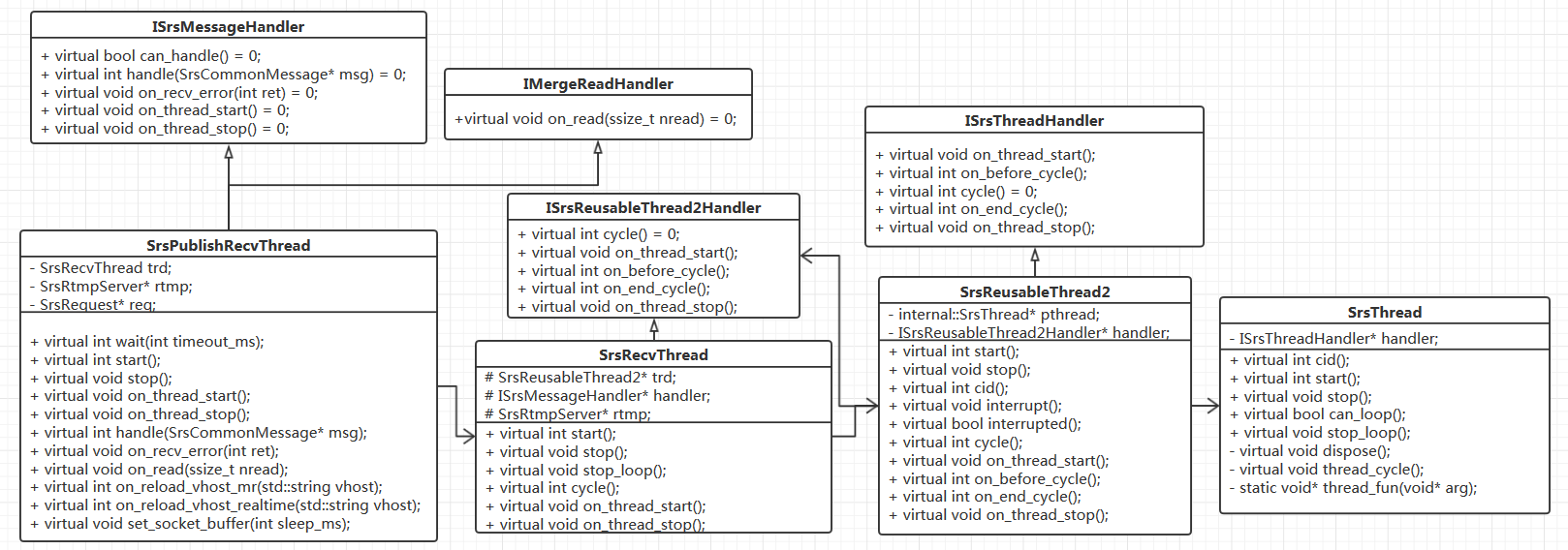
以上 Thread 类之间的关系图
4.3 SrsRtmpConn::set_sock_options
void SrsRtmpConn::set_sock_options()

{

    /* 若配置文件中的 vhost{} 没有配置 tcp_nodelay 配置项,默认返回 false */

    bool nvalue = _srs_config->get_tcp_nodelay(req->vhost);

    if (nvalue != tcp_nodelay) {

        tcp_nodelay = nvalue;

#ifdef SRS_PERF_TCP_NODELAY

        int fd = st_netfd_fileno(stfd);

        socklen_t nb_v = sizeof(int);

        int ov = 0;

        getsocket(fd, IPPROTO_TCP, TCP_NODELAY, &ov, &nb_v);

        int v = tcp_nodelay;

        // set the socket send buffer when required larger buffer

        if (setsockopt(fd, IPPROTO_TCP, TCP_NODELAY, &v, nb_v) < 0) {

            srs_warn("set sock TCP_NODELAY=%d failed.", v);

        }

        getsocket(fd, IPPROTO_TCP, TCP_NODELAY, &v, &nb_v);

        srs_trace("set TCP_NODELAY %d=>%d", ov, v);

#else

        srs_warn("SRS_PERF_TCP_NODELAY is disabled but tcp_nodelay configed.");

#endif

    }

}
4.4 SrsPithyPrint::elapse
/* auto calc the elapse time */

void SrsPithyPrint::elapse()

{

    SrsStageInfo* stage = _srs_stages[stage_id];

    srs_assert(stage != NULL);

    int64_t diff = srs_get_system_time_ms() - previous_tick;

    diff = srs_max(0, diff);

    stage->elapse(diff);

    _age += diff;

    previous_tick = srs_get_system_time_ms();

}

void SrsStageInfo::elapse(int64_t diff)

{

    age += diff;

}
4.5 SrsPublishRecvThread::wait
int SrsPublishRecvThread::wait(int timeout_ms)

{

    /* 若已经发生错误,则直接返回错误码 */

    if (recv_error_code != ERROR_SUCCESS) {

        return recv_error_code;

    }

    // ignore any return of cond wait.

    st_cond_timedwait(error, timeout_ms * 1000);

    return ERROR_SUCCESS;

}
4.5.1 st_cond_timedwait
int st_cond_timedwait(_st_cond_t* cvar, st_utime_t timeout)

{

    _st_thread_t *me = _ST_CURRENT_THREAD();

    int rv;

    if (me->flags & _ST_FL_INTERRUPT) {

        me->flags &= ~_ST_FL_INTERRUPT;

        errno = EINTR;

        return -1;

    }

    /* Put caller thread on the condition variable's wait queue */

    me->state = _ST_ST_COND_WAIT;

    ST_APPEND_LINK(&me->wait_links, &cvar->wait_q);

    /* 当超时时间不为 -1 时,将当前线程添加到 sleep 队列中 */

    if (timeout != ST_UTIME_NO_TIMEOUT)

        _ST_ADD_SLEEPQ(me, timeout);

    /* 然后切换上下文环境,直到被条件变量唤醒或是超时事件到了而醒来 */

    _ST_SWITCH_CONTEXT(me);

    ST_REMOVE_LINK(&me->wait_links);

    rv = 0;

    if (me->flags & _ST_FL_TIMEDOUT) {

        me->flags &= ~_ST_FL_TIMEDOUT;

        errno = ETIME;

        rv = -1;

    }

    if (me->flags & _ST_FL_INTERRUPT) {

        me->flags &= ~_ST_FL_INTERRUPT;

        errno = EINTR;

        rv = -1;

    }

    return rv;

}
4.5.2 ST_APPEND_LINK
/* Insert an element "_e" at the end of the list "_l" */

#define ST_APPEND_LINK(_e, _l) ST_INSERT_BEFORE(_e, _l)

/* Insert element "_e" into the list, before "_l" */

#define ST_INSERT_BEFORE(_e, _l) \

    ST_BEGIN_MACRO  \

    (_e)->next = (_l); \

    (_e)->prev = (_l)->prev; \

    (-l)->prev->next = (_e); \

    (-l)->prev = (_e); \

    ST_END_MACRO
4.6 SrsStatistic::on_video_frames
/* When got videos, update the frames.

 * We only stat the total number of video frames. */

int SrsStatistic::on_video_frames(SrsRequest* req, int nb_frames)

{

    int ret = ERROR_SUCCESS;

    SrsStatisticVhost* vhost = create_vhost(req);

    SrsStatisticStream* stream = create_stream(vhost, req);

    stream->nb_frames += nb_frames;

    return ret;

}
5. SrsPublishRecvThread::stop
当从 do_publishing 函数返回时,终止接收推流数据的 recv 线程。
void SrsPublishRecvThread::stop()

{

    trd.stop();

}
5.1 SrsRecvThread::stop
void SrsRecvThread::stop()

{

    trd->stop();

}
5.2 SrsReusableThread2::stop
void SrsReusableThread2::stop()

{

    pthread->stop();

}
5.3 SrsThread::stop
void SrsThread::stop()

{

    if (!tid) {

        return;

    }

    /* 设置线程循环标志,退出循环 */

    loop = false;

    dispose();

    _cid = -1;

    can_run = false;

    tid = NULL;

}
5.4 SrsThread::dispose
void SrsThread::dispose()

{

    if (disposed) {

        return;

    }

    // the interrupt will cause the socket to read/write error,

    // which will terminate the cycle thread.

    st_thread_interrupt(tid);

    // when joinable, wait util quit.

    if (_joinable) {

        // wait the thread to exit.

        int ret = st_thread_join(tid, NULL);

        if (ret) {

            srs_warn("core: ignore join thread failed.");

        }

    }

    // wait the thread actually terminated.

    // sometimes the thread join return -1, for example,

    // when thread use st_recvfrom, the thread join return -1.

    // so here, we use a variable to ensure the thread stopped.

    // @remark event the thread not joinable, we must ensure the thread stopped when stop.

    while (!really_terminated) {

        st_usleep(10 * 1000);

        if (really_terminated) {

            break;

        }

        srs_warn("core: wait thread to actually terminated");

    }

    disposed = true;

}
5.4.1 st_thread_interrupt
void st_thread_interrupt(_st_thread_t *thread)

{

    /* If thread is already dead */

    if (thread->state == _ST_ST_ZOMEBIE)

        return;

    /* 设置线程标志为 interrupt */

    thread->flags |= _ST_FL_INTERRUPT;

    /* 若线程当前正在运行或已在 run 队列中,则直接返回,在线程函数会检测

     * 线程的 flags,若发现是 interrput,则会终止线程函数的执行 */

    if (thread->state == _ST_ST_RUNNING || thread->state == _ST_ST_RUNNABLE)

        return;

    /* 否则,若线程当前处于 sleep 队列中,即休眠状态,则将该线程从

     * 休眠队列中移除 */

    if (thread->flags & _ST_FL_ON_SLEEPQ)

        _ST_DEL_SLEEPQ(thread);

    /* Make thread runnable */

    thread->state = _ST_ST_RUNNABLE;

    _ST_ADD_RUNQ(thread);

}
5.4.2 st_thread_join
int st_thread_join(_st_thread_t *thread, void **retvalp)

{

    _st_cond_t *term = thread_term;

    /* Can't join a non-joinable thread */

    if (term == NULL) {

        errno = EINVAL;

        return -1;

    }

    if (_ST_CURRENT_THREAD() == thread) {

        errno = EDEADLK;

        return -1;

    }

    /* Multiple threads can't wait on the same joinable thread */

    if (term->wait_q.next != &term->wait_q) {

        errno = EINVAL;

        return -1;

    }

    while (thread->state != _ST_ST_ZOMBIE) {

        if (st_cond_timedwait(term, ST_UTIME_NO_TIMEOUT) != 0)

            return -1;

    }

    if (retvalp)

        *retvalp = thread->retval;

    /*

     * Remove target thread from the zombie queue and make it runnable.

     * When it gets scheduled later, it will do the clean up.

     */

    thread->state = _ST_ST_RUNNABLE;

    _ST_DEL_ZOMBIEQ(thread);

    _ST_ADD_RUNQ(thread);

    return 0;

}
SRS之SrsRtmpConn::publishing详解的更多相关文章
- SRS之SrsRtmpConn::stream_service_cycle详解
首先使用 obs 推流符合如下流程:参考自 Hanvision Makito X cann't publish to SRS.. FFMPEG: C/S: Handshake C: ConnectAp ...
- SRS之SrsRtmpConn::service_cycle详解
1. SrsRtmpConn::service_cycle 当服务器在 conn 线程的开始调用 connect_app 函数接收并解析客户端发送的 connect 消息后,调用该 service_c ...
- SRS之SrsHls::on_audio详解
1. SrsHls::on_audio 将音频数据封装到 ts 文件中. /* * mux the audio packet to ts. * @param shared_audio, directl ...
- SRS之SrsHlsCache::reap_segment详解
1. 是否可切片的检测 首先在调用 SrsHlsCache::reap_segment 函数进行切片时,针对音频或视频,都会有一个函数来进行检测当前片的时长是否符合所要求的时长. 对于音频,会调用 S ...
- SRS之SrsHls::on_video详解
1. SrsHls::on_video /* * mux the video packets to ts. * @param shared_video, directly ptr, copy it i ...
- SRS之SrsTsContext::encode_pes详解
1. SrsTsContext::encode_pes 该函数位于 srs_kernel_ts.cpp 中.下面的分析基于假设当前要封装的消息是视频. /* * @msg: 要写入到 ts 文件中的音 ...
- SRS之SrsRtmpServer::connect_app详解
1. connect('live') 2. SrsRtmpServer::connect_app 位于 srs_rtmp_stack.cpp.在 SRS 的 RTMP 连接处理线程 conn 中,当与 ...
- linux查看端口及端口详解
今天现场查看了TCP端口的占用情况,如下图 红色部分是IP,现场那边问我是不是我的程序占用了tcp的链接,,我远程登陆现场查看了一下,这种类型的tcp链接占用了400多个,,后边查了一下资料,说E ...
- 网络-02-端口号-linux端口详解大全
端口详解 1 tcpmux TCP Port Service Multiplexer 传输控制协议端口服务多路开关选择器 2 compressnet Management Utility compr ...
随机推荐
- 7.Struts2拦截器及源码分析
1.Struts2架构图 2.Struts2 执行过程分析 1.首先,因为使用 struts2 框架,请求被Struts2Filter 拦截 2.Struts2Filter 调用 DisPatche ...
- RAD Studio 10.3.2七大新功能介绍
RAD Studio 10.3.2七大新功能 Delphi支持macOS 64位应用的开发. C++Builder中Windows 64位平台支持C ++ 17特性. C ++ LSP 代码洞察改进. ...
- Migrating authentication of Samba from smbpasswd to tdb
Was addicted various After you upgrade the OS of old Samba server. Put it also was using a set of 2. ...
- Delphi 配置BDE数据源
樊伟胜
- Docker_云计算技术简述
Docker官方网站 > https://www.docker.com/Docker博客 > https://www.docker.com/blog/Docker内容库 > http ...
- deep_learning_backprop
反向传播理解–从抽象到具体 神经网络从计算的角度看,数据是从底层输入,经过每一层,根据与该层之间的权重计算以一个中间结果,这个中间结果再经过一个非线性激活函数作用,得到该层的输出结果,然后把该层的输出 ...
- deep_learning_Function_ Matplotlib 3D 绘图函数 plot_surface 的 rstride 和 cstride 参数
今晚开始接触 Matplotlib 的 3D 绘图函数 plot_surface,真的非常强大,图片质量可以达到出版级别,而且 3D 图像可以旋转 ,可以从不同角度来看某个 3D 立体图,但是我发现各 ...
- JAVA程序员成长路线图
https://www.cnblogs.com/godtrue/p/4283708.html
- 8.2.ZooKeeper应用场景
7.ZooKeeper应用举例 为了方便大家理解ZooKeeper,在此就给大家举个例子,看看ZooKeeper是如何实现的他的服务的,我以ZooKeeper提供的基本服务分布式锁为例. 7.1 分布 ...
- demjson
demjson.decode() 可以扩展json的类型