
防sql注入之参数绑定 SQL Injection Attacks and Defense 预处理语句与存储过程
http://php.net/manual/zh/pdo.prepared-statements.php
预处理语句与存储过程
很多更成熟的数据库都支持预处理语句的概念。什么是预处理语句?可以把它看作是想要运行的 SQL 的一种编译过的模板,它可以使用变量参数进行定制。预处理语句可以带来两大好处:
- 查询仅需解析(或预处理)一次,但可以用相同或不同的参数执行多次。当查询准备好后,数据库将分析、编译和优化执行该查询的计划。对于复杂的查询,此过程要花费较长的时间,如果需要以不同参数多次重复相同的查询,那么该过程将大大降低应用程序的速度。通过使用预处理语句,可以避免重复分析/编译/优化周期。简言之,预处理语句占用更少的资源,因而运行得更快。
- 提供给预处理语句的参数不需要用引号括起来,驱动程序会自动处理。如果应用程序只使用预处理语句,可以确保不会发生SQL 注入。(然而,如果查询的其他部分是由未转义的输入来构建的,则仍存在 SQL 注入的风险)。
预处理语句如此有用,以至于它们唯一的特性是在驱动程序不支持的时PDO 将模拟处理。这样可以确保不管数据库是否具有这样的功能,都可以确保应用程序可以用相同的数据访问模式。
http://php.net/manual/en/pdo.prepared-statements.php
Prepared statements and stored procedures
Many of the more mature databases support the concept of prepared statements. What are they? They can be thought of as a kind of compiled template for the SQL that an application wants to run, that can be customized using variable parameters. Prepared statements offer two major benefits:
- The query only needs to be parsed (or prepared) once, but can be executed multiple times with the same or different parameters. When the query is prepared, the database will analyze, compile and optimize its plan for executing the query. For complex queries this process can take up enough time that it will noticeably slow down an application if there is a need to repeat the same query many times with different parameters. By using a prepared statement the application avoids repeating the analyze/compile/optimize cycle. This means that prepared statements use fewer resources and thus run faster.
- The parameters to prepared statements don't need to be quoted; the driver automatically handles this. If an application exclusively uses prepared statements, the developer can be sure that no SQL injection will occur (however, if other portions of the query are being built up with unescaped input, SQL injection is still possible).
Prepared statements are so useful that they are the only feature that PDO will emulate for drivers that don't support them. This ensures that an application will be able to use the same data access paradigm regardless of the capabilities of the database.
w pdo
业务驱动技术
<?php

$ReadParametersList = array('w_start_unix', 'w_count', 'CreatedAfter', 'CreatedBefore','NextToken');

foreach ($ReadParametersList as $w) {

    $wfile = 'D:\cmd\\' . $w . '.w';

    $handle = fopen($wfile, 'r');

    $wb = fread($handle, filesize($wfile));

    echo $wb . "\r\n";

}

try {

    $dbh = new PDO('mysql:host=localhost;dbname=apiamz',"root", "root");

    $sql = 'SELECT COUNT(*) FROM listorders';

    foreach($dbh->query($sql) as $row) {

        print_r($row);

    }

    $dbh = null;

} catch (PDOException $e) {

    print "Error!: " . $e->getMessage() . "<br/>";

    die();

}

die();
Example #1 用预处理语句进行重复插入
下面例子通过用 name 和 value 替代相应的命名占位符来执行一个插入查询
<?php
$stmt = $dbh->prepare("INSERT INTO REGISTRY (name, value) VALUES (:name, :value)");
$stmt->bindParam(':name', $name);
$stmt->bindParam(':value', $value);

// 插入一行
$name = 'one';
$value = 1;
$stmt->execute();

//  用不同的值插入另一行
$name = 'two';
$value = 2;
$stmt->execute();
?>
Example #2 用预处理语句进行重复插入
下面例子通过用 name 和 value 取代 ? 占位符的位置来执行一条插入查询。
<?php
$stmt = $dbh->prepare("INSERT INTO REGISTRY (name, value) VALUES (?, ?)");
$stmt->bindParam(1, $name);
$stmt->bindParam(2, $value);

// 插入一行
$name = 'one';
$value = 1;
$stmt->execute();

// 用不同的值插入另一行
$name = 'two';
$value = 2;
$stmt->execute();
?>
Example #3 使用预处理语句获取数据
下面例子获取数据基于键值已提供的形式。用户的输入被自动用引号括起来,因此不会有 SQL 注入攻击的危险。
<?php
$stmt = $dbh->prepare("SELECT * FROM REGISTRY where name = ?");
if ($stmt->execute(array($_GET['name']))) {
  while ($row = $stmt->fetch()) {
    print_r($row);
  }
}
?>
如果数据库驱动支持,应用程序还可以绑定输出和输入参数.输出参数通常用于从存储过程获取值。输出参数使用起来比输入参数要稍微复杂一些,因为当绑定一个输出参数时,必须知道给定参数的长度。如果为参数绑定的值大于建议的长度,就会产生一个错误。
Example #4 带输出参数调用存储过程
<?php
$stmt = $dbh->prepare("CALL sp_returns_string(?)");
$stmt->bindParam(1, $return_value, PDO::PARAM_STR, 4000);

// 调用存储过程
$stmt->execute();

print "procedure returned $return_value\n";
?>
还可以指定同时具有输入和输出值的参数,其语法类似于输出参数。在下一个例子中,字符串“hello”被传递给存储过程,当存储过程返回时,hello 被替换为该存储过程返回的值。
Example #5 带输入/输出参数调用存储过程
<?php
$stmt = $dbh->prepare("CALL sp_takes_string_returns_string(?)");
$value = 'hello';
$stmt->bindParam(1, $value, PDO::PARAM_STR|PDO::PARAM_INPUT_OUTPUT, 4000);

// 调用存储过程
$stmt->execute();

print "procedure returned $value\n";
?>
Example #6 占位符的无效使用
<?php
$stmt = $dbh->prepare("SELECT * FROM REGISTRY where name LIKE '%?%'");
$stmt->execute(array($_GET['name']));

// 占位符必须被用在整个值的位置
$stmt = $dbh->prepare("SELECT * FROM REGISTRY where name LIKE ?");
$stmt->execute(array("%$_GET[name]%"));
?>
SQL Injection Attacks and Defense
Second Edition
Using parameterized statements
As we discussed in previous chapters, one of the root causes of SQL injection is the creation of
SQL queries as strings that are then sent to the database for execution. This behavior,
commonly known as dynamic string building or dynamic SQL, is one of the primary causes of
an application being vulnerable to SQL injection.
As a more secure alternative to dynamic string building, most modern programming
languages and database access application program interfaces (APIs) allow you to provide
parameters to a SQL query through the use of placeholders, or bind variables, instead of
working directly with the user input. Commonly known as parameterized statements, these are
a safer alternative that can avoid or solve many of the common SQL injection issues you will
see within an application, and you can use them in most common situations to replace an
existing dynamic query. They also have the advantage of being very efficient on modern
databases, as the database can optimize the query based on the supplied prepared statement,
increasing the performance of subsequent queries.
I should note, however, that parameterized statements are a method of supplying potentially
insecure parameters to the database, usually as a query or stored procedure call. They do not
alter the content of the values that are passed to the database, though, so if the database
functionality being called uses dynamic SQL within the stored procedure or function
implementation it is still possible for SQL injection to occur. This has historically been a
problem with Microsoft SQL Server and Oracle, both of which have shipped with a number of
built-in stored procedures that were vulnerable to SQL injection in the past, and it is a danger
that you should be aware of with any database stored procedures or functions that use dynamic
SQL in their implementation. An additional issue to consider is that malicious content could
have been stored in the database at this point that may then be used elsewhere in the
application, causing SQL injection at another point in the application. We discussed this in
Chapter 7, in “Exploiting second-order SQL injection.”
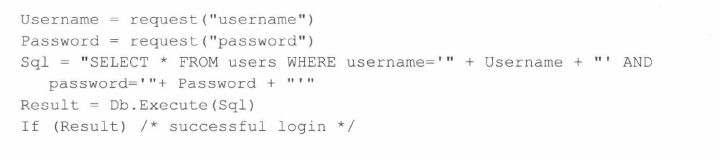
Here is an example of a vulnerable piece of login page pseudocode using dynamic SQL. We
will discuss how to parameterize this code in Java, C#, and PHP in the following sections: Username = request(“username”)
Password = request(“password”)
Sql = “SELECT
∗
FROM users WHERE username=’” + Username + “‘ AND password=’”+ Password + “’”
Result = Db.Execute(Sql)
If (Result) /
∗
successful login
∗
/
Tools & traps…
What Can be Parameterized, and What Can’t?
Not all dynamic SQL statements can be parameterized. In particular, you can parameterize only data values, and
not SQL identifiers or keywords. Therefore, you can’t have parameterized statements such as the following:
SELECT
∗
FROM ? WHERE username = ‘john’
SELECT ? FROM users WHERE username = ‘john’
SELECT
∗
FROM users WHERE username LIKE ‘j%’ ORDER BY ?
Unfortunately, a common solution presented in online forums to solve this problem is to use dynamic SQL in
the string that is then used to parameterize the query, as in the following example:
String sql = “SELECT
∗
FROM ” + tbl Name + “ WHERE user =?”;
In this case, you can end up introducing an SQL injection issue where there previously wasn’t one by trying to
parameterize a statement.
In general, if you’re trying to supply an SQL identifier as a parameter, you should look at your SQL and how
you’re accessing your database first, and then look at whether it is possible to rewrite the query using a fixed
identifier. Although it may be possible to solve this through the use of dynamic SQL, this is also likely to
adversely affect the performance of the query, as the database will not be able to optimize the query. If dynamic
SQL is required, ensure that known value validation (discussed later in this chapter) is performed to validate
identifiers in the database metadata where possible.



https://golang.google.cn/pkg/database/sql/
type Stmt func (s *Stmt) Close() error func (s *Stmt) Exec(args ...interface{}) (Result, error) func (s *Stmt) ExecContext(ctx context.Context, args ...interface{}) (Result, error) func (s *Stmt) Query(args ...interface{}) (*Rows, error) func (s *Stmt) QueryContext(ctx context.Context, args ...interface{}) (*Rows, error) func (s *Stmt) QueryRow(args ...interface{}) *Row func (s *Stmt) QueryRowContext(ctx context.Context, args ...interface{}) *Row
https://github.com/go-sql-driver/mysql/search?q=Stmt
SQL 注入漏洞
应用安全开发指南 - 支付宝开放平台 https://opendocs.alipay.com/open/200/security
SQL 注入漏洞
漏洞描述
SQL 注入攻击(SQL Injection),被广泛用于非法获取网站控制权,是发生在应用程序的数据库层上的安全漏洞。 在设计不良的程序当中,忽略了对输入字符串中夹带的 SQL 指令的检查,那么这些夹带进去的指令就会被数据库误认为是正常的 SQL 指令而运行,从而使数据库受到攻击,可能导致数据被窃取、更改、删除,以及进一步导致网站被嵌入恶意代码、被植入后门程序等危害。
漏洞危害
机密数据被窃取。
核心业务数据被篡改。
网页被篡改。
数据库所在服务器被攻击变为傀儡主机,甚至企业网被入侵。
解决方案
所有的查询语句都使用数据库提供的参数化查询接口,参数化的语句使用参数而不是将用户输入变量嵌入到 SQL 语句中。
对进入数据库的特殊字符 '"\<>&*; 等进行转义处理,或编码转换。
确认每种数据的类型,比如数字型的数据就必须是数字,数据库中的存储字段必须对应为 int 型。
数据长度应该严格规定,能在一定程度上防止比较长的 SQL 注入语句无法正确执行。
网站每个数据层的编码统一,建议全部使用 UTF-8 编码,上下层编码不一致有可能导致一些过滤模型被绕过。
严格限制网站所用数据库账号的权限,给此用户仅提供能够满足其工作的权限,从而最大限度的减少注入攻击对数据库的危害。
避免网站显示 SQL 错误信息,比如类型错误、字段不匹配等,防止攻击者利用这些错误信息进行一些判断。
示例代码
ASP 漏洞代码示例
<%

 Dim oComm, oRs

 Set id = Request.QueryString("d")

 Set oConn = Server.CreateObject("ADODB.Connection")

 oConn.Open "Provider=MSDAORA;Password=sth;Persist Security Info=True;User ID=whats;Data Source=mescp"

 Set oComm = CreateObject("ADODB.Command")

 oComm.ActiveConnection = oConn

 oComm.CommandType = 1

 oComm.CommandText = "select * from all_objects where rownum ="& id

 Set oRs = oComm.Execute

 %>
ASP 修复示例
<%

 Dim oComm, oRs

 Set oConn = Server.CreateObject("ADODB.Connection")

 oConn.Open "Provider=MSDAORA;Password=sth;Persist Security Info=True;User ID=whats;Data Source=mescp"

 Set oComm = CreateObject("ADODB.Command")

 oComm.ActiveConnection = oConn

 oComm.CommandType = 1

 oComm.CommandText = "select * from all_objects where rownum = ? "

 oComm.Parameters.Append

 oComm.CreateParameter("v1",3,1,4,100)

 Set oRs = oComm.Execute

 %>
PHP 漏洞代码示例
<?php

 $id = $_GET [ 'id' ];

 $conn   =   mysql_connect ( " localhost" , " root" , " " )  or   die  ( " wrong!" );

 $sel = mysql_select_db ( " mydb" , $conn );

 $sql = " select * from user where id = " . id

 $que = mysql_query ( $sql , $conn );

 ?>
PHP 修复示例
<?php

 $id = $_GET [ 'id' ];

 $conn   =   mysql_connect ( " localhost" , " root" , " " )  or   die  ( " wrong!" );

 $sel = mysql_select_db ( " mydb" , $conn );

 $sql = " select * from user where id = :id"

 $stmt   =   $conn -> prepare ( $sql );

 $stmt -> execute ( array ( ':id' => $id ));

 ?>
JAVA 漏洞代码示例
JdbcConnection   conn   =   new   JdbcConnection ();

 final   String   sql   =   "select * from product where pname like '%"

          +   request . getParameter ( "pname" )  +   "%'" ;

 conn . execqueryResultSet ( sql );
JAVA 修复示例
JdbcConnection   conn   =   new   JdbcConnection ();

 PreparedStatement   pstmt   =   conn . prepareStatement ( "select * from product where pname like ?" ;

 pstmt . setString ( 1 ,  “ % ” +   request . getParameter ( "pname" ) + ” % ” );

 pstmt . execute ();
SQL 注入漏洞
漏洞描述
SQL 注入攻击(SQL Injection),被广泛用于非法获取网站控制权,是发生在应用程序的数据库层上的安全漏洞。 在设计不良的程序当中,忽略了对输入字符串中夹带的 SQL 指令的检查,那么这些夹带进去的指令就会被数据库误认为是正常的 SQL 指令而运行,从而使数据库受到攻击,可能导致数据被窃取、更改、删除,以及进一步导致网站被嵌入恶意代码、被植入后门程序等危害。
漏洞危害
机密数据被窃取。
核心业务数据被篡改。
网页被篡改。
数据库所在服务器被攻击变为傀儡主机,甚至企业网被入侵。
解决方案
所有的查询语句都使用数据库提供的参数化查询接口,参数化的语句使用参数而不是将用户输入变量嵌入到 SQL 语句中。
对进入数据库的特殊字符 '"\<>&*; 等进行转义处理,或编码转换。
确认每种数据的类型,比如数字型的数据就必须是数字,数据库中的存储字段必须对应为 int 型。
数据长度应该严格规定,能在一定程度上防止比较长的 SQL 注入语句无法正确执行。
网站每个数据层的编码统一,建议全部使用 UTF-8 编码,上下层编码不一致有可能导致一些过滤模型被绕过。
严格限制网站所用数据库账号的权限,给此用户仅提供能够满足其工作的权限,从而最大限度的减少注入攻击对数据库的危害。
避免网站显示 SQL 错误信息,比如类型错误、字段不匹配等,防止攻击者利用这些错误信息进行一些判断。
示例代码
ASP 漏洞代码示例
<%

 Dim oComm, oRs

 Set id = Request.QueryString("d")

 Set oConn = Server.CreateObject("ADODB.Connection")

 oConn.Open "Provider=MSDAORA;Password=sth;Persist Security Info=True;User ID=whats;Data Source=mescp"

 Set oComm = CreateObject("ADODB.Command")

 oComm.ActiveConnection = oConn

 oComm.CommandType = 1

 oComm.CommandText = "select * from all_objects where rownum ="& id

 Set oRs = oComm.Execute

 %>
ASP 修复示例
<%

 Dim oComm, oRs

 Set oConn = Server.CreateObject("ADODB.Connection")

 oConn.Open "Provider=MSDAORA;Password=sth;Persist Security Info=True;User ID=whats;Data Source=mescp"

 Set oComm = CreateObject("ADODB.Command")

 oComm.ActiveConnection = oConn

 oComm.CommandType = 1

 oComm.CommandText = "select * from all_objects where rownum = ? "

 oComm.Parameters.Append

 oComm.CreateParameter("v1",3,1,4,100)

 Set oRs = oComm.Execute

 %>
PHP 漏洞代码示例
<?php

 $id = $_GET [ 'id' ];

 $conn   =   mysql_connect ( " localhost" , " root" , " " )  or   die  ( " wrong!" );

 $sel = mysql_select_db ( " mydb" , $conn );

 $sql = " select * from user where id = " . id

 $que = mysql_query ( $sql , $conn );

 ?>
PHP 修复示例
<?php

 $id = $_GET [ 'id' ];

 $conn   =   mysql_connect ( " localhost" , " root" , " " )  or   die  ( " wrong!" );

 $sel = mysql_select_db ( " mydb" , $conn );

 $sql = " select * from user where id = :id"

 $stmt   =   $conn -> prepare ( $sql );

 $stmt -> execute ( array ( ':id' => $id ));

 ?>
JAVA 漏洞代码示例
JdbcConnection   conn   =   new   JdbcConnection ();

 final   String   sql   =   "select * from product where pname like '%"

          +   request . getParameter ( "pname" )  +   "%'" ;

 conn . execqueryResultSet ( sql );
JAVA 修复示例
JdbcConnection   conn   =   new   JdbcConnection ();

 PreparedStatement   pstmt   =   conn . prepareStatement ( "select * from product where pname like ?" ;

 pstmt . setString ( 1 ,  “ % ” +   request . getParameter ( "pname" ) + ” % ” );

 pstmt . execute ();
防sql注入之参数绑定 SQL Injection Attacks and Defense 预处理语句与存储过程的更多相关文章
- 防sql注入之参数绑定 SQL Injection Attacks and Defense
http://php.net/manual/zh/pdo.prepared-statements.php 预处理语句与存储过程 很多更成熟的数据库都支持预处理语句的概念.什么是预处理语句?可以把它看作 ...
- 黑马程序员_ADO.Net(ExecuteReader,Sql注入与参数添加,DataSet,总结DataSet与SqlDataReader )
转自https://blog.csdn.net/u010796875/article/details/17386131 一.执行有多行结果集的用ExecuteReader SqlDateReader ...
- js防止sql注入的参数过滤
js防止sql注入的参数过滤 <script language="javascript"> <!-- var url = location.search; var ...
- Exploiting second-order SQL injection 利用二阶注入获取数据库版本信息 SQL Injection Attacks and Defense Second Edition
w SQL Injection Attacks and Defense Second Edition Exploiting second-order SQL injection Virtually ...
- sql注入学习笔记,什么是sql注入,如何预防sql注入,如何寻找sql注入漏洞,如何注入sql攻击 (原)
(整篇文章废话很多,但其实是为了新手能更好的了解这个sql注入是什么,需要学习的是文章最后关于如何预防sql注入) (整篇文章废话很多,但其实是为了新手能更好的了解这个sql注入是什么,需要学习的是文 ...
- Statement和PreparedStatement的区别; 什么是SQL注入,怎么防止SQL注入?
问题一:Statement和PreparedStatement的区别 先来说说,什么是java中的Statement:Statement是java执行数据库操作的一个重要方法,用于在已经建立数据库连接 ...
- Statement和PreparedStatement的区别; 什么是SQL注入,怎么防止SQL注入? (转)
问题一:Statement和PreparedStatement的区别 先来说说,什么是java中的Statement:Statement是java执行数据库操作的一个重要方法,用于在已经建立数据库连接 ...
- 【sql注入】浅谈sql注入中的Post注入
[sql注入]浅谈sql注入中的Post注入 本文来源:i春秋学院 00x01在许多交流群中,我看见很多朋友对于post注入很是迷茫,曾几何,我也是这样,因为我们都被复杂化了,想的太辅助了所以导致现在 ...
- [转]SQL注入漏洞及绑定变量浅谈
1.一个问题引发的思考 大家在群里讨论了一个问题,奉文帅之命写篇作文,且看: String user_web = "user_web" String sql = "upd ...
随机推荐
- 为什么线程安全的List推荐使用CopyOnWriteArrayList,而不是Vector
注:本系列文章中用到的jdk版本均为java8 相比很多同学在刚接触Java集合的时候,线程安全的List用的一定是Vector.但是现在用到的线程安全的List一般都会用CopyOnWriteArr ...
- 老板居然让我在Java项目中“造假”
1. 前言 老板说,明天甲方要来看产品,你得造点数据,而且数据必须是"真"的,演示效果要好看一些,这样他才会买我们的产品,我好明年给你换个嫂子.一般开发接到这种过分要求都不会很乐意 ...
- 十个最常用的JVM 配置参数
1.-Xms:初始堆大小.只要启动,就占用的堆大小. 2.-Xmx:最大堆大小.java.lang.OutOfMemoryError:Java heap这个错误可以通过配置-Xms和-Xmx参数来设置 ...
- mysql提权神器
java -jar udf.jar 127.0.0.1 root 123456 [32/64]
- 高效实用linux命令之-history
History(历史)命令用法 15 例 如果你经常使用 Linux 命令行,那么使用 history(历史)命令可以有效地提升你的效率.本文将通过实例的方式向你介绍 history 命令的 15 个 ...
- 认识PHP8
PHP 团队于2020年11月26日宣布 PHP 8 正式发布!这意味着将不会有 PHP 7.5 版本.PHP8 目前正处于非常活跃的开发阶段,所以在接下来的几个月里,情况可能会发生很大的变化.我也分 ...
- 上传功能-弹窗实现-vue
-引入弹窗页面 import fileUpload from 'src/page/cuApplyManage/fileUpload.vue'; -页面布局 <div> <fileUp ...
- Spring源码深度解析之数据库连接JDBC
Spring源码深度解析之数据库连接JDBC JDBC(Java Data Base Connectivity,Java数据库连接)是一种用于执行SQL语句的Java API,可以为多种关系数据库提供 ...
- ASP.NET Core - JWT认证实现
一.JWT结构 JWT介绍就太多了,这里主要关注下Jwt的结构. Jwt中包含三个部分:Header(头部).Payload(负载).Signature(签名) Header:描述 JWT 的元数据的 ...
- 【MySQL】ERROR 1820 (HY000): You must reset your password using ALTER USER statement before executing
今天上午遇到了一个问题,新创建的mysql5.7的数据库,由于初始化有点问题,没有给root密码,用了免密码登录. 但是,修改了root密码之后,把配置中的免密登录的配置注释掉后,重启服务.服务正常启 ...