
04、MyBatis DynamicSQL(Mybatis动态SQL)
1.动态SQL简介
动态 SQL是MyBatis强大特性之一.
动态 SQL 元素和使用 JSTL 或其他类似基于 XML 的文本处理器相似.
MyBatis 采用功能强大的基于 OGNL 的表达式来简化操作.

2.if
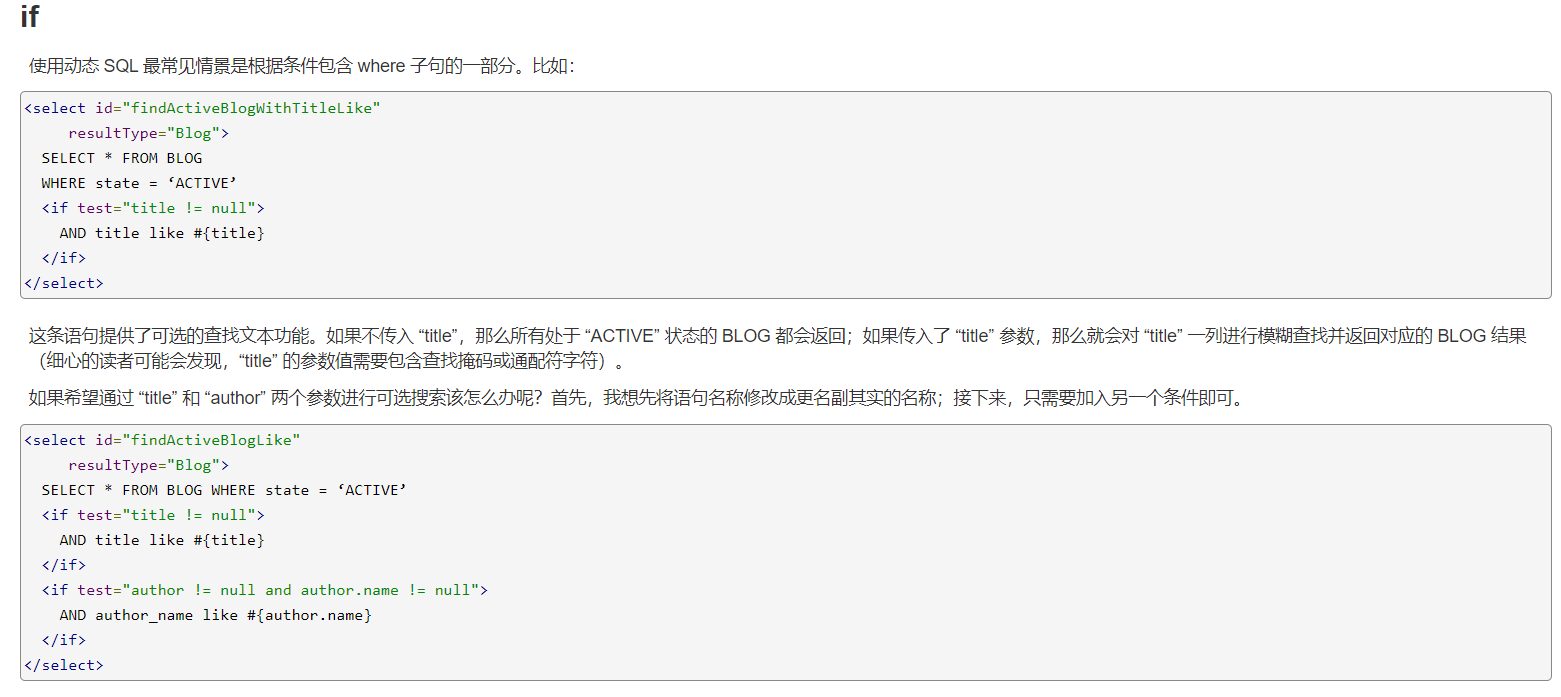
1).实现DynamicSQL
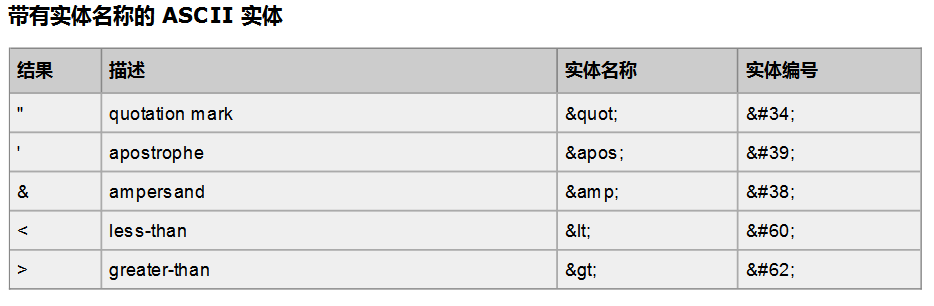
public interface EmployeeMapperDynamicSQL {

	public List<Employee> getEmpsByCondtionIf(Employee employee);

}
<mapper namespace="com.atguigu.mybatis.dao.EmployeeMapperDynamicSQL">

	 <!-- 查询员工:携带指定字段查询条件就带上该字段的值 -->

	 <!-- public List<Employee> getEmpsByCondtionIf(Employee employee) -->

	 <select id="getEmpsByCondtionIf" resultType="com.atguigu.mybatis.bean.Employee">

	 	select * from tbl_employee

	 	<!-- where:根据条件包含 where 子句 -->

	 	where

		 	<!-- test:判断表达式(OGNL) -->

		 	<!-- OGNL语法参照PPT或者官方文档:http://commons.apache.org/proper/commons-ognl/language-guide.html -->

		 	<!-- 从参数中取值进行判断,如果遇到特殊符号去写转义字符,查W3C HTML ISO-8859-1 参考手册 -->

		 	<if test="id!=null">

		 		id=#{id}

		 	</if>

		 	<!-- <if test="lastName!=null and lastName!="""> -->

		 	<!-- <if test="lastName!=null && lastName!=''"> -->

		 	<if test="lastName!=null && lastName!=""">

		 		and last_name like #{lastName}

		 	</if>

		 	<if test="email!=null and email.trim()!=""">

		 		 and email=#{email}

		 	</if>

		 	<!-- ognl会进行字符串与数字的转换判断  "0"==0 -->

		 	<if test="gender==0 or gender==1">

		 		and gender=#{gender}

		 	</if>

	 </select>

</mapper>
//			select * from tbl_employee WHERE id=? and last_name like ? and email=?

//			Employee employee  = new Employee(3, "%e%","atguigu@atguigu.com", null);

			//select * from tbl_employee WHERE id=? and last_name like ?

			Employee employee  = new Employee(null, "%e%",null, null);

			List<Employee> emps = mapper.getEmpsByCondtionIf(employee);

			for(Employee emp:emps) {

				System.out.println(emp);

			}
2.choose
有时候,我们不想使用所有的条件,而只是想从多个条件中选择一个使用.针对这种情况,MyBatis 提供了 choose 元素,它有点像 Java 中的 switch 语句.
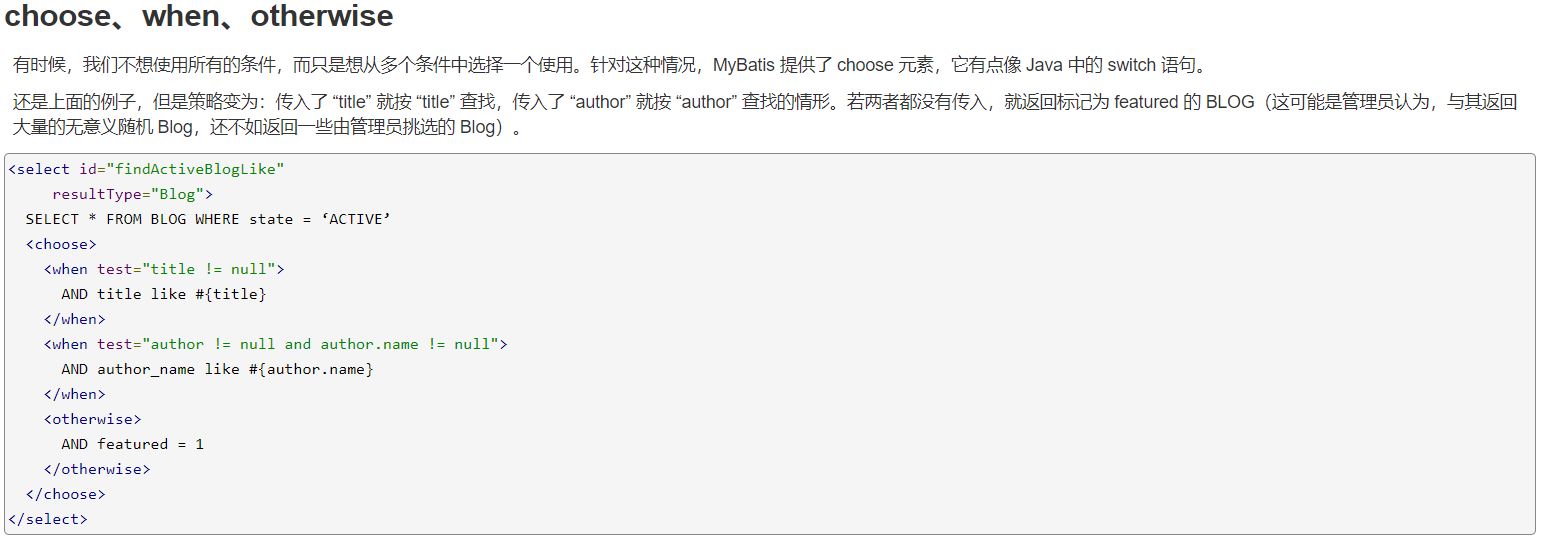
public List<Employee> getEmpByConditionChoose(Employee employee);
<mapper namespace="com.atguigu.mybatis.dao.EmployeeMapperDynamicSQL">

	 <!-- public List<Employee> getEmpByConditionChoose(Employee employee) -->

	 <select id="getEmpByConditionChoose" resultType="com.atguigu.mybatis.bean.Employee">

	 	select * from tbl_employee

	 	<where>

	 		<!-- 如果带了id就用id查,如果带了lastName就用lastName查;只会进入其中一个 -->

	 		<choose>

	 				 			<when test="id!=null">

	 				id=#{id}

	 			</when>

	 			<when test="lastName!=null">

	 				last_name like #{lastName}

	 			</when>

	 			<when test="email!=null">

	 				email = #{email}

	 			</when>

	 			<otherwise>

	 				gender = 0

	 			</otherwise>

	 		</choose>

	 	</where>

	 </select>

</mapper>
			//测试choose

			Employee employee  = new Employee(3, "%e%",null, null);

			List<Employee> list = mapper.getEmpByConditionChoose(employee);

			for(Employee emp:list) {

				System.out.println(emp);

			}
3.trim
1).where
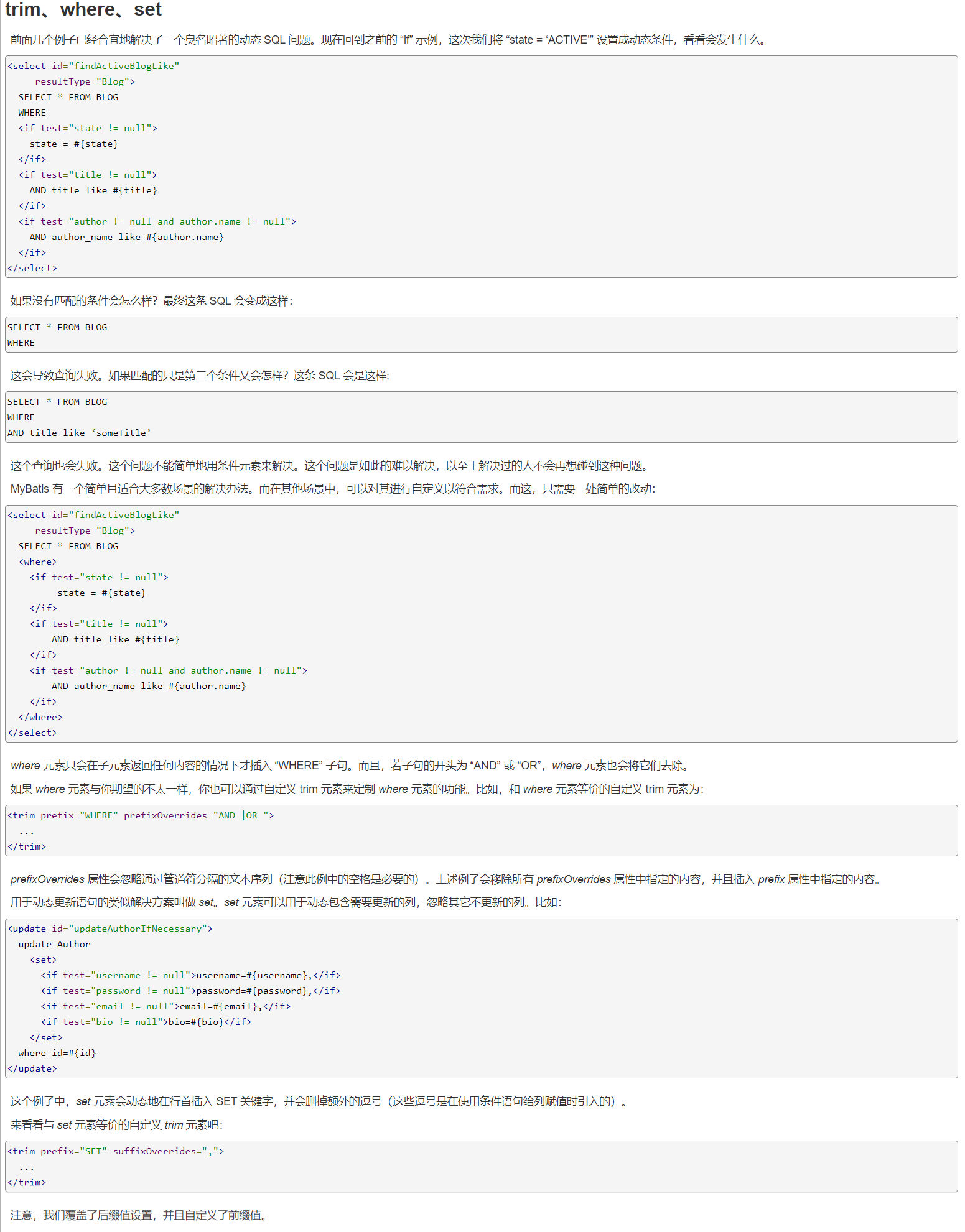
public List<Employee> getEmpsByCondtionTrim(Employee employee);
<mapper namespace="com.atguigu.mybatis.dao.EmployeeMapperDynamicSQL">

	 <!-- public List<Employee> getEmpsByCondtionTrim(Employee employee) -->

	 <select id="getEmpsByCondtionTrim" resultType="com.atguigu.mybatis.bean.Employee">

	 	select * from tbl_employee

	 	<!-- 后面多出的and或者or where标签不能解决,我们使用trim定制where元素功能  -->

	 	<!-- 自定义字符串的截取规则 -->

	 	<!-- trim:根据条件包含 where 子句 -->

	 	<!-- trim标签体中是整个字符串拼串 后的结果 -->

	 	<!-- 通过自定义 trim 元素来定制 where 元素的功能 -->

	 	<!-- prefix:前缀;prefix给拼串后的整个字符串加一个前缀  如:where <===> <trim prefix="where"> -->

	 	<!-- prefixOverrides:前缀覆盖;去掉整个字符串前面多余的字符 -->

	 	<!-- suffix:后缀;suffix给拼串后的整个字符串加一个后缀 -->

	 	<!-- suffixOverrides:后缀覆盖;去掉整个字符串后面多余的字符 -->

	 	<trim prefix="where" suffixOverrides="and">

		 	<if test="id!=null">

		 		 id=#{id} and

		 	</if>

		 	<if test="lastName!=null && lastName!=""">

		 		 last_name like #{lastName} and

		 	</if>

		 	<if test="email!=null and email.trim()!=""">

		 		 email=#{email} and

		 	</if>

		 	<!-- ognl会进行字符串与数字的转换判断  "0"==0 -->

		 	<if test="gender==0 or gender==1">

		 		gender=#{gender}

		 	</if>

		 </trim>

	 </select>

</mapper>
	@Test

	public void testDynamicSql() throws IOException {

		SqlSessionFactory sqlSessionFactory = getSqlSessionFactory();

		SqlSession openSession = sqlSessionFactory.openSession();

		try {

			EmployeeMapperDynamicSQL mapper = openSession.getMapper(EmployeeMapperDynamicSQL.class);

//			select * from tbl_employee WHERE id=? and last_name like ? and email=?

//			Employee employee  = new Employee(3, "%e%","atguigu@atguigu.com", null);

			//select * from tbl_employee WHERE id=? and last_name like ?

			Employee employee  = new Employee(3, "%e%",null, null);

			List<Employee> emps = mapper.getEmpsByCondtionIf(employee);

			for(Employee emp:emps) {

				System.out.println(emp);

			}

			//查询的时候如果某些条件没带可能sql拼装会有问题

			//1、给where后面加上1=1,以后的条件都and xxx.

			//2、mybatis使用where标签来将所有的查询条件包括在内。

				//mybatis就会将where标签中拼装的sql,多出来的and或者or去掉

				//where只会去掉第一个多出来的and或者or。

			//测试Trim

			List<Employee> emps2 = mapper.getEmpsByCondtionTrim(employee);

			for(Employee emp:emps2) {

				System.out.println(emp);

			}

		} finally {

			//  : handle finally clause

			openSession.close();

		}

	}
2).set
①.使用set更新
public void updateEmp(Employee employee);
<mapper namespace="com.atguigu.mybatis.dao.EmployeeMapperDynamicSQL">

	 <update id="updateEmp">

	 	<!-- set:更新拼串  -->

	 	<!-- set标签的使用 -->

	 	update tbl_employee

 	 	<set>

	 		<if test="lastName!=null">

				last_name=#{lastName},

			</if>

			<if test="email!=null">

				email=#{email},

			</if>

			<if test="gender!=null">

				gender=#{gender}

			</if>

	 	</set>

	 	where id=#{id}

	 </update>

</mapper>
			//调试set标签

			Employee employee = new Employee(1, "Adminn",null, null);

			mapper.updateEmp(employee);

			openSession.commit();
②.使用trim拼串更新
public void updateEmp(Employee employee);
<mapper namespace="com.atguigu.mybatis.dao.EmployeeMapperDynamicSQL">

	 <!-- public void  updateEmp(Employee employee) -->

	 <update id="updateEmp">

	 	<!-- Trim:更新拼串  -->

		update tbl_employee

		<trim prefix="set" suffixOverrides=",">

			<if test="lastName!=null">

				last_name=#{lastName},

			</if>

			<if test="email!=null">

				email=#{email},

			</if>

			<if test="gender!=null">

				gender=#{gender}

			</if>

		</trim>

		where id=#{id}

	 </update>

</mapper>
			//调试set标签

			Employee employee = new Employee(1, "Adminn",null, null);

			mapper.updateEmp(employee);

			openSession.commit();
4.foreach

动态 SQL 的另外一个常用的必要操作是需要对一个集合进行遍历,通常是在构建 IN 条件语句的时候.
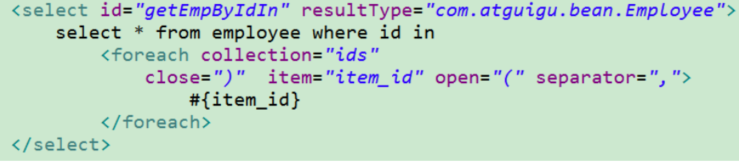
当迭代列表、集合等可迭代对象或者数组时;index是当前迭代的次数,item的值是本次迭代获取的元素.
当使用字典(或者Map.Entry对象的集合)时,index是键,item是值.
1).MySQL
(1).遍历记录
	//查询员工id'在给定集合中的

	public List<Employee> getEmpsByConditionForeach(@Param("ids")List<Integer> ids);
<mapper namespace="com.atguigu.mybatis.dao.EmployeeMapperDynamicSQL">

	 <!-- public List<Employee> getEmpsByConditionForeach(List<Integer> ids) -->

	 <select id="getEmpsByConditionForeach" resultType="com.atguigu.mybatis.bean.Employee">

	 	<!-- collection:指定要遍历的集合;list类型的参数会特殊处理封装在map中,map的key就是list -->

	 	<!-- item:当前遍历出的元素赋值给指定的变量 -->

	 	<!-- separator:每个元素之间的分隔符 -->

	 	<!-- open:遍历出所有结果拼接一个开始的字符 -->

	 	<!-- close:遍历出所有结果拼接一个结束的字符 -->

	 	<!-- index:索引;遍历list的时候是index就是索引,item就是当前值;遍历map的时候index表示的就是map的key,item就是map的值 -->

	 	<!-- #{变量名}:能取出变量的值也就是当前遍历出的元素 -->

	 	select * from tbl_employee

	 	<foreach collection="ids" item="item_id" separator="," open="where id in(" close=")">

	 		#{item_id}

	 	</foreach>

	 </select>

</mapper>
			//测试foreach

			List<Employee> list = mapper.getEmpsByConditionForeach(Arrays.asList(1,2,3,4));

			for(Employee emp : list) {

				System.out.println(emp);

			}
(2).批量保存记录1
public void addEmps(@Param("emps")List<Employee> emps);
<mapper namespace="com.atguigu.mybatis.dao.EmployeeMapperDynamicSQL">

	 <!-- 批量保存数据 -->

	 <!-- MySQL下批量保存:可以foreach遍历   mysql支持values(),(),()语法 -->

	 <!-- public void addEmps(@Param("emps")List<Employee> emps) -->

	 <!-- insert 方式一 -->

	 <!-- 推荐使用inert 方式一 -->

 	 <insert id="addEmps">

	 	insert into tbl_employee(last_name,email,gender,d_id)

		values

		<foreach collection="emps" item="emp" separator=",">

			(#{emp.lastName},#{emp.email},#{emp.gender},#{emp.dept.id})

		</foreach>

	 </insert>

</mapper>
			List<Employee> emps = new ArrayList<>();

			emps.add(new Employee(null, "smith", "smith@atguigu.com", "1",new Department(1)));

			emps.add(new Employee(null, "allen", "allen@atguigu.com", "0",new Department(1)));

			mapper.addEmps(emps);

			openSession.commit();
(3).批量保存记录2
public void addEmps(@Param("emps")List<Employee> emps);
<mapper namespace="com.atguigu.mybatis.dao.EmployeeMapperDynamicSQL">

	 <!-- insert 方式二 -->

	 <!-- public void addEmps(@Param("emps")List<Employee> emps) -->

	 <!-- 这种方式需要数据库连接属性allowMultiQueries=true;

	 	这种分号分隔多个sql可以用于其他的批量操作(删除,修改) -->

	  <insert id="addEmps">

	 	<foreach collection="emps" item="emp" separator=";">

	 		insert into tbl_employee(last_name,email,gender,d_id)

	 		values(#{emp.lastName},#{emp.email},#{emp.gender},#{emp.dept.id})

	 	</foreach>

	 </insert>

</mapper>
			List<Employee> emps = new ArrayList<>();

			emps.add(new Employee(null, "smith", "smith@atguigu.com", "1",new Department(1)));

			emps.add(new Employee(null, "allen", "allen@atguigu.com", "0",new Department(1)));

			mapper.addEmps(emps);

			openSession.commit();
2).Oracle
(1).批量保存1
<mapper namespace="com.atguigu.mybatis.dao.EmployeeMapperDynamicSQL">

	 <insert id="addEmps" databaseId="oracle">

	 	<!-- oracle第一种批量方式 -->

	 	<!-- <foreach collection="emps" item="emp" open="begin" close="end;">

	 		insert into employees(employee_id,last_name,email)

			    values(employees_seq.nextval,#{emp.lastName},#{emp.email});

	 	</foreach>

	 </insert>

</mapper>
(2).批量保存2
<mapper namespace="com.atguigu.mybatis.dao.EmployeeMapperDynamicSQL">

	 <insert id="addEmps" databaseId="oracle">

	 	<!-- oracle第二种批量方式  -->

	 	insert into employees(

	 		<!-- 引用外部定义的sql -->

	 		<include refid="insertColumn">

	 			<property name="testColomn" value="abc"/>

	 		</include>

	 	)

	 			<foreach collection="emps" item="emp" separator="union"

	 				open="select employees_seq.nextval,lastName,email from("

	 				close=")">

	 				select #{emp.lastName} lastName,#{emp.email} email from dual

	 			</foreach>

	 </insert>

</mapper>
5.bind
bind 元素可以从 OGNL 表达式中创建一个变量并将其绑定到上下文.

1).bind
若在 mybatis 配置文件中配置了 databaseIdProvider , 则可以使用 “_databaseId”变量,这样就可以根据不同的数据库厂商构建特定的语句.
public List<Employee> getEmpsTestInnerParameter(Employee employee);
<mapper namespace="com.atguigu.mybatis.dao.EmployeeMapperDynamicSQL">

	 <!-- public List<Employee> getEmpsTestInnerParameter(Employee employee) -->

	 <!-- mybatis默认还有两个内置参数:_parameter|_databaseId -->

	 <!-- _parameter:代表整个参数;单个参数:_parameter就是这个参数;多个参数:参数会被封装为一个map,_parameter就是代表这个map -->

	 <!-- _databaseId:如果配置了databaseIdProvider标签;_databaseId就是代表当前数据库的别名 -->

	 <select id="getEmpsTestInnerParameter" resultType="com.atguigu.mybatis.bean.Employee">

		<!-- bind:可以将OGNL表达式的值绑定到一个变量中,方便后来引用这个变量的值 -->

	  		<if test="_databaseId=='mysql'">

	  			select * from tbl_employee

	  			<if test="_parameter!=null">

	  				where last_name like #{lastName}

	  			</if>

	  		</if>

	  		<if test="_databaseId=='oracle'">

	  			select * from employees

	  			<if test="_parameter!=null">

	  				where last_name like #{_parameter.lastName}

	  			</if>

	  		</if>

	  </select>

</mapper>
	@Test

	public void testInnerParam() throws IOException{

		SqlSessionFactory sqlSessionFactory = getSqlSessionFactory();

		SqlSession openSession = sqlSessionFactory.openSession();

		try{

			EmployeeMapperDynamicSQL mapper = openSession.getMapper(EmployeeMapperDynamicSQL.class);

			Employee employee2 = new Employee();

			employee2.setLastName("%e%");

			List<Employee> list = mapper.getEmpsTestInnerParameter(employee2);

			for (Employee employee : list) {

				System.out.println(employee);

			}

		}finally{

			openSession.close();

		}

	}
2).SQL片段
public void addEmps(@Param("emps")List<Employee> emps);
<mapper namespace="com.atguigu.mybatis.dao.EmployeeMapperDynamicSQL">

	 <!-- insert 方式三 -->

	<insert id="addEmps">

		insert into tbl_employee(

			<include refid="insertColumn"></include>

	 	)

		values

		<foreach collection="emps" item="emp" separator=",">

			(#{emp.lastName},#{emp.email},#{emp.gender},#{emp.dept.id})

		</foreach>

	</insert>

	<!-- 抽取可重用的sql片段;方便后面引用  -->

	<!-- 1、sql抽取:经常将要查询的列名,或者插入用的列名抽取出来方便引用 -->

	<!-- 2、include来引用已经抽取的sql -->

	<!-- 3、include还可以自定义一些property,sql标签内部就能使用自定义的属性 -->

	<!-- include-property:取值的正确方式${prop} #{不能使用这种方式} -->

	<sql id="insertColumn">

		<if test="_databaseId=='oracle'">

			employee_id,last_name,email

		</if>

		<if test="_databaseId=='mysql'">

			last_name,email,gender,d_id

		</if>

	</sql>

</mapper>
	@Test

	public void testBatchSave() throws IOException {

		SqlSessionFactory sqlSessionFactory = getSqlSessionFactory();

		SqlSession openSession = sqlSessionFactory.openSession();

		try {

			EmployeeMapperDynamicSQL mapper = openSession.getMapper(EmployeeMapperDynamicSQL.class);

			List<Employee> emps = new ArrayList<>();

			emps.add(new Employee(null, "smith", "smith@atguigu.com", "1",new Department(1)));

			emps.add(new Employee(null, "allen", "allen@atguigu.com", "0",new Department(1)));

			mapper.addEmps(emps);

			openSession.commit();

		}finally {

			openSession.close();

		}

	}
6.OGNL
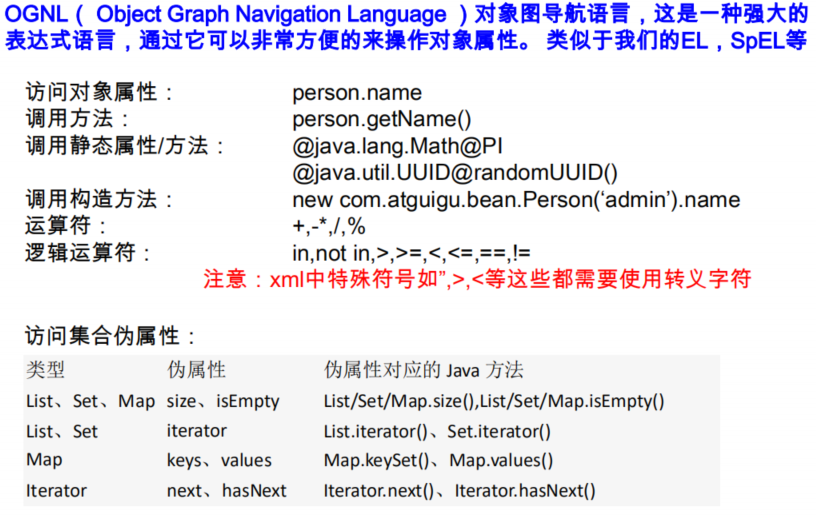
参考文档:http://commons.apache.org/proper/commons-ognl/language-guide.html
https://mybatis.org/mybatis-3/zh/dynamic-sql.html
04、MyBatis DynamicSQL(Mybatis动态SQL)的更多相关文章
- 【mybatis深度历险系列】mybatis中的动态sql
最近一直做项目,博文很长时间没有更新了,今天抽空,学习了一下mybatis,并且总结一下.在前面的博文中,小编主要简单的介绍了mybatis中的输入和输出映射,并且通过demo简单的介绍了输入映射和输 ...
- Mybatis入门之动态sql
Mybatis入门之动态sql 通过mybatis提供的各种标签方法实现动态拼接sql. 1.if.where.sql.include标签(条件.sql片段) <sql id="sel ...
- mybatis 详解------动态SQL
mybatis 详解------动态SQL 目录 1.动态SQL:if 语句 2.动态SQL:if+where 语句 3.动态SQL:if+set 语句 4.动态SQL:choose(when,o ...
- mybatis中的动态SQL
在实际开发中,数据库的查询很难一蹴而就,我们往往要根据各种不同的场景拼接出不同的SQL语句,这无疑是一项复杂的工作,我们在使用mybatis时,mybatis给我们提供了动态SQL,可以让我们根据具体 ...
- Mybatis映射文件动态SQL语句-01
因为在很多业务逻辑复杂的项目中,往往不是简单的sql语句就能查询出来自己想要的数据,所有mybatis引入了动态sql语句, UserMapper.xml <?xml version=" ...
- 6.Mybatis中的动态Sql和Sql片段(Mybatis的一个核心)
动态Sql是Mybatis的核心,就是对我们的sql语句进行灵活的操作,他可以通过表达式,对sql语句进行判断,然后对其进行灵活的拼接和组装.可以简单的说成Mybatis中可以动态去的判断需不需要某些 ...
- MyBatis注解配置动态SQL
MySQL创建表 DROP TABLE IF EXISTS `tb_employee`; CREATE TABLE `tb_employee` ( `id` int(11) NOT NULL AUTO ...
- mybatis框架(5)---动态sql
那么,问题来了: 什么是动态SQL? 动态SQL有什么作用? 传统的使用JDBC的方法,相信大家在组合复杂的的SQL语句的时候,需要去拼接,稍不注意哪怕少了个空格,都会导致错误.Mybatis的动态S ...
- MyBatis进阶使用——动态SQL
MyBatis的强大特性之一就是它的动态SQL.如果你有使用JDBC或者其他类似框架的经验,你一定会体会到根据不同条件拼接SQL语句的痛苦.然而利用动态SQL这一特性可以彻底摆脱这一痛苦 MyBati ...
随机推荐
- HTML <del> 标签
HTML <del> 标签 什么是<del> 标签? 定义文档中已被删除的文本. 实例 a month is <del>25</del> 30 day ...
- centos7下PHP安装gd扩展
第一步: 安装需要用到的库 yum -y install libjpeg libjpeg-devel libpng libpng-devel freetype freetype-devel 第二步: ...
- 栈&队列&并查集&哈希表(julyedu网课整理)
date: 2018-11-25 08:31:30 updated: 2018-11-25 08:31:30 栈&队列&并查集&哈希表(julyedu网课整理) 栈和队列 1. ...
- HBase基础理论知识
来源:第四章:大数据 の HBase 基础 本课主题 NoSQL 数据库介绍 HBase 基本操作 HBase 集群架构与设计介紹 HBase 与HDFS的关系 HBase 数据拆分和紧缩 引言 ...
- 【1】TensorFlow光速入门-tensorflow开发基本流程
本文地址:https://www.cnblogs.com/tujia/p/13862339.html 系列文章: [0]TensorFlow光速入门-序 [1]TensorFlow光速入门-tenso ...
- Rancher 2.5特性解读丨更简单友好的API和Dashboard
本文来自Rancher Labs 关注我们,看K8S干货教程 作者简介 张智博,Rancher中国研发与产品总监.7年云计算领域经验,一直活跃在研发一线,经历了OpenStack到Kubernetes ...
- ui 自动化的测试用例从哪来
从手工测试当中选取,尽量选择 1.简单且需要反复回归 2.稳定且不会经常变化 3.优先覆盖核心功能
- js-同步和异步
js异步 学习js开发,无论是前端开发还是node.js,都避免不了要接触异步编程这个问题,就和其它大多数以多线程同步为主的编程语言不同,js的主要设计是单线程异步模型.正因为js天生的与众不同,才使 ...
- React中useLayoutEffect和useEffect的区别
重点: 1.二者函数签名相同,调用方式是一致的 2. 怎么简单进行选择: 无脑选择useEffect,除非运行效果和你预期的不一致再试试useLayoutEffect 区别详解:useEffect是异 ...
- 没人比我更懂 HashMap :)
哈,标题开个玩笑,0202 年的段子哈. 一.首先看一下 HashMap 的构造函数 /** * Constructs an empty <tt>HashMap</tt> wi ...