
RESTEasy + JBOSS 7 Hello world application---reference
RESTEasy is JBOSS provided implementation of JAX-RS specification for building RESTful Web Services and RESTful Java applications. Though this is not limited to be used in JBOSS only, and you can use with other servers also. In this post, I am building such a hello world application in JBOSS AS7 server.
Environment used:
- RESTEasy 2.3.1.GA
- Jboss AS7
- JDK 1.6
Follow below steps to build a demo application.
1) Create a maven project and convert to eclipse web project
mvn archetype:generate -DgroupId=com.howtodoinjava -DartifactId=RESTfulDemoApplication

-DarchetypeArtifactId=maven-archetype-webapp -DinteractiveMode=false

mvn eclipse:eclipse -Dwtpversion=2.0
2) Update runtime dependencies in pom.xml
You need to define only compile time dependencies. Even better, if you can identify and include the jars from jboss distribution package.
|
1
2
3
4
5
6
7
8
9
10
11
12
13
14
15
16
17
18
19
20
21
22
23
24
25
26
27
28
29
30
31
32
33
34
35
36
37
38
39
40
41
42
43
44
45
46
47
48
49
50
51
52
53
54
|
<project xmlns="http://maven.apache.org/POM/4.0.0" xmlns:xsi="http://www.w3.org/2001/XMLSchema-instance" <modelVersion>4.0.0</modelVersion> <groupId>com.howtodoinjava</groupId> <artifactId>RESTfulDemoApplication</artifactId> <packaging>war</packaging> <version>1.0-SNAPSHOT</version> <name>RESTfulDemoApplication Maven Webapp</name> <repositories> <repository> <id>jboss</id> </repository> </repositories> <dependencies> <dependency> <groupId>junit</groupId> <artifactId>junit</artifactId> <version>3.8.1</version> <scope>test</scope> </dependency> <!-- core library --> <dependency> <groupId>org.jboss.resteasy</groupId> <artifactId>resteasy-jaxrs</artifactId> <version>2.3.1.GA</version> <scope>compile</scope> </dependency> <!-- JAXB support --> <dependency> <groupId>org.jboss.resteasy</groupId> <artifactId>resteasy-jaxb-provider</artifactId> <version>2.3.1.GA</version> <scope>compile</scope> </dependency> <!-- multipart/form-data and multipart/mixed support --> <dependency> <groupId>org.jboss.resteasy</groupId> <artifactId>resteasy-multipart-provider</artifactId> <version>2.3.1.GA</version> <scope>compile</scope> </dependency> <dependency> <groupId>net.sf.scannotation</groupId> <artifactId>scannotation</artifactId> <version>1.0.2</version> <scope>compile</scope> </dependency> </dependencies> <build> <finalName>RESTfulDemoApplication</finalName> </build></project> |
3) Create a blank web.xml file
JBOSS’s inbuilt support RESTeasy makes it a perfect combo for RESTFul web application. The minimum configuration to build such application is none. Yes, a blank web.xml file.
|
1
2
3
4
5
6
7
|
<!DOCTYPE web-app PUBLIC "-//Sun Microsystems, Inc.//DTD Web Application 2.3//EN"<web-app> <display-name>Restful Web Application</display-name></web-app> |
5) Register the application path
You will need to extend javax.ws.rs.core.Application class and provide @ApplicationPath annotation.
|
1
2
3
4
5
6
7
8
9
10
11
12
13
14
15
16
17
18
|
<img src="http://howtodoinjava.com/wp-content/uploads/jboss+resteasy1.png" alt="JBOSS 7+ RESTEasy demo application" width="453" height="225" class="size-full wp-image-2033" /> JBOSS 7+ RESTEasy demo applicationpackage com.howtodoinjava;import java.util.Arrays;import java.util.HashSet;import java.util.Set;import javax.ws.rs.ApplicationPath;import javax.ws.rs.core.Application;import com.howtodoinjava.service.UserService;@ApplicationPath("/")public class ApplicationConfig extends Application { @SuppressWarnings("unchecked") public Set<Class<?>> getClasses() { return new HashSet<Class<?>>(Arrays.asList(UserService.class)); }} |
4) Write a service class having @Path annotations
|
1
2
3
4
5
6
7
8
9
10
11
12
13
14
15
16
17
18
19
20
21
22
23
24
25
26
27
28
29
30
31
32
33
34
35
36
37
38
39
40
41
42
43
44
45
46
47
48
49
50
51
52
53
54
55
56
57
58
59
60
61
62
63
64
65
66
67
68
69
70
71
72
73
74
75
76
77
78
79
80
81
82
83
84
85
86
87
88
89
90
91
92
93
94
95
96
97
98
99
100
101
102
103
104
105
106
107
108
109
110
111
112
113
114
115
116
117
118
119
120
121
122
123
124
125
|
package com.howtodoinjava.service;import java.net.URI;import java.net.URISyntaxException;import java.util.ArrayList;import javax.ws.rs.Consumes;import javax.ws.rs.DELETE;import javax.ws.rs.DefaultValue;import javax.ws.rs.GET;import javax.ws.rs.POST;import javax.ws.rs.PUT;import javax.ws.rs.Path;import javax.ws.rs.PathParam;import javax.ws.rs.Produces;import javax.ws.rs.QueryParam;import javax.ws.rs.core.Response;import javax.xml.bind.annotation.XmlAccessType;import javax.xml.bind.annotation.XmlAccessorType;import javax.xml.bind.annotation.XmlElement;import javax.xml.bind.annotation.XmlRootElement;import com.howtodoinjava.model.User;import com.howtodoinjava.model.Users;@XmlAccessorType(XmlAccessType.NONE)@XmlRootElement(name = "user-management")@Path("/user-management")public class UserService { @XmlElement(name = "users") private String uri1 = "/user-management/users"; @XmlElement(name = "report") private String uri2 = "/user-managemet/generate-report"; public String getUri1() { return uri1; } public void setUri1(String uri1) { this.uri1 = uri1; } public String getUri2() { return uri2; } public void setUri2(String uri2) { this.uri2 = uri2; } @GET @Path("/") @Produces("application/vnd.com.demo.user-management+xml;charset=UTF-8;version=1") public UserService getServiceInfo() { return new UserService(); } @GET @Path("/users") @Produces("application/vnd.com.demo.user-management.users+xml;charset=UTF-8;version=1") public Users getAllUsers() { User user1 = new User(); user1.setId(1); user1.setFirstName("demo"); user1.setLastName("user"); user1.setUri("/user-management/users/1"); User user2 = new User(); user2.setId(2); user2.setFirstName("demo"); user2.setLastName("user"); user2.setUri("/user-management/users/2"); Users users = new Users(); users.setUsers(new ArrayList<User>()); users.getUsers().add(user1); users.getUsers().add(user2); return users; } @GET @Path("/users/{id}") @Produces("application/vnd.com.demo.user-management.user+xml;charset=UTF-8;version=1") public User getUserById(@PathParam("id") int id) { User user = new User(); user.setId(id); user.setFirstName("demo"); user.setLastName("user"); user.setUri("/user-management/users/" + id); return user; } @POST @Path("/users") @Consumes("application/vnd.com.demo.user-management.user+xml;charset=UTF-8;version=1") public Response createUser(User user, @DefaultValue("false") @QueryParam("allow-admin") boolean allowAdmin) throws URISyntaxException { System.out.println(user.getFirstName()); System.out.println(user.getLastName()); return Response.status(201) .contentLocation(new URI("/user-management/users/123")).build(); } @PUT // @Path("/users/{id: [0-9]*}") @Path("/users/{id}") @Consumes("application/vnd.com.demo.user-management.user+xml;charset=UTF-8;version=1") @Produces("application/vnd.com.demo.user-management.user+xml;charset=UTF-8;version=1") public User updateUser(@PathParam("id") int id, User user) throws URISyntaxException { user.setId(id); user.setFirstName(user.getFirstName() + "updated"); return user; } @DELETE @Path("/users/{id}") public Response deleteUser(@PathParam("id") int id) throws URISyntaxException { return Response.status(200).build(); }} |
5) Run the application
When we deploy above built application in jboss and hit the URL: ” http://localhost:8080/RESTfulDemoApplication/user-management/users”, below is the response.
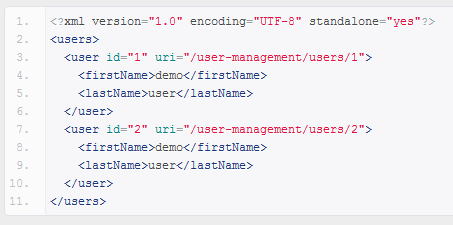
reference from:http://howtodoinjava.com/2013/05/12/resteasy-jboss-7-hello-world-application/
RESTEasy + JBOSS 7 Hello world application---reference的更多相关文章
- Hibernate Validator 6.0.9.Final - JSR 380 Reference Implementation: Reference Guide
Preface Validating data is a common task that occurs throughout all application layers, from the pre ...
- 转载---jboss简单使用
初学Jboss,对于Jboss的基础认识以及配置做一些记录 Jboss基础: JBoss是什么–基于J2EE的应用服务器–开放源代码–JBoss核心服务不包括支持servlet/JSP的WEB容器,一 ...
- Jboss基础及简单的应用
初学Jboss,对于Jboss的基础认识以及配置做一些记录 Jboss基础: JBoss是什么–基于J2EE的应用服务器–开放源代码–JBoss核心服务不包括支持servlet/JSP的WEB容器,一 ...
- jboss相关的术语
1 jboss eap java ee application server.red hat官方版本. 2 jboss as/wildfly java ee application server的社区 ...
- zt 比较各JAX-RS实现:CXF,Jersey,RESTEasy,Restlet
http://news.misuland.com/20080926/1222396399411.html JavaSE/EE执行委员批准了JSR 311 JAX-RS作为支持RESTful web服务 ...
- 分布式服务治理框架Dubbo的前世今生及应用实战
Dubbo的出现背景 Dubbo从开源到现在,已经出现了接近10年时间,在国内各大企业被广泛应用. 它到底有什么魔力值得大家去追捧呢?本篇文章给大家做一个详细的说明. 大规模服务化对于服务治理的要求 ...
- RESTful和JAX-RS
一.简介 Java Web有很多成熟的框架,主要可以分为两类Web Application和Web Services.用于Web Application的框架包括官方的Servlet/JSP, JST ...
- Apache CXF 102 CXF with REST
前言 续上篇Apache CXF 101,摘抄部分REST概念性知识,以运行实例考察CXF对REST的支持. 目录 1 REST简介 2 工具 3 运行实例 内容 本Spike记录中内容,如无特别指出 ...
- WebService基础学习(二)—三要素
一.Java中WebService规范 JAVA 中共有三种WebService 规范,分别是JAX-WS.JAX-RS.JAXM&SAAJ(废弃). 1.JAX-WS规范 ...
随机推荐
- 使用Slip.js快速创建整屏滑动的手机网页
原文 http://segmentfault.com/blog/laopopo/1190000000708417 现在滑屏网页越来越多,比如我在搜狐视频就做了好几个,举个例子,可以用手机扫描以下的二 ...
- ASP.NET Web API下Controller激活
一.HttpController激活流程 对于组成ASP.NET Web API核心框架的消息处理管道来说,处于末端的HttpMessageHandler是一个HttpRoutingDispatche ...
- js+dom开发第十六天
一.css常用标签及页面布局 1.常用标签 position(定位) z-index(定位多层顺序) background(背景) text-align(针对字符自动左右居中) margin(外边距) ...
- OC面向对象的三大特征
OC面向对象的三大特征 1.OC面向对象的三大特封装 1)封装:完整的说是成员变量的封装. 2)在成语方法里面的成员变量最好不要使用@public这样会直接暴露在外面被别人随随便便修改,封装的方法还可 ...
- map和lambda
同事问我python里,比如一个列表: a = ['1', '2', '3'] 如何变成: b = ['1x', '2x', '3x'] 好吧,果断不知道-原来pthon中有map函数,查看帮助文档: ...
- 转载:.NET Web开发技术简单整理
在最初学习一些编程语言.一些编程技术的时候,做的更多的是如何使用该技术,如何更好的使用该技术解决问题,而没有去关注它的相关性.关注它的理论支持,这种学习技术的方式是短平快.其实工作中有时候也是这样,公 ...
- 工作总结:将电脑中的ARP缓存清空黑屏命令
ARP -d 将电脑中的ARP缓存清空ARP-a 查看arp缓存arp-s ip与mac绑定
- Spring MVC控制器用@ResponseBody声明返回json数据报406的问题
本打算今天早点下班,结果下午测试调试程序发现一个问题纠结到晚上才解决,现在写一篇博客来总结下. 是这样的,本人在Spring mvc控制层用到了@ResponseBody标注,以便返回的数据为json ...
- Delphi中的THashTable
在Delphi中,Inifiles单元中有一个TStringHash的类,不过它的Value仅支持Integer(其实也不是问题,有其它类型可以将变量变为Pointer),有点不舒服,今天没事做就把它 ...
- underscore.js框架使用
Underscore.js是一个很精干的库,压缩后只有4KB.它提供了几十种函数式编程的方法,弥补了标准库的不足,大大方便了JavaScript的编程.MVC框架Backbone.js就将这个库作为自 ...