
Redis以及Redis的php扩展安装无错版
安装Redis
下载最新的
官网:http://redis.io/ 或者 http://code.google.com/p/redis/downloads/list
第一步:下载安装编译
#wget http://redis.googlecode.com/files/redis-2.4.4.tar.gz
#tar zxvf redis-2.4.4.tar.gz
#cd redis-2.4.4
#make
#make install
#cp redis.conf /etc/
第二步:修改配置
第三步:启动进程
#redis-server /etc/redis.conf
查看进程有没有成功启动

关闭redis
# redis-cli shutdown //关闭所有
关闭某个端口上的redis
# redis-cli -p 6397 shutdown //关闭6397端口的redis
说明:关闭以后缓存数据会自动dump到硬盘上,硬盘地址见redis.conf中的dbfilename dump.rdb
PHP扩展
# Redis configuration file example

# Note on units: when memory size is needed, it is possible to specifiy

# it in the usual form of 1k 5GB 4M and so forth:

#

# 1k =>  bytes

# 1kb =>  bytes

# 1m =>  bytes

# 1mb => * bytes

# 1g =>  bytes

# 1gb => ** bytes

#

# units are case insensitive so 1GB 1Gb 1gB are all the same.

# By default Redis does not run as a daemon. Use 'yes' if you need it.

# Note that Redis will write a pid file in /var/run/redis.pid when daemonized.

daemonize yes

# When running daemonized, Redis writes a pid file in /var/run/redis.pid by

# default. You can specify a custom pid file location here.

pidfile /var/run/redis.pid

# Accept connections on the specified port, default is .

# If port  is specified Redis will not listen on a TCP socket.

port

# If you want you can bind a single interface, if the bind option is not

# specified all the interfaces will listen for incoming connections.

#

 bind 127.0.0.1

# Specify the path for the unix socket that will be used to listen for

# incoming connections. There is no default, so Redis will not listen

# on a unix socket when not specified.

#

# unixsocket /tmp/redis.sock

# unixsocketperm

# Close the connection after a client is idle for N seconds ( to disable)

timeout

# Set server verbosity to 'debug'

# it can be one of:

# debug (a lot of information, useful for development/testing)

# verbose (many rarely useful info, but not a mess like the debug level)

# notice (moderately verbose, what you want in production probably)

# warning (only very important / critical messages are logged)

loglevel verbose

# Specify the log file name. Also 'stdout' can be used to force

# Redis to log on the standard output. Note that if you use standard

# output for logging but daemonize, logs will be sent to /dev/null

logfile stdout

# To enable logging to the system logger, just set 'syslog-enabled' to yes,

# and optionally update the other syslog parameters to suit your needs.

# syslog-enabled no

# Specify the syslog identity.

# syslog-ident redis

# Specify the syslog facility.  Must be USER or between LOCAL0-LOCAL7.

# syslog-facility local0

# Set the number of databases. The default database is DB , you can select

# a different one on a per-connection basis using SELECT <dbid> where

# dbid is a number between  and 'databases'-

databases

################################ SNAPSHOTTING  #################################

#

# Save the DB on disk:

#

#   save <seconds> <changes>

#

#   Will save the DB if both the given number of seconds and the given

#   number of write operations against the DB occurred.

#

#   In the example below the behaviour will be to save:

#   after  sec ( min) if at least  key changed

#   after  sec ( min) if at least  keys changed

#   after  sec if at least  keys changed

#

#   Note: you can disable saving at all commenting all the "save" lines.

save

save

save

# Compress string objects using LZF when dump .rdb databases?

# For default that's set to 'yes' as it's almost always a win.

# If you want to save some CPU in the saving child set it to 'no' but

# the dataset will likely be bigger if you have compressible values or keys.

rdbcompression yes

# The filename where to dump the DB

dbfilename dump.rdb

# The working directory.

#

# The DB will be written inside this directory, with the filename specified

# above using the 'dbfilename' configuration directive.

#

# Also the Append Only File will be created inside this directory.

#

# Note that you must specify a directory here, not a file name.

dir /usr/local/redis-2.4.
################################# REPLICATION #################################

# Master-Slave replication. Use slaveof to make a Redis instance a copy of

# another Redis server. Note that the configuration is local to the slave

# so for example it is possible to configure the slave to save the DB with a

# different interval, or to listen to another port, and so on.

#

# slaveof <masterip> <masterport>

# If the master is password protected (using the "requirepass" configuration

# directive below) it is possible to tell the slave to authenticate before

# starting the replication synchronization process, otherwise the master will

# refuse the slave request.

#

# masterauth <master-password>

# When a slave lost the connection with the master, or when the replication

# is still in progress, the slave can act in two different ways:

#

# ) if slave-serve-stale-data is set to 'yes' (the default) the slave will

#    still reply to client requests, possibly with out of data data, or the

#    data set may just be empty if this is the first synchronization.

#

# ) if slave-serve-stale data is set to 'no' the slave will reply with

#    an error "SYNC with master in progress" to all the kind of commands

#    but to INFO and SLAVEOF.

#

slave-serve-stale-data yes

################################## SECURITY ###################################

# Require clients to issue AUTH <PASSWORD> before processing any other

# commands.  This might be useful in environments in which you do not trust

# others with access to the host running redis-server.

#

# This should stay commented out for backward compatibility and because most

# people do not need auth (e.g. they run their own servers).

#

# Warning: since Redis is pretty fast an outside user can try up to

# 150k passwords per second against a good box. This means that you should

# use a very strong password otherwise it will be very easy to break.

#

# requirepass foobared

# Command renaming.

#

# It is possilbe to change the name of dangerous commands in a shared

# environment. For instance the CONFIG command may be renamed into something

# of hard to guess so that it will be still available for internal-use

# tools but not available for general clients.

#

# Example:

#

# rename-command CONFIG b840fc02d524045429941cc15f59e41cb7be6c52

#

# It is also possilbe to completely kill a command renaming it into

# an empty string:

#

# rename-command CONFIG ""

################################### LIMITS ####################################

# Set the max number of connected clients at the same time. By default there

# is no limit, and it's up to the number of file descriptors the Redis process

# is able to open. The special value '' means no limits.

# Once the limit is reached Redis will close all the new connections sending

# an error 'max number of clients reached'.

#

# maxclients

# Don't use more memory than the specified amount of bytes.

# When the memory limit is reached Redis will try to remove keys with an

# EXPIRE set. It will try to start freeing keys that are going to expire

# in little time and preserve keys with a longer time to live.

# Redis will also try to remove objects from free lists if possible.

#

# If all this fails, Redis will start to reply with errors to commands

# that will use more memory, like SET, LPUSH, and so on, and will continue

# to reply to most read-only commands like GET.

#

# WARNING: maxmemory can be a good idea mainly if you want to use Redis as a

# 'state' server or cache, not as a real DB. When Redis is used as a real

# database the memory usage will grow over the weeks, it will be obvious if

# it is going to use too much memory in the long run, and you'll have the time

# to upgrade. With maxmemory after the limit is reached you'll start to get

# errors for write operations, and this may even lead to DB inconsistency.

#

# maxmemory <bytes>

# MAXMEMORY POLICY: how Redis will select what to remove when maxmemory

# is reached? You can select among five behavior:

#

# volatile-lru -> remove the key with an expire set using an LRU algorithm

# allkeys-lru -> remove any key accordingly to the LRU algorithm

# volatile-random -> remove a random key with an expire set

# allkeys->random -> remove a random key, any key

# volatile-ttl -> remove the key with the nearest expire time (minor TTL)

# noeviction -> don't expire at all, just return an error on write operations

#

# Note: with all the kind of policies, Redis will return an error on write

#       operations, when there are not suitable keys for eviction.

#

#       At the date of writing this commands are: set setnx setex append

#       incr decr rpush lpush rpushx lpushx linsert lset rpoplpush sadd

#       sinter sinterstore sunion sunionstore sdiff sdiffstore zadd zincrby

#       zunionstore zinterstore hset hsetnx hmset hincrby incrby decrby

#       getset mset msetnx exec sort

#

# The default is:

#

# maxmemory-policy volatile-lru

# LRU and minimal TTL algorithms are not precise algorithms but approximated

# algorithms (in order to save memory), so you can select as well the sample

# size to check. For instance for default Redis will check three keys and

# pick the one that was used less recently, you can change the sample size

# using the following configuration directive.

#

# maxmemory-samples

############################## APPEND ONLY MODE ###############################

# By default Redis asynchronously dumps the dataset on disk. If you can live

# with the idea that the latest records will be lost if something like a crash

# happens this is the preferred way to run Redis. If instead you care a lot

# about your data and don't want to that a single record can get lost you should

# enable the append only mode: when this mode is enabled Redis will append

# every write operation received in the file appendonly.aof. This file will

# be read on startup in order to rebuild the full dataset in memory.

#

# Note that you can have both the async dumps and the append only file if you

# like (you have to comment the "save" statements above to disable the dumps).

# Still if append only mode is enabled Redis will load the data from the

# log file at startup ignoring the dump.rdb file.

#

# IMPORTANT: Check the BGREWRITEAOF to check how to rewrite the append

# log file in background when it gets too big.

appendonly yes

# The name of the append only file (default: "appendonly.aof")

 appendfilename appendonly.aof

# The fsync() call tells the Operating System to actually write data on disk

# instead to wait for more data in the output buffer. Some OS will really flush

# data on disk, some other OS will just try to do it ASAP.

#

# Redis supports three different modes:

#

# no: don't fsync, just let the OS flush the data when it wants. Faster.

# always: fsync after every write to the append only log . Slow, Safest.

# everysec: fsync only if one second passed since the last fsync. Compromise.

#

# The default is "everysec" that's usually the right compromise between

# speed and data safety. It's up to you to understand if you can relax this to

# "no" that will will let the operating system flush the output buffer when

# it wants, for better performances (but if you can live with the idea of

# some data loss consider the default persistence mode that's snapshotting),

# or on the contrary, use "always" that's very slow but a bit safer than

# everysec.

#

# If unsure, use "everysec".

# appendfsync always

appendfsync everysec

# appendfsync no

# When the AOF fsync policy is set to always or everysec, and a background

# saving process (a background save or AOF log background rewriting) is

# performing a lot of I/O against the disk, in some Linux configurations

# Redis may block too long on the fsync() call. Note that there is no fix for

# this currently, as even performing fsync in a different thread will block

# our synchronous write() call.

#

# In order to mitigate this problem it's possible to use the following option

# that will prevent fsync() from being called in the main process while a

# BGSAVE or BGREWRITEAOF is in progress.

#

# This means that while another child is saving the durability of Redis is

# the same as "appendfsync none", that in pratical terms means that it is

# possible to lost up to  seconds of log in the worst scenario (with the

# default Linux settings).

#

# If you have latency problems turn this to "yes". Otherwise leave it as

# "no" that is the safest pick from the point of view of durability.

no-appendfsync-on-rewrite no

# Automatic rewrite of the append only file.

# Redis is able to automatically rewrite the log file implicitly calling

# BGREWRITEAOF when the AOF log size will growth by the specified percentage.

#

# This is how it works: Redis remembers the size of the AOF file after the

# latest rewrite (or if no rewrite happened since the restart, the size of

# the AOF at startup is used).

#

# This base size is compared to the current size. If the current size is

# bigger than the specified percentage, the rewrite is triggered. Also

# you need to specify a minimal size for the AOF file to be rewritten, this

# is useful to avoid rewriting the AOF file even if the percentage increase

# is reached but it is still pretty small.

#

# Specify a precentage of zero in order to disable the automatic AOF

# rewrite feature.

auto-aof-rewrite-percentage

auto-aof-rewrite-min-size 64mb

################################## SLOW LOG ###################################

# The Redis Slow Log is a system to log queries that exceeded a specified

# execution time. The execution time does not include the I/O operations

# like talking with the client, sending the reply and so forth,

# but just the time needed to actually execute the command (this is the only

# stage of command execution where the thread is blocked and can not serve

# other requests in the meantime).

#

# You can configure the slow log with two parameters: one tells Redis

# what is the execution time, in microseconds, to exceed in order for the

# command to get logged, and the other parameter is the length of the

# slow log. When a new command is logged the oldest one is removed from the

# queue of logged commands.

# The following time is expressed in microseconds, so  is equivalent

# to one second. Note that a negative number disables the slow log, while

# a value of zero forces the logging of every command.

slowlog-log-slower-than

# There is no limit to this length. Just be aware that it will consume memory.

# You can reclaim memory used by the slow log with SLOWLOG RESET.

slowlog-max-len

################################ VIRTUAL MEMORY ###############################

### WARNING! Virtual Memory is deprecated in Redis 2.4

### The use of Virtual Memory is strongly discouraged.

# Virtual Memory allows Redis to work with datasets bigger than the actual

# amount of RAM needed to hold the whole dataset in memory.

# In order to do so very used keys are taken in memory while the other keys

# are swapped into a swap file, similarly to what operating systems do

# with memory pages.

#

# To enable VM just set 'vm-enabled' to yes, and set the following three

# VM parameters accordingly to your needs.

vm-enabled no

 #vm-enabled yes

# This is the path of the Redis swap file. As you can guess, swap files

# can't be shared by different Redis instances, so make sure to use a swap

# file for every redis process you are running. Redis will complain if the

# swap file is already in use.

#

# The best kind of storage for the Redis swap file (that's accessed at random)

# is a Solid State Disk (SSD).

#

# *** WARNING *** if you are using a shared hosting the default of putting

# the swap file under /tmp is not secure. Create a dir with access granted

# only to Redis user and configure Redis to create the swap file there.

vm-swap-file /tmp/redis.swap

# vm-max-memory configures the VM to use at max the specified amount of

# RAM. Everything that deos not fit will be swapped on disk *if* possible, that

# is, if there is still enough contiguous space in the swap file.

#

# With vm-max-memory  the system will swap everything it can. Not a good

# default, just specify the max amount of RAM you can in bytes, but it's

# better to leave some margin. For instance specify an amount of RAM

# that's more or less between 60 and 80% of your free RAM.

vm-max-memory

# Redis swap files is split into pages. An object can be saved using multiple

# contiguous pages, but pages can't be shared between different objects.

# So if your page is too big, small objects swapped out on disk will waste

# a lot of space. If you page is too small, there is less space in the swap

# file (assuming you configured the same number of total swap file pages).

#

# If you use a lot of small objects, use a page size of  or  bytes.

# If you use a lot of big objects, use a bigger page size.

# If unsure, use the default :)

vm-page-size

# Number of total memory pages in the swap file.

# Given that the page table (a bitmap of free/used pages) is taken in memory,

# every  pages on disk will consume  byte of RAM.

#

# The total swap size is vm-page-size * vm-pages

#

# With the default of -bytes memory pages and  pages Redis will

# use a  GB swap file, that will use  MB of RAM for the page table.

#

# It's better to use the smallest acceptable value for your application,

# but the default is large in order to work in most conditions.

vm-pages

# Max number of VM I/O threads running at the same time.

# This threads are used to read/write data from/to swap file, since they

# also encode and decode objects from disk to memory or the reverse, a bigger

# number of threads can help with big objects even if they can't help with

# I/O itself as the physical device may not be able to couple with many

# reads/writes operations at the same time.

#

# The special value of  turn off threaded I/O and enables the blocking

# Virtual Memory implementation.

vm-max-threads

############################### ADVANCED CONFIG ###############################

# Hashes are encoded in a special way (much more memory efficient) when they

# have at max a given numer of elements, and the biggest element does not

# exceed a given threshold. You can configure this limits with the following

# configuration directives.

hash-max-zipmap-entries

hash-max-zipmap-value

# Similarly to hashes, small lists are also encoded in a special way in order

# to save a lot of space. The special representation is only used when

# you are under the following limits:

list-max-ziplist-entries

list-max-ziplist-value

# Sets have a special encoding in just one case: when a set is composed

# of just strings that happens to be integers in radix  in the range

# of  bit signed integers.

# The following configuration setting sets the limit in the size of the

# set in order to use this special memory saving encoding.

set-max-intset-entries

# Similarly to hashes and lists, sorted sets are also specially encoded in

# order to save a lot of space. This encoding is only used when the length and

# elements of a sorted set are below the following limits:

zset-max-ziplist-entries

zset-max-ziplist-value

# Active rehashing uses  millisecond every  milliseconds of CPU time in

# order to help rehashing the main Redis hash table (the one mapping top-level

# keys to values). The hash table implementation redis uses (see dict.c)

# performs a lazy rehashing: the more operation you run into an hash table

# that is rhashing, the more rehashing "steps" are performed, so if the

# server is idle the rehashing is never complete and some more memory is used

# by the hash table.

#

# The default is to use this millisecond  times every second in order to

# active rehashing the main dictionaries, freeing memory when possible.

#

# If unsure:

# use "activerehashing no" if you have hard latency requirements and it is

# not a good thing in your environment that Redis can reply form time to time

# to queries with  milliseconds delay.

#

# use "activerehashing yes" if you don't have such hard requirements but

# want to free memory asap when possible.

activerehashing yes

################################## INCLUDES ###################################

# Include one or more other config files here.  This is useful if you

# have a standard template that goes to all redis server but also need

# to customize a few per-server settings.  Include files can include

# other files, so use this wisely.

#

# include /path/to/local.conf

# include /path/to/other.conf
1,是否以后台进程运行,默认为no
daemonize no
2,如以后台进程运行,则需指定一个pid,默认为/var/run/redis.pid
pidfile /var/run/redis.pid
3,监听端口,默认为6379
port 6379
4,绑定主机IP,默认值为127.0.0.1(注释)
bind 127.0.0.1
5,超时时间,默认为300(秒)
timeout 300
6,日志记录等级,有4个可选值,debug,verbose(默认值),notice,warning
loglevel verbose
7,日志记录方式,默认值为stdout
logfile stdout
8,可用数据库数,默认值为16,默认数据库为0
databases 16
9,指出在多长时间内,有多少次更新操作,就将数据同步到数据文件。这个可以多个条件配合,比如默认配置文件中的设置,就设置了三个条件。
900秒(15分钟)内至少有1个key被改变
save 900 1
300秒(5分钟)内至少有10个key被改变
save 300 10
10,存储至本地数据库时是否压缩数据,默认为yes
rdbcompression yes
11,本地数据库文件名,默认值为dump.rdb
dbfilename /root/redis_db/dump.rdb
12,本地数据库存放路径,默认值为 ./
dir /root/redis_db/
13,当本机为从服务时,设置主服务的IP及端口(注释)
slaveof <masterip> <masterport>
14,当本机为从服务时,设置主服务的连接密码(注释)
masterauth <master-password>
15,连接密码(注释)
requirepass foobared
16,最大客户端连接数,默认不限制(注释)
maxclients 128
17,设置最大内存,达到最大内存设置后,Redis会先尝试清除已到期或即将到期的Key,当此方法处理后,任到达最大内存设置,将无法再进行写入操作。(注释)
maxmemory <bytes>
18,是否在每次更新操作后进行日志记录,如果不开启,可能会在断电时导致一段时间内的数据丢失。因为redis本身同步数据文件是按上面save条件来同步的,所以有的数据会在一段时间内只存在于内存中。默认值为no
appendonly yes
19,更新日志文件名,默认值为appendonly.aof(注释)
appendfilename /root/redis_db/appendonly.aof
20,更新日志条件,共有3个可选值。no表示等操作系统进行数据缓存同步到磁盘,always表示每次更新操作后手动调用fsync()将数据写到磁盘,everysec表示每秒同步一次(默认值)。
appendfsync everysec
21,是否使用虚拟内存,默认值为no
vm-enabled yes
22,虚拟内存文件路径,默认值为/tmp/redis.swap,不可多个Redis实例共享
vm-swap-file /tmp/redis.swap
23,将所有大于vm-max-memory的数据存入虚拟内存,无论vm-max-memory设置多小,所有索引数据都是内存存储的 (Redis的索引数据就是keys),也就是说,当vm-max-memory设置为0的时候,其实是所有value都存在于磁盘。默认值为0。
vm-max-memory 0
24,虚拟内存文件以块存储,每块32bytes
vm-page-size 32
25,虚拟内在文件的最大数
vm-pages 134217728
26,可以设置访问swap文件的线程数,设置最好不要超过机器的核数,如果设置为0,那么所有对swap文件的操作都是串行的.可能会造成比较长时间的延迟,但是对数据完整性有很好的保证.
vm-max-threads 4
27,把小的输出缓存放在一起,以便能够在一个TCP packet中为客户端发送多个响应,具体原理和真实效果我不是很清楚。所以根据注释,你不是很确定的时候就设置成yes
glueoutputbuf yes
28,在redis 2.0中引入了hash数据结构。当hash中包含超过指定元素个数并且最大的元素没有超过临界时,hash将以一种特殊的编码方式(大大减少内存使用)来存储,这里可以设置这两个临界值
hash-max-zipmap-entries 64
29,hash中一个元素的最大值
hash-max-zipmap-value 512
30,开启之后,redis将在每100毫秒时使用1毫秒的CPU时间来对redis的hash表进行重新hash,可以降低内存的使用。当你的使 用场景中,有非常严格的实时性需要,不能够接受Redis时不时的对请求有2毫秒的延迟的话,把这项配置为no。如果没有这么严格的实时性要求,可以设置 为yes,以便能够尽可能快的释放内存
activerehashing yes
可以参考:
Redis的部署使用文档 http://www.elain.org/?p=505
========================================================
安装PHP的Redis扩展
先去下载https://github.com/nicolasff/phpredis/downloads
#wget https://github.com/nicolasff/phpredis/downloads
# tar -zxvf nicolasff-phpredis-2.1.3-124-gd4ad907.tar.gz
# mv nicolasff-phpredis-d4ad907 php-5.3.8/ext/phpredis/
# cd php-5.3.8/ext/phpredis/
# /usr/local/php/bin/phpize
# ./configure --with-php-config=/usr/local/php/bin/php-config
# make && make install
配置php.ini
vi /usr/local/php/lib/php.ini
(加入:
extension=redis.so
)
先要看看有没有extension_dir=/…….
重启apache或者nginx
# /usr/local/apache2/bin/apachectl restart
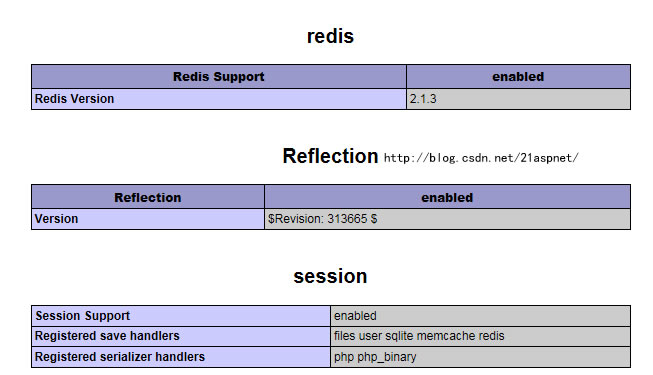
测试代码:
<?php

$redis = new Redis();

$redis->connect('127.0.0.1',6379);

$redis->set('test','hello world!');

echo $redis->get('test');

?>
参考:
Linux(CentOS 5.5) Redis 安装及RedisPHP拓展安装应用
http://www.linuxidc.com/Linux/2011-08/41404.htm
安装redis和phpredis模块
http://skandgjxa.blog.163.com/blog/static/14152982011712112933816/
RHEL5下编译安装Redis及其PHP扩展库
http://hi.baidu.com/zjstandup/blog/item/9f38b825d379c96c35a80f7f.html
windows下phpnow安装phpredis扩展:
http://www.2cto.com/os/201204/125971.html
http://os.51cto.com/art/201305/392576.htm
phpnow如何安装使用phpredis?
http://segmentfault.com/q/1010000000373690
下载地址(注意选择对应的php版本):https://github.com/nicolasff/phpredis/downloads
Redis以及Redis的php扩展安装无错版的更多相关文章
- CentOS下安装Redis及Redis的PHP扩展
1.安装Redis 1.1 如果没有安装wget,安装wget yum install wget 1.2 在http://redis.io/download页面查看redis版本,并下载安装 wget ...
- redis 扩展 安装 和 memcached 安装
在Windows下为PHP5.6安装redis扩展和memcached扩展 一.php安装redis扩展 1.使用phpinfo()函数查看PHP的版本信息,这会决定扩展文件版本 ...
- redis/php redis扩展 安装
作者:silenceper 日期:2013-10-03 原文地址: http://silenceper.com/archives/952.html 我是在CentOS 6.3 中进行的. 使用到的软件 ...
- windows下与linux下安装redis及redis扩展
1. Redis的介绍 Redis是一个开源的使用ANSI C语言编写.支持网络.可基于内存亦可持久化的日志型.Key-Value数据库,并提供多种语言的API.从2010年3月15日起 ...
- redis服务和扩展安装(windows)
Windows下安装redis和在php中使用phpredis扩展 原文地址:http://m.oschina.net/blog/281058 Junn 发布于 2年前,共有 0 条评论 1.redi ...
- linux下Redis与phpredis扩展安装
++++++++++++++++++++++++++++++++++++++++++++++linux下Redis与phpredis扩展安装++++++++++++++++++++++++++++++ ...
- redis 扩展安装使用
Redis的php客户端库非常之多, Redis推荐客户端链接是:http://redis.io/clients 推荐用phpredis,下载地址:https://github.com/nicolas ...
- redis和redis php扩展安装(转)
redis是一个内存数据库,比memcache支持更丰富的value类型,新浪微博就使用redis来做缓存. redis的源码安装 wget http://download.redis.io/redi ...
- redis安装和配置教程phpredis扩展安装测试
作者:zhanhailiang 日期:2014-10-16 推荐阅读: Redis持久化策略 关于Redis很多其它资料阅读 1. 下载redis-2.8.17.tar.gz:http://downl ...
随机推荐
- 领域驱动设计和实践(转:http://kb.cnblogs.com/page/112298/)
引言 软件系统面向对象的设计思想可谓历史悠久,20世纪70年代的Smalltalk可以说是面向对象语言的经典,直到今天我们依然将这门语言视为面向对象语言的基础.随着编程语言和技术的发展,各种语言特性层 ...
- Maven仓库详解
转载自:Maven入门指南④:仓库 1 . 仓库简介 没有 Maven 时,项目用到的 .jar 文件通常需要拷贝到 /lib 目录,项目多了,拷贝的文件副本就多了,占用磁盘空间,且难于管理.Ma ...
- URAL 1119. Metro(BFS)
点我看题目 题意 : 这个人在左下角,地铁在右上角,由很多格子组成的地图,每一条边都是一条路,每一条边都是100米.还有的可以走对角线,问你从起点到终点最短是多少. 思路 : 其实我想说一下,,,, ...
- solr的原子更新/局部更新
solr支持三种类型的原子更新: set - to set a field. add - to add to a multi-valued field. inc - to increment a fi ...
- QML嵌入到QWidget中方法
简介 嵌入方法有两种一种是直接拖控件,另一种是cpp代码动态生成, 控件方式 动态代码生成 QQuickWidget *m_quickWidget=new QQuickWidget(); QUrl s ...
- 【Linux安全】系统资源监控与进程终止
linux系统允许多用户同时操作,当用户量非常大且占用系统资源非常严重的时候, 管理员想要分析一下资源的占用情况,而在linux中有没有类似于windows系统的 资源管理器一样的工具呢,答案是肯定的 ...
- MySQL学习笔记之一
MySQL装有一个名为mysql的命令行,在提示符下输入mysql将出现如下的简单提示: ➜ ~ mysql Welcome to the MySQL monitor. Commands end wi ...
- java.sizeOf
Introduction With java.SizeOf you can measure the real memory size of your Java objects. Download it ...
- powerdesigner简单使用
---- 1) --- 新建流程图:新建模型,选择activity的那个就可以了. ----
- 【DataStructure In Python】Python模拟栈和队列
用Python模拟栈和队列主要是利用List,当然也可以使用collection的deque.以下内容为栈: #! /usr/bin/env python # DataStructure Stack ...