
struts2-第一章-基础用法3
一,结果类型配置
在之前servlet学习中,知道网页页面路径跳转有两种方式,内部跳转(请求转发)和外部跳转(重定向),两者的区别,内部跳转浏览器地址不会变化
可以保存上一次请求的数据
外部跳转浏览器地址会发生变化,但是不能保存上一次请求数据
struts2中也有上述两种跳转方式,但是需要我们进行指定,在struts.xml中action节点的result节点的type属性进行配置
type属性的取值:
(1)dispatcher :内部跳转,默认值,通常跳转jsp
(2)redirect:外部跳转,通常跳转jsp
(3)chain:内部跳转,通常跳转到action
(4)redirectAction:外部跳转,通常跳转到action
案例
(1)action1类
@Getter

@Setter

public class Demo1Action extends ActionSupport {

    private String name = "zhangsan";

    //内部跳转jsp

    public String dispatcher(){

        System.out.println("Demo1Action.dispatcher...");

        return "a";

    }

    //外部跳转jsp

    public String redirect(){

        System.out.println("Demo1Action.redirect...");

        return "b";

    }

    //内部跳转action

    public String chain(){

        System.out.println("Demo1Action.chain...");

        return "c";

    }

    //外部跳转action

    public String redirectAction(){

        System.out.println("Demo1Action.redirectAction...");

        return "d";

    }

}
(2)struts.xml配置
<package name="default" namespace="/" extends="struts-default">

        <action name="demo1Action" class="com.yujun.maven.action.Demo1Action">

            <!-- 跳转到jsp,内部和外部 -->

            <result name="a" type="dispatcher">/demo1.jsp</result>

            <result name="b" type="redirect">/demo1.jsp</result>

            <!-- 跳转到action,内部和外部 -->

            <result name="c" type="chain">

                <!-- 指定跳转的action的名称 -->

                <param name="actionName">demo2Action</param>

                <!-- 指定action所在命名空间 -->

                <param name="namespace">/</param>

                <!-- 指定执行action的哪个方法 -->

                <param name="method">m1</param>

            </result>

            <result name="d" type="redirectAction">

                <!-- 指定跳转的action的名称 -->

                <param name="actionName">demo2Action!m2.action</param>

                <!-- 指定action所在命名空间 -->

                <param name="namespace">/</param>

            </result>

        </action>

        <action name="demo2Action" class="com.yujun.maven.action.Demo2Action">

            <result>/demo2.jsp</result>

        </action>

    </package>
(3)action2类
public class Demo2Action extends ActionSupport {

    public String m1(){

        System.out.println("Demo2Action.m1...");

        return SUCCESS;

    }

    public String m2(){

        System.out.println("Demo2Action.m2...");

        return SUCCESS;

    }

}
(4)demo1.jsp
<h3>

        姓名:${name }

    </h3>
(5)demo2.jsp
<h3>

        this is demo2.jsp

    </h3>
(6)index.jsp
<%@ page language="java" contentType="text/html; charset=UTF-8"

    pageEncoding="UTF-8"%>

<!DOCTYPE html PUBLIC "-//W3C//DTD HTML 4.01 Transitional//EN" "http://www.w3.org/TR/html4/loose.dtd">

<html>

<head>

<base href="${pageContext.request.contextPath}/ "/>

<meta http-equiv="Content-Type" content="text/html; charset=UTF-8">

<title>Insert title here</title>

</head>

<body>

<h4>

        <a href="demo3Action!dispatcher.action">访问demo1Action的dispatcher方法</a>

    </h4>

    <h4>

        <a href="demo3Action!redirect.action">访问demo1Action的redirect方法</a>

    </h4>

    <h4>

        <a href="demo3Action!chain.action">访问demo1Action的chain方法</a>

    </h4>

    <h4>

        <a href="demo3Action!redirectAction.action">访问demo1Action的redirectAction方法</a>

    </h4>

</body>

</html>
二,action中访问request,session,application
在struts2中的action有时需要访问servlet资源,比如会话,记录登录人信息,通常有三种
(1)使用ActionContext
(2)使用ServletActionContext
(3)action实现ServletRequestAware/ServletContextAware接口
1.ActionContext
表示action上下文,上下文看做一个容器(本质就是HashMap),存放的是action在执行时需要用到的对象,是一个线程安全类
(1)action类
public class Demo3Action extends ActionSupport {

    public String m1(){

        //都可以给当前请求中存放数据

        //等效于request对象,但并不是request

        ActionContext.getContext().put("name", "小明");

        //真正的request对象

        ((Map)ActionContext.getContext().get("request")).put("name2", "小红");

        //session对象

        ActionContext.getContext().getSession().put("username", "admin");

        //application对象

        ActionContext.getContext().getApplication().put("count", 10);

        return SUCCESS;

    }

}
(2)struts.xml配置
<action name="demo3Action" class="com.yujun.maven.action.Demo3Action">

            <result>/demo3.jsp</result>

</action>
(3)页面
<h3>

        ${name },${name2 },${username },${count }

</h3>
若想查看值栈的信息,可以使用struts2提供的debug标签

(4)访问
http://127.0.0.1:8080/struts2-chapter1-3/demo3Action!m1.action
2.servletActionContext
public class ServletActionContext extend ActionContext implements StrutsStatics{
ServletActionContext类继承了ActionContext,因此此类也是一个线程安全类;该类提供了直接访问servlet容器对象(request、session、application)的功能
(1)action类
public class Demo4Action extends ActionSupport {

    public String m1(){

        //request对象

        ServletActionContext.getRequest().setAttribute("abc", "abc123");

        //session对象

        ServletActionContext.getRequest().getSession().setAttribute("xyz", "xyz123");

        //application对象

        ServletActionContext.getServletContext().setAttribute("opq", "opq123");

        return SUCCESS;

    }

}
(2)struts.xml配置
<action name="demo4Action" class="com.yujun.maven.action.Demo4Action">

            <result>/demo4.jsp</result>

</action>
(3)页面
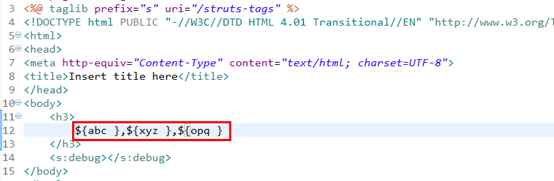
(4) 访问
http://127.0.0.1:8080/struts2-chapter1-3/demo4Action!m1.action
3.实现接口的方式
(1)action类
public class Demo5Action extends ActionSupport implements ServletRequestAware,ServletContextAware{

    //成员变量保存servlet容器对象

    private HttpServletRequest request;

    private ServletContext application;

    private HttpSession session;

    //参数的request是struts2注入给我们的,我们可以直接保存起来

    @Override

    public void setServletRequest(HttpServletRequest request) {

        this.request = request;

        this.session = request.getSession();

    }

    @Override

    public void setServletContext(ServletContext context) {

        this.application = context;

    }

    public String m1(){

        request.setAttribute("a", "a123");

        session.setAttribute("b", "b123");

        application.setAttribute("c", "c123");

        return SUCCESS;

    }

}
(2)struts.xml配置
<action name="demo5Action" class="com.yujun.maven.action.Demo5Action">

            <result>/demo5.jsp</result>

</action>
(3)页面

(4)访问
http://127.0.0.1:8080/struts2-chapter1-3/demo5Action!m1.action
struts2-第一章-基础用法3的更多相关文章
- struts2第一章-基本用法
一.struts简介 1.回顾 MVC M-model模型层 V-view 视图层 前端界面 C-controller 控制层 struts2: Apache提供的开源的控制层框架,相当于servl ...
- .net架构设计读书笔记--第一章 基础
第一章 基础 第一节 软件架构与软件架构师 简单的说软件架构即是为客户构建一个软件系统.架构师随便软件架构应运而生,架构师是一个角色. 2000年9月ANSI和IEEE发布了<密集性软件架构建 ...
- Laxcus大数据管理系统2.0(2)- 第一章 基础概述 1.1 基于现状的一些思考
第一章 基础概述 1.1 基于现状的一些思考 在过去十几年里,随着互联网产业的普及和高速发展,各种格式的互联网数据也呈现爆炸性增长之势.与此同时,在数据应用的另一个重要领域:商业和科学计算,在各种新兴 ...
- Linux系统shell编程自学_第一章基础
第一章 基础shell的优势在于处理操作系统底层的业务,Python,php的优势在于开发运维工具,web界面的管理工具以及web业务开发.处理一键安装.优化.报警脚本shell又叫命令解释器,它能识 ...
- wpf(第一章 基础知识)
wpf第一章基础知识:通过vs2015创建wpf程序会在引用里面多出3个核心程序集PresentationCore.PresentationFramework.WindowsBase.并且会在解决方案 ...
- 《openssl编程》:第一章基础知识
第一章 基础知识 1.1 对称算法 对称算法使用一个密钥.给定一个明文和一个密钥,加密产生密文,其长度和明文大致相同.解密时,使用读密钥与加密密钥相同. 对称算法主要有四种加密模式: (1) 电子密码 ...
- Python第一章-基础知识
第一章:基础知识 1.1 安装python. 直接官网下载最新的python然后默认安装就可以了,然后开始菜单里找到pyhton *.*.* Shell.exe运行python的交互shell ...
- 【SSH三框架】Struts2第一章的基础:第一次写Struts2规划
今年八月,当已经SSH三架完成学业.然后,他感动Android开展.三个框架已经很长的时间做无用的东西.所以,如果你想花三四天的时间来复习一下,写在博客. 附带SSH整个jar包网盘下载:http:/ ...
- 《Python基础教程(第二版)》学习笔记 -> 第一章 基础知识
写笔记的原因:书也看了一遍,视频也看了,但总是感觉效果不好,一段时间忘记了,再看又觉得有心无力,都是PDF的书籍,打开了就没有心情了,上班一天了,回家看这些东西,真的没多大精力了,所以,我觉得还是把p ...
- TypeScript学习指南第一章--基础数据类型(Basic Types)
基础数据类型(Basic Types) 为了搭建应用程序,我们需要使用一些基础数据类型比如:numbers,strings,structures,boolean等等. 在TypeScript中除了Ja ...
随机推荐
- Python IDLE 代码高亮主题
Python IDLE 代码高亮主题 使用方法: 打开C盘我的 C:\Documents and Settings\你的用户名.idlerc文件夹 里面会有一个 config-highlight.cf ...
- Xshell连接ubuntu server端的vim(256色彩配置)
VIM主题(Xshell端) [注]我的配置:Xshell连接VMware Workstation Pro下的Ubuntu 18 server版(要注意这里的server版,好似该版本没有下述的256 ...
- CSS3基础入门02
CSS3 基础入门02 边框相关属性 border-radius 通过这个属性我们可以设置边框圆角,即可以将四个角设置为统一的圆角,也可以单独的设置具体的某一个角的圆角. grammer: borde ...
- [BJOI2017]树的难题
题目描述 给你一棵 n 个点的无根树. 树上的每条边具有颜色.一共有 m 种颜色,编号为 1 到 m.第 i 种颜色的权值为 ci. 对于一条树上的简单路径,路径上经过的所有边按顺序组成一个颜色序列, ...
- 对于BFS的理解和部分例题(
(图文无关 雾 搜索是一个NOIP当中经常出现的考点,其实搜索换个方式来想也无非就是让电脑来帮你试,最后得到一个结果,当然这么口胡谁都会,那么我们就来看看搜索当中的一个大部分: BFS(广度优先 ...
- ACM-ICPC 2018 徐州赛区网络预赛 HRyuji doesn't want to study 树状数组
题目链接:https://nanti.jisuanke.com/t/A2007 题目大意:有一个序列含有n个数a[1],a[2],a[3],……a[n],有两种操作: 第一种操作:k=1,l,r,询问 ...
- codeforces-1136 (div2)
A.读到第i章,就有N - i + 1章还没读. #include <map> #include <set> #include <ctime> #include & ...
- 老男孩Python全栈学习 S9 日常作业 009
1.写函数,检查获取传入列表或元组对象的所有奇数位索引对应的元素,并将其作为新列表返回给调用者. def func1(List): List2 = [] for num in range(len(Li ...
- vue 中监测滚动条加载数据(懒加载数据)
vue 中监测滚动条加载数据(懒加载数据) 1:钩子函数监听滚动事件: mounted () { this.$nextTick(function () { window.addEventListene ...
- [Android] Android Error: Suspicious namespace and prefix combination [NamespaceTypo] when I try create Signed APK
Error: Suspicious namespace and prefix combination [NamespaceTypo] 解决办法: xmlns:app 的值改为: xmlns:app=& ...