
Java多线程状态切换
原创转载请注明出处:https://www.cnblogs.com/agilestyle/p/11426573.html
线程状态
- NEW
- RUNNABLE
- BLOCKED
- WAITING
- TIMED_WAITING
- TERMINATED
参考JDK源码Thread.java中的State枚举类
 /**

  * A thread state.  A thread can be in one of the following states:

  * <ul>

  * <li>{@link #NEW}<br>

  *     A thread that has not yet started is in this state.

  *     </li>

  * <li>{@link #RUNNABLE}<br>

  *     A thread executing in the Java virtual machine is in this state.

  *     </li>

  * <li>{@link #BLOCKED}<br>

  *     A thread that is blocked waiting for a monitor lock

  *     is in this state.

  *     </li>

  * <li>{@link #WAITING}<br>

  *     A thread that is waiting indefinitely for another thread to

  *     perform a particular action is in this state.

  *     </li>

  * <li>{@link #TIMED_WAITING}<br>

  *     A thread that is waiting for another thread to perform an action

  *     for up to a specified waiting time is in this state.

  *     </li>

  * <li>{@link #TERMINATED}<br>

  *     A thread that has exited is in this state.

  *     </li>

  * </ul>

  *

  * <p>

  * A thread can be in only one state at a given point in time.

  * These states are virtual machine states which do not reflect

  * any operating system thread states.

  *

  * @since   1.5

  * @see #getState

  */

 public enum State {

     /**

      * Thread state for a thread which has not yet started.

      */

     NEW,

     /**

      * Thread state for a runnable thread.  A thread in the runnable

      * state is executing in the Java virtual machine but it may

      * be waiting for other resources from the operating system

      * such as processor.

      */

     RUNNABLE,

     /**

      * Thread state for a thread blocked waiting for a monitor lock.

      * A thread in the blocked state is waiting for a monitor lock

      * to enter a synchronized block/method or

      * reenter a synchronized block/method after calling

      * {@link Object#wait() Object.wait}.

      */

     BLOCKED,

     /**

      * Thread state for a waiting thread.

      * A thread is in the waiting state due to calling one of the

      * following methods:

      * <ul>

      *   <li>{@link Object#wait() Object.wait} with no timeout</li>

      *   <li>{@link #join() Thread.join} with no timeout</li>

      *   <li>{@link LockSupport#park() LockSupport.park}</li>

      * </ul>

      *

      * <p>A thread in the waiting state is waiting for another thread to

      * perform a particular action.

      *

      * For example, a thread that has called <tt>Object.wait()</tt>

      * on an object is waiting for another thread to call

      * <tt>Object.notify()</tt> or <tt>Object.notifyAll()</tt> on

      * that object. A thread that has called <tt>Thread.join()</tt>

      * is waiting for a specified thread to terminate.

      */

     WAITING,

     /**

      * Thread state for a waiting thread with a specified waiting time.

      * A thread is in the timed waiting state due to calling one of

      * the following methods with a specified positive waiting time:

      * <ul>

      *   <li>{@link #sleep Thread.sleep}</li>

      *   <li>{@link Object#wait(long) Object.wait} with timeout</li>

      *   <li>{@link #join(long) Thread.join} with timeout</li>

      *   <li>{@link LockSupport#parkNanos LockSupport.parkNanos}</li>

      *   <li>{@link LockSupport#parkUntil LockSupport.parkUntil}</li>

      * </ul>

      */

     TIMED_WAITING,

     /**

      * Thread state for a terminated thread.

      * The thread has completed execution.

      */

     TERMINATED;

 }
线程状态切换图
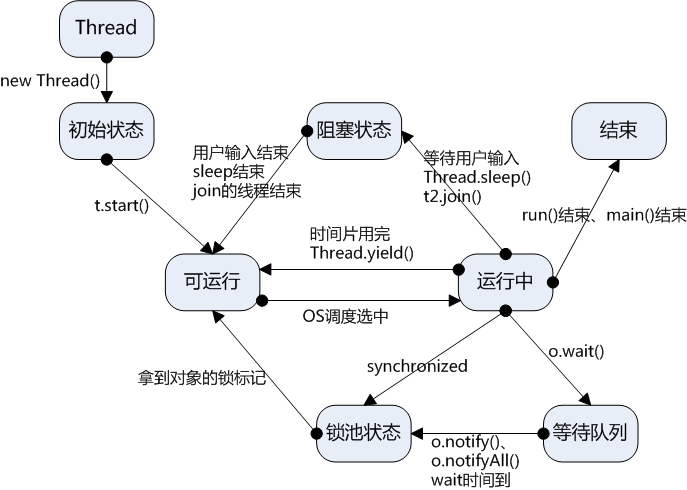
Note:
阻塞状态是线程因为某种原因放弃CPU使用权,暂时停止运行。直到线程进入就绪状态,才有机会转到运行状态。阻塞的情况分三种:
- 等待阻塞:运行的线程执行wait()方法,JVM会把该线程放入等待池中。(wait会释放持有的锁)
- 同步阻塞:运行的线程在获取对象的同步锁时,若该同步锁被别的线程占用,则JVM会把该线程放入锁池中。
- 其他阻塞:运行的线程执行sleep()或join()方法,或者发出了I/O请求时,JVM会把该线程置为阻塞状态。当sleep()状态超时、join()等待线程终止或者超时、或者I/O处理完毕时,线程重新转入就绪状态。
Java多线程状态切换的更多相关文章
- Java线程状态切换以及核心方法
1.Java线程状态 1.1 线程主要状态 ①初始(NEW):新创建了一个线程对象,但还没有调用start()方法.②运行(RUNNABLE):Java线程中将就绪(ready)和运行中(runnin ...
- java多线程状态转换
http://www.mamicode.com/info-detail-517008.html 相关资料链接 我觉得下面这张图总结的很好
- java多线程状态
造成线程进入阻塞状态的情况大致可分为: 1.调用sleep()方法 2.调用阻塞式IO方法 3. 4.等待通知 5.调用suspend(),程序挂起.
- Java线程状态及切换
Java线程状态及切换 一.什么是Java线程状态 在Java程序中,用于描述Java线程的六种状态: 新建(NEW):当前线程,刚刚新建出来,尚未启动. 运行(RUNNABLE):当前线程,处于竞争 ...
- Java多线程的内存模型和Thread状态切换
线程的内存模型 32位操作系统的寻址空间为2的32次方,也就是4GB的寻址空间:系统在这4GB的空间里划分出1GB的空间给系统专用,称作内核空间,具有最高权限:剩下3GB的空间为用户空间(一般JVM的 ...
- Java多线程系列1 线程创建以及状态切换
我们知道线程线程有三种创建方式 1实现Runnable接口 2 继承Thread类 3使用Callable和Future接口创建线程.具体是创建Callable接口的实现类,并实现clall()方法. ...
- Java多线程(一) —— 线程的状态详解
一.多线程概述 1. 进程 是一个正在执行的程序.是程序在计算机上的一次运行活动. 每一个进程执行都有一个执行顺序.该顺序是一个执行路径,或者叫一个控制单元. 系统以进程为基本单位进行系统资源的调度 ...
- java多线程-概念&创建启动&中断&守护线程&优先级&线程状态(多线程编程之一)
今天开始就来总结一下Java多线程的基础知识点,下面是本篇的主要内容(大部分知识点参考java核心技术卷1): 1.什么是线程以及多线程与进程的区别 2.多线程的创建与启动 3.中断线程和守护线程以及 ...
- Java线程生命周期与状态切换
前提 最近有点懒散,没什么比较有深度的产出.刚好想重新研读一下JUC线程池的源码实现,在此之前先深入了解一下Java中的线程实现,包括线程的生命周期.状态切换以及线程的上下文切换等等.编写本文的时候, ...
随机推荐
- springboot上传excel到oss
参考:https://blog.csdn.net/qq_34864038/article/details/80239320 https://blog.csdn.net/qq_27319683/arti ...
- B/S架构和C/S架构介绍
一.C/S架构 C/S架构及其背景 C/S架构是一种比较早的软件架构,主要应用于局域网内.在这之前经历了集中计算模式,随着计算机网络的进步与发展,尤其是可视化工具的应用,出现过两层C/S和三层C/S架 ...
- Java并发与多线程与锁优化
前言 目前CPU的运算速度已经达到了百亿次每秒,所以为了提高生产率和高效地完成任务,基本上都采用多线程和并发的运作方式. 并发(Concurrency):是指在某个时间段内,多任务交替处理的能力.CP ...
- springMVC带参数请求重定向
SpirngMVC返回逻辑视图名 可以分下面几种情况: 1. servlet进行请求转发,返回到jsp页面,如 return "index.jsp" ; 2. servlet 返 ...
- Shiro安全框架的说明及配置入门
Shiro是什么? Shiro是一个非常强大的,易于使用的,开源的,权限框架.它包括了权限校验,权限授予,会话管理,安全加密等组件 什么时候使用它呢? 如果你是设计RBAC基础系统,需要编写大量用于权 ...
- 基于Socket和OpenCV的实时视频传输
https://blog.csdn.net/pengz0807/article/details/52204475
- Java总结第二期
大家好,我又来了!!啦啦,我知道你们很想我,很想我赶快写更多的文章来提高自己的水平,好吧,我就从了你们.下面跟我一起来光顾Java第二期,掌声,掌声!!! 第二章: 这章,我要给大家讲得内容有变量,常 ...
- BZOJ 2281: [Sdoi2011]黑白棋(dp+博弈论)
传送门 解题思路 首先发现可以把相邻的黑白棋子之间的距离看成一堆棋子,那么这个就可以抽象成\(Nim\)游戏每次可以取\(d\)堆这个游戏,而这个游戏的\(SG\)值为\(x\%(d+1)\),那么题 ...
- bzoj 1233: [Usaco2009Open]干草堆tower 【想法题】
首先这题的$n^3$的DP是比较好想的 $f[i][j]$表示用前$i$包干草 且最顶层为第$j+1$包到第$i$包 所能达到的最大高度 然而数据范围还是太大了 因此我们需要去想一想有没有什么单调性 ...
- 汇编指令ADD
格式: ADD OPRD1,OPRD2 功能: 两数相加(不带进位) 例子: add ax,bx add ax,ax 解释: