
Springboot原理
1. SpringBoot特点
一个starter导入所有
依赖管理
- 父项目做依赖管理:声明了所需依赖的版本号
依赖管理

<parent>

        <groupId>org.springframework.boot</groupId>

        <artifactId>spring-boot-starter-parent</artifactId>

        <version>2.3.4.RELEASE</version>

</parent>

----------------------------------------------------------

spring-boot-starter-parent的父项目

 <parent>

    <groupId>org.springframework.boot</groupId>

    <artifactId>spring-boot-dependencies</artifactId>

    <version>2.3.4.RELEASE</version>

  </parent>

------------------------------------------------------------

点进spring-boot-dependencies内部

几乎声明了所有开发中常用的依赖(<dependency>,比如mysql的jdbc)的版本号,

自动版本仲裁机制
因此日常开发时若想引入mysql的jdbc便无需再标注版本,而可以凭父依赖自动仲裁
- 若想自定义版本:
1、查看spring-boot-dependencies里面规定当前依赖的版本 用的 key,

	如<mysql.version></mysql.version>

2、在当前项目的pom.xml里面重写配置

    <properties>

        <mysql.version>5.1.43</mysql.version>

    </properties>
- starter
1、见到很多 spring-boot-starter-* : *就某种场景
2、只要引入starter,这个场景的所有常规需要的依赖我们都自动引入
3、SpringBoot所有支持的场景:https://docs.spring.io/spring-boot/docs/current/reference/html/using-spring-boot.html#using-boot-starter
4、见到的 *-spring-boot-starter: 第三方为我们提供的简化开发的场景启动器。
5、所有场景启动器最底层的依赖:
<dependency>

  <groupId>org.springframework.boot</groupId>

  <artifactId>spring-boot-starter</artifactId>

  <version>2.3.4.RELEASE</version>

  <scope>compile</scope>

</dependency>
- 无需关注版本号
- 引入依赖默认都可以不写版本
- 引入非版本仲裁的jar,要写版本号。
### 自动配置
- 自动配好Tomcat
- 自动配好SpringMVC
- springMVC全套组件
- 不使用springboot,则配置
web.xml很麻烦,比如需要配置Serverlet - springboot自动配置好了web开发的常见场景
- 默认包结构
- 主程序所在的包以及其下面的子包的组件都会被默认扫描进来,也就是**非同包或者子包的默认扫描不到 **,若非要改变扫描的结构,则:
- 在主函数顶上通过加入
@SpringbootApplication(scanBasePackages="...")注解在完成, - 或者
@ComponentScan("..."),但是需要与@SpringbootApplication中的其他元注解一起使用
- 在主函数顶上通过加入
- 主程序所在的包以及其下面的子包的组件都会被默认扫描进来,也就是**非同包或者子包的默认扫描不到 **,若非要改变扫描的结构,则:
比如:
/**

* 文件目录:

* - com

* 	-first

*		-boot

*			- controller

*				- InsideController.java

*			- MainApplication.java

*		- OutsideController.java

*

* 配置了之后OutsideController与InsideController都能被扫描到,否则前者就扫描不到

*/

@SpringbootApplication(scanBasePackages="com.first")

/**

* 或者:

* @SpringBootConfiguration

* @EnableAutoConfiguration

* CompoentScan("com.first")

*/

public static void main(String[] args){

	...

}
- 各种配置拥有默认值
- 最终都是映射到
MultipartProperties - 配置文件的值最终会绑定到某个类上,这个类会在容器中创建对象
- 最终都是映射到
- 按需加载所有自动配置项
- starter特别多,但是只会开启被引入场景关联的包的自动配置
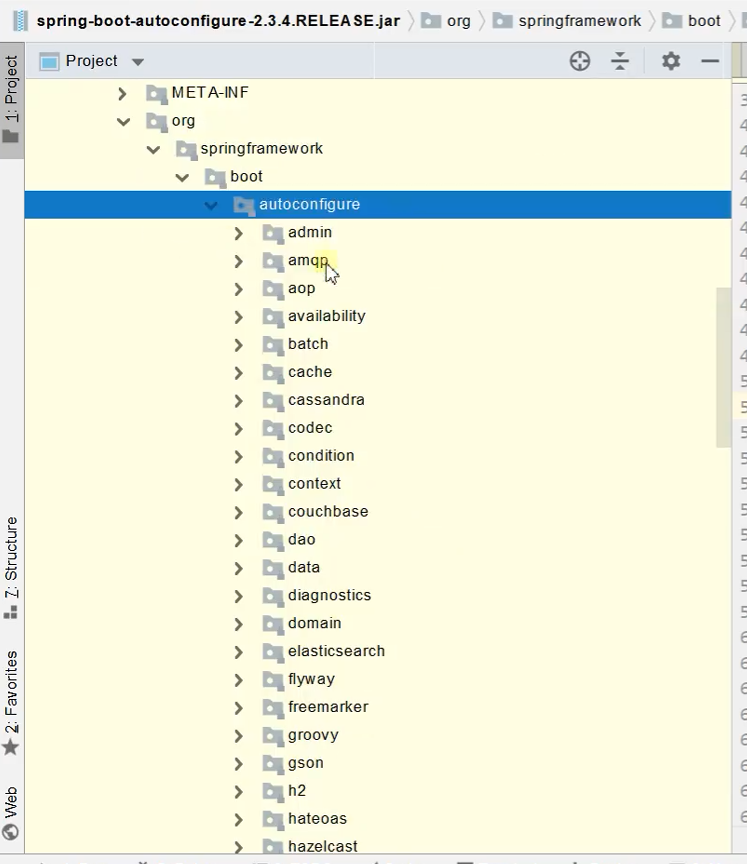
- Sprintboot所有的自动配置功能都在
spring-boot-autoconfigure里:
!(
) - 如何引入场景?例如引入批处理(batch)场景:
<dependencies>

  ...

<!--引入场景 spring-boot-starter-* -->

  <dependency>

    <groupId>org.springframework.boot</groupId>

    <artifactId>spring-boot-starter-batch</artifactId>

  </dependency>

  ...

</dependencies>
2. 容器功能
2.1 组件添加
1. @Configuration
- 基本使用
- Full模式与Lite模式
- 示例
- 最佳实战
- 不保证Bean单例模式:配置 类组件之间无依赖关系用Lite模式加速容器启动过程,减少判断,所以启动的快
- 保证Bean单例模式:配置类组件之间有依赖关系,方法会被调用得到之前单实例组件,用Full模式
#############################Configuration使用示例######################################################

/**

 * 1、配置类里面使用@Bean标注在方法上给容器注册组件,默认也是单实例的

 * 2、配置类本身也是组件

 * 3、proxyBeanMethods:代理bean的方法

 *      Full(proxyBeanMethods = true)、【保证每个@Bean方法被调用多少次返回的组件都是单实例的】

 *      Lite(proxyBeanMethods = false)【每个@Bean方法被调用多少次返回的组件都是新创建的】

 *      组件依赖必须使用Full模式默认。其他默认是否Lite模式

 *

 *

 *

 */

@Configuration(proxyBeanMethods = false) //告诉SpringBoot这是一个配置类 == 配置文件

public class MyConfig {

    /**

     * Full:外部无论对配置类中的这个组件注册方法调用多少次获取的都是之前注册容器中的单实例对象

     * @return

     */

    @Bean //给容器中添加组件。以方法名作为组件的id。返回类型就是组件类型。返回的值,就是组件在容器中的实例

    public User user01(){

        User zhangsan = new User("zhangsan", 18);

        //user组件依赖了Pet组件

        zhangsan.setPet(tomcatPet());

        return zhangsan;

    }

    @Bean("tom")

    public Pet tomcatPet(){

        return new Pet("tomcat");

    }

}

################################@Configuration测试代码如下########################################

@SpringBootConfiguration

@EnableAutoConfiguration

@ComponentScan("com.atguigu.boot")

public class MainApplication {

    public static void main(String[] args) {

        //1、返回我们IOC容器

        ConfigurableApplicationContext run = SpringApplication.run(MainApplication.class, args);

        //2、查看容器里面的组件

        String[] names = run.getBeanDefinitionNames();

        for (String name : names) {

            System.out.println(name);

        }

        //3、从容器中获取组件

        Pet tom01 = run.getBean("tom", Pet.class);

        Pet tom02 = run.getBean("tom", Pet.class);

		//若proxyBeanMethods = true则为true,否则为false

        System.out.println("组件:"+(tom01 == tom02));

        //4、说明配置类本身也是一个Bean,若proxyBeanMethods = true则,该bean为com.atguigu.boot.config.MyConfig$$EnhancerBySpringCGLIB$$51f1e1ca@1654a892,是EnhancerBySpringCGLIB的增强对象

        MyConfig bean = run.getBean(MyConfig.class);

        System.out.println(bean);

        //如果@Configuration(proxyBeanMethods = true)代理对象调用方法。SpringBoot总会检查这个组件是否在容器中有。

        //也就是,保持组件单实例

        User user = bean.user01();

        User user1 = bean.user01();

        System.out.println(user == user1);

        User user01 = run.getBean("user01", User.class);

        Pet tom = run.getBean("tom", Pet.class);

        System.out.println("用户的宠物:"+(user01.getPet() == tom));

    }

}
2、@Bean、@Component、@Controller、@Service、@Repository
3、@ComponentScan、@Import
 * 4、@Import({User.class, DBHelper.class})

 *      给容器中自动创建出这两个类型的组件、默认组件的名字就是全类名

 *

 *

 *

 */

@Import({User.class, DBHelper.class})

@Configuration(proxyBeanMethods = false) //告诉SpringBoot这是一个配置类 == 配置文件

public class MyConfig {

}
@Import 高级用法: https://www.bilibili.com/video/BV1gW411W7wy?p=8
4、@Conditional
条件装配:满足Conditional指定的条件,则进行组件注入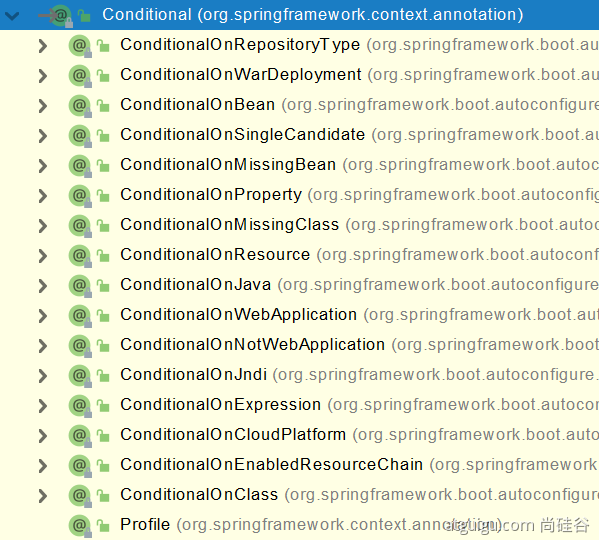
=====================测试条件装配==========================

@Configuration(proxyBeanMethods = false) //告诉SpringBoot这是一个配置类 == 配置文件

//@ConditionalOnBean(name = "tom")

@ConditionalOnMissingBean(name = "tom") //告诉SpringBoot当没用名为tom的组件时才添加下列组件

public class MyConfig {

    /**

     * Full:外部无论对配置类中的这个组件注册方法调用多少次获取的都是之前注册容器中的单实例对象

     * @return

     */

    @Bean //给容器中添加组件。以方法名作为组件的id。返回类型就是组件类型。返回的值,就是组件在容器中的实例

    public User user01(){

        User zhangsan = new User("zhangsan", 18);

        //user组件依赖了Pet组件

        zhangsan.setPet(tomcatPet());

        return zhangsan;

    }

    @Bean("tom22")

    public Pet tomcatPet(){

        return new Pet("tomcat");

    }

}

public static void main(String[] args) {

        //1、返回我们IOC容器

        ConfigurableApplicationContext run = SpringApplication.run(MainApplication.class, args);

        //2、查看容器里面的组件

        String[] names = run.getBeanDefinitionNames();

        for (String name : names) {

            System.out.println(name);

        }

        boolean tom = run.containsBean("tom");

        System.out.println("容器中Tom组件:"+tom);

        boolean user01 = run.containsBean("user01");

        System.out.println("容器中user01组件:"+user01);

        boolean tom22 = run.containsBean("tom22");

        System.out.println("容器中tom22组件:"+tom22);

    }
2.2、原生配置文件引入
1、@ImportResource
======================beans.xml=========================

<?xml version="1.0" encoding="UTF-8"?>

<beans xmlns="http://www.springframework.org/schema/beans"

       xmlns:xsi="http://www.w3.org/2001/XMLSchema-instance"

       xmlns:context="http://www.springframework.org/schema/context"

       xsi:schemaLocation="http://www.springframework.org/schema/beans http://www.springframework.org/schema/beans/spring-beans.xsd http://www.springframework.org/schema/context https://www.springframework.org/schema/context/spring-context.xsd">

    <bean id="haha" class="com.atguigu.boot.bean.User">

        <property name="name" value="zhangsan"></property>

        <property name="age" value="18"></property>

    </bean>

    <bean id="hehe" class="com.atguigu.boot.bean.Pet">

        <property name="name" value="tomcat"></property>

    </bean>

</beans>
@ImportResource("classpath:beans.xml") //加上这个注解之后就可以引入beans.xml中的配置了

public class MyConfig {}

======================测试=================

        boolean haha = run.containsBean("haha");

        boolean hehe = run.containsBean("hehe");

        System.out.println("haha:"+haha);//true

        System.out.println("hehe:"+hehe);//true
2.3、配置绑定
如何使用Java读取到properties文件中的内容,并且把它封装到JavaBean中,以供随时使用;
public class getProperties {

     public static void main(String[] args) throws FileNotFoundException, IOException {

         Properties pps = new Properties();

         pps.load(new FileInputStream("a.properties"));

         Enumeration enum1 = pps.propertyNames();//得到配置文件的名字

         while(enum1.hasMoreElements()) {

             String strKey = (String) enum1.nextElement();

             String strValue = pps.getProperty(strKey);

             System.out.println(strKey + "=" + strValue);

             //封装到JavaBean。

         }

     }

 }
1、@ConfigurationProperties
/**

 * 只有在容器中的组件,才会拥有SpringBoot提供的强大功能

 */

@Component

@ConfigurationProperties(prefix = "mycar")

public class Car {

    private String brand;

    private Integer price;

    public String getBrand() {

        return brand;

    }

    public void setBrand(String brand) {

        this.brand = brand;

    }

    public Integer getPrice() {

        return price;

    }

    public void setPrice(Integer price) {

        this.price = price;

    }

    @Override

    public String toString() {

        return "Car{" +

                "brand='" + brand + '\'' +

                ", price=" + price +

                '}';

    }

}
2、@EnableConfigurationProperties + @ConfigurationProperties
3、@Component + @ConfigurationProperties
@EnableConfigurationProperties(Car.class)

//1、开启Car配置绑定功能

//2、把这个Car这个组件自动注册到容器中

public class MyConfig {

}
3. 自动配置原理
3.1 引导加载自动配置类
main方法上的@SpringBootApplication注解内部下的关键3个注解:
@Target({ElementType.TYPE})

@Retention(RetentionPolicy.RUNTIME)

@Documented

@Inherited

@SpringBootConfiguration

@EnableAutoConfiguration

@ComponentScan(

    excludeFilters = {@Filter(

    type = FilterType.CUSTOM,

    classes = {TypeExcludeFilter.class}

), @Filter(

    type = FilterType.CUSTOM,

    classes = {AutoConfigurationExcludeFilter.class}

)}

)

public @interface SpringBootApplication {

    ...
@SpringBootConfiguration@EnableAutoConfiguration@ComponentScan
其中@SpringBootConfiguration,代表当前是一个配置类;@ComponentScan代表指定扫描哪些目录。
关键在@EnableAutoConfiguration:
@Target({ElementType.TYPE})

@Retention(RetentionPolicy.RUNTIME)

@Documented

@Inherited

@AutoConfigurationPackage

@Import({AutoConfigurationImportSelector.class})

public @interface EnableAutoConfiguration {

    String ENABLED_OVERRIDE_PROPERTY = "spring.boot.enableautoconfiguration";

    Class<?>[] exclude() default {};

    String[] excludeName() default {};

}
1、@AutoConfigurationPackage
自动配置包,指定默认的包规则:
@Target({ElementType.TYPE})

@Retention(RetentionPolicy.RUNTIME)

@Documented

@Inherited

@Import({Registrar.class})

public @interface AutoConfigurationPackage {

    String[] basePackages() default {};

    Class<?>[] basePackageClasses() default {};

}
@Import({Registrar.class})给容器到了一个组件:
static class Registrar implements ImportBeanDefinitionRegistrar, DeterminableImports {

        Registrar() {

        }

        public void registerBeanDefinitions(AnnotationMetadata metadata, BeanDefinitionRegistry registry) {

            AutoConfigurationPackages.register(registry, (String[])(new AutoConfigurationPackages.PackageImports(metadata)).getPackageNames().toArray(new String[0]));

        }

        public Set<Object> determineImports(AnnotationMetadata metadata) {

            return Collections.singleton(new AutoConfigurationPackages.PackageImports(metadata));

        }

    }
其中的AutoConfigurationPackages.register(registry, (String[])(new AutoConfigurationPackages.PackageImports(metadata)).getPackageNames().toArray(new String[0]));方法根据参数AnnotationMetadata metadata给容器中导入一系列的组件。
事实上,是**MainApplication.java** 文件所在目录的包内进行导入。
2、@Import({AutoConfigurationImportSelector.class})
- 该类内部的
selectImports方法,调用getAutoConfigurationEntry方法,给容器中批量导入一些组件:
public class AutoConfigurationImportSelector implements DeferredImportSelector, BeanClassLoaderAware, ResourceLoaderAware, BeanFactoryAware, EnvironmentAware, Ordered {

    ...

    public String[] selectImports(AnnotationMetadata annotationMetadata) {

        if (!this.isEnabled(annotationMetadata)) {

            return NO_IMPORTS;

        } else {

            AutoConfigurationImportSelector.AutoConfigurationEntry autoConfigurationEntry = this.getAutoConfigurationEntry(annotationMetadata);

            return StringUtils.toStringArray(autoConfigurationEntry.getConfigurations());

        }

    }

    ...

  }
getAutoConfigurationEntry方法内部的List<String> configurations = getCandidateConfigurations(annotationMetadata, attributes)可以获得所需要导入到容器中的配置类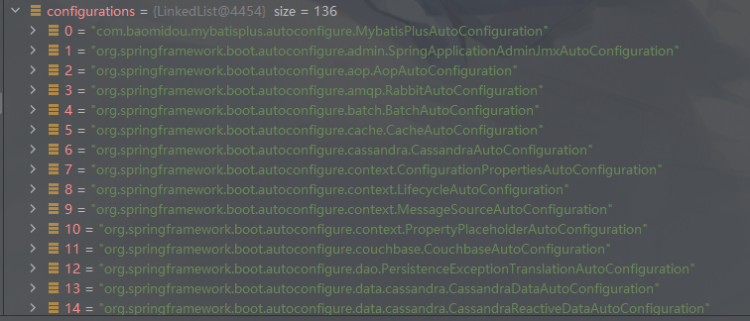
getCandidateConfigurations方法内部的SpringFactoriesLoader.loadFactoryNames->_loadSpringFactories_获得所有的组件
    protected List<String> getCandidateConfigurations(AnnotationMetadata metadata, AnnotationAttributes attributes) {

        List<String> configurations = SpringFactoriesLoader.loadFactoryNames(this.getSpringFactoriesLoaderFactoryClass(), this.getBeanClassLoader());

        Assert.notEmpty(configurations, "No auto configuration classes found in META-INF/spring.factories. If you are using a custom packaging, make sure that file is correct.");

        return configurations;

    }
private static Map<String, List<String>> loadSpringFactories(@Nullable ClassLoader classLoader) {

        MultiValueMap<String, String> result = (MultiValueMap)cache.get(classLoader);

        if (result != null) {

            return result;

        } else {

            try {

                Enumeration<URL> urls = classLoader != null ? classLoader.getResources("META-INF/spring.factories") : ClassLoader.getSystemResources("META-INF/spring.factories");

                LinkedMultiValueMap result = new LinkedMultiValueMap();

...
其中
Enumeration<URL> urls = classLoader != null ? classLoader.getResources("META-INF/spring.factories") :ClassLoader.getSystemResources("META-INF/spring.factories");
语句指示了springboot会默认从系统中所有META-INF/spring.factories文件进行扫描,比如spring-boot-autoconfigure-2.3.5.RELEASE.jar包里的META-INF/spring.factories文件: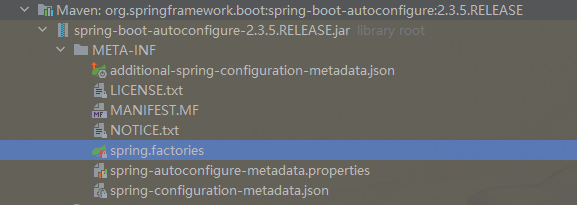
# Initializers

org.springframework.context.ApplicationContextInitializer=\

org.springframework.boot.autoconfigure.SharedMetadataReaderFactoryContextInitializer,\

org.springframework.boot.autoconfigure.logging.ConditionEvaluationReportLoggingListener

# Application Listeners

org.springframework.context.ApplicationListener=\

org.springframework.boot.autoconfigure.BackgroundPreinitializer

# Auto Configuration Import Listeners

org.springframework.boot.autoconfigure.AutoConfigurationImportListener=\

org.springframework.boot.autoconfigure.condition.ConditionEvaluationReportAutoConfigurationImportListener

# Auto Configuration Import Filters

org.springframework.boot.autoconfigure.AutoConfigurationImportFilter=\

org.springframework.boot.autoconfigure.condition.OnBeanCondition,\

org.springframework.boot.autoconfigure.condition.OnClassCondition,\

org.springframework.boot.autoconfigure.condition.OnWebApplicationCondition

# Auto Configure

org.springframework.boot.autoconfigure.EnableAutoConfiguration=\

org.springframework.boot.autoconfigure.admin.SpringApplicationAdminJmxAutoConfiguration,\

org.springframework.boot.autoconfigure.aop.AopAutoConfiguration,\

org.springframework.boot.autoconfigure.amqp.RabbitAutoConfiguration,\

org.springframework.boot.autoconfigure.batch.BatchAutoConfiguration,\

org.springframework.boot.autoconfigure.cache.CacheAutoConfiguration,\

org.springframework.boot.autoconfigure.cassandra.CassandraAutoConfiguration,\

org.springframework.boot.autoconfigure.context.ConfigurationPropertiesAutoConfiguration,\

org.springframework.boot.autoconfigure.context.LifecycleAutoConfiguration,\

org.springframework.boot.autoconfigure.context.MessageSourceAutoConfiguration,\

org.springframework.boot.autoconfigure.context.PropertyPlaceholderAutoConfiguration,\

org.springframework.boot.autoconfigure.couchbase.CouchbaseAutoConfiguration,\

org.springframework.boot.autoconfigure.dao.PersistenceExceptionTranslationAutoConfiguration,\

org.springframework.boot.autoconfigure.data.cassandra.CassandraDataAutoConfiguration,\

org.springframework.boot.autoconfigure.data.cassandra.CassandraReactiveDataAutoConfiguration,\

org.springframework.boot.autoconfigure.data.cassandra.CassandraReactiveRepositoriesAutoConfiguration,\

org.springframework.boot.autoconfigure.data.cassandra.CassandraRepositoriesAutoConfiguration,\

org.springframework.boot.autoconfigure.data.couchbase.CouchbaseDataAutoConfiguration,\

org.springframework.boot.autoconfigure.data.couchbase.CouchbaseReactiveDataAutoConfiguration,\

org.springframework.boot.autoconfigure.data.couchbase.CouchbaseReactiveRepositoriesAutoConfiguration,\

org.springframework.boot.autoconfigure.data.couchbase.CouchbaseRepositoriesAutoConfiguration,\

org.springframework.boot.autoconfigure.data.elasticsearch.ElasticsearchDataAutoConfiguration,\

org.springframework.boot.autoconfigure.data.elasticsearch.ElasticsearchRepositoriesAutoConfiguration,\

org.springframework.boot.autoconfigure.data.elasticsearch.ReactiveElasticsearchRepositoriesAutoConfiguration,\

org.springframework.boot.autoconfigure.data.elasticsearch.ReactiveElasticsearchRestClientAutoConfiguration,\

org.springframework.boot.autoconfigure.data.jdbc.JdbcRepositoriesAutoConfiguration,\

org.springframework.boot.autoconfigure.data.jpa.JpaRepositoriesAutoConfiguration,\

org.springframework.boot.autoconfigure.data.ldap.LdapRepositoriesAutoConfiguration,\

org.springframework.boot.autoconfigure.data.mongo.MongoDataAutoConfiguration,\

org.springframework.boot.autoconfigure.data.mongo.MongoReactiveDataAutoConfiguration,\

org.springframework.boot.autoconfigure.data.mongo.MongoReactiveRepositoriesAutoConfiguration,\

org.springframework.boot.autoconfigure.data.mongo.MongoRepositoriesAutoConfiguration,\

org.springframework.boot.autoconfigure.data.neo4j.Neo4jDataAutoConfiguration,\

org.springframework.boot.autoconfigure.data.neo4j.Neo4jRepositoriesAutoConfiguration,\

org.springframework.boot.autoconfigure.data.solr.SolrRepositoriesAutoConfiguration,\

org.springframework.boot.autoconfigure.data.r2dbc.R2dbcDataAutoConfiguration,\

org.springframework.boot.autoconfigure.data.r2dbc.R2dbcRepositoriesAutoConfiguration,\

org.springframework.boot.autoconfigure.data.r2dbc.R2dbcTransactionManagerAutoConfiguration,\

org.springframework.boot.autoconfigure.data.redis.RedisAutoConfiguration,\

org.springframework.boot.autoconfigure.data.redis.RedisReactiveAutoConfiguration,\

org.springframework.boot.autoconfigure.data.redis.RedisRepositoriesAutoConfiguration,\

org.springframework.boot.autoconfigure.data.rest.RepositoryRestMvcAutoConfiguration,\

org.springframework.boot.autoconfigure.data.web.SpringDataWebAutoConfiguration,\

org.springframework.boot.autoconfigure.elasticsearch.ElasticsearchRestClientAutoConfiguration,\

org.springframework.boot.autoconfigure.flyway.FlywayAutoConfiguration,\

org.springframework.boot.autoconfigure.freemarker.FreeMarkerAutoConfiguration,\

org.springframework.boot.autoconfigure.groovy.template.GroovyTemplateAutoConfiguration,\

org.springframework.boot.autoconfigure.gson.GsonAutoConfiguration,\

org.springframework.boot.autoconfigure.h2.H2ConsoleAutoConfiguration,\

org.springframework.boot.autoconfigure.hateoas.HypermediaAutoConfiguration,\

org.springframework.boot.autoconfigure.hazelcast.HazelcastAutoConfiguration,\

org.springframework.boot.autoconfigure.hazelcast.HazelcastJpaDependencyAutoConfiguration,\

org.springframework.boot.autoconfigure.http.HttpMessageConvertersAutoConfiguration,\

org.springframework.boot.autoconfigure.http.codec.CodecsAutoConfiguration,\

org.springframework.boot.autoconfigure.influx.InfluxDbAutoConfiguration,\

org.springframework.boot.autoconfigure.info.ProjectInfoAutoConfiguration,\

org.springframework.boot.autoconfigure.integration.IntegrationAutoConfiguration,\

org.springframework.boot.autoconfigure.jackson.JacksonAutoConfiguration,\

org.springframework.boot.autoconfigure.jdbc.DataSourceAutoConfiguration,\

org.springframework.boot.autoconfigure.jdbc.JdbcTemplateAutoConfiguration,\

org.springframework.boot.autoconfigure.jdbc.JndiDataSourceAutoConfiguration,\

org.springframework.boot.autoconfigure.jdbc.XADataSourceAutoConfiguration,\

org.springframework.boot.autoconfigure.jdbc.DataSourceTransactionManagerAutoConfiguration,\

org.springframework.boot.autoconfigure.jms.JmsAutoConfiguration,\

org.springframework.boot.autoconfigure.jmx.JmxAutoConfiguration,\

org.springframework.boot.autoconfigure.jms.JndiConnectionFactoryAutoConfiguration,\

org.springframework.boot.autoconfigure.jms.activemq.ActiveMQAutoConfiguration,\

org.springframework.boot.autoconfigure.jms.artemis.ArtemisAutoConfiguration,\

org.springframework.boot.autoconfigure.jersey.JerseyAutoConfiguration,\

org.springframework.boot.autoconfigure.jooq.JooqAutoConfiguration,\

org.springframework.boot.autoconfigure.jsonb.JsonbAutoConfiguration,\

org.springframework.boot.autoconfigure.kafka.KafkaAutoConfiguration,\

org.springframework.boot.autoconfigure.availability.ApplicationAvailabilityAutoConfiguration,\

org.springframework.boot.autoconfigure.ldap.embedded.EmbeddedLdapAutoConfiguration,\

org.springframework.boot.autoconfigure.ldap.LdapAutoConfiguration,\

org.springframework.boot.autoconfigure.liquibase.LiquibaseAutoConfiguration,\

org.springframework.boot.autoconfigure.mail.MailSenderAutoConfiguration,\

org.springframework.boot.autoconfigure.mail.MailSenderValidatorAutoConfiguration,\

org.springframework.boot.autoconfigure.mongo.embedded.EmbeddedMongoAutoConfiguration,\

org.springframework.boot.autoconfigure.mongo.MongoAutoConfiguration,\

org.springframework.boot.autoconfigure.mongo.MongoReactiveAutoConfiguration,\

org.springframework.boot.autoconfigure.mustache.MustacheAutoConfiguration,\

org.springframework.boot.autoconfigure.orm.jpa.HibernateJpaAutoConfiguration,\

org.springframework.boot.autoconfigure.quartz.QuartzAutoConfiguration,\

org.springframework.boot.autoconfigure.r2dbc.R2dbcAutoConfiguration,\

org.springframework.boot.autoconfigure.rsocket.RSocketMessagingAutoConfiguration,\

org.springframework.boot.autoconfigure.rsocket.RSocketRequesterAutoConfiguration,\

org.springframework.boot.autoconfigure.rsocket.RSocketServerAutoConfiguration,\

org.springframework.boot.autoconfigure.rsocket.RSocketStrategiesAutoConfiguration,\

org.springframework.boot.autoconfigure.security.servlet.SecurityAutoConfiguration,\

org.springframework.boot.autoconfigure.security.servlet.UserDetailsServiceAutoConfiguration,\

org.springframework.boot.autoconfigure.security.servlet.SecurityFilterAutoConfiguration,\

org.springframework.boot.autoconfigure.security.reactive.ReactiveSecurityAutoConfiguration,\

org.springframework.boot.autoconfigure.security.reactive.ReactiveUserDetailsServiceAutoConfiguration,\

org.springframework.boot.autoconfigure.security.rsocket.RSocketSecurityAutoConfiguration,\

org.springframework.boot.autoconfigure.security.saml2.Saml2RelyingPartyAutoConfiguration,\

org.springframework.boot.autoconfigure.sendgrid.SendGridAutoConfiguration,\

org.springframework.boot.autoconfigure.session.SessionAutoConfiguration,\

org.springframework.boot.autoconfigure.security.oauth2.client.servlet.OAuth2ClientAutoConfiguration,\

org.springframework.boot.autoconfigure.security.oauth2.client.reactive.ReactiveOAuth2ClientAutoConfiguration,\

org.springframework.boot.autoconfigure.security.oauth2.resource.servlet.OAuth2ResourceServerAutoConfiguration,\

org.springframework.boot.autoconfigure.security.oauth2.resource.reactive.ReactiveOAuth2ResourceServerAutoConfiguration,\

org.springframework.boot.autoconfigure.solr.SolrAutoConfiguration,\

org.springframework.boot.autoconfigure.task.TaskExecutionAutoConfiguration,\

org.springframework.boot.autoconfigure.task.TaskSchedulingAutoConfiguration,\

org.springframework.boot.autoconfigure.thymeleaf.ThymeleafAutoConfiguration,\

org.springframework.boot.autoconfigure.transaction.TransactionAutoConfiguration,\

org.springframework.boot.autoconfigure.transaction.jta.JtaAutoConfiguration,\

org.springframework.boot.autoconfigure.validation.ValidationAutoConfiguration,\

org.springframework.boot.autoconfigure.web.client.RestTemplateAutoConfiguration,\

org.springframework.boot.autoconfigure.web.embedded.EmbeddedWebServerFactoryCustomizerAutoConfiguration,\

org.springframework.boot.autoconfigure.web.reactive.HttpHandlerAutoConfiguration,\

org.springframework.boot.autoconfigure.web.reactive.ReactiveWebServerFactoryAutoConfiguration,\

org.springframework.boot.autoconfigure.web.reactive.WebFluxAutoConfiguration,\

org.springframework.boot.autoconfigure.web.reactive.error.ErrorWebFluxAutoConfiguration,\

org.springframework.boot.autoconfigure.web.reactive.function.client.ClientHttpConnectorAutoConfiguration,\

org.springframework.boot.autoconfigure.web.reactive.function.client.WebClientAutoConfiguration,\

org.springframework.boot.autoconfigure.web.servlet.DispatcherServletAutoConfiguration,\

org.springframework.boot.autoconfigure.web.servlet.ServletWebServerFactoryAutoConfiguration,\

org.springframework.boot.autoconfigure.web.servlet.error.ErrorMvcAutoConfiguration,\

org.springframework.boot.autoconfigure.web.servlet.HttpEncodingAutoConfiguration,\

org.springframework.boot.autoconfigure.web.servlet.MultipartAutoConfiguration,\

org.springframework.boot.autoconfigure.web.servlet.WebMvcAutoConfiguration,\

org.springframework.boot.autoconfigure.websocket.reactive.WebSocketReactiveAutoConfiguration,\

org.springframework.boot.autoconfigure.websocket.servlet.WebSocketServletAutoConfiguration,\

org.springframework.boot.autoconfigure.websocket.servlet.WebSocketMessagingAutoConfiguration,\

org.springframework.boot.autoconfigure.webservices.WebServicesAutoConfiguration,\

org.springframework.boot.autoconfigure.webservices.client.WebServiceTemplateAutoConfiguration

# Failure analyzers

org.springframework.boot.diagnostics.FailureAnalyzer=\

org.springframework.boot.autoconfigure.data.redis.RedisUrlSyntaxFailureAnalyzer,\

org.springframework.boot.autoconfigure.diagnostics.analyzer.NoSuchBeanDefinitionFailureAnalyzer,\

org.springframework.boot.autoconfigure.flyway.FlywayMigrationScriptMissingFailureAnalyzer,\

org.springframework.boot.autoconfigure.jdbc.DataSourceBeanCreationFailureAnalyzer,\

org.springframework.boot.autoconfigure.jdbc.HikariDriverConfigurationFailureAnalyzer,\

org.springframework.boot.autoconfigure.r2dbc.ConnectionFactoryBeanCreationFailureAnalyzer,\

org.springframework.boot.autoconfigure.session.NonUniqueSessionRepositoryFailureAnalyzer

# Template availability providers

org.springframework.boot.autoconfigure.template.TemplateAvailabilityProvider=\

org.springframework.boot.autoconfigure.freemarker.FreeMarkerTemplateAvailabilityProvider,\

org.springframework.boot.autoconfigure.mustache.MustacheTemplateAvailabilityProvider,\

org.springframework.boot.autoconfigure.groovy.template.GroovyTemplateAvailabilityProvider,\

org.springframework.boot.autoconfigure.thymeleaf.ThymeleafTemplateAvailabilityProvider,\

org.springframework.boot.autoconfigure.web.servlet.JspTemplateAvailabilityProvider
3.2 按需开启自动配置
- 虽然我们127个场景的所有自动配置启动的时候默认全部加载。xxxxAutoConfiguration
- 按照条件装配规则(注解
@Conditional),最终会按需配置。
3.3 修改默认配置
如:org.springframework.boot.autoconfigure.web.servlet.DispatcherServletAutoConfiguration
        @Bean

		@ConditionalOnBean(MultipartResolver.class)  //注入条件:容器中有MultipartResolver这个类型组件

		@ConditionalOnMissingBean(name = DispatcherServlet.MULTIPART_RESOLVER_BEAN_NAME) //注入条件:容器中没有这个名字 multipartResolver 的组件

		public MultipartResolver multipartResolver(MultipartResolver resolver) {

            //给@Bean标注的方法传入了对象参数,这个参数的值就会从容器中找。

            //SpringMVC multipartResolver。防止有些用户配置的文件上传解析器不符合规范

			// Detect if the user has created a MultipartResolver but named it incorrectly

			return resolver;

		}

实际上是将用户自定义的不合名字规范的组件,从原来的无论什么名字,重新改成以方法名为multipartResolver(SpringBoot自身约定的),返回给容器中加入了文件上传解析器;
SpringBoot默认会在底层配好所有的组件。但是如果用户自己配置了以用户的优先,比如在用户自定义的MyConfig.java文件中加入:
@Bean

public CharacterEncodingFilter characterEncodingFilter() {

    ...

}
总结:
- SpringBoot先加载所有的自动配置类 xxxxxAutoConfiguration
- 每个自动配置类( xxxxxAutoConfiguration)按照条件进行生效,默认都会绑定配置文件指定的值。xxxxProperties里面拿。xxxProperties和配置文件进行了绑定
- 生效的配置类就会给容器中装配很多组件
- 只要容器中有这些组件,相当于这些功能就有了
- 定制化配置
- 用户直接自己@Bean替换底层的组件
- 用户去看这个组件是获取的配置文件什么值就去修改。xxxxxAutoConfiguration ---> 组件 ---> xxxxProperties里面拿值 ----> application.properties
Web开发原理
1、SpringMVC自动配置概览
Spring Boot provides auto-configuration for Spring MVC that works well with most applications.(大多场景我们都无需自定义配置)
The auto-configuration adds the following features on top of Spring’s defaults:
- Inclusion of
ContentNegotiatingViewResolverandBeanNameViewResolverbeans.- 内容协商视图解析器和BeanName视图解析器
- Support for serving static resources, including support for WebJars (covered later in this document)).
- 静态资源(包括webjars)
- Automatic registration of
Converter,GenericConverter, andFormatterbeans.- 自动注册
Converter,GenericConverter,Formatter
- 自动注册
- Support for
HttpMessageConverters(covered later in this document).- 支持
HttpMessageConverters(后来我们配合内容协商理解原理)
- 支持
- Automatic registration of
MessageCodesResolver(covered later in this document).- 自动注册
MessageCodesResolver(国际化用)
- 自动注册
- Static
index.htmlsupport.- 静态index.html 页支持
- Custom
Faviconsupport (covered later in this document).- 自定义
Favicon
- 自定义
- Automatic use of a
ConfigurableWebBindingInitializerbean (covered later in this document).- 自动使用
ConfigurableWebBindingInitializer,(DataBinder负责将请求数据绑定到JavaBean上)
- 自动使用
If you want to keep those Spring Boot MVC customizations and make more MVC customizations (interceptors, formatters, view controllers, and other features), you can add your own
@Configurationclass of typeWebMvcConfigurerbut without@EnableWebMvc.
不用@EnableWebMvc注解。使用**@Configuration**+**WebMvcConfigurer**自定义规则
If you want to provide custom instances of
RequestMappingHandlerMapping,RequestMappingHandlerAdapter, orExceptionHandlerExceptionResolver, and still keep the Spring Boot MVC customizations, you can declare a bean of typeWebMvcRegistrationsand use it to provide custom instances of those components.
声明**WebMvcRegistrations**改变默认底层组件
If you want to take complete control of Spring MVC, you can add your own
@Configurationannotated with@EnableWebMvc, or alternatively add your own@Configuration-annotatedDelegatingWebMvcConfigurationas described in the Javadoc of@EnableWebMvc.
**使用 ****@EnableWebMvc+@Configuration+DelegatingWebMvcConfiguration 全面接管SpringMVC**
Springboot原理的更多相关文章
- 深入springboot原理——动手封装一个starter
从上一篇文章<深入springboot原理——一步步分析springboot启动机制(starter机制)> 我们已经知道springboot的起步依赖与自动配置的机制.spring-bo ...
- SpringBoot原理发现(一)
说明: 本系列基于SpringBoot 2.2.9.RELEASE 版本,对SpringBoot的原理进行分析,一共分为四节: SpringBoot原理发现(一):创建Hello World,对pom ...
- 深入springboot原理——一步步分析springboot启动机制(starter机制)
前言 使用过springboot的同学应该已经知道,springboot通过默认配置了很多框架的使用方式帮我们大大简化了项目初始搭建以及开发过程.本文的目的就是一步步分析springboot的启动过程 ...
- Spring-boot原理(附带实现一个spring-boot-starter实例和代码下载)
(我就是个封面) Spring-boot自出现后,到现在火的很,大家貌似都在用,连招聘里面也要求会这个.但是说实话,spring-boot无外乎想实现一种可插拔的编程方式,说是简化配置,其实并没有 ...
- SpringBoot原理讲解
一.问题的引入 首先我们来看一个最简单的例子. 我们先创建一个SpringBoot的工程,如何创建一个SpringBoot工程就不说了,不会请自行解决.然后写一个controller类,通过请求路径, ...
- SpringBoot原理分析与配置
1.1 起步依赖原理分析 1.1.1 分析spring-boot-starter-parent 按住Ctrl点击pom.xml中的spring-boot-starter-parent,跳转到了spri ...
- SpringBoot原理—分析SpringBoot启动机制(starter机制)
一:前言使用过springboot的同学应该已经知道,springboot通过默认配置了很多框架的使用方式帮我们大大简化了项目初始搭建以及开发过程.本文的目的就是一步步分析springboot的启动过 ...
- Spring-Boot原理及应用布署
一.Spring Boot的理念 从最根本上来讲,Spring Boot就是一些库的集合,它能够被任意项目的构建系统所使用.简便起见,该框架也提供了命令行界面,它可以用来运行和测试Boot应用.框架的 ...
- SpringBoot原理深入及源码剖析(一) 依赖管理及自动配置
前言 传统的Spring框架实现一个Web服务需要导入各种依赖jar包,然后编写对应的XML配置文件等,相较而言,SpringBoot显得更加方便.快捷和高效.那么,SpringBoot究竟是如何做到 ...
随机推荐
- vue 自动生成菜单
import constant from './const' export function getRouters (files) { let filenames = files.keys() let ...
- 微服务架构 | 3.3 Apache Zookeeper 注册中心
@ 目录 前言 1. Zookeeper 基础知识 1.1 Zookeeper 是什么 1.2 Zookeeper 的数据结构 1.3 Watcher 机制 1.4 常见应用场景分析 1.5 Zook ...
- 【reverse】逆向2 寄存器与内存
[reverse]逆向2 寄存器与内存 1.通用寄存器 主要用途其实没必要记下来,因为只是CPU建议你这么做. 寄存器需要按照顺序被下来 32位就是可以存32个0或1 所以存储范围就是0-0xFFFF ...
- Solon Web 开发,十四、与Spring、Jsr330的常用注解对比
Solon Web 开发 一.开始 二.开发知识准备 三.打包与运行 四.请求上下文 五.数据访问.事务与缓存应用 六.过滤器.处理.拦截器 七.视图模板与Mvc注解 八.校验.及定制与扩展 九.跨域 ...
- http状态码 200 304 404 503等
浏览器采用http请求时,会封装http get等信息见下图请求头,然后服务器响应后回发一些信息,包括状态码,响应头,响应信息等等,如下图. 右上图可见两种状态码,一种是200 一种是304.其中20 ...
- golang中的配置管理库viper
viper简介 Viper是适用于Go应用程序的完整配置解决方案.它旨在在应用程序中工作,并且可以处理所有类型的配置需求和格式.它支持: 设置默认值 从JSON,TOML,YAML,HCL,envfi ...
- shell循环ping ip的写法
#!/bin/bash for i in `seq 1 20` do if ping -w 2 -c 1 192.168.43.$i | grep "100%" > /dev ...
- Flink源码学习笔记(3)了解Flink HA功能的实现
使用Flink HA功能维护JobManager中组件的生命周期,可以有效的避免因为JobManager 进程失败导致任务无法恢复的情况. 接下来分享下 Flink HA功能的实现 大纲 基于Zook ...
- Spring源码-IOC部分-容器简介【1】
实验环境:spring-framework-5.0.2.jdk8.gradle4.3.1 Spring源码-IOC部分-容器简介[1] Spring源码-IOC部分-容器初始化过程[2] Spring ...
- vue组件中使用watch响应数据
在vue中,使用watch来响应数据的变化.watch的用法大致有三种.下面代码是watch的一种简单的用法: 普通用法: <template> //视图 <input v-mode ...