
C++设计模式-Decorator装饰模式
Decorator装饰模式
作用:动态地给一个对象添加一些额外的职责,就增加功能来说,装饰模式比生成子类更为灵活。
UML图如下:
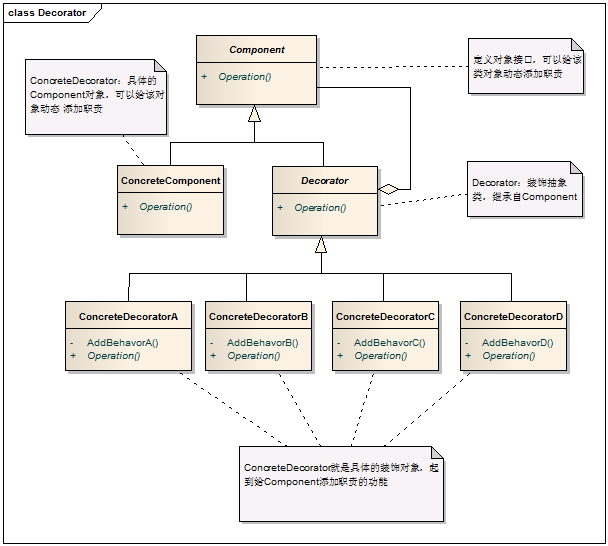
Component是定义一个对象接口,可以给这些对象动态地添加职责。
ConcreteComponent是定义了一个具体的对象,也可以给这个对象添加一些职责。
Decorator,装饰抽象类,继承了Component,从外类来扩展Component类的功能,但对于Component来说,是无需知道Decorator的存在的。
至于ConcreteDecorator就是具体的装饰对象,起到给Component添加职责的功能。
要善于变通,如果只有一个ConcreteComponent类而没有抽象的Component类,那么Decorator类可以是ConcreteComponent的一个子类。
同样道理,如果只有一个ConcreteDecorator类,那么就没有必要建立一个单独的Decorator类,而可以把Decorator和ConcreteDecorator的责任合并成一个类。
新加入的东西仅仅是为了满足一些只在某种特定情况下才会执行的特殊行为 的需要。而装饰模式却提供了一个非常好的解决方案,它把每个要装饰的功能放在单独的类中,并让这个类包装它所要装饰的对象,因此,当需要执行特殊行为 时,客户代码就可以在运行时根据需要有选择地、按顺序地使用装饰功能包装对象了。
代码如下:
Decorator.h
 #ifndef _DECORATOR_H_

 #define _DECORATOR_H_

 //Component抽象类,定义该类对象的接口

 class Component

 {

 public:

     virtual ~Component();

     virtual void Operation()=;

 protected:

     Component();

 };

 //ConcreteDecorator:具体的Component对象,可以给该对象动态 添加职责

 class ConcreteComponent:public Component

 {

 public:

     ConcreteComponent();

     ~ConcreteComponent();

     virtual void Operation();

 };

 //Decorator:装饰抽象类,继承自Component

 class Decorator:public Component

 {

 public:

     Decorator(Component* com);

     void SetComponent(Component* com);

     virtual ~Decorator();

     virtual void Operation();

 protected:

     Component* _com;

 };

 //ConcreteDecorator就是具体的装饰对象之一,起到给Component添加职责的功能

 class ConcreteDecoratorA:public Decorator

 {

 public:

     ConcreteDecoratorA(Component* com);

     ~ConcreteDecoratorA();

     virtual void Operation();

     void AddBehavorA();

 };

 //ConcreteDecorator就是具体的装饰对象之二,起到给Component添加职责的功能

 class ConcreteDecoratorB:public Decorator

 {

 public:

     ConcreteDecoratorB(Component* com);

     ~ConcreteDecoratorB();

     virtual void Operation();

     void AddBehavorB();

 };

 //ConcreteDecorator就是具体的装饰对象之三,起到给Component添加职责的功能

 class ConcreteDecoratorC:public Decorator

 {

 public:

     ConcreteDecoratorC(Component* com);

     ~ConcreteDecoratorC();

     virtual void Operation();

     void AddBehavorC();

 };

 //ConcreteDecorator就是具体的装饰对象之四,起到给Component添加职责的功能

 class ConcreteDecoratorD:public Decorator

 {

 public:

     ConcreteDecoratorD(Component* com);

     ~ConcreteDecoratorD();

     virtual void Operation();

     void AddBehavorD();

 };

 //只添加一种装饰,则不用抽象出装饰基类

 class DecoratorOnlyOne:public Component

 {

 public:

     DecoratorOnlyOne(Component* com);

     ~DecoratorOnlyOne();

     virtual void Operation();

     void AddBehavor();

 private:

     Component* _com;

 };

 //如果只有一个ConcreteComponent类而没有抽象的Component类,那么Decorator类可以是ConcreteComponent的一个子类。

 //略

 #endif
Decorator.cpp
 #include "Decorator.h"

 #include <iostream>

 using namespace std;

 Component::Component()

 {}

 Component::~Component()

 {

     cout << "~Component" << endl;

 }

 ConcreteComponent::ConcreteComponent()

 {}

 ConcreteComponent::~ConcreteComponent()

 {

     cout << "~ConcreteComponent" << endl;

 }

 void ConcreteComponent::Operation()

 {

     cout << "原职责:ConcreteComponent::Operation" << endl;

 }

 Decorator::Decorator(Component* com)

 {

     this->_com = com;

 }

 void Decorator::SetComponent(Component* com)

 {

     this->_com = com;

 }

 Decorator::~Decorator()

 {

     cout << "~Decorator" << endl;

     delete this->_com;

     this->_com = NULL;

 }

 void Decorator::Operation()

 {}

 ConcreteDecoratorA::ConcreteDecoratorA(Component* com):Decorator(com)

 {}

 ConcreteDecoratorA::~ConcreteDecoratorA()

 {

     cout << "~ConcreteDecoratorA" << endl;

 }

 void ConcreteDecoratorA::Operation()

 {

     this->_com->Operation();

     //附加职责A

     this->AddBehavorA();

 }

 void ConcreteDecoratorA::AddBehavorA()

 {

     cout << "附加职责A:ConcreteDecoratorA::AddBehavorA" << endl;

 }

 ConcreteDecoratorB::ConcreteDecoratorB(Component* com):Decorator(com)

 {}

 ConcreteDecoratorB::~ConcreteDecoratorB()

 {

     cout << "~ConcreteDecoratorB" << endl;

 }

 void ConcreteDecoratorB::Operation()

 {

     this->_com->Operation();

     //附加职责B

     this->AddBehavorB();

 }

 void ConcreteDecoratorB::AddBehavorB()

 {

     cout << "附加职责B:ConcreteDecoratorB::AddBehavorB" << endl;

 }

 ConcreteDecoratorC::ConcreteDecoratorC(Component* com):Decorator(com)

 {}

 ConcreteDecoratorC::~ConcreteDecoratorC()

 {

     cout << "~ConcreteDecoratorC" << endl;

 }

 void ConcreteDecoratorC::Operation()

 {

     this->_com->Operation();

     //附加职责C

     this->AddBehavorC();

 }

 void ConcreteDecoratorC::AddBehavorC()

 {

     cout << "附加职责C:ConcreteDecoratorC::AddBehavorC" << endl;

 }

 ConcreteDecoratorD::ConcreteDecoratorD(Component* com):Decorator(com)

 {}

 ConcreteDecoratorD::~ConcreteDecoratorD()

 {

     cout << "~ConcreteDecoratorD" << endl;

 }

 void ConcreteDecoratorD::Operation()

 {

     this->_com->Operation();

     //附加职责D

     this->AddBehavorD();

 }

 void ConcreteDecoratorD::AddBehavorD()

 {

     cout << "附加职责D:ConcreteDecoratorD::AddBehavorD" << endl;

 }

 //**************只添加一种修饰******************

 DecoratorOnlyOne::DecoratorOnlyOne(Component* com):_com(com)

 {

 }

 DecoratorOnlyOne::~DecoratorOnlyOne()

 {

     cout << "~DecoratorOnlyOne" << endl;

     delete this->_com;

     this->_com = NULL;

 }

 void DecoratorOnlyOne::Operation()

 {

     this->_com->Operation();

     this->AddBehavor();

 }

 void DecoratorOnlyOne::AddBehavor()

 {

     cout << "附加唯一职责:DecoratorOnlyOne::AddBehavor" << endl;

 }
main.cpp
 #include "Decorator.h"

 #include <iostream>

 using namespace std;

 int main()

 {

     Component* pCom = new ConcreteComponent();        //要装饰的对象

     Decorator* pDec = NULL;

     pDec = new ConcreteDecoratorA(pCom);            //给装饰对象附加职责A

     pDec = new ConcreteDecoratorB(pDec);            //给装饰对象附加职责B

     pDec = new ConcreteDecoratorC(pDec);            //给装饰对象附加职责C

     pDec = new ConcreteDecoratorD(pDec);            //给装饰对象附加职责D

     pDec->Operation();

     cout << "-------------------------------" << endl;

     //只添加一种修饰

     Component* pCom1 = new ConcreteComponent();

     DecoratorOnlyOne* pDec1 = new DecoratorOnlyOne(pCom1);

     pDec1->Operation();

     cout << "-------------------------------" << endl;

     delete pDec;

     cout << "-------------------------------" << endl;

     delete pDec1;

     return ;

 }
运行结果:
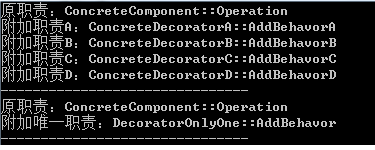
Decorator模式除了采用组合的方式取得了比采用继承方式更好的效果,Decorator模式还给设计带来一种“即用即付”的方式来添加职责。在OO设计和分析经常有这样一种情况:为了多态,通过父类指针指向其具体子类,但是这就带来另外一个问题,当具体子类要添加新的职责,就必须向其父类添加一个这个职责的抽象接口,否则是通过父类指针是调用不到这个方法了。这样处于高层的父类就承载了太多的特征(方法),并且继承自这个父类的所有子类都不可避免继承了父类的这些接口,但是可能这并不是这个具体子类所需要的。而在Decorator模式提供了一种较好的解决方法,当需要添加一个操作的时候就可以通过Decorator模式来解决,你可以一步步添加新的职责。
C++设计模式-Decorator装饰模式的更多相关文章
- c++ 设计模式6 (Decorator 装饰模式)
4. “单一职责”类模式 在软件组件的设计中,如果责任划分的不清晰,使用继承得到的结果往往是随着需求的变化,子类急剧膨胀,同时充斥着重复代码,这时候的关键是划清责任. 典型模式代表: Decorato ...
- 乐在其中设计模式(C#) - 装饰模式(Decorator Pattern)
原文:乐在其中设计模式(C#) - 装饰模式(Decorator Pattern) [索引页][源码下载] 乐在其中设计模式(C#) - 装饰模式(Decorator Pattern) 作者:weba ...
- 设计模式之装饰模式(Decorator)摘录
版权声明:本文为博主原创文章,未经博主同意不得转载. https://blog.csdn.net/fengbingchun/article/details/29237955 23种GOF设计模式一般分 ...
- 设计模式09: Decorator 装饰模式(结构型模式)
Decorator 装饰模式(结构型模式) 子类复子类,子类何其多加入我们需要为游戏中开发一种坦克,除了不同型号的坦克外,我们还希望在不同场合中为其增加以下一种多种功能:比如红外线夜视功能,比如水路两 ...
- 设计模式-09装饰模式(Decorator Pattern)
1.模式动机 一般有两种方式可以实现给一个类或对象增加行为: 继承机制:使用继承机制是给现有类添加功能的一种有效途径,通过继承一个现有类可以使得子类在拥有自身方法的同时还拥有父类的方法.但是这种方法是 ...
- java设计模式—Decorator装饰者模式
一.装饰者模式 1.定义及作用 该模式以对客户端透明的方式扩展对象的功能. 2.涉及角色 抽象构件角色:定义一个抽象接口,来规范准备附加功能的类. 具体构件角色:将要被附加功能的类,实现抽象 ...
- C#设计模式之八装饰模式(Decorator Pattern)【结构型】
一.引言 今天我们要讲[结构型]设计模式的第三个模式,该模式是[装饰模式],英文名称:Decorator Pattern.我第一次看到这个名称想到的是另外一个词语“装修”,我就说说我对“装修”的理解吧 ...
- GOF23设计模式之装饰模式(decorator)
一.装饰模式概述 (1)动态的为一个对象增加新的功能. (2)装饰模式是一种用于代替继承的技术,无需通过继承增加子类就能扩展对象的新功能. 使用对象的关联关系代替继承关系,更加灵活,同时避免类型体 ...
- 设计模式学习之路——Decorator装饰模式(结构模式)
子类复子类,子类何其多 假如我们需要为游戏中开发一种坦克,除了各种不同型号的坦克外,我们还希望在不同场合中为其增加以下一种或多种功能:比如红外线夜视功能,比如水陆两栖功能,比如卫星定位功能等等. 动机 ...
随机推荐
- 【转】Alchemy的使用和多项式批量计算的优化
原文:http://www.cnblogs.com/flash3d/archive/2012/01/30/2332158.html ================================== ...
- git和SVN交互(待完善)
右键 git bash here 然后从SVN同步代码,git status命令,用来确认版本库状态 右键 --> TortoiseGit --> show log 打开日志 查看gi ...
- 转载《Android Handler、Message》
之前也是由于周末通宵看TI3比赛,一直没找到时间写博客,导致已经有好久没更新了.惭愧!后面还会恢复进度,尽量保证每周都写吧.这里也是先恭喜一下来自瑞典的Alliance战队夺得了TI3的冠军,希望明年 ...
- 关于redis扩展安装及使用
11月23日,预留 http://blog.sina.com.cn/s/blog_68431a3b0102v6dz.html http://blog.csdn.net/rachel_luo/artic ...
- mysql 基础列题
1:emp表中查询公司总共有几个部门注意,会查询出来大量重复的,使用函数distinctselect distinct job from scott.emp; 2:查询公司工资在1000-3000之间 ...
- floyd算法
求两个顶点间的最短距离,直觉是这样的问题可以用尝试和枚举的办法来求解,这显然可行,但是我们可以换个方式来看待这个问题,比如, 可以这样描述,“在给定的点集(编号为1~k,k=图中所有的顶点数量)中,i ...
- js获取ip地址
方法三(所有的平台及浏览器):使用的搜狐接口 <script src="http://pv.sohu.com/cityjson?ie=utf-8"></scrip ...
- delphi中的各种文件类型介绍【转】
1.DPR: Delphi Project文件,包含了Pascal代码.应用系统的工程文件2.PAS: Pascal文件,Pascal单元的源代码,可以是与窗体有关的单元或是独立的单元.3.DFM:D ...
- mvc中Url.RouteUrl或者Html.RouteLink实现灵活超链接,使href的值随路由名称或配置的改变而改变[bubuko.com]
mvc,超链接除了直接写在a标签的href内还可以使用路由规则来生成,这样在改变了路由规则或者路由名称时不用再去代码中更改href的值,而且还容易遗漏.借助Url.RouteUrl或者Html.Rou ...
- MyXls: 导出Excel的各种设置
MyXls是一个操作Excel的开源类库,支持设置字体.列宽.行高(由BOSSMA实现).合并单元格.边框.背景颜色.数据类型.自动换行.对齐方式等,通过众多项目的使用表现,证明MyXls对于创建简单 ...