
ML_note1
Supervised Learning
In supervised learning, we are given a data set and already know what our correct output should look like, having the idea that there is a relationship between the input and the output.
Supervised learning problems are categorized into "regression" and "classification" problems. In a regression problem, we are trying to predict results within a continuous output, meaning that we are trying to map input variables to some continuous function. In a classification problem, we are instead trying to predict results in a discrete output. In other words, we are trying to map input variables into discrete categories.
Example 1:
Given data about the size of houses on the real estate market, try to predict their price. Price as a function of size is a continuous output, so this is a regression problem.
We could turn this example into a classification problem by instead making our output about whether the house "sells for more or less than the asking price." Here we are classifying the houses based on price into two discrete categories.
Example 2:
(a) Regression - Given a picture of a person, we have to predict their age on the basis of the given picture
(b) Classification - Given a patient with a tumor, we have to predict whether the tumor is malignant or benign.
Unsupervised Learning
Unsupervised learning allows us to approach problems with little or no idea what our results should look like. We can derive structure from data where we don't necessarily know the effect of the variables.
We can derive this structure by clustering the data based on relationships among the variables in the data.
With unsupervised learning there is no feedback based on the prediction results.
Example:
Clustering: Take a collection of 1,000,000 different genes, and find a way to automatically group these genes into groups that are somehow similar or related by different variables, such as lifespan, location, roles, and so on.
Non-clustering: The "Cocktail Party Algorithm", allows you to find structure in a chaotic environment. (i.e. identifying individual voices and music from a mesh of sounds at a cocktail party).
Cost Function
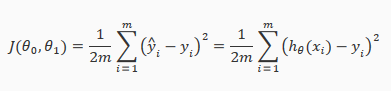
This function is otherwise called the "Squared error function", or "Mean squared error".
ML_note1的更多相关文章
随机推荐
- HTML center tag
<center>This text will be center-aligned.</center> 或者可以把一个div给center了,例如将一个html表格给center ...
- 使用curl获取乱码问题
今天通过curl获取百度地图接口数据,获取到居然是乱码,于是我查看是不是编码问题,发现返回的编码和自己的编码都是utf-8, 继续找原因,发现header报文中 Content-encoding 为 ...
- Oracle获取系统时间及格式化
Oracle 获取当前日期及日期格式 获取系统日期: SYSDATE() 格式化日期: TO_CHAR(SYSDATE(),'YY/MM/DD HH24:MI:SS) ...
- HDU 1711 Number Sequence(KMP匹配数字串)
这个就是kmp的数组形式,不用来处理字符串还真有点不习惯呢... #include<iostream> using namespace std; ,MAXM = ; int T[MAXN] ...
- P3P解决cookie存取的跨域问题
最近在做一个流量统计的东西的时候,偶然发现IE在对iframe里面的页面写Cookie的时候有一些安全限制,导致读取Cookie不成功,找了好长时间的解决办法,重要找到如下的办法: 1.页面里的COO ...
- 英语学习/词典app行业top5简要分析
综述 根据豌豆夹上的下载量如下图所示,我们组确定的国内行业top5分别是:有道词典(黄明帅负责),金山词霸(黄珂锐负责),百度翻译(刘馨负责),百词斩(贾猛负责),英语流利说(亢建强负责)(时间有限, ...
- 关于css3的calc()
么是calc()? 学习calc()之前,我们有必要先知道calc()是什么?只有知道了他是个什么东东?在实际运用中更好的使用他. calc()从字面我们可以把他理解为一个函数function.其实c ...
- mysql 索引对于select速度提升作用实验
说明:News2在News的基础上把is_active加上索引. mysql> select count(*) from News2 where is_active=1; +---------- ...
- mysql优化---优化sql
一.通过show status和应用特点了解各种SQL的执行频率 通过SHOW STATUS可以提供服务器状态信息,也可以使用mysqladmin extended-status命令获得.SHOW S ...
- android4.0 的图库Gallery2代码分析(四) 之相册的数据处理以及显示
最近迫于生存压力,不得不给人兼职打工.故在博文中加了个求点击的链接.麻烦有时间的博友们帮我点击一下.没时间的不用勉强啊.不过请放心,我是做技术的,肯定链接没病毒,就是我打工的淘宝店铺.嘻嘻.http: ...