
【Zookeeper】源码分析之网络通信(一)
一、前言
前面已经分析了请求处理链中的多数类,接着继续分析Zookeeper中的网络通信模块。
二、总体框图
对于网络通信模块,其总体框图如下所示
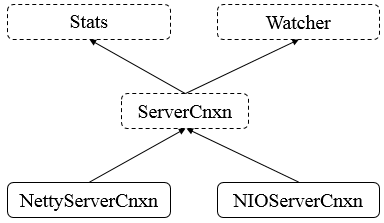
说明:
Stats,表示ServerCnxn上的统计数据。
Watcher,表示时间处理器。
ServerCnxn,表示服务器连接,表示一个从客户端到服务器的连接。
NettyServerCnxn,基于Netty的连接的具体实现。
NIOServerCnxn,基于NIO的连接的具体实现。
三、ServerCnxn源码分析
3.1 类的继承关系
public abstract class ServerCnxn implements Stats, Watcher {}
说明:ServerCnxn为抽象类,其继承Stats和Watcher两个接口,表示客户端到服务端的连接。
3.2 类的内部类
    // 请求关闭异常类

    protected static class CloseRequestException extends IOException {

        private static final long serialVersionUID = -7854505709816442681L;

        public CloseRequestException(String msg) {

            super(msg);

        }

    }

    // 流结束异常类

    protected static class EndOfStreamException extends IOException {

        private static final long serialVersionUID = -8255690282104294178L;

        public EndOfStreamException(String msg) {

            super(msg);

        }

        public String toString() {

            return "EndOfStreamException: " + getMessage();

        }

    }
说明:ServerCnxn包含了两个异常类,用于表示在连接中发生的异常情况。
3.3 类的属性
public abstract class ServerCnxn implements Stats, Watcher {

    // This is just an arbitrary object to represent requests issued by

    // (aka owned by) this class

    // 代表由本类提出的请求

    final public static Object me = new Object();

    // 认证信息

    protected ArrayList<Id> authInfo = new ArrayList<Id>();

    /**

     * If the client is of old version, we don't send r-o mode info to it.

     * The reason is that if we would, old C client doesn't read it, which

     * results in TCP RST packet, i.e. "connection reset by peer".

     */

    // 是否为旧的C客户端

    boolean isOldClient = true;

    // Zookeeper的Sasl服务器

    protected ZooKeeperSaslServer zooKeeperSaslServer = null;

    /**

    * CMD命令

    **/

    /*

     * See <a href="{@docRoot}/../../../docs/zookeeperAdmin.html#sc_zkCommands">

     * Zk Admin</a>. this link is for all the commands.

     */

    // CMD命令

    protected final static int confCmd =

        ByteBuffer.wrap("conf".getBytes()).getInt();

    /*

     * See <a href="{@docRoot}/../../../docs/zookeeperAdmin.html#sc_zkCommands">

     * Zk Admin</a>. this link is for all the commands.

     */

    protected final static int consCmd =

        ByteBuffer.wrap("cons".getBytes()).getInt();

    /*

     * See <a href="{@docRoot}/../../../docs/zookeeperAdmin.html#sc_zkCommands">

     * Zk Admin</a>. this link is for all the commands.

     */

    protected final static int crstCmd =

        ByteBuffer.wrap("crst".getBytes()).getInt();

    /*

     * See <a href="{@docRoot}/../../../docs/zookeeperAdmin.html#sc_zkCommands">

     * Zk Admin</a>. this link is for all the commands.

     */

    protected final static int dumpCmd =

        ByteBuffer.wrap("dump".getBytes()).getInt();

    /*

     * See <a href="{@docRoot}/../../../docs/zookeeperAdmin.html#sc_zkCommands">

     * Zk Admin</a>. this link is for all the commands.

     */

    protected final static int enviCmd =

        ByteBuffer.wrap("envi".getBytes()).getInt();

    /*

     * See <a href="{@docRoot}/../../../docs/zookeeperAdmin.html#sc_zkCommands">

     * Zk Admin</a>. this link is for all the commands.

     */

    protected final static int getTraceMaskCmd =

        ByteBuffer.wrap("gtmk".getBytes()).getInt();

    /*

     * See <a href="{@docRoot}/../../../docs/zookeeperAdmin.html#sc_zkCommands">

     * Zk Admin</a>. this link is for all the commands.

     */

    protected final static int ruokCmd =

        ByteBuffer.wrap("ruok".getBytes()).getInt();

    /*

     * See <a href="{@docRoot}/../../../docs/zookeeperAdmin.html#sc_zkCommands">

     * Zk Admin</a>. this link is for all the commands.

     */

    protected final static int setTraceMaskCmd =

        ByteBuffer.wrap("stmk".getBytes()).getInt();

    /*

     * See <a href="{@docRoot}/../../../docs/zookeeperAdmin.html#sc_zkCommands">

     * Zk Admin</a>. this link is for all the commands.

     */

    protected final static int srvrCmd =

        ByteBuffer.wrap("srvr".getBytes()).getInt();

    /*

     * See <a href="{@docRoot}/../../../docs/zookeeperAdmin.html#sc_zkCommands">

     * Zk Admin</a>. this link is for all the commands.

     */

    protected final static int srstCmd =

        ByteBuffer.wrap("srst".getBytes()).getInt();

    /*

     * See <a href="{@docRoot}/../../../docs/zookeeperAdmin.html#sc_zkCommands">

     * Zk Admin</a>. this link is for all the commands.

     */

    protected final static int statCmd =

        ByteBuffer.wrap("stat".getBytes()).getInt();

    /*

     * See <a href="{@docRoot}/../../../docs/zookeeperAdmin.html#sc_zkCommands">

     * Zk Admin</a>. this link is for all the commands.

     */

    protected final static int wchcCmd =

        ByteBuffer.wrap("wchc".getBytes()).getInt();

    /*

     * See <a href="{@docRoot}/../../../docs/zookeeperAdmin.html#sc_zkCommands">

     * Zk Admin</a>. this link is for all the commands.

     */

    protected final static int wchpCmd =

        ByteBuffer.wrap("wchp".getBytes()).getInt();

    /*

     * See <a href="{@docRoot}/../../../docs/zookeeperAdmin.html#sc_zkCommands">

     * Zk Admin</a>. this link is for all the commands.

     */

    protected final static int wchsCmd =

        ByteBuffer.wrap("wchs".getBytes()).getInt();

    /*

     * See <a href="{@docRoot}/../../../docs/zookeeperAdmin.html#sc_zkCommands">

     * Zk Admin</a>. this link is for all the commands.

     */

    protected final static int mntrCmd = ByteBuffer.wrap("mntr".getBytes())

            .getInt();

    /*

     * See <a href="{@docRoot}/../../../docs/zookeeperAdmin.html#sc_zkCommands">

     * Zk Admin</a>. this link is for all the commands.

     */

    protected final static int isroCmd = ByteBuffer.wrap("isro".getBytes())

            .getInt();

    // 存储CMD的整形值与String的键值对

    protected final static HashMap<Integer, String> cmd2String =

        new HashMap<Integer, String>();

    // specify all of the commands that are available

    static {

        cmd2String.put(confCmd, "conf");

        cmd2String.put(consCmd, "cons");

        cmd2String.put(crstCmd, "crst");

        cmd2String.put(dumpCmd, "dump");

        cmd2String.put(enviCmd, "envi");

        cmd2String.put(getTraceMaskCmd, "gtmk");

        cmd2String.put(ruokCmd, "ruok");

        cmd2String.put(setTraceMaskCmd, "stmk");

        cmd2String.put(srstCmd, "srst");

        cmd2String.put(srvrCmd, "srvr");

        cmd2String.put(statCmd, "stat");

        cmd2String.put(wchcCmd, "wchc");

        cmd2String.put(wchpCmd, "wchp");

        cmd2String.put(wchsCmd, "wchs");

        cmd2String.put(mntrCmd, "mntr");

        cmd2String.put(isroCmd, "isro");

    }

    /**

    * 服务器的统计数据

    **/

    // 创建连接的时间

    protected final Date established = new Date();

    // 接受的packet数量

    protected final AtomicLong packetsReceived = new AtomicLong();

    // 发送的packet数量

    protected final AtomicLong packetsSent = new AtomicLong();

    // 最小延迟

    protected long minLatency;

    // 最大延迟

    protected long maxLatency;

    // 最后操作类型

    protected String lastOp;

    // 最后的cxid

    protected long lastCxid;

    // 最后的zxid

    protected long lastZxid;

    // 最后的响应时间

    protected long lastResponseTime;

    // 最后的延迟

    protected long lastLatency;

    // 数量

    protected long count;

    // 总的延迟

    protected long totalLatency;

}
类的属性
说明:可以看到,ServerCnxn类维护了很多属性,主要是服务器的统计信息和和命令行信息。
3.4 核心函数分析
1. 抽象方法
    // 获取会话超时时间

    abstract int getSessionTimeout();

    // 关闭

    abstract void close();

    // 发送响应

    public abstract void sendResponse(ReplyHeader h, Record r, String tag)

        throws IOException;

    /* notify the client the session is closing and close/cleanup socket */

    // 关闭会话

    abstract void sendCloseSession();

    // 处理,Watcher接口中的方法

    public abstract void process(WatchedEvent event);

    // 获取会话id

    abstract long getSessionId();

    // 设置会话id

    abstract void setSessionId(long sessionId);

    // 设置缓冲

    abstract void sendBuffer(ByteBuffer closeConn);

    // 允许接收

    abstract void enableRecv();

    // 不允许接收

    abstract void disableRecv();

    // 设置会话超时时间

    abstract void setSessionTimeout(int sessionTimeout);

    // 获取服务器的统计数据

    protected abstract ServerStats serverStats();
说明:以上的方法均为抽象方法,需要具体子类实现,如process方法是Watcher接口中的方法,在ServerCnxn中并未实现,需要具体子类实现。
2. 具体方法
    /** auth info for the cnxn, returns an unmodifyable list */

    // 获取认证信息,返回不可修改的列表

    public List<Id> getAuthInfo() {

        return Collections.unmodifiableList(authInfo);

    }

    // 添加认证信息

    public void addAuthInfo(Id id) {

        if (authInfo.contains(id) == false) {

            authInfo.add(id);

        }

    }

    // 移除认证信息

    public boolean removeAuthInfo(Id id) {

        return authInfo.remove(id);

    }

    // 接收的packet

    protected void packetReceived() {

        incrPacketsReceived();

        ServerStats serverStats = serverStats();

        if (serverStats != null) {

            serverStats().incrementPacketsReceived();

        }

    }

    // 发送的packet

    protected void packetSent() {

        incrPacketsSent();

        ServerStats serverStats = serverStats();

        if (serverStats != null) {

            serverStats().incrementPacketsSent();

        }

    }

    // 重置统计数据

    public synchronized void resetStats() {

        packetsReceived.set(0);

        packetsSent.set(0);

        minLatency = Long.MAX_VALUE;

        maxLatency = 0;

        lastOp = "NA";

        lastCxid = -1;

        lastZxid = -1;

        lastResponseTime = 0;

        lastLatency = 0;

        count = 0;

        totalLatency = 0;

    }

    // 增加接收的packet数量

    protected long incrPacketsReceived() {

        return packetsReceived.incrementAndGet();

    }

    // 增加outstandingRequest数量

    protected void incrOutstandingRequests(RequestHeader h) {

    }

    // 增加发送的packet数量

    protected long incrPacketsSent() {

        return packetsSent.incrementAndGet();

    }

    // 更新响应的统计数据

    protected synchronized void updateStatsForResponse(long cxid, long zxid,

            String op, long start, long end)

    {

        // don't overwrite with "special" xids - we're interested

        // in the clients last real operation

        if (cxid >= 0) {

            lastCxid = cxid;

        }

        lastZxid = zxid;

        lastOp = op;

        lastResponseTime = end;

        long elapsed = end - start;

        lastLatency = elapsed;

        if (elapsed < minLatency) {

            minLatency = elapsed;

        }

        if (elapsed > maxLatency) {

            maxLatency = elapsed;

        }

        count++;

        totalLatency += elapsed;

    }

    public Date getEstablished() {

        return (Date)established.clone();

    }

    public abstract long getOutstandingRequests();

    public long getPacketsReceived() {

        return packetsReceived.longValue();

    }

    public long getPacketsSent() {

        return packetsSent.longValue();

    }

    public synchronized long getMinLatency() {

        return minLatency == Long.MAX_VALUE ? 0 : minLatency;

    }

    public synchronized long getAvgLatency() {

        return count == 0 ? 0 : totalLatency / count;

    }

    public synchronized long getMaxLatency() {

        return maxLatency;

    }

    public synchronized String getLastOperation() {

        return lastOp;

    }

    public synchronized long getLastCxid() {

        return lastCxid;

    }

    public synchronized long getLastZxid() {

        return lastZxid;

    }

    public synchronized long getLastResponseTime() {

        return lastResponseTime;

    }

    public synchronized long getLastLatency() {

        return lastLatency;

    }

    /**

     * Prints detailed stats information for the connection.

     *

     * @see dumpConnectionInfo(PrintWriter, boolean) for brief stats

     */

    @Override

    public String toString() {

        StringWriter sw = new StringWriter();

        PrintWriter pwriter = new PrintWriter(sw);

        dumpConnectionInfo(pwriter, false);

        pwriter.flush();

        pwriter.close();

        return sw.toString();

    }

    public abstract InetSocketAddress getRemoteSocketAddress();

    public abstract int getInterestOps();

    /**

     * Print information about the connection.

     * @param brief iff true prints brief details, otw full detail

     * @return information about this connection

     */

    protected synchronized void

    dumpConnectionInfo(PrintWriter pwriter, boolean brief) {

        pwriter.print(" ");

        pwriter.print(getRemoteSocketAddress());

        pwriter.print("[");

        int interestOps = getInterestOps();

        pwriter.print(interestOps == 0 ? "0" : Integer.toHexString(interestOps));

        pwriter.print("](queued=");

        pwriter.print(getOutstandingRequests());

        pwriter.print(",recved=");

        pwriter.print(getPacketsReceived());

        pwriter.print(",sent=");

        pwriter.print(getPacketsSent());

        if (!brief) {

            long sessionId = getSessionId();

            if (sessionId != 0) {

                pwriter.print(",sid=0x");

                pwriter.print(Long.toHexString(sessionId));

                pwriter.print(",lop=");

                pwriter.print(getLastOperation());

                pwriter.print(",est=");

                pwriter.print(getEstablished().getTime());

                pwriter.print(",to=");

                pwriter.print(getSessionTimeout());

                long lastCxid = getLastCxid();

                if (lastCxid >= 0) {

                    pwriter.print(",lcxid=0x");

                    pwriter.print(Long.toHexString(lastCxid));

                }

                pwriter.print(",lzxid=0x");

                pwriter.print(Long.toHexString(getLastZxid()));

                pwriter.print(",lresp=");

                pwriter.print(getLastResponseTime());

                pwriter.print(",llat=");

                pwriter.print(getLastLatency());

                pwriter.print(",minlat=");

                pwriter.print(getMinLatency());

                pwriter.print(",avglat=");

                pwriter.print(getAvgLatency());

                pwriter.print(",maxlat=");

                pwriter.print(getMaxLatency());

            }

        }

        pwriter.print(")");

    }
具体方法
说明:ServerCnxn实现了Stats接口中的很多方法,其相对简单,不再累赘。
四、总结
本篇博文分析了ServerCnxn的源码,其是抽象类,定义了子类需要实现的方法,较为简单,也谢谢各位园友的观看~
【Zookeeper】源码分析之网络通信(一)的更多相关文章
- zookeeper源码分析之五服务端(集群leader)处理请求流程
leader的实现类为LeaderZooKeeperServer,它间接继承自标准ZookeeperServer.它规定了请求到达leader时需要经历的路径: PrepRequestProcesso ...
- zookeeper源码分析之四服务端(单机)处理请求流程
上文: zookeeper源码分析之一服务端启动过程 中,我们介绍了zookeeper服务器的启动过程,其中单机是ZookeeperServer启动,集群使用QuorumPeer启动,那么这次我们分析 ...
- zookeeper源码分析之三客户端发送请求流程
znode 可以被监控,包括这个目录节点中存储的数据的修改,子节点目录的变化等,一旦变化可以通知设置监控的客户端,这个功能是zookeeper对于应用最重要的特性,通过这个特性可以实现的功能包括配置的 ...
- Zookeeper 源码分析-启动
Zookeeper 源码分析-启动 博客分类: Zookeeper 本文主要介绍了zookeeper启动的过程 运行zkServer.sh start命令可以启动zookeeper.入口的main ...
- 【Zookeeper】源码分析之网络通信(二)
一.前言 前面介绍了ServerCnxn,下面开始学习NIOServerCnxn. 二.NIOServerCnxn源码分析 2.1 类的继承关系 public class NIOServerCnxn ...
- 【Zookeeper】源码分析之网络通信(三)
一.前言 前面已经学习了NIOServerCnxn,接着继续学习NettyServerCnxn. 二.NettyServerCnxn源码分析 2.1 类的继承关系 public class Netty ...
- 【Zookeeper】源码分析之网络通信(三)之NettyServerCnxn
一.前言 前面已经学习了NIOServerCnxn,接着继续学习NettyServerCnxn. 二.NettyServerCnxn源码分析 2.1 类的继承关系 public class Netty ...
- 【Zookeeper】源码分析之网络通信(二)之NIOServerCnxn
一.前言 前面介绍了ServerCnxn,下面开始学习NIOServerCnxn. 二.NIOServerCnxn源码分析 2.1 类的继承关系 public class NIOServerCnxn ...
- storm操作zookeeper源码分析-cluster.clj
storm操作zookeeper的主要函数都定义在命名空间backtype.storm.cluster中(即cluster.clj文件中).backtype.storm.cluster定义了两个重要p ...
随机推荐
- Java中实现Serializable接口为什么要声明serialVersionUID?
什么情况下需要修改serialVersionUID 的值? 序列化运行时使用一个称为 serialVersionUID 的版本号与每个可序列化类相关联,该序列号在反序列化过程中用于验证序列化 ...
- linux mint运行docker
1,sudo apt-get install docker.io 或者sudo apt-get install docker* 2,安装好之后 sudo docker -d 启动进程提示: yimiy ...
- Python使用Selenium/PhantomJS
安装selenium: 1 pip install selenium 安装PhantomJS: 1 2 3 4 https://bitbucket.org/ariya/phantomjs/downlo ...
- html 转义
function escapeHTML(n) { var t = document.createElement("div"), i = document.createTextNod ...
- JS拖动技术--- 关于setCapture
<script type="text/javascript"> <!-- window.onload=function(){ objDiv = documen ...
- Zepto.js入门介绍
GitHub Zepto Zepto的一些可选功能是专门针对移动端浏览器的:因为它的最初目标在移动端提供一个精简的类似jquery的js库. Zepto不支持旧版本的Internet Explorer ...
- Linux 系统分区
合理的系统分区,便于后期管理和提高文件的搜索速度 分区格式说明 linux分区不同于windows,linux下硬盘设备名为(IDE硬盘为hdx(x为从a—d)因为IDE硬盘最多四 个,SCSI,SA ...
- HDU-5123-who is the best?
题目链接 http://acm.hdu.edu.cn/showproblem.php?pid=5123 水题一个,直接hash: 代码 #include<stdio.h>#include& ...
- Netty学习笔记
一些类与方法说明 1)ByteBuf ByteBuf的API说明: Creation of a buffer It is recommended to create a new buffer usin ...
- Spring @Aspect切面参数传递
Spring @Aspect切面参数传递: Xml: <?xml version="1.0" encoding="UTF-8"?> <bean ...