
java架构之路-(spring源码篇)springIOC容器源码解析(上)
我们这次来叭叭一下Spring的源码,这次博客主要来说说Spring源码,先粗略的撸一遍,下篇博客选几个重点去说,由于过于复杂,我也是看了一点点,我们先来过一遍源码,然后上流程图,最后我们再回头总结一下,我们来循序渐进的叭叭一下。
我们来回顾一下上次Spring博客的内容,每次都有用到AnnotationConfigApplicationContext来加载我们的配置类,我们就从这里开始。
/**

     * Create a new AnnotationConfigApplicationContext, deriving bean definitions

     * from the given annotated classes and automatically refreshing the context.  创建新的注释configapplicationcontext,获得bean定义并自动刷新上下文。

     * @param annotatedClasses one or more annotated classes,  我们的配置类

     * e.g. {@link Configuration @Configuration} classes

     */

    public AnnotationConfigApplicationContext(Class<?>... annotatedClasses) {

        this();

        register(annotatedClasses);

        refresh();

    }
翻译过来就是“创建新的注释configapplicationcontext,获得bean定义并自动刷新上下文”。三个方法,我们先来一个个看,优先看父类有没有构造方法。AnnotationConfigApplicationContext继承了GenericApplicationContext类,所以我们先看GenericApplicationContext类的构造方法。代码很简单
父类构造方法
/**

 * Create a new GenericApplicationContext.

 * @see #registerBeanDefinition

 * @see #refresh

 */

public GenericApplicationContext() {

  this.beanFactory = new DefaultListableBeanFactory();

}
这里创建了一个新的DefaultListableBeanFactory对象,也是我们熟悉的beanFactory对象,记住是DefaultListableBeanFactory对象。我们回到AnnotationConfigApplicationContext的this方法。
this
/**

 * Create a new AnnotationConfigApplicationContext that needs to be populated

 * through {@link #register} calls and then manually {@linkplain #refresh refreshed}.

 */

public AnnotationConfigApplicationContext() {

    this.reader = new AnnotatedBeanDefinitionReader(this);//注解类型的解析器

    this.scanner = new ClassPathBeanDefinitionScanner(this);//包扫描器

}
再往下扒一层。看一下那个AnnotatedBeanDefinitionReader注解类型的解析器是怎么创建的,里面都有什么。
/**

 * Create a new {@code AnnotatedBeanDefinitionReader} for the given registry.

 * If the registry is {@link EnvironmentCapable}, e.g. is an {@code ApplicationContext},

 * the {@link Environment} will be inherited, otherwise a new

 * {@link StandardEnvironment} will be created and used.

 * @param registry the {@code BeanFactory} to load bean definitions into,

 * in the form of a {@code BeanDefinitionRegistry}

 * @see #AnnotatedBeanDefinitionReader(BeanDefinitionRegistry, Environment)

 * @see #setEnvironment(Environment)

 */

public AnnotatedBeanDefinitionReader(BeanDefinitionRegistry registry) {

    this(registry, getOrCreateEnvironment(registry)); //优先设置了环境并存在缓存内

}
设置了环境,将我们的beanFactory作为参数,做了this调用,
/**

 * Create a new {@code AnnotatedBeanDefinitionReader} for the given registry and using

 * the given {@link Environment}.   用registry和Environment创建一个新的AnnnotatedBeanDefinitionReader

 * @param registry the {@code BeanFactory} to load bean definitions into,

 * in the form of a {@code BeanDefinitionRegistry}

 * @param environment the {@code Environment} to use when evaluating bean definition

 * profiles.

 * @since 3.1

 */

public AnnotatedBeanDefinitionReader(BeanDefinitionRegistry registry, Environment environment) {

    Assert.notNull(registry, "BeanDefinitionRegistry must not be null");

    Assert.notNull(environment, "Environment must not be null");

    this.registry = registry;

    this.conditionEvaluator = new ConditionEvaluator(registry, environment, null);

    AnnotationConfigUtils.registerAnnotationConfigProcessors(this.registry);

}
前三行不用看,第四行是用来解析我们@Conditional注解的。可以自己打开瞧瞧源代码。我们直接看第五行AnnotationConfigUtils.registerAnnotationConfigProcessors(this.registry); 也是很重要的代码,我们继续叭叭。
/**

 * Register all relevant annotation post processors in the given registry.

 * @param registry the registry to operate on

 * @param source the configuration source element (already extracted)

 * that this registration was triggered from. May be {@code null}.

 * @return a Set of BeanDefinitionHolders, containing all bean definitions

 * that have actually been registered by this call

 */

public static Set<BeanDefinitionHolder> registerAnnotationConfigProcessors(

        BeanDefinitionRegistry registry, @Nullable Object source) {

    DefaultListableBeanFactory beanFactory = unwrapDefaultListableBeanFactory(registry);

    if (beanFactory != null) {

        if (!(beanFactory.getDependencyComparator() instanceof AnnotationAwareOrderComparator)) {

            beanFactory.setDependencyComparator(AnnotationAwareOrderComparator.INSTANCE);

        }

        if (!(beanFactory.getAutowireCandidateResolver() instanceof ContextAnnotationAutowireCandidateResolver)) {

            beanFactory.setAutowireCandidateResolver(new ContextAnnotationAutowireCandidateResolver());

        }

    }

    Set<BeanDefinitionHolder> beanDefs = new LinkedHashSet<>(8);

    if (!registry.containsBeanDefinition(CONFIGURATION_ANNOTATION_PROCESSOR_BEAN_NAME)) {

        RootBeanDefinition def = new RootBeanDefinition(ConfigurationClassPostProcessor.class);

        def.setSource(source);

        beanDefs.add(registerPostProcessor(registry, def, CONFIGURATION_ANNOTATION_PROCESSOR_BEAN_NAME));

    }

    if (!registry.containsBeanDefinition(AUTOWIRED_ANNOTATION_PROCESSOR_BEAN_NAME)) {

        RootBeanDefinition def = new RootBeanDefinition(AutowiredAnnotationBeanPostProcessor.class);

        def.setSource(source);

        beanDefs.add(registerPostProcessor(registry, def, AUTOWIRED_ANNOTATION_PROCESSOR_BEAN_NAME));

    }

    // Check for JSR-250 support, and if present add the CommonAnnotationBeanPostProcessor.

    if (jsr250Present && !registry.containsBeanDefinition(COMMON_ANNOTATION_PROCESSOR_BEAN_NAME)) {

        RootBeanDefinition def = new RootBeanDefinition(CommonAnnotationBeanPostProcessor.class);

        def.setSource(source);

        beanDefs.add(registerPostProcessor(registry, def, COMMON_ANNOTATION_PROCESSOR_BEAN_NAME));

    }

    // Check for JPA support, and if present add the PersistenceAnnotationBeanPostProcessor.

    if (jpaPresent && !registry.containsBeanDefinition(PERSISTENCE_ANNOTATION_PROCESSOR_BEAN_NAME)) {

        RootBeanDefinition def = new RootBeanDefinition();

        try {

            def.setBeanClass(ClassUtils.forName(PERSISTENCE_ANNOTATION_PROCESSOR_CLASS_NAME,

                    AnnotationConfigUtils.class.getClassLoader()));

        }

        catch (ClassNotFoundException ex) {

            throw new IllegalStateException(

                    "Cannot load optional framework class: " + PERSISTENCE_ANNOTATION_PROCESSOR_CLASS_NAME, ex);

        }

        def.setSource(source);

        beanDefs.add(registerPostProcessor(registry, def, PERSISTENCE_ANNOTATION_PROCESSOR_BEAN_NAME));

    }

    if (!registry.containsBeanDefinition(EVENT_LISTENER_PROCESSOR_BEAN_NAME)) {

        RootBeanDefinition def = new RootBeanDefinition(EventListenerMethodProcessor.class);

        def.setSource(source);

        beanDefs.add(registerPostProcessor(registry, def, EVENT_LISTENER_PROCESSOR_BEAN_NAME));

    }

    if (!registry.containsBeanDefinition(EVENT_LISTENER_FACTORY_BEAN_NAME)) {

        RootBeanDefinition def = new RootBeanDefinition(DefaultEventListenerFactory.class);

        def.setSource(source);

        beanDefs.add(registerPostProcessor(registry, def, EVENT_LISTENER_FACTORY_BEAN_NAME));

    }

    return beanDefs;

}
原文的注释为在给定的注册器中处理所有有意义的后置处理器,基本就是是否包含***,如果包含就set进去。这段代码是用来初始化内部的组件的。走到这里就已经初始化的Bean定义。也就是说我们的容器已经注入了定义信息,还未实例化。
this方法的上半部分就说完了,我们再来看下半部分的new ClassPathBeanDefinitionScanner,创建一个类路径扫描器,这个代码不多,就是判断我们是否使用默认的类路径扫描器。
 /**

  * Create a new {@code ClassPathBeanDefinitionScanner} for the given bean factory and

  * using the given {@link Environment} when evaluating bean definition profile metadata.

  * @param registry the {@code BeanFactory} to load bean definitions into, in the form

  * of a {@code BeanDefinitionRegistry}

  * @param useDefaultFilters whether to include the default filters for the

  * {@link org.springframework.stereotype.Component @Component},

  * {@link org.springframework.stereotype.Repository @Repository},

  * {@link org.springframework.stereotype.Service @Service}, and

  * {@link org.springframework.stereotype.Controller @Controller} stereotype annotations

  * @param environment the Spring {@link Environment} to use when evaluating bean

  * definition profile metadata

  * @param resourceLoader the {@link ResourceLoader} to use

  * @since 4.3.6

  */

 public ClassPathBeanDefinitionScanner(BeanDefinitionRegistry registry, boolean useDefaultFilters,

                                       Environment environment, @Nullable ResourceLoader resourceLoader) {

     Assert.notNull(registry, "BeanDefinitionRegistry must not be null");

     this.registry = registry;

     if (useDefaultFilters) {

         registerDefaultFilters();

     }

     setEnvironment(environment);

     setResourceLoader(resourceLoader);

 }
我们来直接看一下第23行代码,是否注册一个默认的过滤器(扫描策略)。25行设置环境,26行设置资源加载器。
到这里就已经制定好了我们的扫描策略了。
有点乱啊梳理一下。

register(annotatedClasses)
this部分就说你完了,再来看看register(annotatedClasses);字面意思来看是带着我们的配置文件注册,我们来看一下代码。
/**

 * Register one or more annotated classes to be processed.

 * <p>Note that {@link #refresh()} must be called in order for the context

 * to fully process the new classes.

 * @param annotatedClasses one or more annotated classes,

 * e.g. {@link Configuration @Configuration} classes

 * @see #scan(String...)

 * @see #refresh()

 */

public void register(Class<?>... annotatedClasses) {

    Assert.notEmpty(annotatedClasses, "At least one annotated class must be specified");

    this.reader.register(annotatedClasses);

}
用我们上一步的reader解析器去注册,里面是一个循环方法。最终调用doRegisterBean来真正的注册。这一步我们先来简单的叫做注册吧。
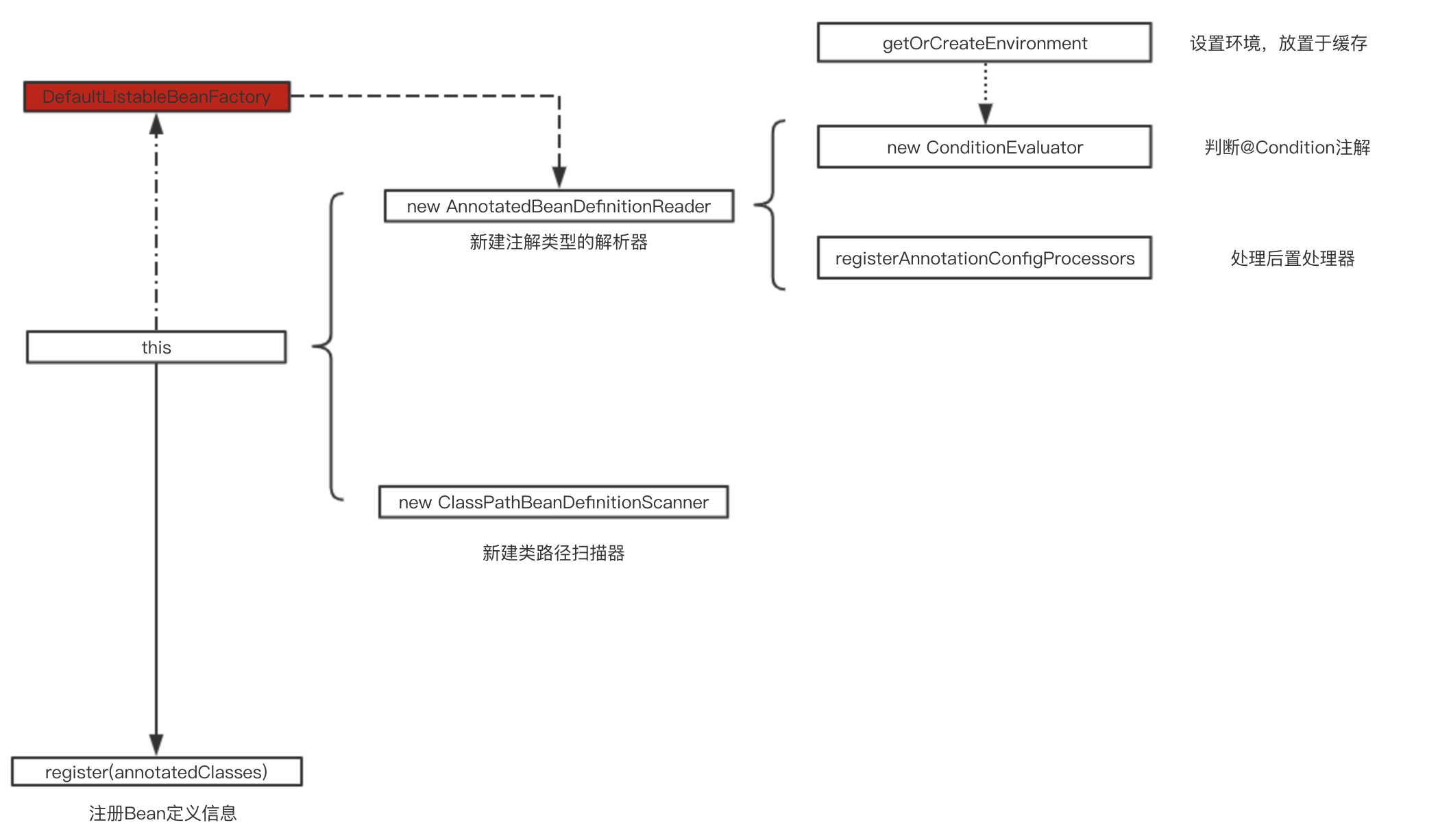
直到这里其实我们容器还是没有创建的,这些都是一些前期的准备工作。最后也是最关键的一步才是我们的容器的实例化。refresh()方法。内容超多。
@Override

public void refresh() throws BeansException, IllegalStateException {

    synchronized (this.startupShutdownMonitor) {

        // Prepare this context for refreshing.

        prepareRefresh();

        // Tell the subclass to refresh the internal bean factory.

        ConfigurableListableBeanFactory beanFactory = obtainFreshBeanFactory();

        // Prepare the bean factory for use in this context.

        prepareBeanFactory(beanFactory);

        try {

            // Allows post-processing of the bean factory in context subclasses.

            postProcessBeanFactory(beanFactory);

            // Invoke factory processors registered as beans in the context.

            invokeBeanFactoryPostProcessors(beanFactory);

            // Register bean processors that intercept bean creation.

            registerBeanPostProcessors(beanFactory);

            // Initialize message source for this context.

            initMessageSource();

            // Initialize event multicaster for this context.

            initApplicationEventMulticaster();

            // Initialize other special beans in specific context subclasses.

            onRefresh();

            // Check for listener beans and register them.

            registerListeners();

            // Instantiate all remaining (non-lazy-init) singletons.

            finishBeanFactoryInitialization(beanFactory);

            // Last step: publish corresponding event.

            finishRefresh();

        }

        catch (BeansException ex) {

            if (logger.isWarnEnabled()) {

                logger.warn("Exception encountered during context initialization - " +

                        "cancelling refresh attempt: " + ex);

            }

            // Destroy already created singletons to avoid dangling resources.

            destroyBeans();

            // Reset 'active' flag.

            cancelRefresh(ex);

            // Propagate exception to caller.

            throw ex;

        }

        finally {

            // Reset common introspection caches in Spring's core, since we

            // might not ever need metadata for singleton beans anymore...

            resetCommonCaches();

        }

    }

}
我们来逐个方法看一下都是做什么的。
prepareRefresh()创建早期程序监听器。
ConfigurableListableBeanFactory beanFactory = obtainFreshBeanFactory()通知子类刷新Bean工厂
prepareBeanFactory(beanFactory)配置工厂上下文。
postProcessBeanFactory(beanFactory)处理Bean工厂的后置处理
invokeBeanFactoryPostProcessors实例化并调用所有注册的Bean工厂的后置处理器
registerBeanPostProcessors(beanFactory)注册Bean工厂的后置处理器
initMessageSource()初始化消息源
initApplicationEventMulticaster()初始化事件多播器
onRefresh()初始化特殊定义的Bean
registerListeners()注册事件监听器
finishBeanFactoryInitialization(beanFactory)实例化剩余非懒加载Bean
finishRefresh()事件发布
resetCommonCaches()刷新缓存
就这样我们的Bean工厂就创建完成了。看着如此简单吧。后面我们来详细看一下。内部还有超多的东西。Spring源码不建议太过于深入的学习,容易陷进去....


最近搞了一个个人公众号,会每天更新一篇原创博文,java,python,自然语言处理相关的知识有兴趣的小伙伴可以关注一下。

java架构之路-(spring源码篇)springIOC容器源码解析(上)的更多相关文章
- [转帖]java架构之路-(面试篇)JVM虚拟机面试大全
java架构之路-(面试篇)JVM虚拟机面试大全 https://www.cnblogs.com/cxiaocai/p/11634918.html 下文连接比较多啊,都是我过整理的博客,很多答案都 ...
- Java基础-SSM之Spring MVC入门篇
Java基础-SSM之Spring MVC入门篇 作者:尹正杰 版权声明:原创作品,谢绝转载!否则将追究法律责任. 一.Spring MVC简介 1>.什么是Spring MVC 答:Sprin ...
- Java基础-SSM之Spring快速入门篇
Java基础-SSM之Spring快速入门篇 作者:尹正杰 版权声明:原创作品,谢绝转载!否则将追究法律责任. Spring是一个开源框架,Spring是于2003 年兴起的一个轻量级的Java ...
- java架构之路-(SpringMVC篇)SpringMVC主要流程源码解析(上)源码执行流程
做过web项目的小伙伴,对于SpringMVC,Struts2都是在熟悉不过了,再就是我们比较古老的servlet,我们先来复习一下我们的servlet生命周期. servlet生命周期 1)初始化阶 ...
- java架构之路-(spring源码篇)由浅入深-spring实战详细使用
今天我更新了一篇jvm垃圾回收的算法和垃圾回收器的内部逻辑,但是看的人不多啊......貌似大家还是比较喜欢看源码吧,毕竟实战要比理论用的多. 这篇文章不会详细的深入底层源码,只是基于注解和配置来说说 ...
- java架构之路-(源码)mybatis基本使用
我们今天先来简单了解一下我们持久层框架,mybatis的使用.而且现在的注解成为趋势,我主要说一下注解方向的使用吧(配置文件也会说) 从使用角度只要是三个部分,mybatis-config.xml,m ...
- java架构之路-(源码)mybatis的一二级缓存问题
上次博客我们说了mybatis的基本使用,我们还捎带提到一下Mapper.xml中的select标签的useCache属性,这个就是设置是否存入二级缓存的. 回到我们正题,经常使用mybatis的小伙 ...
- java架构之路-(源码)mybatis执行流程源码解析
这次我们来说说Mybatis的源码,这里只说执行的流程,内部细节太多了,这里只能授之以渔了.还是最近的那段代码,我们来回顾一下. package mybatis; import mybatis.bea ...
- java架构之路(多线程)AQS之ReetrantLock显示锁的使用和底层源码解读
说完了我们的synchronized,这次我们来说说我们的显示锁ReetrantLock. 上期回顾: 上次博客我们主要说了锁的分类,synchronized的使用,和synchronized隐式锁的 ...
随机推荐
- [企业微信通知系列]Jenkins发布后自动通知
一.前言 最近使用Jenkins进行自动化部署,但是部署后,并没有相应的通知,虽然有邮件发送通知,但是发现邮件会受限于接收方的接收设置,导致不能及时看到相关的发布内容.而由于公司使用的是企业微信,因此 ...
- MySQL5.7.27报错[Err] 1055 - Expression #1 of ORDER BY clause is not in GROUP BY clause and contains nonaggregated
mysql5.7.27在运行更新语句时出现如下情况,mysql5.6之前没有这种情况出现. of ORDER BY clause is not in GROUP BY clause and conta ...
- 日志RedisTemplate 存储
import org.springframework.beans.factory.annotation.Autowired;import org.springframework.data.redis. ...
- 求树的重心 DFS
树的重心 何谓重心 树的重心:找到一个点,其所有的子树中最大的子树节点数最少,那么这个点就是这棵树的重心,删去重心后,生成的多棵树尽可能平衡. 树的重心可以通过简单的两次搜索求出,第一遍搜索求出每个结 ...
- 逆序对 线段树&树状数组 (重制版)
逆序对的定义:长度为n的数组a,求满足i<j时a[i]>a[j]条件的数对个数. 第一次接触这种问题的人可能是更先想到的是n^2去暴力数前面有几个比他大的数. int main() { i ...
- 牛客暑假多校第六场 I Team Rocket
题意: 现在有n条火车, 每条火车都有一个运行 [ Li, Ri ], 现在有m支火箭队, 每次火箭队都会破坏这整条铁路上的一个点, 如果一条火车的运行区间[Li, Ri] 被破坏了, 那么这条火车会 ...
- codeforces 733D Kostya the Sculptor(贪心)
Kostya is a genial sculptor, he has an idea: to carve a marble sculpture in the shape of a sphere. K ...
- U盘便携式hexo&博客搭建&极速纯净低bug主题推荐&部署到coding&SEO优化搜索
指南:U盘便携式hexo&博客搭建&极速纯净低bug主题推荐&部署到coding&SEO优化搜索 U盘便携式hexo随处写博客 简述:在任意一台联网的电脑上续写he ...
- webstorm 突然不能用了?解决办法~
首先 感谢http://idea.lanyus.com 提供的试用方法,就在刚刚,webstorm突然就不能使了,http://idea.lanyus.com立马给出了解决办法,就是在hosts文 ...
- 2019icpc南昌网络赛_I_Yukino With Subinterval
题意 给定一个序列,两种操作,单点修改,询问区间\([l,r]\)值域在\([x,y]\)范围内的连续段个数. 分析 原数组为\(a\),构造一个新的数组\(b\),\(b[i]=(a[i]==a[i ...