
LINQ 之 GroupBy
声明:本文为www.cnc6.cn原创,转载时请注明出处,谢谢!
本文作者文采欠佳,文字表达等方面不是很好,但实际的代码例子是非常实用的,请作参考。
一、先准备要使用的类:
1、Person类:

    class Person

    {

        public string Name { set; get; }

        public int Age { set; get; }

        public string Gender { set; get; }

        public override string ToString() => Name;

    }
2、准备要使用的List,用于分组(GroupBy):
        List<Person> personList = new List<Person>

        {

            new Person

            {

                Name = "P1", Age = , Gender = "Male"

            },

            new Person

            {

                Name = "P2", Age = , Gender = "Male",

            },

            new Person

            {

                Name = "P2", Age = ,Gender = "Female",

            }

        };
二、第一种用法:
public static IEnumerable<IGrouping<TKey, TSource>> GroupBy<TSource, TKey>(this IEnumerable<TSource> source, Func<TSource, TKey> keySelector);
官方释义:根据指定的键选择器函数对序列中的元素进行分组。
我们要分组的集合为source,集合内每个元素的类型为TSource,这里第一个参数keySelector的类型为Func<TSource, TKey>,用于将TSource元素按照由此委托返回的类型TKey进行分组,结果为一个已分好组的集合(集合中的集合)。
编写客户端试验代码如下:
        var groups = personList.GroupBy(p => p.Gender);

        foreach (var group in groups)

        {

            Console.WriteLine(group.Key);

            foreach(var person in group)

            {

                Console.WriteLine($"\t{person.Name},{person.Age}");

            }

        }
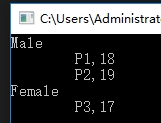
以上代码指定的KeySelector是Person类的Gender属性,因此,以上会按照Gender(性别)进行分组,我们使用两个嵌套的foreach循环将分组的内容打印到控制台。
因为groups返回的类型为IEnumerable<IGouping<TKey,TSource>>,因此以上返回的类型为IEnumerable<IGouping<string,Person>>。
IGouping<string,Person>是已经分组后的集合,内部集合元素为Person,且IGouping有一个Key属性,类型为string(指的是Gender属性类型),用于分组的标识。
输出结果如下:
其等价的LINQ语句为:
var groups = from p in personList

             group p by p.Gender;
以上的意思可以这样理解:从personList取出p,并对p进行分组,使用分组的依据(Key)为p.Gender,并将分组的结果存储到pGroup,并将分组的结果选择出来合并成一个集合。
三、第二种用法:
public static IEnumerable<IGrouping<TKey, TSource>> GroupBy<TSource, TKey>(this IEnumerable<TSource> source, Func<TSource, TKey> keySelector, IEqualityComparer<TKey> comparer);
官方释义:根据指定的键选择器函数对序列中的元素进行分组,并使用指定的比较器对键进行比较。
这种比第一种方法多了一个参数,那就是一个相等比较器,目的是为了当TKey为自定义的类时,GroupBy能根据TKey指定的类根据相等比较器进行分组,
因此,自定义类如何进行分组,GroupBy是不知道的,需要自己定义自己的相等比较器。
首先,将personList更改如下(下划线部分):
        List<Person> personList = new List<Person>

        {

            new Person

            {

                Name = "P1", Age = , Gender = "Male"

            },

            new Person

            {

                Name = "P1", Age = , Gender = "Male",

            },

            new Person

            {

                Name = "P3", Age = ,Gender = "Female",

            }

        };
其次,增加一个相等比较器类,用于对Person进行分组:
    class PersonEqualityComparer : IEqualityComparer<Person>

    {

        public bool Equals(Person x, Person y) => x.Name == y.Name;

        public int GetHashCode(Person obj) => obj.Name.GetHashCode();

    }
其中定义了如何对一个Person相等性定义,只要实现IEqualityComparer<Person>即可,这里以Name作为Person类是否相同的依据。
最后,现在我们对Person类进行分组,编写客户端实验代码如下:
        var groups = personList.GroupBy(p => p, new PersonEqualityComparer());

        foreach (var group in groups)

        {

            Console.WriteLine(group.Key.ToString());

            foreach(var person in group)

            {

                Console.WriteLine($"\t{person.Age},{person.Gender}");

            }

        }
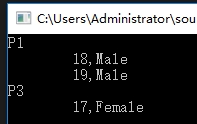
以上的分组依据是Person类,并运用了自己定义的Person类相同比较器,只要Name相同,就分为一组,
输出结果如下:
四、第三种用法:
public static IEnumerable<IGrouping<TKey, TElement>> GroupBy<TSource, TKey, TElement>(this IEnumerable<TSource> source, Func<TSource, TKey> keySelector, Func<TSource, TElement> elementSelector);
官方释义:根据指定的键选择器函数对序列中的元素进行分组,并且通过使用指定的函数对每个组中的元素进行投影。
这个比第一种用法多了一个elementSelector,第一种用法是对集合本身按照TKey分组,并将自己(TSource)添加到分组内,而当前的用法则可以选择自己想要添加到分组内的元素类型。
编写客户端实验代码如下:
        var groups = personList.GroupBy(p => p.Gender, p=>p.Name);

        foreach (var group in groups)

        {

            Console.WriteLine(group.Key.ToString());

            foreach(var name in group)

            {

                Console.WriteLine($"\t{name}");

            }

        }
以上代码是按照p.Gender进行分组,并将p.Name作为组内的元素。
输出结果如下:

其等价的LINQ语句为:
var groups = from p in personList

             group p.Name by p.Gender;
五、第四种用法:
public static IEnumerable<TResult> GroupBy<TSource, TKey, TResult>(this IEnumerable<TSource> source, Func<TSource, TKey> keySelector, Func<TKey, IEnumerable<TSource>, TResult> resultSelector);
官方释义:根据指定的键选择器函数对序列中的元素进行分组,并且从每个组及其键中创建结果值。
这个跟之前的用法都不同,之前的用法都是将结果进行分组,并返回IGrouping<TKey,TSource>对象,而当前用法则是返回自己定义的类型(TResult),在返回自己定义类型之前,将会传入两个参数,一个是TKey,为分组时指定的对象,另外一个则是IEnumerable<TSource>,为分组后的内部对象集合。
编写客户端实验代码如下:
            string GetPersonInfo(string gender, IEnumerable<Person> persons)

            {

                string result = $"{gender}:\t";

                foreach (var p in persons)

                {

                    result += $"{p.Name},{p.Age}\t";

                }

                return result;

            }

            var results = personList.GroupBy(p => p.Gender,(g, ps) => GetPersonInfo(g,ps));

            foreach (var result in results)

            {

                Console.WriteLine(result);

            }
GetPersonInfo为局部方法,见于C#7.0及以上。
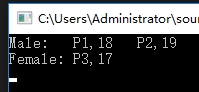
以上代码将分组后的内容(一个是TKey,为p.Gender,另外一个是IEnumerable<TSource>,为IEnumerable<Person>)作为字符串输出,因此,将返回的类型为字符串集合。
输出结果如下:
其等价的LINQ语句为:
            var results = from p in personList

                          group p by p.Gender into pGroup

                          select GetPersonInfo(pGroup.Key, pGroup);
六、第五种用法:
public static IEnumerable<IGrouping<TKey, TElement>> GroupBy<TSource, TKey, TElement>(this IEnumerable<TSource> source, Func<TSource, TKey> keySelector, Func<TSource, TElement> elementSelector, IEqualityComparer<TKey> comparer);
官方释义:根据键选择器函数对序列中的元素进行分组。通过使用比较器对键进行比较,并且通过使用指定的函数对每个组的元素进行投影。
与第三种用法基本相同,只是多了一个相等比较器,用于分组的依据。
使用第二种用法的personList及PersonEqualityComparer,编写客户端实验代码如下:
            var groups = personList.GroupBy(p => p, p => new { p.Age,p.Gender },new PersonEqualityComparer());

            foreach (var group in groups)

            {

                Console.WriteLine(group.Key.ToString());

                foreach (var name in group)

                {

                    Console.WriteLine($"\t{name.Age},{name.Gender}");

                }

            }
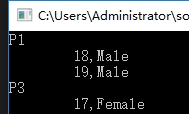
以上代码的分组依据是Person,PersonEqualityComparer则是作为Person分组的比较器,每个组内为一个匿名类型集合。
输出结果如下:
七、第六种用法:
public static IEnumerable<TResult> GroupBy<TSource, TKey, TResult>(this IEnumerable<TSource> source, Func<TSource, TKey> keySelector, Func<TKey, IEnumerable<TSource>, TResult> resultSelector, IEqualityComparer<TKey> comparer);
官方释义:根据指定的键选择器函数对序列中的元素进行分组,并且从每个组及其键中创建结果值。通过使用指定的比较器对键进行比较。
与第四种用法基本相同,只是多了一个相等比较器,用于分组的依据。
使用第二种用法的personList及PersonEqualityComparer,编写客户端实验代码如下:
            string GetPersonInfo(Person person, IEnumerable<Person> persons)

            {

                string result = $"{person.ToString()}:\t";

                foreach (var p in persons)

                {

                    result += $"{p.Age},{p.Gender}\t";

                }

                return result;

            }

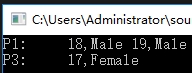
            var results = personList.GroupBy(p => p, (p, ps) => GetPersonInfo(p, ps),new PersonEqualityComparer());

            foreach (var result in results)

            {

                Console.WriteLine(result);

            }
以上代码的分组依据是Person,PersonEqualityComparer则是作为Person分组的比较器,每个组内为一个Person集合,并将返回类型为string的字符串输出。
输出结果如下:
八、第七种用法:
public static IEnumerable<TResult> GroupBy<TSource, TKey, TElement, TResult>(this IEnumerable<TSource> source, Func<TSource, TKey> keySelector, Func<TSource, TElement> elementSelector, Func<TKey, IEnumerable<TElement>, TResult> resultSelector);
官方释义:根据指定的键选择器函数对序列中的元素进行分组,并且从每个组及其键中创建结果值。通过使用指定的函数对每个组的元素进行投影。
与第四种方法很类似,只是对分组内的元素进行选择,原有为TSource,现改为TElement。
编写客户端实验代码如下:
            string GetPersonInfo(string gender, IEnumerable<string> names)

            {

                string result = $"{gender}:\t";

                foreach (var name in names)

                {

                    result += $"{name}\t";

                }

                return result;

            }

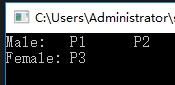
            var results = personList.GroupBy(p => p.Gender, (p=>p.Name) ,(g, ns) => GetPersonInfo(g, ns));

            foreach (var result in results)

            {

                Console.WriteLine(result);

            }
以上代码将使用Gender分组,并将分组后的信息组合成一条字符串,并输出到控制台。
输出结果如下:
九、第八种用法:
public static IEnumerable<TResult> GroupBy<TSource, TKey, TElement, TResult>(this IEnumerable<TSource> source, Func<TSource, TKey> keySelector, Func<TSource, TElement> elementSelector, Func<TKey, IEnumerable<TElement>, TResult> resultSelector, IEqualityComparer<TKey> comparer);
官方释义: 根据指定的键选择器函数对序列中的元素进行分组,并且从每个组及其键中创建结果值。通过使用指定的比较器对键值进行比较,并且通过使用指定的函数对每个组的元素进行投影。
与第七种用法基本相同,只是多了一个相等比较器,用于分组的依据。
使用第二种用法的personList及PersonEqualityComparer,编写客户端实验代码如下:
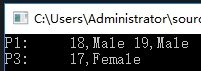
            var results = personList.GroupBy(p => p, (p=>new { p.Age,p.Gender}),

                (p, ns) =>

                {

                    string result = $"{p.ToString()}:\t";

                    foreach (var n in ns)

                    {

                        result += $"{n.Age},{p.Gender}\t";

                    }

                    return result;

                },new PersonEqualityComparer());

            foreach (var result in results)

            {

                Console.WriteLine(result);

            }
以上代码将使用Person分组,使用Person比较器作为分组的依据,并将分组后的信息组合成一条字符串,并输出到控制台。
输出结果如下:
LINQ 之 GroupBy的更多相关文章
- Linq Mysql GroupBy语句的问题处理
语句如下: var resumeList = db.ChannelResume.Where(model); var groupValues = resumeList.GroupBy(t => n ...
- linq lambda GroupBy 用法
Linq 中按照多个值进行分组(GroupBy) /// <summary>要查询的对象</summary> class Employee { public int ID ...
- 转载有个小孩跟我说LINQ(重点讲述Linq中GroupBy的原理及用法)
转载原出处: http://www.cnblogs.com/AaronYang/archive/2013/04/02/2994635.html 小孩LINQ系列导航:(一)(二)(三)(四)(五)(六 ...
- 转载Linq中GroupBy方法的使用总结
Group在SQL经常使用,通常是对一个字段或者多个字段分组,求其总和,均值等. Linq中的Groupby方法也有这种功能.具体实现看代码: 假设有如下的一个数据集: public class St ...
- [C#] LINQ之GroupBy
声明:本文为www.cnc6.cn原创,转载时请注明出处,谢谢! 本文作者文采欠佳,文字表达等方面不是很好,但实际的代码例子是非常实用的,请作参考. 一.先准备要使用的类: 1.Person类: cl ...
- Linq中GroupBy方法的使用总结(转)
Group在SQL经常使用,通常是对一个字段或者多个字段分组,求其总和,均值等. Linq中的Groupby方法也有这种功能.具体实现看代码: 假设有如下的一个数据集: public class St ...
- Linq中GroupBy方法的使用总结(转载)
from:https://www.cnblogs.com/zhouzangood/articles/4565466.html Group在SQL经常使用,通常是对一个字段或者多个字段分组,求其总和,均 ...
- c# linq 分组groupby
转载: https://www.cnblogs.com/cncc/p/9846390.html 一.先准备要使用的类: 1.Person类: class Person { public string ...
- DataTable/Array Linq查询,groupby
DataTable Linq查询 1.查询DataRow IEnumerable<DataRow> q1 = from r in dt.AsEnumerable() == select r ...
随机推荐
- 将HTML字符转换为DOM节点并动态添加到文档中
将HTML字符转换为DOM节点并动态添加到文档中 将字符串动态转换为DOM节点,在开发中经常遇到,尤其在模板引擎中更是不可或缺的技术. 字符串转换为DOM节点本身并不难,本篇文章主要涉及两个主题: 1 ...
- 彻底关闭windows10自动更新解决方案
window10的自动更新其实和window7和window8都有所不同,有些人认为只要停止了windows updates 就可以了,不会再开始了! 但是往往不是这样的,因为微软在window up ...
- android学习笔记--Scanner
private static List<String> getxxxx(Context ctx) { try { Scanner sc = new Scanner( ctx.openFil ...
- 【Android Studio安装部署系列】三十三、windows系统中通过SourceTree使用git
版权声明:本文为HaiyuKing原创文章,转载请注明出处! 概述 前期准备 选择代码托管服务器:gitlab.github.开源中国等. 注册账号 创建项目 安装git 参考<[Android ...
- Java~类,抽象类和接口
最近有空就着迷于java的世界,希望可以把自己的lind重构一个java版本出来,虽然遇到一些小问题,但也都解决了,还是那句话,知识需要积累,程序员需要一个追求! 类 抽象类 接口 泛型类 泛型接口 ...
- apriori && fpgrowth:频繁模式与关联规则挖掘
已迁移到我新博客,阅读体验更佳apriori && fpgrowth:频繁模式与关联规则挖掘 详细代码我放在github上:click me 一.实验说明 1.1 任务描述 1.2 数 ...
- MIPI DSI之DBI DPI含义和区别(3-1)
一.MIPI MIPI(Mobile Industry Processor Interface/移动工业处理器接口)是2003年由ARM.Nokia.ST 等公司成立联盟并为移动应用处理器制定的一个开 ...
- 并发系列(2)之 ThreadLocal 详解
本文将主要结合源码讲述 ThreadLocal 的使用场景和内部结构,以及 ThreadLocalMap 的内部结构:另外在阅读文本之前只好先了解一下引用和 HashMap 的相关知识,可以参考 Re ...
- Docker 容器镜像删除
1.停止所有的container,这样才能够删除其中的images: docker stop $(docker ps -a -q) 如果想要删除所有container的话再加一个指令: docker ...
- WPF 水印TextBox WatermarkTextBox
//https://blog.csdn.net/puchitomato/article/details/12248691 转自以上链接,自己添加了Enter响应事件. public class ...